
21 Best Email Marketing Platforms for E-Commerce in 2026

E-commerce email marketing has its own physics. You need abandoned cart recovery, product recommendations, post-purchase flows, browse abandonment, back-in-stock alerts, and revenue attribution that ties dollars back to specific emails. A generic email tool can send pretty newsletters, but it will leak revenue from the moment you turn it on.
I've compared 21 platforms specifically against an e-commerce checklist: Shopify and WooCommerce integration depth, automation pre-builds, product data handling, SMS, and revenue tracking. The list below puts the dedicated ecom leaders (Klaviyo, Omnisend, Drip) at the top of the recommendation order they deserve, and is honest about where Sequenzy fits, which is not as the default ecom pick, but as a viable choice for hybrid SaaS-plus-store founders.
How we evaluated these platforms
Every platform was assessed against the same e-commerce checklist using its public documentation, app-store listing, pricing page and changelog: what the Shopify and WooCommerce integrations sync and how an abandoned-checkout event reaches the platform, whether product data (image, price, variant, URL) can be dropped into an email without custom code, which of the seven standard ecom flows ship pre-built, whether revenue attribution reports per flow and per campaign with an adjustable window, and whether SMS is native, an add-on, or a partner integration. Pricing was taken from each vendor's public pricing page at 10,000 contacts as well as at the entry tier, because ecommerce platforms diverge sharply as lists grow. Sequenzy is our own product and the only platform here we use first-hand. Last verified September 2026.
Quick Comparison Table
| Tool | Best For | Starting Price | Free Tier | Ecommerce Integrations |
|---|---|---|---|---|
| Sequenzy | Hybrid SaaS + store founders | $19/mo | Yes (2.5k emails/mo) | Shopify + Stripe |
| Klaviyo | Serious Shopify stores | $20/mo (~$150 at 10k profiles) | Yes (250 contacts) | Shopify (deepest), WooCommerce |
| Omnisend | Multi-channel ecom (email + SMS + push) | $16/mo | Yes (250 contacts) | Shopify, WooCommerce, BigCommerce |
| Drip | DTC brands wanting customer intelligence | $39/mo | No | Shopify, WooCommerce |
| Shopify Email | Tiny Shopify stores | Free (10k/mo) | Yes | Shopify only (native) |
| Privy | Shopify list-growth via pop-ups | $30/mo | Yes (limited) | Shopify (pop-ups) |
| Sendlane | Mid-market multi-store ops | $83/mo | No | Shopify, BigCommerce, WooCommerce |
| Yotpo Email | Stores running Yotpo reviews/loyalty | Custom | No | Shopify (Yotpo ecosystem) |
| Attentive | Enterprise SMS-led ecom | Custom | No | Shopify, major platforms |
| Postscript | Shopify SMS-first stores | $100/mo | No | Shopify only |
| Mailchimp | Generalist small stores | $13/mo | Yes (500 contacts) | Shopify, WooCommerce, 300+ |
| MailerLite | Budget Shopify/Woo stores | $12/mo | Yes (250 subs) | Shopify, WooCommerce |
| Brevo | Stores billing by send volume | $9/mo | Yes (300/day) | Shopify, WooCommerce |
| GetResponse | Stores running funnels + webinars | $19/mo | Yes (500 contacts) | Shopify, WooCommerce |
| Constant Contact | Older small retailers | $12/mo | No | Shopify, WooCommerce |
| Campaign Monitor | Brand-led teams wanting design control | $11/mo | No | Shopify |
| ActiveCampaign | Stores needing CRM + automation | $29/mo | No | Shopify, WooCommerce, BigCommerce |
| HubSpot Marketing Hub | Larger stores already on HubSpot CRM | $20/mo | Yes (limited) | Shopify, WooCommerce |
| Bloomreach Engagement | Enterprise CDP-led retailers | Custom | No | All major platforms + POS |
| Listrak | Mid-market and enterprise retailers | Custom | No | Shopify, Magento, custom |
| Iterable | Enterprise multi-channel teams | Custom | No | All major platforms |
Pricing verified September 2026 against each vendor's public pricing page. Klaviyo bills on active profiles, so the entry price and the price at 10,000 profiles are very different numbers; MailerLite cut its free plan on 16 June 2026.
Best E-Commerce Email Platform by Use Case
Best email marketing platform for serious Shopify stores
Klaviyo is still the best pick when Shopify email revenue is already meaningful and you need the deepest product, order, segment, and predictive data. Start with the Klaviyo comparison if you are deciding between Sequenzy and Klaviyo, or read the broader Klaviyo alternatives list if price or complexity is the blocker.
Best email marketing platform for hybrid SaaS and store founders
Sequenzy makes the most sense when your store is not the whole business. If you sell products through Shopify but also bill subscriptions, memberships, courses, or software through Stripe, the Stripe integration and Shopify integration keep both revenue streams in one email system instead of splitting customers across two tools.
Best email marketing platform for WooCommerce and omnichannel stores
Omnisend is the cleaner fit when WooCommerce, SMS, and push notifications matter more than Shopify-specific depth. The Omnisend comparison is the right next page if you are weighing an ecommerce-native omnichannel platform against Sequenzy's simpler email automation.
Best free email marketing option for very small Shopify stores
Shopify Email is the practical starting point before you have enough subscribers or revenue to justify a dedicated tool. Once you need stronger abandoned cart, post-purchase, or welcome series templates, compare Shopify Email against more complete platforms in the Shopify Email comparison.
What E-Commerce Email Actually Needs
Real-time product and order sync. Your email tool needs to know within seconds when a customer adds to cart, completes a purchase, or marks a product as a favorite. Hourly batch syncs kill abandoned cart performance and break post-purchase timing.
Pre-built ecom flows that work out of the box. Welcome, abandoned cart, browse abandonment, post-purchase, replenishment, winback, VIP. The leaders ship these with sensible defaults so you can be sending revenue-driving automation in a day, not a quarter.
Product blocks and dynamic recommendations. Pulling product cards (image, price, name, link) from your catalog into emails should be a drag-and-drop operation. Dynamic recommendation blocks (based on purchase history, browse history, or AI predictions) are what separate ecom-native tools from general marketing tools.
Revenue attribution. You should be able to see revenue per email, per flow, and per segment, with attribution windows you can adjust. If your tool can't tell you that the abandoned cart flow generated $14,200 last month, you're flying blind.
SMS, ideally in the same tool. SMS abandoned cart recovery converts at 2-5x the rate of email. Klaviyo, Omnisend, and Attentive bundle SMS in. Specialist SMS-only tools (Postscript) integrate via email partners. If you only run email, you're leaving real money on the table.
Honest take on Sequenzy: Sequenzy is not the leader in any of those categories, but it is not missing them either. Shopify browse tracking, browse-abandonment and price-drop triggers, catalog-driven product recommendation blocks, back-in-stock capture through the theme app extension, shipment-tracking events, campaign A/B testing, and SMS and MMS as a paid add-on are all shipped. What it does not have is predictive/ML product recommendations (Klaviyo's edge), a two-way SMS inbox, and a native WooCommerce integration - Woo support is still a beta sync. If you run a pure store at volume, the recommendation order below puts Klaviyo and Omnisend ahead of Sequenzy on purpose, because their flow libraries and product-data depth are more mature. Where Sequenzy fits best is the hybrid case: a founder running both a Shopify store and a Stripe-billed subscription product, who would rather run one platform than two.
The 21 Best Options
1. Sequenzy
Best for: Hybrid founders running both an e-commerce store and a Stripe-billed subscription or SaaS product
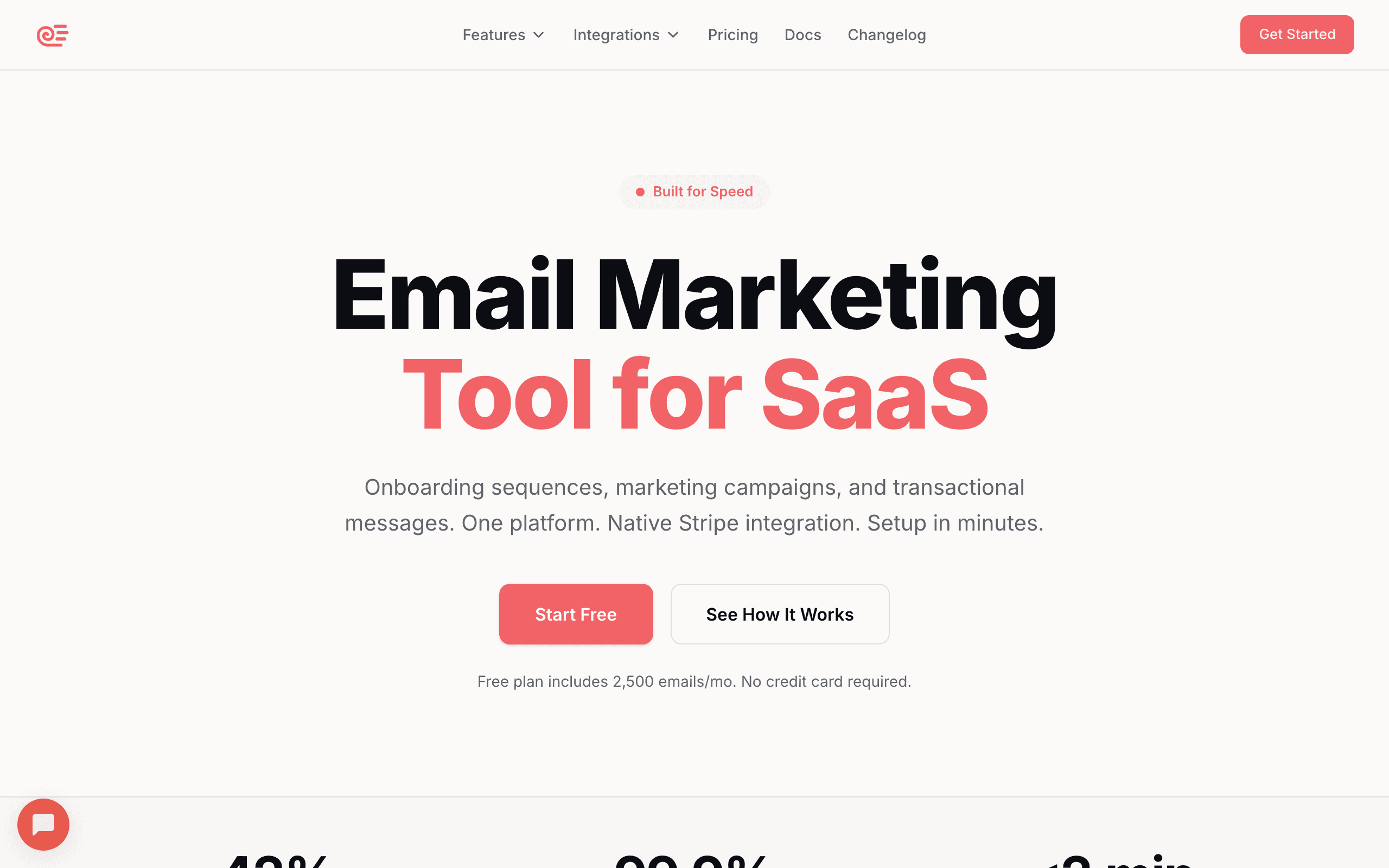
Sequenzy is included at the top of this list because of who I am, not because it's the best dedicated ecom tool on the market. For a pure Shopify store, Klaviyo or Omnisend will outperform it on integration depth, pre-built flows, and product recommendations. That's the honest read.
Where Sequenzy is a credible pick is the hybrid case. Many modern brands sell physical product on Shopify and a digital subscription, membership, or course on Stripe. Running Klaviyo for the store and a separate tool (Customer.io, Loops) for the subscription side means two subscriber lists, two billing relationships, and constant deduping. Sequenzy unifies both: the Stripe integration handles subscription events (renewals, failed payments, plan changes, cancels), and the Shopify sync handles store events (new orders, abandoned checkouts).
The campaign editor and automation builder cover the standard ecom automations: welcome series, post-purchase, abandoned cart, winback. They are functional and ship sensible defaults, but they are not as polished as Klaviyo's flow library or Omnisend's pre-built workflow gallery. Browse abandonment, price-drop triggers, back-in-stock capture, shipment-tracking events (shipped, out for delivery, delivered) and catalog product blocks are all available; what you will not find is a machine-learning model predicting lifetime value or the next best product, which is where Klaviyo still leads.
Revenue tracking ties orders to specific emails for both Shopify orders and Stripe payments, which is useful for hybrid founders who want a single view of email-attributed revenue across both stacks. The developer API is fully featured and lets you push custom events (e.g., a digital download fired from your app) into the same automation engine.
For a 100% Shopify store doing $50k+ a month, this is not the recommendation. For a founder running a $500/month subscription product alongside a Shopify storefront and tired of paying for and operating two email platforms, this is a real fit.
- Best for: Hybrid SaaS + store founders, subscription brands, Stripe-billed products with a Shopify storefront
- Pricing: Free up to 2,500 emails/month, paid plans from $19/month
- Pros: Stripe + Shopify in one platform, marketing + transactional unified, simple pricing, API-first, direct founder support
- Cons: Not a dedicated ecom tool, no predictive/ML product recommendations, WooCommerce is a beta sync, SMS is a paid add-on with no two-way inbox, flow library less mature than Klaviyo's
2. Klaviyo
Best for: Serious Shopify stores treating email as a primary revenue channel
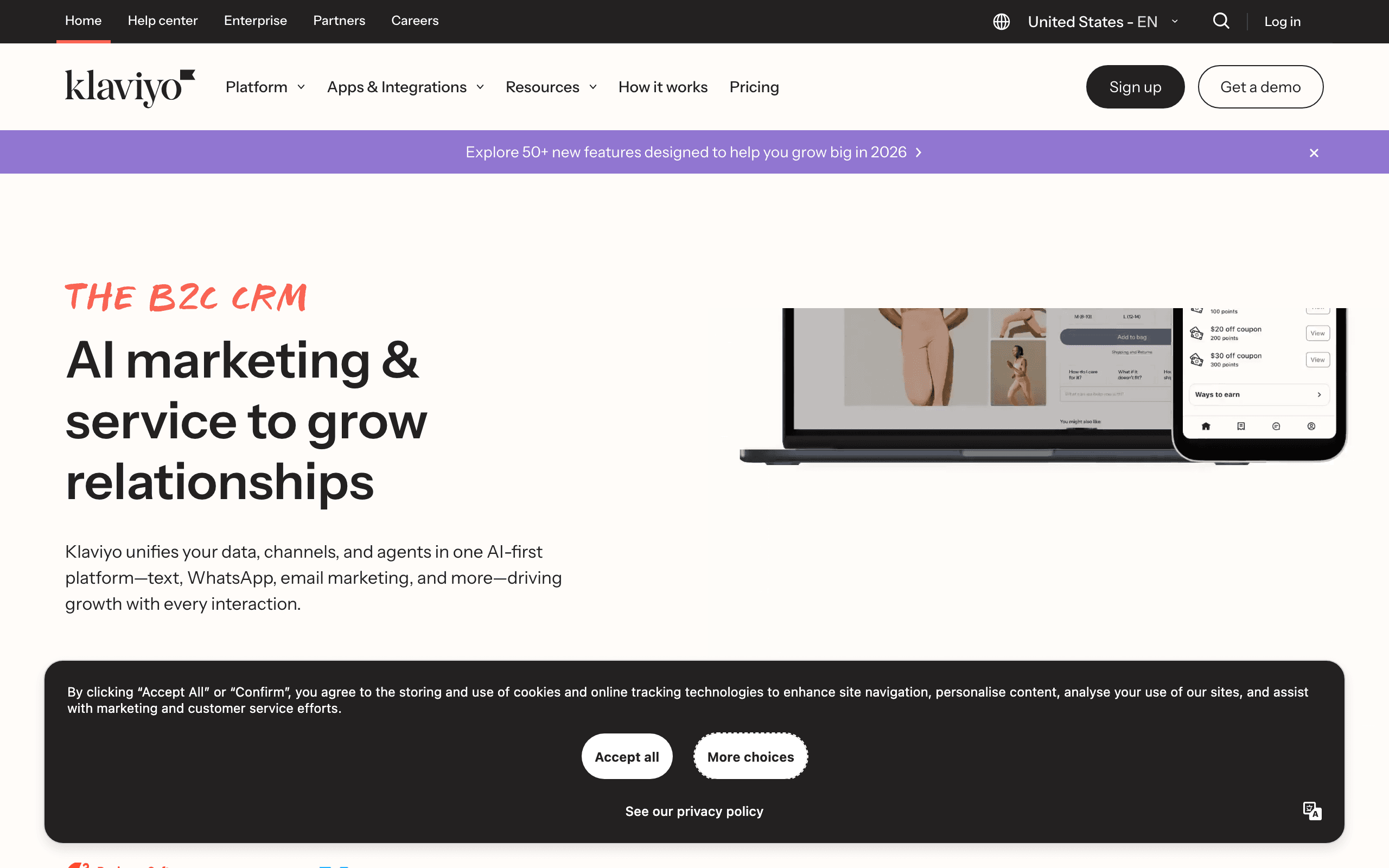
Klaviyo is the default email platform for serious Shopify stores, and the recommendation order reflects that. The Shopify integration is the deepest in the market: real-time sync of products, orders, customer profiles, browse behavior, and review data. Predictive analytics estimate next purchase date, expected lifetime value, and churn risk at the individual subscriber level.
The pre-built flow library is the best in the category. Welcome, abandoned cart, browse abandonment, post-purchase, replenishment, winback, sunset, VIP, all ship with sensible defaults that you can run in a day. Most stores see 20-35% of email revenue come from these flows once they're tuned.
Dynamic product recommendation blocks pull AI-ranked products into emails based on a subscriber's purchase and browse history. This is the feature that pure email tools struggle to match. Klaviyo Reviews and Klaviyo SMS integrate natively, so you can run one bill instead of three.
The downside is price. At 10k contacts you're looking at $150/month for email, more if you add SMS. The learning curve is real for advanced flows and conditional content. The template editor is functional but trails dedicated email design tools. None of that changes the recommendation: for a Shopify store doing $30k+ a month, Klaviyo pays for itself.
- Best for: Shopify stores doing $30k+/mo, DTC brands, multi-store operators
- Pricing: Free up to 250 contacts (500 emails/mo), email from $20/mo, email + SMS from $35/mo
- Pros: Deepest Shopify integration, predictive analytics, pre-built flows, dynamic recommendations, SMS in-house, benchmark data
- Cons: Expensive at scale, learning curve, weaker template editor, occasional support delays
3. Omnisend
Best for: E-commerce stores wanting email, SMS, and push managed in one platform
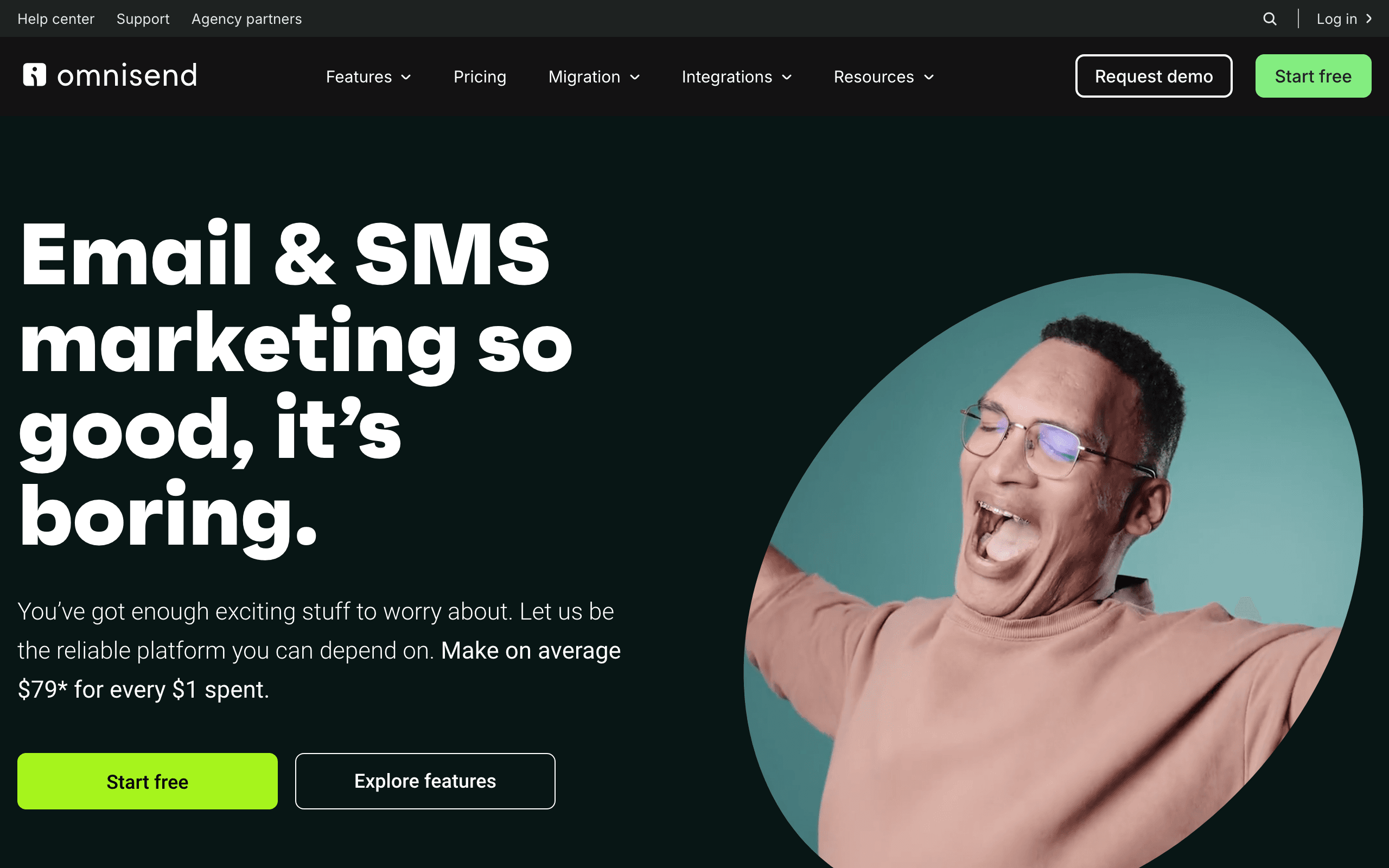
Omnisend is the strongest Klaviyo alternative for ecom and the best multi-channel option in the category. Email, SMS, and web push all run from one platform with shared subscriber data, shared automations, and one bill. For Shopify, WooCommerce, and BigCommerce stores, this consolidation is genuinely useful.
The pre-built workflow library has 25+ ecom automations covering the full lifecycle, and the product picker makes inserting product cards into emails trivial. The discount code generator creates unique single-use codes on the fly for abandoned cart and winback flows, which prevents code sharing on Reddit and Slickdeals.
Where Omnisend trails Klaviyo is on predictive analytics and the very deepest Shopify hooks. It catches up on multi-channel and on WooCommerce, where the integration is meaningfully better than Klaviyo's. For stores splitting volume between Shopify and WooCommerce, or stores that want SMS without the Klaviyo price tag, Omnisend is the practical choice.
Pricing is also more forgiving than Klaviyo's at scale. The free plan covers 250 contacts with 500 emails/month plus 60 SMS, which is enough to test the platform end to end. Standard plans start at $16/mo for 500 contacts.
- Best for: Multi-channel ecom (email + SMS + push), WooCommerce and BigCommerce stores, Shopify stores wanting cheaper SMS than Klaviyo
- Pricing: Free up to 250 contacts, Standard from $16/mo, Pro from $59/mo
- Pros: Email + SMS + push in one, strong WooCommerce support, 25+ pre-built workflows, single-use discount codes, generous free plan
- Cons: Predictive analytics not as deep as Klaviyo, SMS credits cost extra past the bundle, fewer integrations than Mailchimp
4. Drip
Best for: DTC brands that want customer intelligence over multi-channel breadth
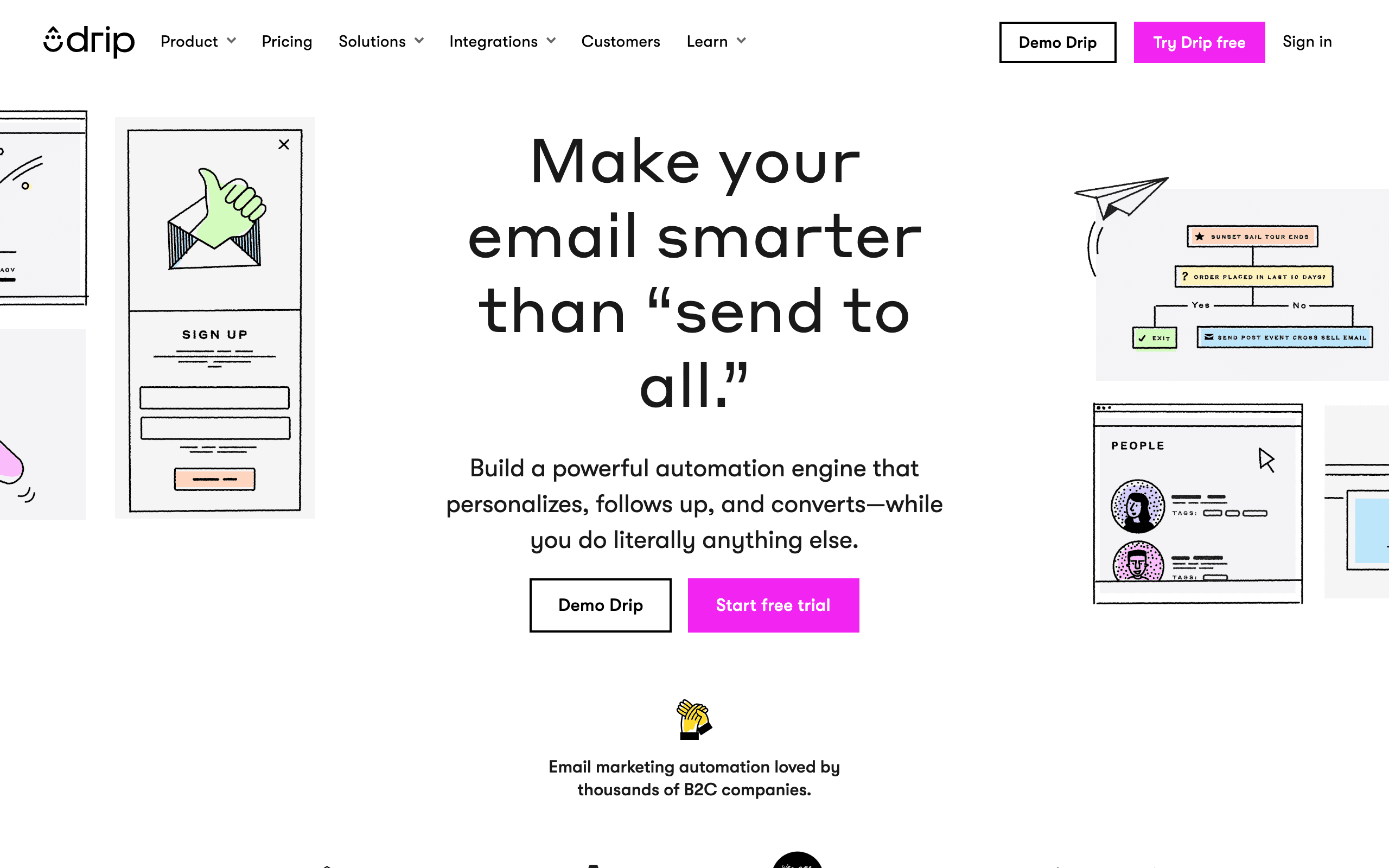
Drip trades multi-channel breadth for customer intelligence depth. It is email-only (no SMS), but the customer profiles, behavioral tracking, and revenue attribution are best-in-class. Every email open, click, site visit, product view, cart addition, and purchase rolls up into a unified profile you can use for hyper-targeted automation.
The visual workflow builder is one of the better ones in the category, with proper conditional splits, delays, and branch merging. Dynamic content blocks change based on purchase history, predicted interests, or arbitrary subscriber attributes. Facebook and Instagram custom audience sync lets you trigger paid retargeting from email events.
All features are included at every price tier, which is rare in this category. No "upgrade to access predictive analytics" upsells. The trade-off is the entry price: $39/mo for 2,500 contacts, with no free plan beyond a 14-day trial.
For DTC brands doing $100k+/year that value understanding customer behavior and don't need SMS in the same tool, Drip is the most thoughtful pick. For stores that need multi-channel, Omnisend is a better fit.
- Best for: DTC brands $100k+/year, stores prioritizing customer intelligence, email-only operators
- Pricing: From $39/mo for 2,500 contacts (no free plan, 14-day trial)
- Pros: Best-in-class revenue attribution, deep customer profiles, all features at every tier, strong WooCommerce support
- Cons: No SMS, higher entry price, no free plan, fewer pre-built workflows than Omnisend, basic pop-up builder
5. Shopify Email
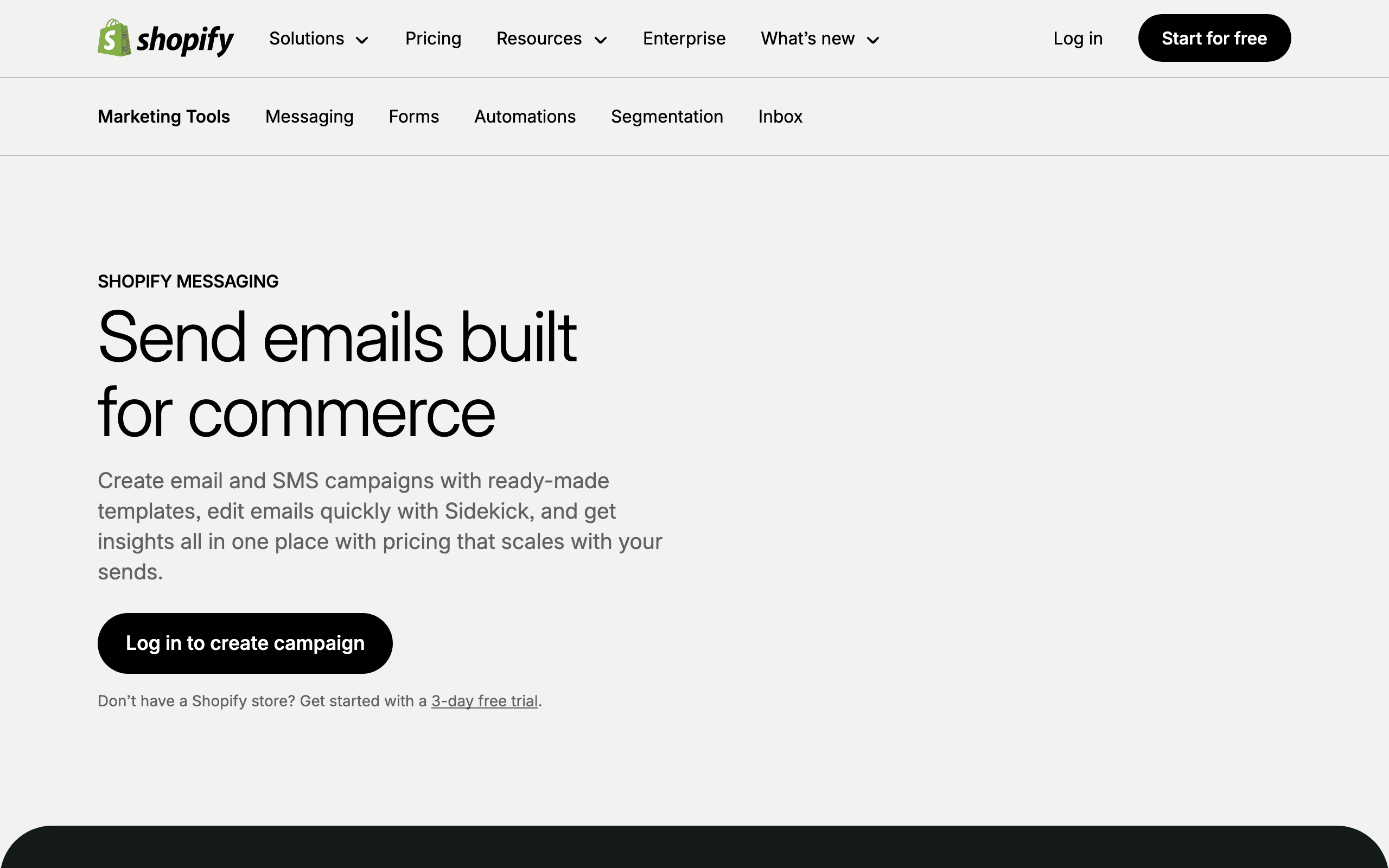
Best for: Tiny Shopify stores sending under 10,000 emails/mo
Shopify Email is built directly into Shopify admin. No third-party app, no data sync, no separate login, no extra subscription. For stores in the first $0-50k/year of revenue, this is the pragmatic starting point.
The first 10,000 emails/month are free, then it's $1 per 1,000 emails after that. There's no monthly platform fee, which makes it the cheapest option in the category for low-volume stores. You compose campaigns from inside Shopify admin using your existing product catalog and brand assets.
Limitations are significant. Automation is basic (welcome series, abandoned cart, post-purchase, that's roughly it). Segmentation is limited. No SMS, no pop-ups, no dynamic recommendations, no real flow builder. You'll outgrow it somewhere between 1,000 and 5,000 active subscribers, depending on how serious you get about email.
The right move is to start here, run free Shopify Email until your revenue justifies an upgrade, then migrate to Klaviyo or Omnisend. Don't pay for a sophisticated tool before you have the volume to use it.
- Best for: Shopify stores under $50k/year, stores under 10k emails/month, founders who want one less app
- Pricing: Free up to 10,000 emails/mo, then $1 per 1,000 emails
- Pros: Zero setup, native to Shopify, very cheap at low volume, no extra login, uses existing brand assets
- Cons: Basic automation only, weak segmentation, no SMS, no pop-ups, no dynamic recommendations, you will outgrow it
6. Privy
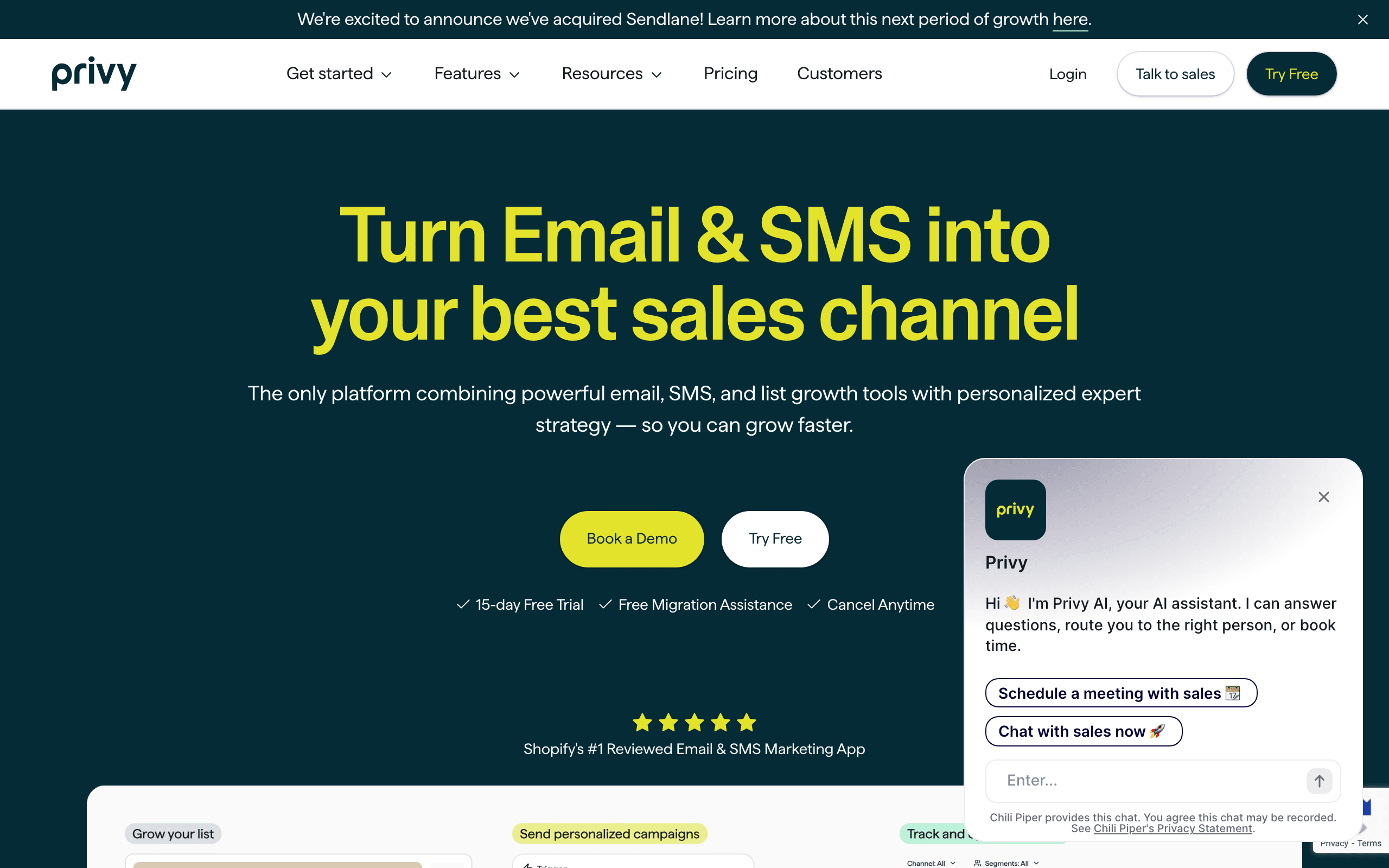
Best for: Shopify stores prioritizing list growth via on-site pop-ups
Privy started as the best Shopify pop-up tool and expanded into email and SMS. The pop-up and signup form builder remains best-in-class for Shopify: spin-to-win wheels, exit-intent overlays, cart-saver displays, flyouts, and announcement bars. If your bottleneck is list growth (not email features), Privy fixes the bottleneck first.
The email side of Privy is functional but not the reason to pick it. You get welcome series, abandoned cart, and basic broadcast campaigns. Coupon code generation is integrated into both the pop-ups and the email flows, which is useful for first-purchase incentives and cart recovery.
Most stores that use Privy seriously pair it with another email tool: Privy for forms and pop-ups, Klaviyo or Omnisend for the heavy email work. Privy plays nicely in that role with a Klaviyo integration that pushes captured emails directly into Klaviyo lists.
- Best for: Shopify stores struggling with list growth, stores wanting gamified signup forms, owners who pair it with Klaviyo
- Pricing: Free with limited features, Starter from $30/mo
- Pros: Best pop-up builder for Shopify, exit-intent and spin-to-win, fast install, A/B testing on forms, integrates with Klaviyo
- Cons: Email side is basic, more expensive than email-only tools, not great outside Shopify, limited automation
7. Sendlane
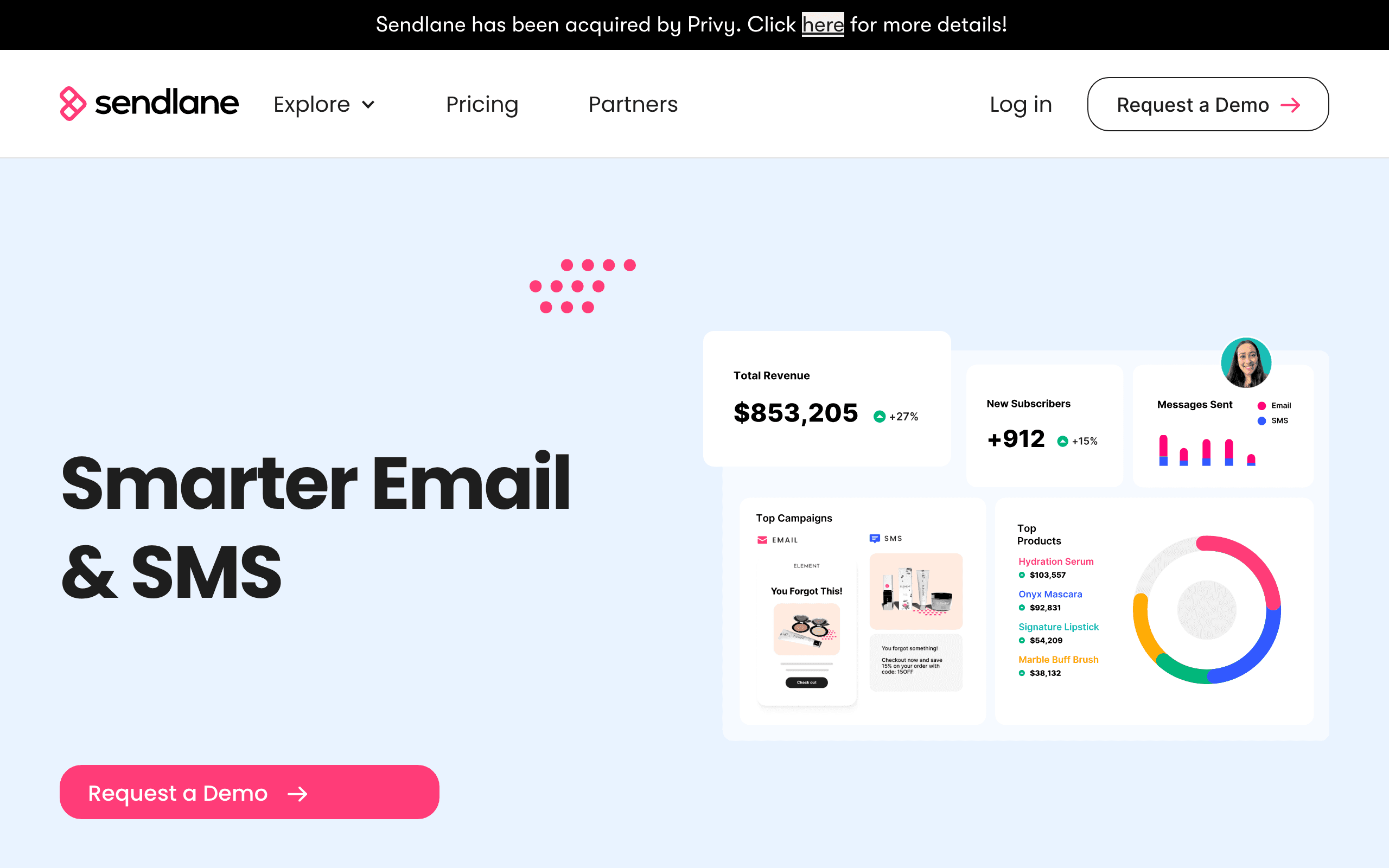
Best for: Mid-market multi-store operators wanting deep data and attribution
Sendlane targets the gap between Klaviyo and enterprise tools. Multi-touch revenue attribution, machine-learning segmentation, and deep integrations with Shopify, BigCommerce, and WooCommerce make it a credible pick for stores doing $1M+/year that find Klaviyo's reporting limiting.
The platform supports email, SMS, and review collection in a single subscription, with proper cross-channel attribution rather than three separate dashboards stitched together. Pre-built ecom flows cover the standard set, plus some less common ones (post-review request, browse-to-purchase, second-purchase nudge).
Pricing is on the higher end: $83/mo for 2,500 contacts. That's a meaningful jump over Omnisend or Klaviyo at the same list size. For mid-market operators where the attribution data drives real decisions, the price is reasonable. For smaller stores it's hard to justify.
- Best for: Mid-market stores $1M+/year, multi-store operators, stores prioritizing attribution
- Pricing: From $83/mo for 2,500 contacts (no free plan, trial only)
- Pros: Multi-touch attribution, ML segmentation, email + SMS + reviews unified, strong on Shopify/Woo/BigCommerce
- Cons: Higher entry price, no free plan, smaller community than Klaviyo, fewer integrations
8. Yotpo Email
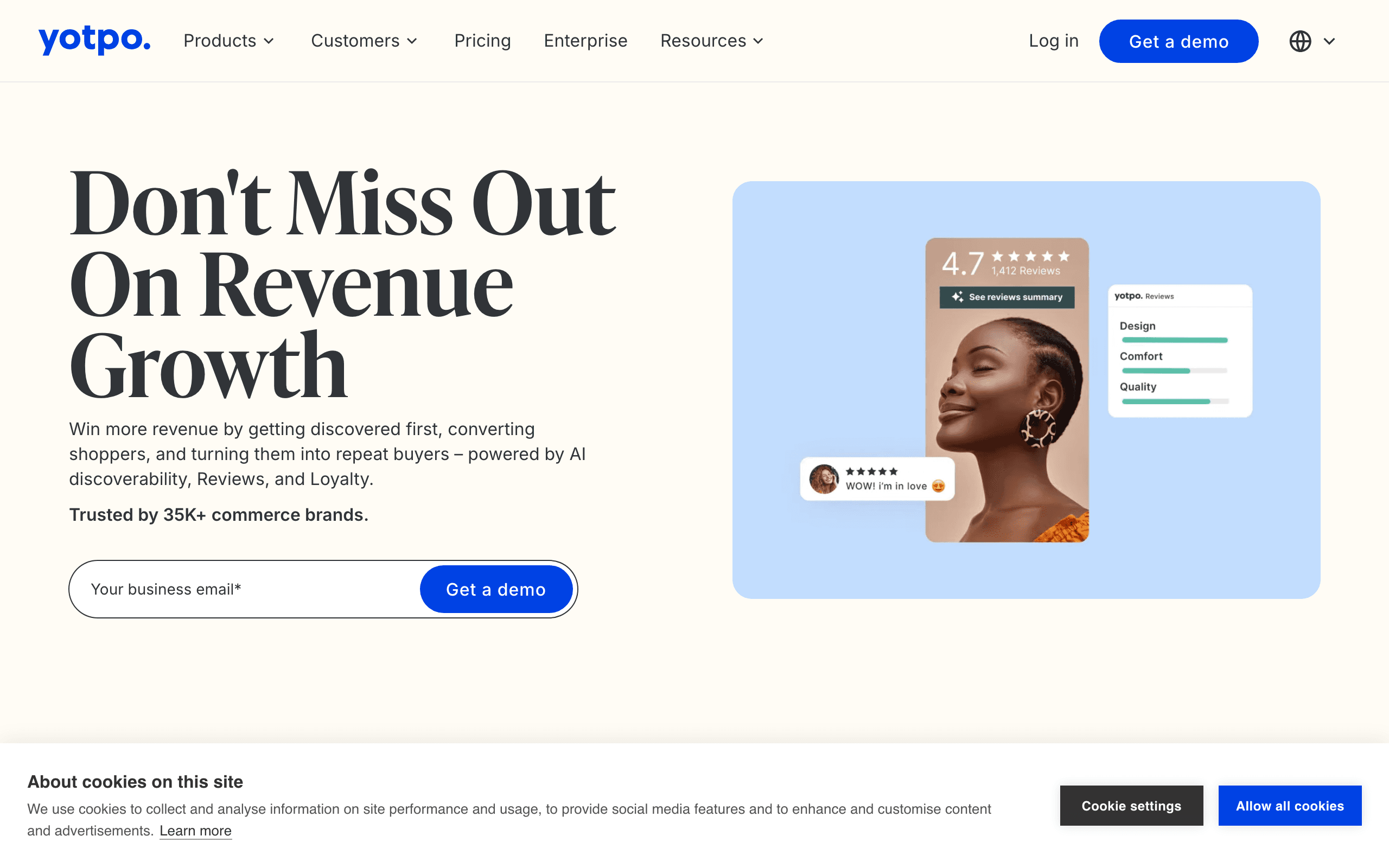
Best for: Stores already running Yotpo Reviews or Loyalty
Yotpo added email to its reviews-and-loyalty stack to compete for full lifecycle ownership. If you already run Yotpo Reviews and Yotpo Loyalty, the email module slots in cleanly, sharing data with the other modules and reducing the number of integrations you have to maintain.
The differentiator is using review and loyalty data inside email. You can target a campaign at customers who left a 5-star review last month, or trigger a post-purchase email that includes UGC photos from other customers of the same product. That kind of cross-module targeting is hard to replicate with a separate email tool.
The email product itself is competent but not category-leading. If you're not already on Yotpo, the email module alone isn't a reason to switch. If you are on Yotpo, consolidating onto Yotpo Email rather than running it alongside Klaviyo can simplify your stack.
- Best for: Stores already on Yotpo Reviews or Loyalty, brands wanting reviews + email unified
- Pricing: Custom (typically bundled with Reviews/Loyalty plans)
- Pros: Reviews + loyalty + email + SMS in one stack, UGC inside emails, cross-module segmentation
- Cons: Email-alone is uncompetitive, custom pricing makes comparison hard, lock-in to Yotpo ecosystem
9. Attentive
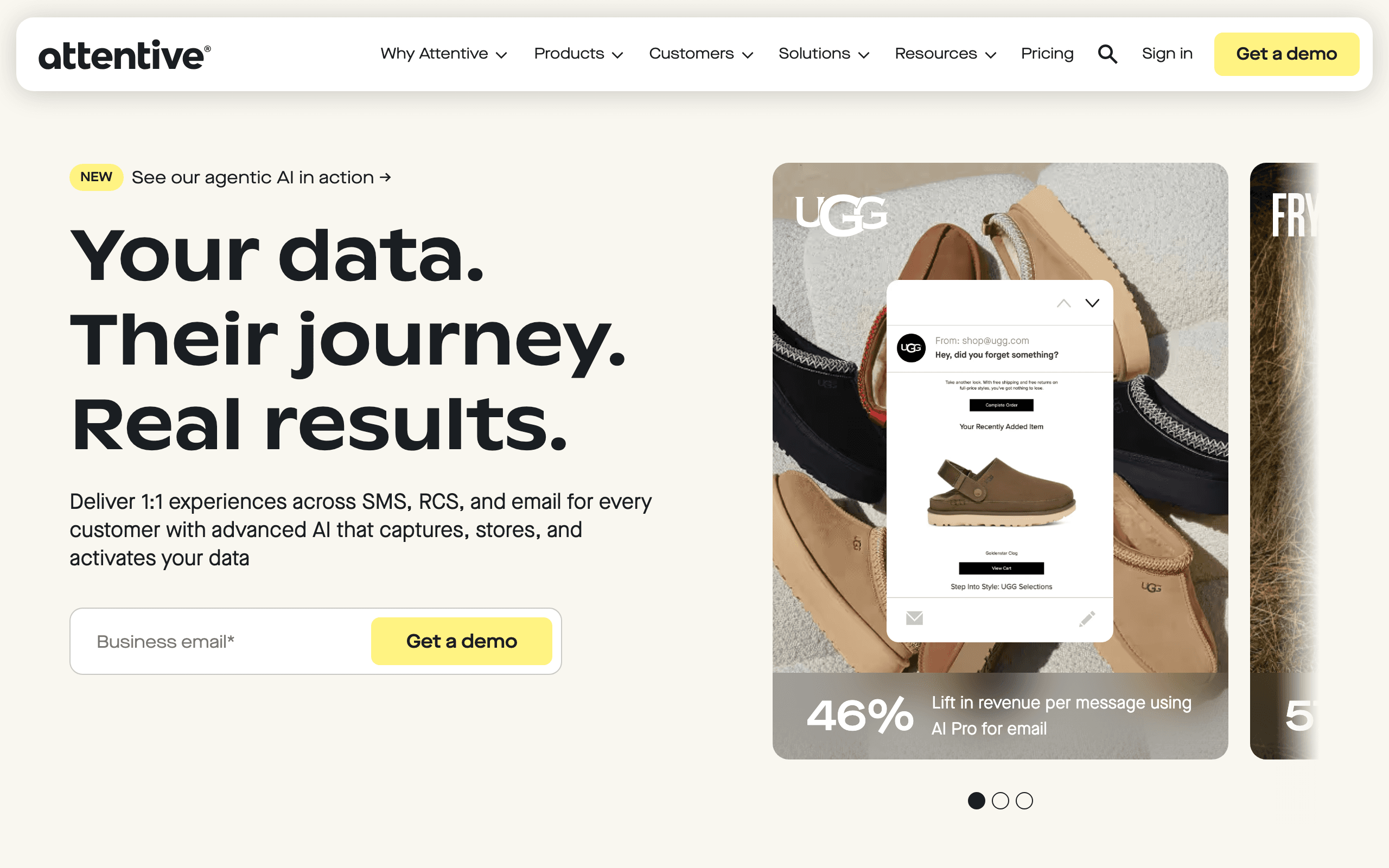
Best for: Enterprise ecom brands going SMS-led with email as a secondary channel
Attentive is the SMS leader for enterprise ecom and added an email product to compete for full lifecycle ownership. For brands where SMS drives more revenue than email (common in DTC fashion, beauty, and supplements), Attentive is the platform built around that reality.
The SMS product is best-in-class: deep Shopify integration, two-way conversation handling, AI-driven content generation, sophisticated journey builders, and an enormous compliance and deliverability operations team. Email is a more recent addition and is competent but not leading.
Attentive pricing is enterprise (custom, typically $5k+/month minimum). For brands at that scale, the SMS-led approach often makes sense. For sub-$5M/year stores, Postscript or Klaviyo SMS will be a better fit.
- Best for: Enterprise DTC brands $10M+/year, SMS-led ecom strategies, fashion/beauty/supplements
- Pricing: Custom (enterprise minimums apply)
- Pros: Best SMS in the category, strong Shopify integration, two-way conversations, AI content, dedicated compliance ops
- Cons: Email is secondary, expensive, enterprise-only, custom pricing opaque
10. Postscript
Best for: Sub-enterprise Shopify stores going SMS-first
Postscript is the Shopify-native SMS platform for stores that aren't ready for Attentive's enterprise pricing. It integrates deeply with Shopify (real-time order, customer, and product sync) and offers SMS-specific automations: abandoned cart, browse abandonment, post-purchase, winback, and back-in-stock.
Postscript does not include email, so you'll pair it with Klaviyo, Omnisend, or another email platform. The integrations are well-built, especially with Klaviyo, where subscriber data and event data flow cleanly between the two.
For Shopify stores at $500k-$5M/year that want serious SMS without enterprise lift, Postscript is the obvious pick. For smaller stores, Omnisend or Klaviyo SMS bundled with email will be cheaper and simpler.
- Best for: Shopify stores $500k-$5M/year, SMS-first DTC brands, brands pairing SMS with Klaviyo email
- Pricing: From $100/mo + per-message pricing
- Pros: Deep Shopify SMS integration, strong abandoned cart and back-in-stock flows, pairs cleanly with Klaviyo
- Cons: SMS-only (no email), per-message pricing adds up, Shopify-only, requires a separate email tool
11. Mailchimp
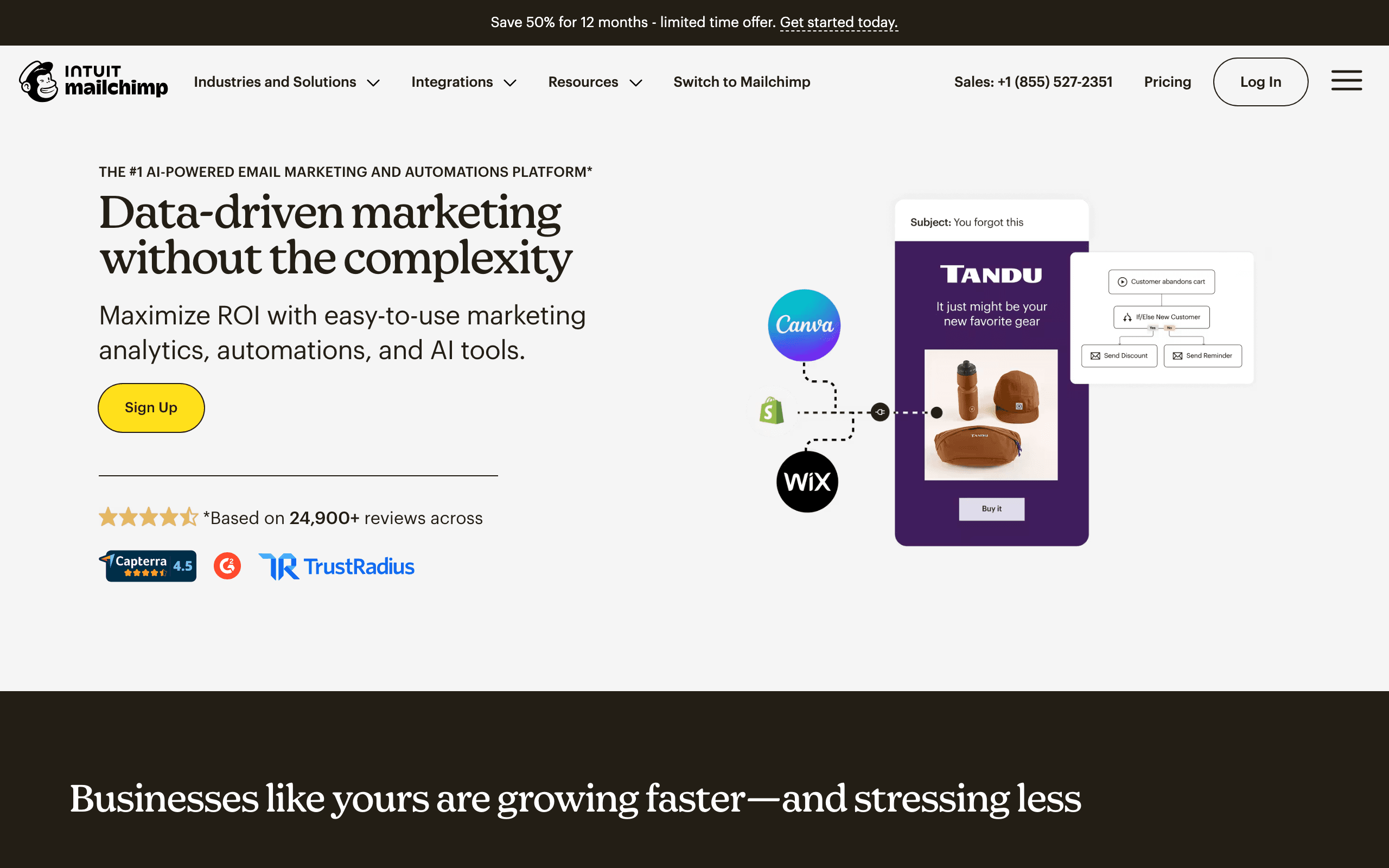
Best for: Generalist small stores already using Mailchimp for other things
Mailchimp is the most-recognized brand in email and connects to almost every business tool through 300+ native integrations. For small stores running a stack of Mailchimp + Canva + QuickBooks + a dozen others, the integration density is the main reason to stay.
The ecom features are middling. Abandoned cart and post-purchase exist, but they're not as deep as Klaviyo's or Omnisend's, and product recommendations are basic. Pricing also scales aggressively with list size; a 10k subscriber list runs around $100/month, which is uncompetitive vs. Omnisend or MailerLite at the same volume.
For a brand-new ecom store with no existing tooling, I would not start here in 2026. For stores already invested in Mailchimp (and not big enough to justify a Klaviyo migration), staying is reasonable.
- Best for: Generalist small stores, brands already on Mailchimp, ecom-as-side-channel for service businesses
- Pricing: Free up to 500 contacts, Standard from $13/mo, scales steeply
- Pros: Huge integration ecosystem, recognized brand, decent template editor, AI content assistant
- Cons: Ecom features trail Klaviyo and Omnisend, expensive at scale, charges for unsubscribed contacts on some plans
12. MailerLite
Best for: Budget-conscious Shopify and WooCommerce stores
MailerLite is the budget pick that doesn't feel cheap. The interface is genuinely clean, the templates are restrained, and pricing is honest. For small stores that want a hosted email tool without paying Klaviyo or Drip prices, this is the middle ground.
The Shopify and WooCommerce integrations cover the basics: product blocks, abandoned cart, post-purchase, segment by purchase history. They aren't as deep as Klaviyo's, but they cover the 80% of use cases that drive most ecom email revenue.
For stores with budgets under $50/month and lists under 5,000 subscribers, MailerLite's $12/month Comfort plan is a strong pick (its free plan is now only 250 subscribers). Above that, you'll start to outgrow the segmentation and automation depth and want to step up to Omnisend or Klaviyo.
- Best for: Small stores on a tight budget, Shopify and WooCommerce stores, brands prioritizing template quality
- Pricing: Free up to 1,000 subscribers, from $10/mo
- Pros: Cheap, clean interface, good templates, decent automation, generous free tier
- Cons: Not built for ecom specifically, automation is shallower than Klaviyo, no SMS, no AI recommendations
13. Brevo
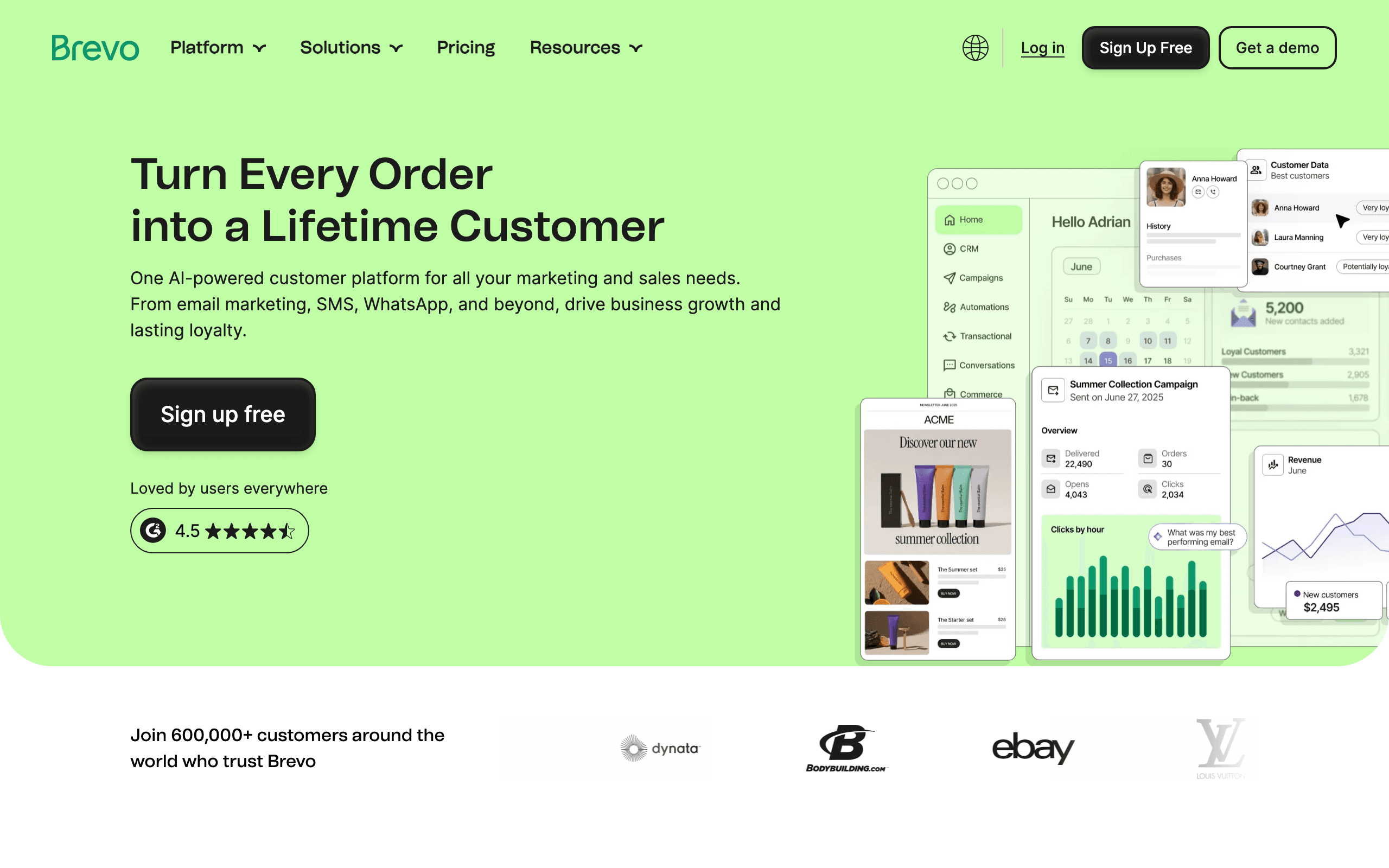
Best for: Stores with large lists that email infrequently
Brevo (formerly Sendinblue) bills by emails sent, not by contacts on your list. For stores with 50,000+ subscribers who email once a month, this pricing model is dramatically cheaper than the per-contact pricing on Klaviyo or Omnisend.
The platform covers email, SMS, WhatsApp, and transactional email under one roof, which is unusual at this price point. Ecom features include a basic abandoned cart flow, product recommendations (limited), and segmentation by purchase behavior.
The trade-off is depth. Brevo is a competent generalist, not an ecom specialist. For high-frequency senders ($50k+/year ecom revenue, 2-3 emails/week), Klaviyo or Omnisend will outperform. For low-frequency senders with large lists, Brevo's pricing model is hard to beat.
- Best for: Large lists with low send frequency, stores wanting WhatsApp + email + SMS, budget-first operators
- Pricing: Free up to 300 emails/day, Starter from $9/mo, scales by sends
- Pros: Pay-by-send pricing, WhatsApp + SMS + email + transactional, very cheap at scale, generous free tier
- Cons: Ecom features are shallow, not built for high-frequency ecom, weaker product recommendations
14. GetResponse
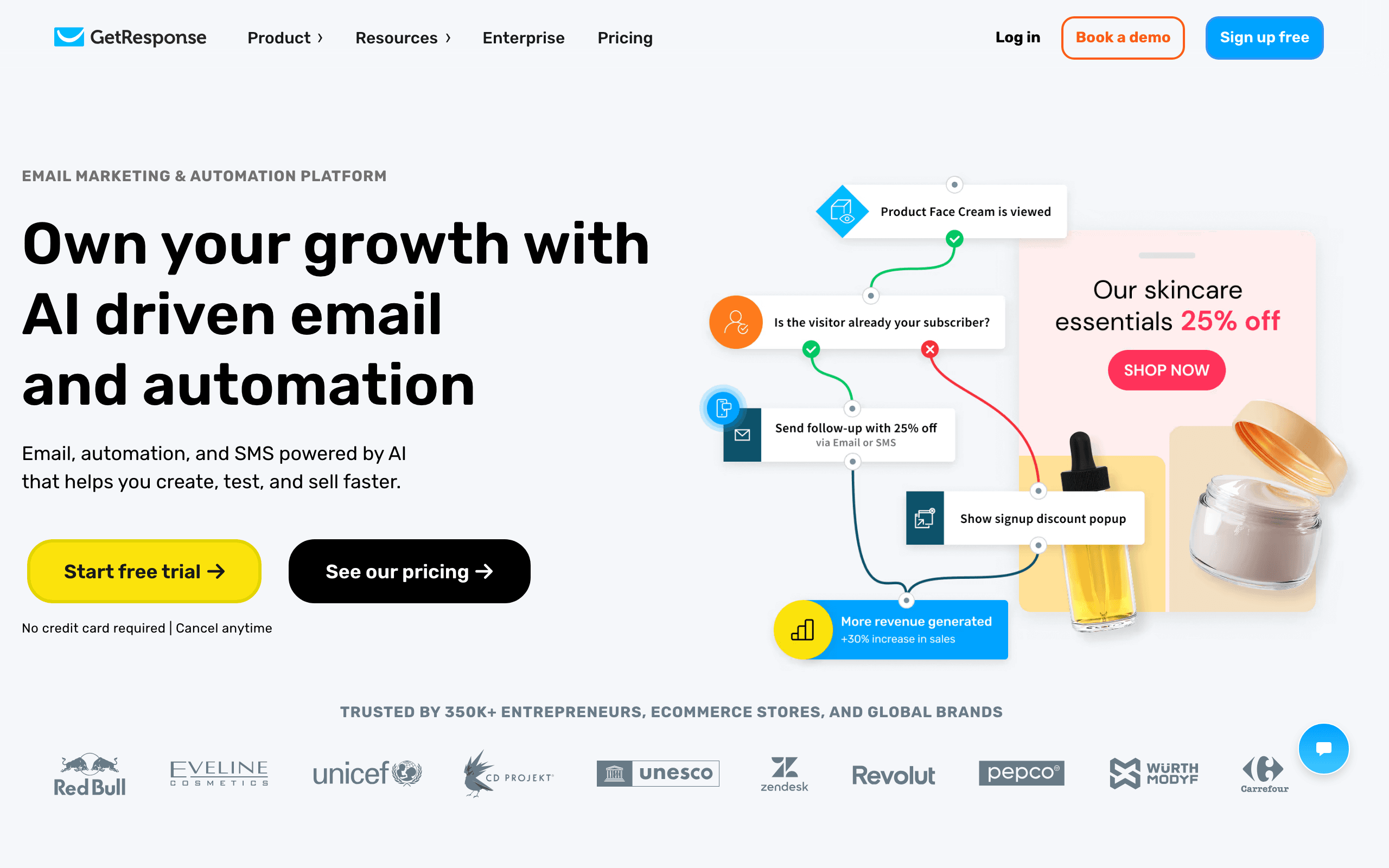
Best for: Stores selling through funnels or webinars alongside ecom
GetResponse bundles email marketing with conversion funnels, landing pages, webinars, and a basic CRM. For ecom stores that also sell info products, courses, or run webinars to drive store sales, this consolidation is useful.
The pure ecom email features are competent but not category-leading. Abandoned cart, post-purchase, and product recommendations all exist. Where GetResponse pulls ahead is the funnel builder: drag-and-drop sequences that combine landing pages, sign-up forms, sales pages, email follow-up, and webinars in one workflow.
For pure ecom stores, this is overkill and the ecom-specific tools (Klaviyo, Omnisend) will be a better fit. For hybrid ecom-plus-courses or ecom-plus-webinar businesses, GetResponse covers more of the stack in one tool.
- Best for: Ecom + course/info-product hybrids, brands that sell through webinars, funnel-led growth
- Pricing: Free up to 500 contacts, Email Marketing from $19/mo
- Pros: Funnels and webinars built in, decent email automation, landing pages included, CRM bundled
- Cons: Pure ecom features trail Klaviyo and Omnisend, jack-of-all-trades, smaller integration ecosystem
15. Constant Contact
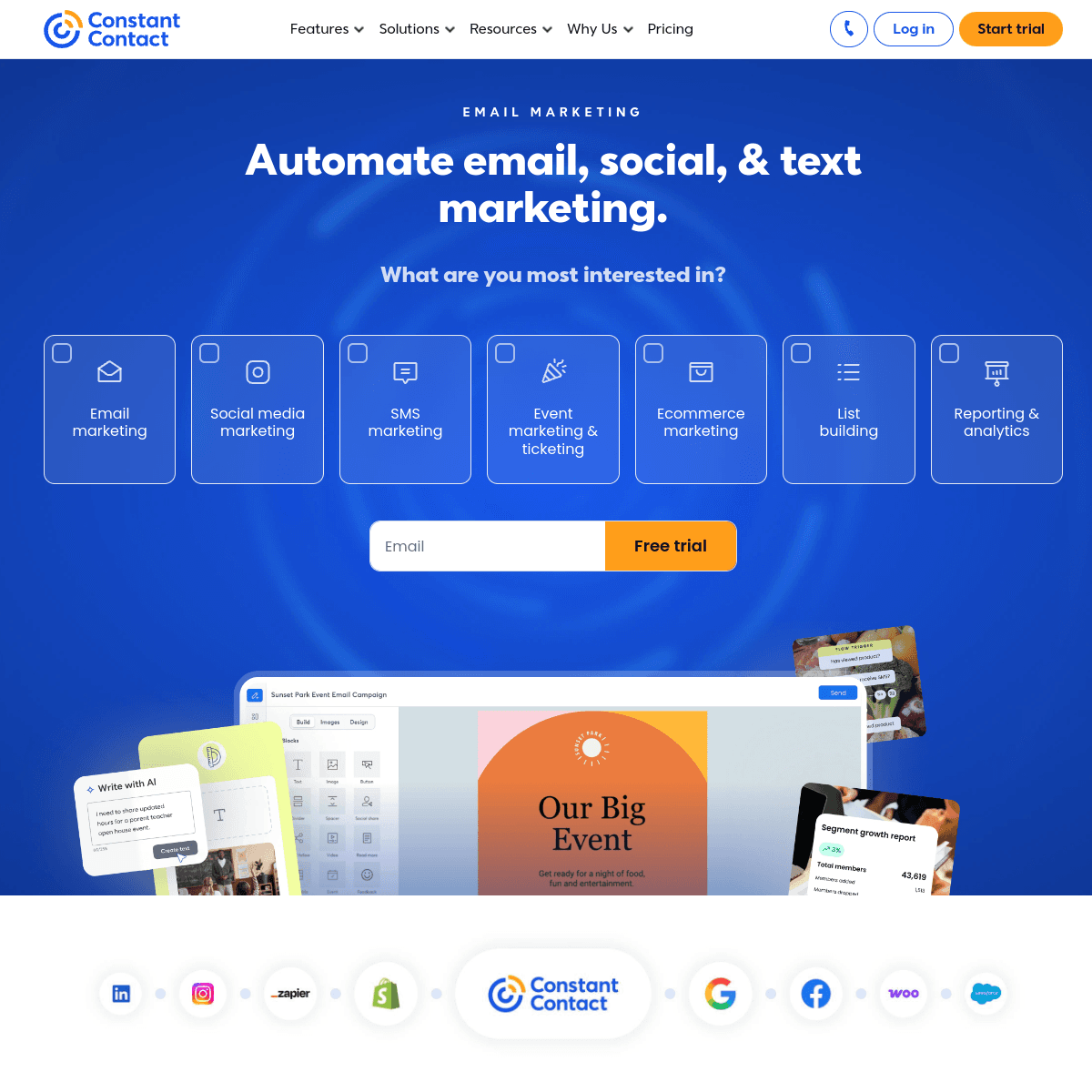
Best for: Older small retailers wanting hand-holding and phone support
Constant Contact is one of the oldest email platforms still actively used by small retailers. The product is straightforward, the templates are conservative, and the support team picks up the phone, which still matters to a meaningful slice of small business owners.
The ecom features are basic. There's a Shopify integration, abandoned cart, and product blocks, but the depth and polish lag well behind Klaviyo and Omnisend. The interface and templates also feel dated compared to newer competitors.
For a brick-and-mortar retailer who started using Constant Contact in 2014 and just wants to keep things working, staying is fine. For anyone starting fresh in 2026, MailerLite or Mailchimp will give you a better product at a similar price.
- Best for: Long-time Constant Contact users, brick-and-mortar with light ecom, owners who value phone support
- Pricing: Lite from $12/mo, Standard from $35/mo
- Pros: Mature platform, real phone support, simple interface, recognized brand among small businesses
- Cons: Dated product, ecom features are shallow, expensive vs. modern competitors, no SMS
16. Campaign Monitor
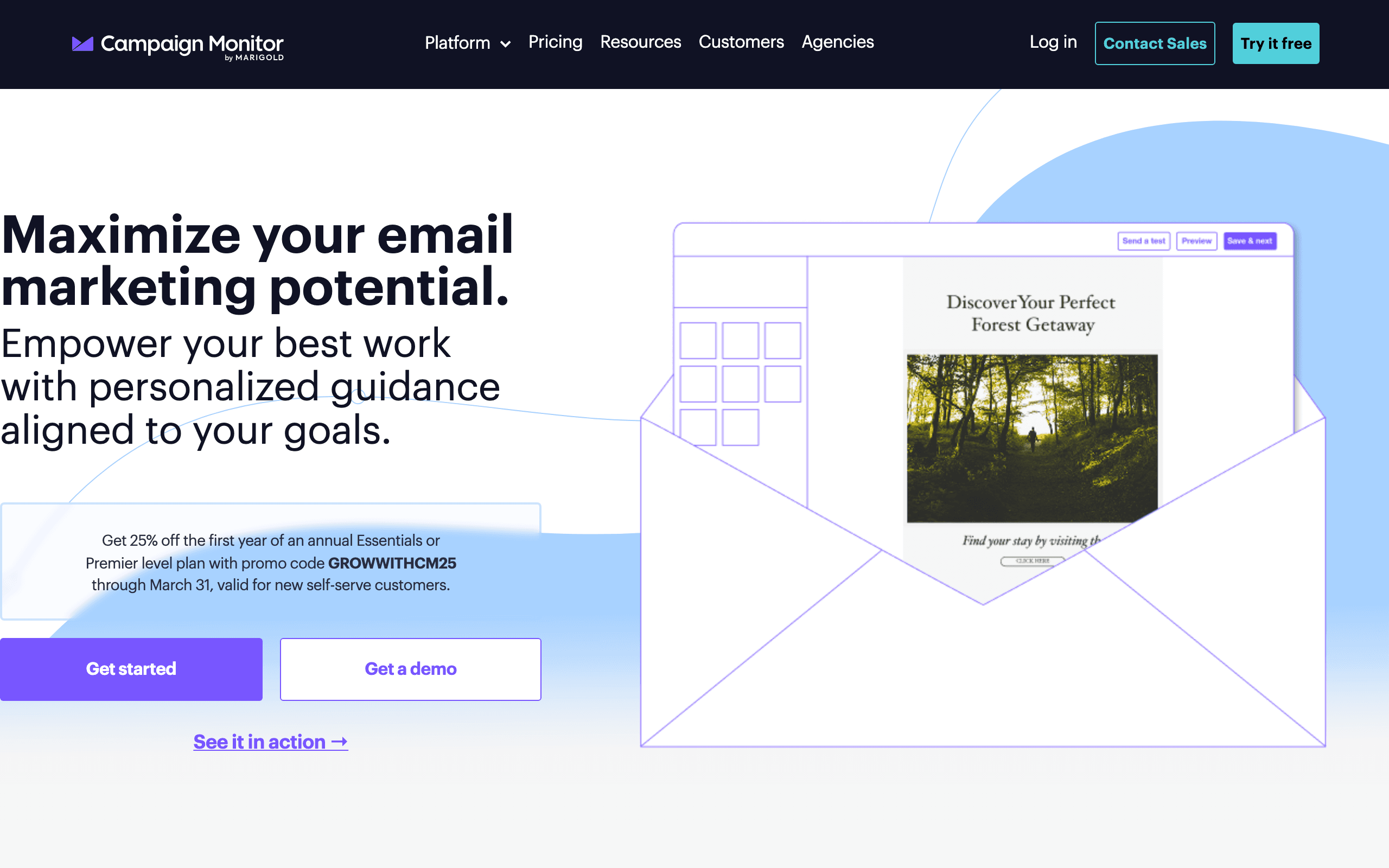
Best for: Brand-led teams wanting design control and clean templates
Campaign Monitor (now part of Marigold) has long been the choice of design-conscious teams who want polished, on-brand emails without fighting the editor. The template gallery is genuinely good and the visual editor produces clean, predictable output across email clients.
Ecom features include a Shopify integration, abandoned cart, and segmentation by purchase behavior. They are competent but trail the dedicated tools. The platform shines more on the campaign side (newsletters, announcements, promotions) than on automation depth.
For DTC brands where brand polish is a priority and the email program is more campaign-led than automation-led, Campaign Monitor is a defensible pick. For automation-heavy stores, Klaviyo or Drip will outperform.
- Best for: Brand-led DTC, campaign-heavy programs, design-conscious teams
- Pricing: Lite from $11/mo, Essentials from $19/mo
- Pros: Polished templates, predictable rendering, clean editor, decent Shopify integration
- Cons: Automation depth trails Klaviyo, smaller ecosystem, ecom features not category-leading
17. ActiveCampaign
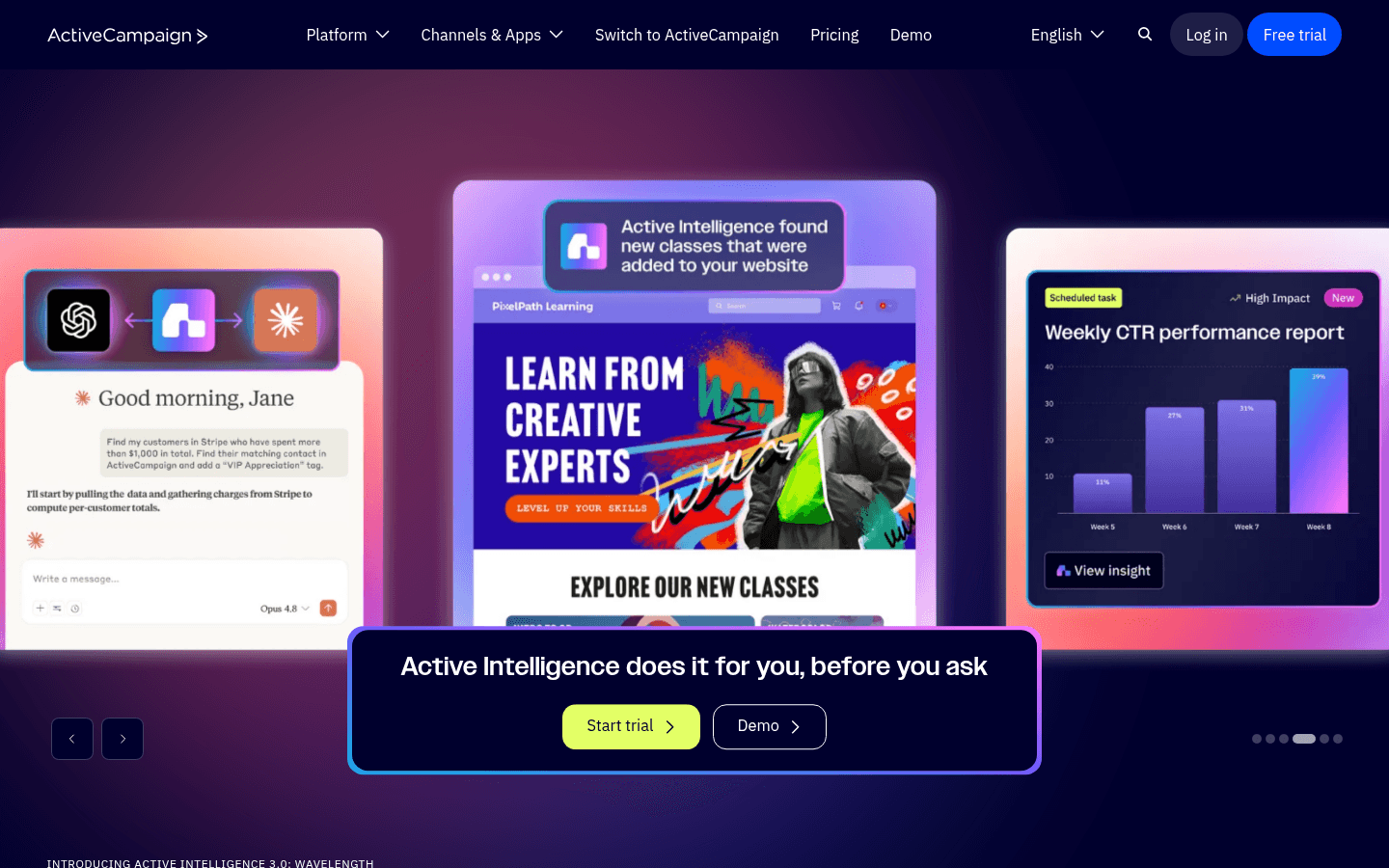
Best for: Stores with complex sales cycles needing CRM + automation
ActiveCampaign has the best general-purpose automation builder on this list. For ecom stores with non-standard sales processes (custom orders, B2B wholesale, consultation-led products, high-touch service add-ons), the visual workflow builder handles things that simpler ecom tools can't express.
The built-in CRM with pipeline management, contact scoring, and 250+ pre-built automation recipes make it a reasonable single platform for ecom-plus-B2B-wholesale stores. Shopify, WooCommerce, and BigCommerce integrations all work, though none are as deep as Klaviyo's Shopify integration.
For pure DTC stores, this is overkill. For stores with sales reps, custom quotes, or wholesale flows alongside an ecom storefront, ActiveCampaign covers more of the workflow than any ecom-specific tool.
- Best for: Ecom + B2B wholesale, custom-order stores, consultation-led ecom, high-touch service businesses
- Pricing: Starter from $29/mo (1k contacts), Plus from $49/mo
- Pros: Best general automation builder, CRM included, 250+ pre-built workflows, contact scoring, 900+ integrations
- Cons: Not ecom-specialized, no SMS on Starter, more expensive than budget options, learning curve
18. HubSpot Marketing Hub
Best for: Larger stores already standardized on HubSpot CRM
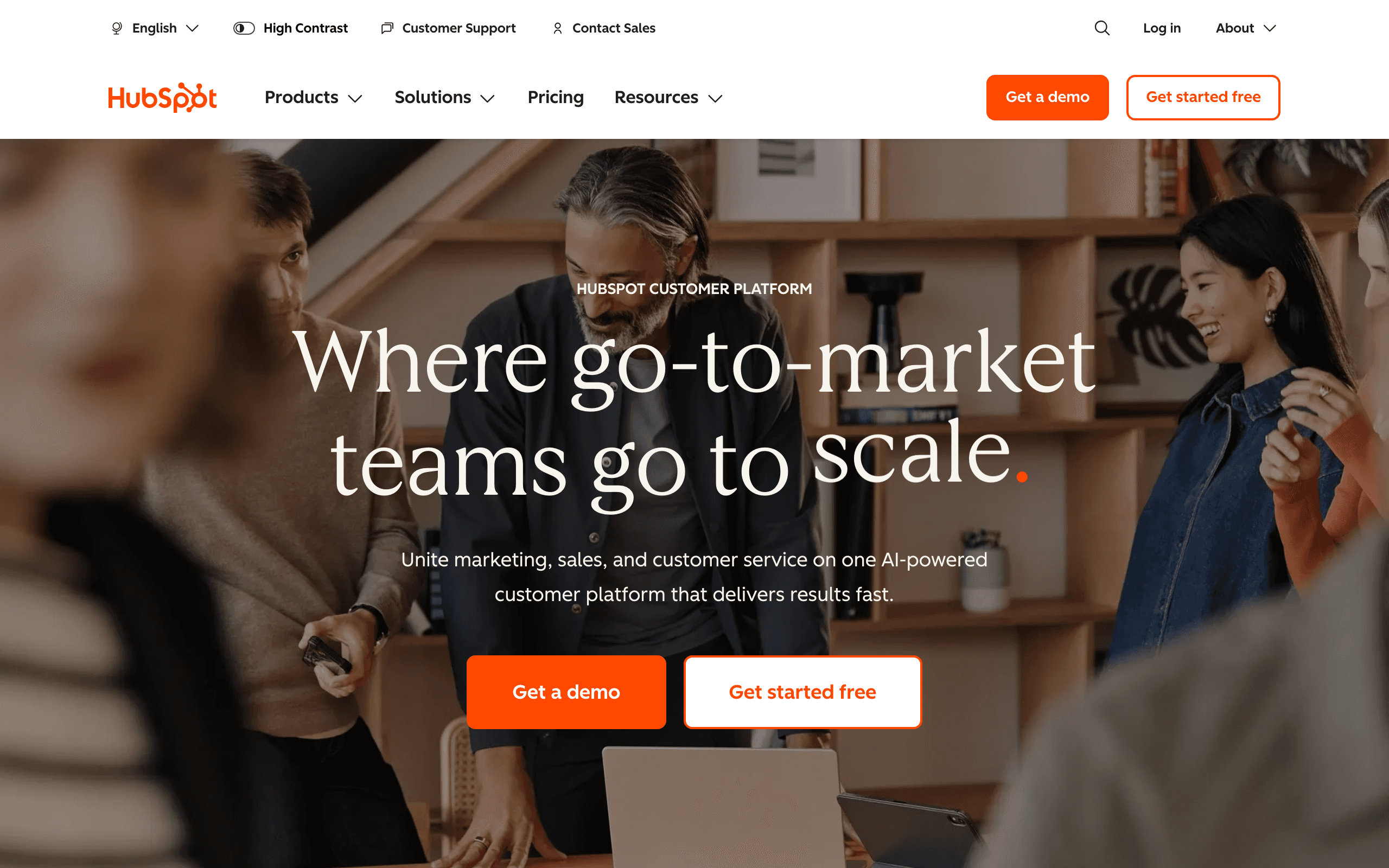
HubSpot Marketing Hub is the right pick for one specific situation: your company already runs HubSpot CRM for sales and customer ops, and you want email marketing to share that data without integration glue. For everyone else, it's expensive and overbuilt for ecom.
The Shopify integration is competent. Email + landing pages + ads + CRM all share contact records, which makes attribution across channels cleaner than running separate tools. The free tier exists but is limited enough that any serious user will be on a paid Hub plan.
For ecom stores not already on HubSpot, Klaviyo + a separate CRM is almost always cheaper and more focused. For HubSpot-standardized teams, the unified data model is the reason to stay.
- Best for: Companies already on HubSpot CRM, larger ecom-plus-B2B operations, teams wanting unified contact records
- Pricing: Free limited, Marketing Hub Starter from $20/mo, scales steeply
- Pros: Unified CRM + marketing data, polished UI, strong landing pages, broad integrations
- Cons: Expensive at scale, ecom features trail Klaviyo, overkill for pure DTC, contact-based pricing punishes large lists
19. Bloomreach Engagement
Best for: Enterprise retailers running a full CDP-led marketing strategy
Bloomreach Engagement (formerly Exponea) is a customer data platform with email, SMS, web personalization, and product recommendations built on top. For enterprise retailers ($25M+/year) that want one platform for all customer data and all customer messaging, this is the leader.
The CDP foundation means every channel sees the same unified customer profile. Email targeting can use any data point in the CDP, including data from POS systems, mobile apps, customer service tools, and ad platforms. Web personalization (recommended products on the homepage, dynamic banners) runs from the same engine.
This is overkill for everyone except enterprise retailers with complex customer journeys and tons of CPG analytics data. Pricing is custom and starts well into five figures per month. For the brands it fits, the unified data model justifies the cost.
- Best for: Enterprise retailers $25M+/year, brands prioritizing CDP-led marketing, omnichannel retailers
- Pricing: Custom (enterprise)
- Pros: True CDP foundation, all channels share data, web + email + SMS unified, strong AI personalization
- Cons: Expensive, enterprise-only, complex implementation, overkill for SMB
20. Listrak
Best for: Mid-market and enterprise retailers wanting cross-channel orchestration
Listrak targets mid-market and enterprise retailers ($10M+/year) with email, SMS, push, social ads, and direct mail orchestration in one platform. Strong on cross-channel attribution and audience sync to ad platforms.
For retailers that want an enterprise-grade alternative to Klaviyo with SMS bundled in and dedicated implementation support, Listrak is a credible pick. The interface and depth are designed for marketing teams (not solo founders), with enterprise account management included.
Custom pricing, enterprise sales cycles, and a long onboarding process make this wrong for SMB. For mid-market retail with a real marketing team, it's competitive with the upper end of Klaviyo and the lower end of Bloomreach.
- Best for: Mid-market and enterprise retail $10M+/year, brands with real marketing teams, retailers needing cross-channel orchestration
- Pricing: Custom (mid-market and enterprise)
- Pros: Cross-channel orchestration, enterprise account management, ad platform sync, SMS included
- Cons: Enterprise-only, custom pricing, long sales cycle, overkill for sub-$10M brands
21. Iterable
Best for: Enterprise multi-channel teams wanting flexible workflow infrastructure
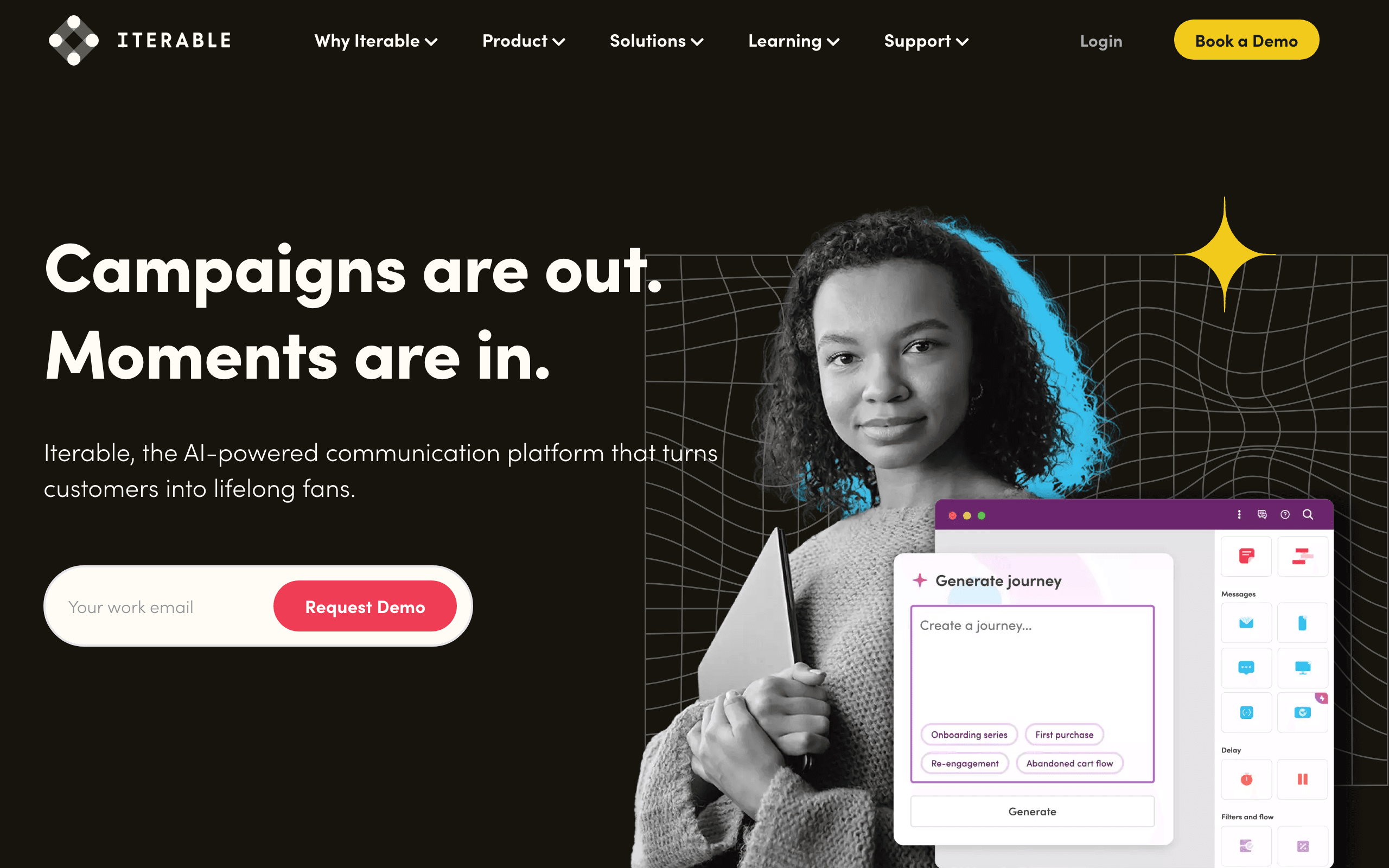
Iterable is a cross-channel customer engagement platform aimed at enterprise marketing teams. Email, SMS, push, in-app, and web personalization run from a single workflow engine that's notably more flexible than Klaviyo's flow builder when you need branching, conditional logic, and event-driven sequences across multiple channels.
For marketing teams at enterprise consumer brands (DTC, marketplace, subscription), Iterable's workflow engine handles complex multi-touch journeys that simpler tools can't express cleanly. The platform is opinionated about composability: you build small reusable journey components and stitch them together rather than maintaining one giant flow.
Pricing is enterprise-custom. Implementation is typically a multi-month engagement with consultants. Wrong for SMB, well-fit for enterprise consumer marketing teams.
- Best for: Enterprise consumer brands, multi-channel lifecycle teams, marketplaces and subscription businesses
- Pricing: Custom (enterprise)
- Pros: Flexible workflow engine, true cross-channel, composable journey design, strong API
- Cons: Enterprise-only, complex implementation, expensive, custom pricing
How to Choose
Pure Shopify store: Klaviyo if revenue justifies it ($30k+/mo), Omnisend if you want SMS bundled cheaper, Shopify Email if you're under 10k emails/month. Privy for pop-ups regardless.
WooCommerce or BigCommerce: Omnisend or MailerLite. Klaviyo's WooCommerce integration is weaker than its Shopify one.
Multi-channel (email + SMS + push): Omnisend for SMB, Attentive for enterprise SMS-led brands, Postscript + Klaviyo for Shopify SMS at mid-market.
DTC brand wanting customer intelligence: Drip if you're email-only, Klaviyo if you also want SMS.
Hybrid ecom + Stripe subscriptions: Sequenzy. The Stripe + Shopify combination is the case it's actually built for.
Mid-market and enterprise: Sendlane for $1M-$5M, Listrak or Bloomreach for $10M+, Iterable for cross-channel composability, Klaviyo if you want the leader.
Already on HubSpot CRM: HubSpot Marketing Hub. Otherwise Klaviyo or Omnisend will outperform.
Brand-led, design-heavy: Campaign Monitor or MailerLite for templates and polish.
Tight budget: MailerLite hosted, or Brevo if you have a large list and email infrequently.
For more on how these flows actually work, see our email marketing strategy guide.
HubSpot vs Klaviyo vs Mailchimp vs Omnisend for ecommerce email
These four come up together constantly because they represent four different bets: CRM-first, ecommerce-first, generalist, and multichannel-on-a-budget.
| HubSpot | Klaviyo | Mailchimp | Omnisend | |
|---|---|---|---|---|
| Entry price | Free CRM; Marketing Hub Starter from $20/seat/mo | From $20/mo, ~$150/mo at 10,000 profiles | From $13/mo | From $16/mo |
| Billing basis | Seats + marketing contacts | Active profiles + SMS usage | Contacts | Contacts + SMS credits |
| Shopify depth | Basic app sync | Deepest on the market: catalog, browse, predictive | Adequate; product blocks and cart recovery | Strong: catalog, cart, browse, product picker |
| Pre-built ecom flows | Few; you build them | Full library with benchmarks | Cart, welcome, winback | Full library, quick to launch |
| Product recommendations | Manual | Predictive/ML plus catalog blocks | Catalog blocks | Catalog blocks and best-sellers |
| SMS | Add-on via partners | Native, billed per message | Add-on, US-focused | Native, credits bundled |
| Revenue attribution | Via CRM deals | Per flow, per campaign, adjustable window | Basic per campaign | Per flow and per campaign |
| Best when | Sales team and store share one contact record | Store revenue justifies the bill | You already run Mailchimp and the store is secondary | You want cart plus SMS cheaply |
The short version. Klaviyo wins on ecommerce depth and is worth its premium above roughly $30k a month in store revenue. Omnisend gets you 80% of that for materially less, and bundles SMS, which is the right trade below that threshold. Mailchimp is the right answer only if it is already your marketing system of record and the store is a secondary channel. HubSpot is not an ecommerce email tool - pick it when a sales team needs the same contact record as the store, and accept that you will build the flows yourself.
Ecommerce email marketing services and agencies: when to hire vs buy software
A large share of "ecommerce email marketing" searches are looking for someone to run it, not something to run it with. The decision is mostly about revenue and flow maturity.
Buy software and run it yourself when your store does under roughly $30k a month, you have fewer than seven automated flows live, or nobody has yet tuned the abandoned-cart sequence. At that stage an agency spends most of its retainer building the flows that ship pre-built in Klaviyo and Omnisend, and you pay a markup for setup you could do in a fortnight.
Hire an agency or a freelance ESP specialist when the flows are live and the constraint has shifted to volume and testing: weekly campaign calendars, creative production, segmentation experiments, deliverability management across a growing list, and migration work. Retainers for ecommerce email specifically usually run $2,000 to $8,000 a month, or a percentage of email-attributed revenue.
What to ask before signing. Who owns the platform account and the sending domain (it should be you). Are they reporting email-attributed revenue on the platform's own attribution window, or on a custom model you cannot audit. Will you get the flows and templates if you leave. Our B2B lead generation agencies guide covers the contract mechanics in more depth, and they transfer directly to ecommerce retainers.
A middle path most stores skip. Buy the software, then hire a specialist for a one-off build sprint - four to six weeks to set up flows, templates and segments properly - and run it in-house afterwards. It costs a fraction of an ongoing retainer and leaves the knowledge with you.
Must-Have E-Commerce Email Flows
Every store should have these running, in this priority order:
- Welcome series (3-5 emails). Introduce the brand, show best sellers, offer a first-purchase incentive.
- Abandoned cart (2-3 emails). The single highest-revenue automation in ecom. Recover 5-15% of abandoned carts.
- Post-purchase (2-4 emails). Thank you, shipping updates, review request, cross-sell, replenishment reminder.
- Browse abandonment (1-2 emails). Remind shoppers of products they viewed but didn't add to cart.
- Winback (2-3 emails). Re-engage customers who haven't purchased in 60-90 days.
- VIP / loyalty (ongoing). Reward your top 10% by revenue with early access and exclusive offers.
Read more on smart segments and growing your list.
FAQ
What's the best email marketing platform for Shopify in 2026?
Klaviyo for serious stores, Omnisend if you want cheaper SMS bundled in, Shopify Email if you're a brand-new store under 10k emails/month. The order hasn't changed materially in three years.
Is Klaviyo worth the price?
For a Shopify store doing $30k+/month, yes. The pre-built flows and predictive analytics typically generate enough additional revenue to cover the bill many times over. Below that volume, start cheaper and migrate when the ROI is obvious.
Should I use email and SMS together?
Yes, especially for abandoned cart recovery. SMS abandoned cart converts at 2-5x the email rate. Either bundle them in one tool (Klaviyo, Omnisend, Attentive) or pair an SMS specialist (Postscript) with your email tool.
What's the best free option for a small store?
Shopify Email if you're on Shopify (10k emails/mo free), Omnisend if you want a free tier with SMS included, or Sequenzy for 2,500 emails/mo with unlimited contacts. MailerLite's free plan is now only 250 subscribers and 2,500 emails after its June 2026 cut.
How does Sequenzy compare to Klaviyo for ecommerce?
Honestly, for a pure Shopify store Klaviyo will outperform Sequenzy on integration depth, pre-built flows, and product recommendations. Sequenzy is a better fit when you're running both a Shopify store and a Stripe-billed subscription product and want one platform instead of two. Don't pick Sequenzy for a pure ecom use case.
How much revenue should email drive for my store?
Industry benchmarks suggest 25-40% of total ecom revenue. If you're under 20%, you're missing automations (abandoned cart, post-purchase, winback) more often than you have a content problem.
Do I need browse abandonment if I have abandoned cart?
Yes, but lower priority. Abandoned cart recovers people who started checkout. Browse abandonment recovers people who looked but never added to cart, a much larger pool with lower conversion. Stack browse abandonment after your cart flow is tuned.
How often should I send campaigns to ecom subscribers?
2-3 campaigns per week plus your automated flows is the sweet spot for most DTC brands. Watch unsubscribe rates: above 0.5% per send means you're sending too much. Automated flows don't count toward that frequency.
Related Resources
- Best Email Marketing Tools - Full general comparison
- Best Email Marketing Platforms for Small Business - Small business focus
- Best email automation software - Automation depth comparison
- Email Marketing Strategy Guide - Strategy playbook
- How to Improve Email Open Rates - Open rate optimization
- How to Grow Your Email List - List growth tactics
- Best Newsletter Platforms - Newsletter-focused tools
- What Is Email Marketing? - Email marketing fundamentals
Try it on your store free
Sequenzy's free plan sends 2,500 emails a month with unlimited contacts and includes the Shopify integration, Stripe integration, automation builder, catalog product blocks, A/B testing and revenue attribution. Start free or compare the tiers on pricing.