
12 Best Email and SMS Marketing Platforms in 2026

Almost every marketing platform now claims email and SMS. Very few of them actually run the two channels together.
The difference shows up in one specific capability: can one channel suppress the other? A platform that stores email subscribers and text subscribers in separate lists, with separate segments and separate campaign builders, has two products in one login. A platform where a single flow can send an email, wait, check whether it was opened or converted, and only then send a text is doing something meaningfully different.
That is the axis this comparison is built on. I looked at whether profiles are genuinely shared, whether consent is separate per channel, whether suppression and frequency caps apply across both, and whether the attribution report can tell you which touch mattered rather than double-counting the same order.
I also priced the combined bill honestly, because "email from $16" and "SMS from $0.007" are two numbers that never appear together on an invoice.
If you want the SMS-only comparison, see the best SMS marketing tools. For e-commerce email specifically, see the best email marketing platforms for e-commerce.
Quick comparison table
| Platform | Email billing | SMS billing | Shared profile | Cross-channel suppression |
|---|---|---|---|---|
| Klaviyo | Active profiles, about $20 to $150/mo to 10k | Credits by plan, from about $35/mo bundled | Yes, one profile | Yes, inside a single flow |
| Omnisend | Contacts, Standard from about $16/mo | $0.007 to $0.009 per US SMS on Pro | Yes | Yes, on one workflow canvas |
| Attentive | Bundled into a custom quote | Custom, roughly $0.01/SMS with commitments | Yes | Yes, cross-channel journeys |
| Sendlane | Sends, from $100/mo for 50k emails | From about $0.009 per credit | Yes, unlimited profiles | Yes |
| Sequenzy | Sends, paid plans from $19/mo | Add-on from $16/mo with 1,000 credits | Yes, one subscriber | Yes, steps in one sequence |
| Brevo | Sends, Starter from about $9/mo | Credits priced per destination | Yes | Partial |
| Privy | Mailable contacts, email from about $30/mo | Credits sold separately | Yes | Limited |
| Postscript | Newer email product | $0.007 to $0.009/SMS plus carrier fees | SMS-led | Within its own flows |
| ActiveCampaign | Contacts, Starter from about $15/mo | Via connected provider | Partial | Limited |
| Mailchimp | Contacts, paid from about $13/mo | Varies by region and eligibility | Partial | Limited |
| Emotive | Not an email platform | Plans from about $100/mo plus usage | SMS-led | Within its own flows |
| Recart | Not an email platform | From about $299/mo managed | SMS-led | Within its own flows |
Pricing, plan gates, and regional SMS availability change frequently. Confirm the current quote, carrier fee treatment, and eligible destinations before you sign.
What "email and SMS in one platform" should actually mean
Four capabilities separate a genuinely combined platform from two bolted-together products. Test all four in a trial.
One profile, two consent states
A single subscriber record should hold both an email marketing state and an SMS marketing state, independently. Someone can be opted in to email, opted out of SMS, and still receive transactional order updates.
If a platform infers SMS consent from the presence of a phone number, or treats one unsubscribe as covering both channels, it is not modeling this correctly and it will eventually create either a compliance problem or a lost subscriber.
One segment definition
The same segment ("bought twice, not in 90 days, spent over $200") should be usable for an email campaign and an SMS campaign without being rebuilt. If you maintain parallel segment logic per channel, they will drift, and the drift is invisible until a customer gets contradictory messages.
One flow that decides the channel
This is the capability that justifies the whole architecture. A flow should be able to send an email, wait six hours, check whether it was opened or whether the order was placed, and send a text only to the people for whom the email did not work.
Ask to see this built in a trial. It is the single fastest way to distinguish a real combined platform from a marketing claim.
One frequency cap and one attribution model
A customer does not experience your email calendar and your SMS calendar separately. They experience total interruptions per week. A combined platform should let you cap that globally.
Attribution matters just as much. If email and SMS each claim the same order, your reported revenue is inflated and your channel decisions are being made on bad numbers.
How I evaluated these platforms
- Created a subscriber opted in to email and out of SMS, then confirmed no automation could text them.
- Built one segment and used it unchanged for both an email campaign and an SMS campaign.
- Built a flow with an email step, a wait, a conditional check on open or conversion, and an SMS step for the non-converters.
- Set a global frequency cap and tested whether it counted both channels.
- Sent overlapping campaigns and compared the sum of channel-attributed revenue against actual store orders.
- Priced each platform at 5,000, 10,000, and 25,000 contacts with 20,000 monthly texts, carrier fees included.
- Checked whether an SMS opt-out left transactional messages intact.
The 12 best email and SMS marketing platforms
1. Klaviyo
Best for: Commerce teams that want one profile making every channel decision.
Pricing: Email from about $20/month at 251 to 500 active profiles, rising to roughly $150/month at 10,000. Email and SMS plans start around $35/month with 1,250 SMS or MMS credits included, with usage beyond that billed separately.
Klaviyo is the reference implementation of a combined platform. Email and SMS share one profile, one segment builder, and one flow canvas, so cross-channel logic is native rather than a workaround. The conditional split on "did the email work?" before sending a text is straightforward here and genuinely difficult elsewhere.
The underlying data model is the deepest in commerce: orders, products, browse behavior, predicted lifetime value, and churn risk are all available to both channels. Flow-level revenue reporting means you can evaluate an email step and an SMS step within the same journey.
The costs are real. Active-profile billing means a large dormant list costs money before you send anything, SMS credits stack on top of the email plan, and the platform takes time to learn well enough to use its depth. It is also not the best SMS platform in isolation: capture units and reply handling trail Attentive and Postscript.
- Pros: True shared profile and segments, genuine cross-channel suppression, deepest commerce data, best flow library, flow-level attribution.
- Cons: Active-profile billing, SMS billed on top, learning curve, SMS specialization trails the specialists.
Verdict: The best combined platform, and the default recommendation if coordination is the priority.
2. Omnisend
Best for: Small and mid-size stores that want email, SMS, and push without an implementation project.
Pricing: Standard from about $16/month at low contact counts, roughly $115 to $132/month at 10,000 contacts. On current Pro plans, US and Canada SMS runs from about $0.009 per message down to about $0.007 at high volume, with bundles from around $10/month and credits rolling over for 60 days.
Omnisend is the best value in this category below roughly 10,000 contacts, and it is genuinely multichannel rather than email with a text bolt-on. Email, SMS, and push all live on one workflow canvas with shared subscriber data, so a three-channel journey takes minutes rather than a rebuild.
The prebuilt commerce automations cover welcome, cart, browse abandonment, and post-purchase, and the product picker makes catalog-driven messages fast. Shopify and WooCommerce both connect without engineering time.
Its ceiling is segmentation depth, and SMS sits behind the Pro plan on current pricing, which is a real gate for a small store. Reply handling is thin compared with an SMS specialist.
- Pros: Three channels on one canvas, excellent value under 10k contacts, strong prebuilt commerce flows, credits roll over, easy setup.
- Cons: SMS gated to Pro, less segmentation depth than Klaviyo, weak two-way messaging, contact billing grows with dormant lists.
Verdict: The best-value combined platform for most stores that are not yet at scale.
3. Attentive
Best for: Brands where messaging is a department with a budget and a named owner.
Pricing: Custom and consumption-based across SMS, email, RCS, and push, shaped by message volume, subscriber count, channels, and selected AI products. Reported minimums commonly sit around $2,000 to $3,000 per quarter, with roughly $0.01 per SMS and volume commitments.
Attentive built its reputation on SMS and has since become a credible combined platform. Cross-channel journeys, shared profiles, and unified reporting are all there, and the email product is strong enough that some brands consolidate onto it rather than running an ESP alongside.
What you actually pay for is upstream of messaging: the best signup units in the category, two-tap mobile capture, RCS, conversational commerce, and strategic support that meaningfully replaces internal work.
It is sales-led with no published rate card, contract-based, and priced for volume. Below roughly $5M in revenue the minimums are hard to justify on economics alone.
- Pros: Best-in-class list growth, RCS and conversational commerce, genuine cross-channel journeys, strategic support included.
- Cons: Enterprise minimums and commitments, no published pricing, contract complexity, excessive for smaller brands.
Verdict: The premium option, and worth it when capture and support replace headcount.
4. Sendlane
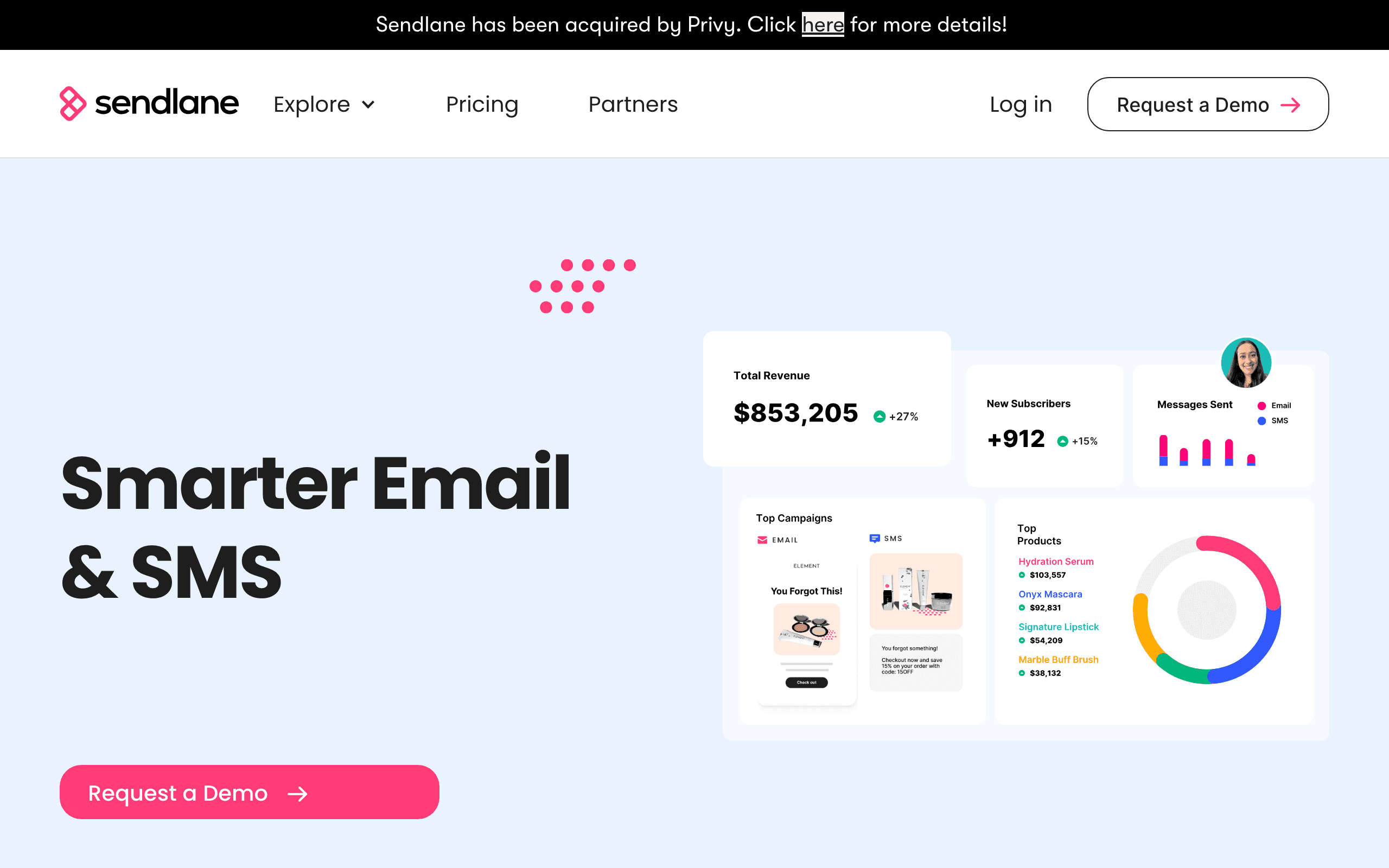
Best for: Stores with a large database and a moderate send calendar.
Pricing: Professional from $100/month for 50,000 email sends with unlimited contacts. SMS from about $0.009 per credit, subject to destination rates and current promotions.
Sendlane's differentiator in this category is billing shape rather than feature set. Unlimited profiles with send-based email pricing changes the math for any store carrying years of accumulated subscribers, and the SMS side is priced competitively on top.
The commerce data and behavioral automation are genuinely deep, built for stores rather than adapted from a general ESP, and email and SMS share profiles and segments properly.
The entry price is the barrier: $100/month is not where a small store starts. The ecosystem is smaller, so there are fewer agencies and fewer community answers when something specific breaks.
- Pros: Unlimited contacts on send-based pricing, deep behavioral data, real email plus SMS integration, good multi-store support.
- Cons: High entry spend, smaller ecosystem, regional SMS economics need verification.
Verdict: The most commonly skipped comparison. Price it before renewing Klaviyo.
5. Sequenzy
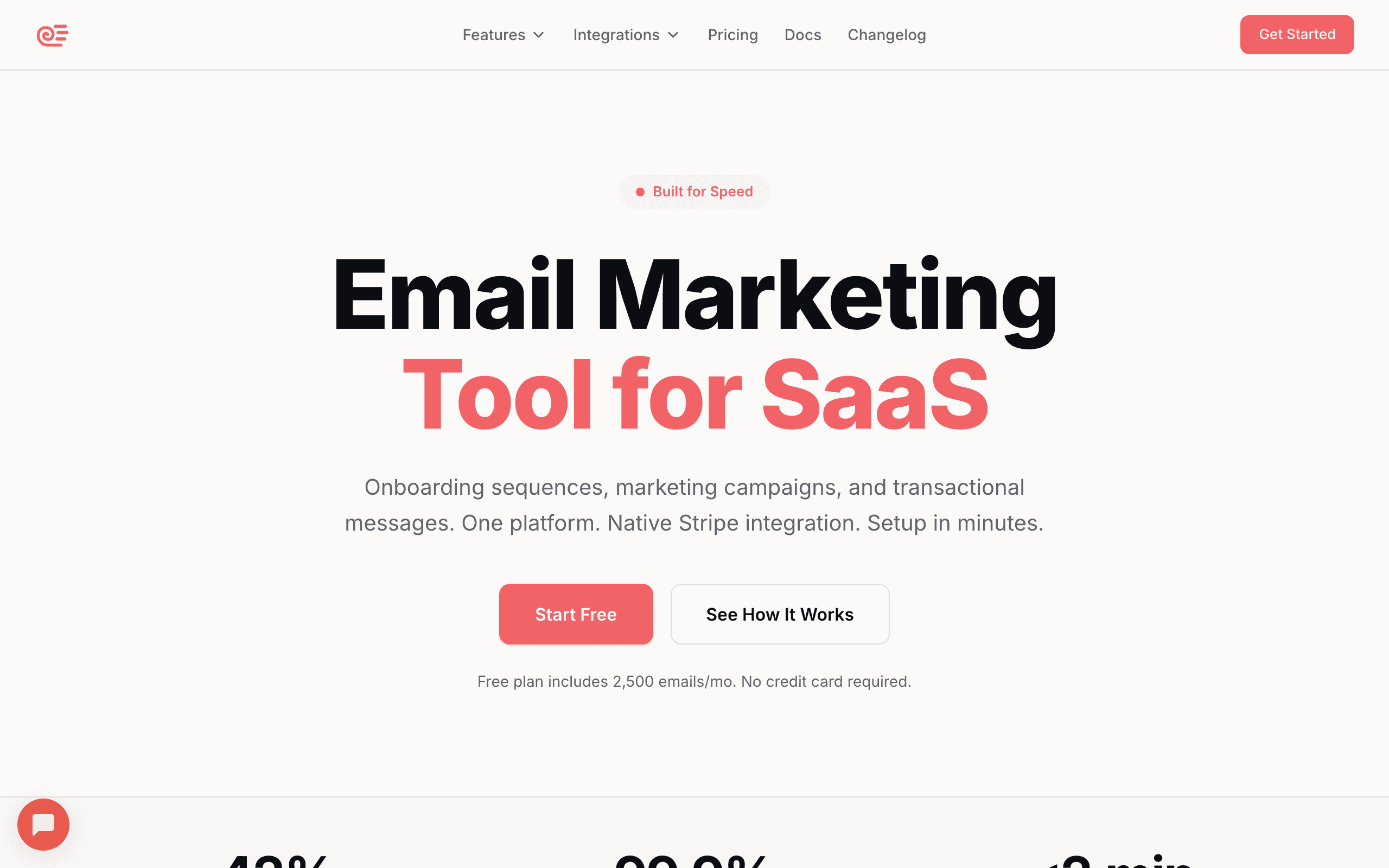
Best for: Lifecycle teams that want SMS as a step inside the email program they already run.
Pricing: Paid plans from $19/month with send-based email pricing. SMS is a paid add-on from $16/month including 1,000 credits, where one US or Canada segment uses one credit and international credits are cost-weighted by destination.
Disclosure: I build Sequenzy, so read this as disclosed rather than neutral. Its position in this category is deliberately narrower than Klaviyo's or Attentive's: it is a lifecycle platform where SMS is a step type, not a second product.
Concretely, a Send SMS step drops into any sequence alongside email steps, using the same subscribers, segments, and revenue attribution. SMS consent is a separate field from email status and is never inferred from a phone number, so a subscriber can be email-only, SMS-only, or both. Sequenzy provisions a dedicated toll-free number, guides carrier verification, handles STOP, START, and HELP per number, and defers sends outside local quiet hours rather than dropping them. Everything is available through the API, CLI, and MCP server, which matters for teams that script their campaign operations.
Honest limits for this comparison: there is no in-app two-way SMS inbox yet, so replies forward to your account email; MMS is US and Canada only; and it is not competing on capture units or conversational depth with the specialists. It is also not the deepest commerce merchandising platform here.
- Pros: Email and SMS in one sequence, separate consent per channel by design, managed number and verification, quiet hours enforced, shared attribution, send-based pricing, full API, CLI, and MCP coverage.
- Cons: No two-way inbox yet, MMS US and Canada only, lighter merchandising than Klaviyo, SMS is a paid add-on on paid plans.
Verdict: Right when email leads and SMS supports. Wrong when SMS needs to be its own program.
6. Brevo
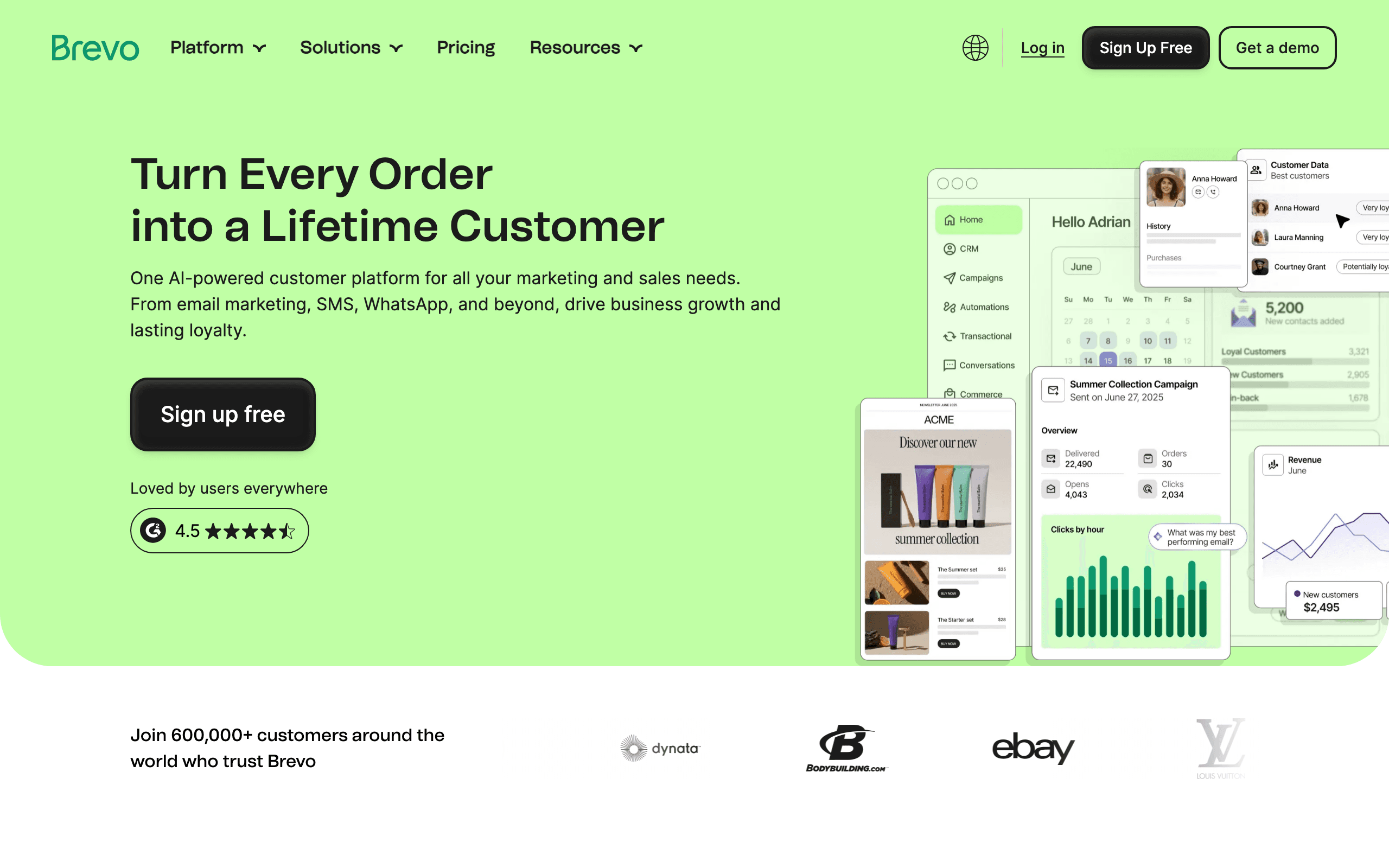
Best for: Budget-conscious teams that also need transactional email and international SMS.
Pricing: Free plan with a daily send allowance, then Starter from around $9/month for 5,000 emails, with unlimited contacts. SMS is credit-based and priced per destination country.
Brevo covers the widest surface for the lowest price: marketing email, transactional email, SMS, and basic CRM in one account, with unlimited contacts and volume-based email billing.
Its international SMS reach is a practical advantage that the commerce-focused platforms often lack. If your list spans several countries, Brevo will usually both send and price better than a US-centric tool.
Where it falls short is exactly the thing this article is about: cross-channel orchestration is partial. You can send both channels, but the conditional "email first, text the non-converters" pattern is not as clean, and commerce automation is thinner throughout.
- Pros: Unlimited contacts, send-based email pricing, transactional included, broad international SMS, very low entry cost.
- Cons: Partial cross-channel logic, shallow commerce automation, SMS pricing varies sharply by country, basic reporting.
Verdict: The best budget generalist. Not the best orchestrator.
7. Privy
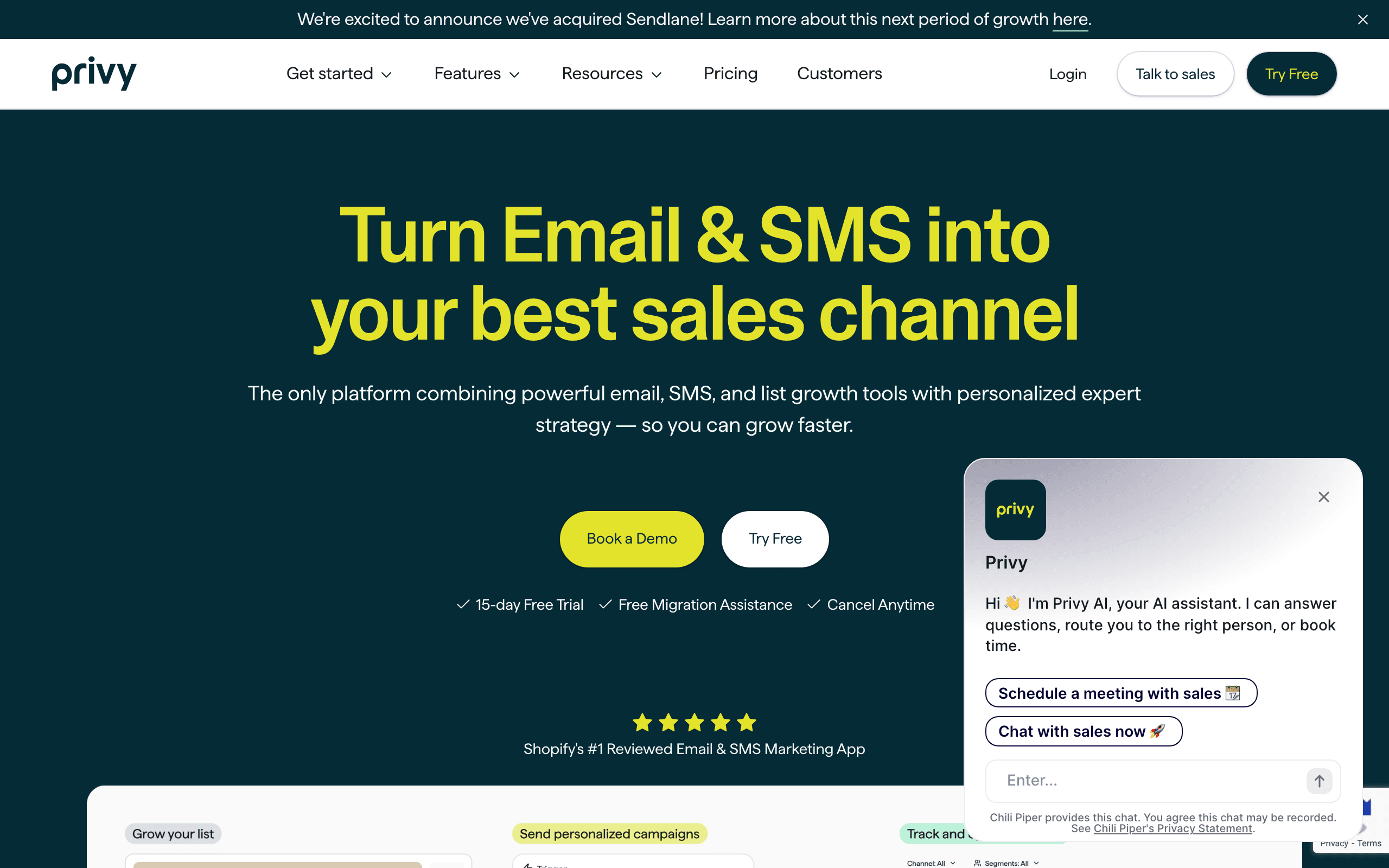
Best for: Stores whose combined-channel problem is actually a capture problem.
Pricing: About $24/month for pop-ups and displays only, around $30/month with email included, with SMS credits sold separately and display pricing scaling by page views.
Privy belongs in this comparison as a corrective. A lot of teams shop for a combined platform when their SMS list is a tenth the size of their email list, which is a capture failure, not an orchestration failure.
On-site capture is what Privy does well: exit intent, spin-to-win, cart savers, and targeted mobile units. The email and SMS layer handles a welcome and a cart reminder adequately.
It is not built to run a lifecycle program long term, and most stores end up pairing it with a primary platform, which means two bills and a decision about consent ownership.
- Pros: Strong on-site capture, cheap relative to impact, quick to deploy, good Shopify fit.
- Cons: Shallow lifecycle messaging, SMS credits separate, usually a second tool rather than the only one.
Verdict: Fix capture here, orchestrate somewhere else.
8. Postscript
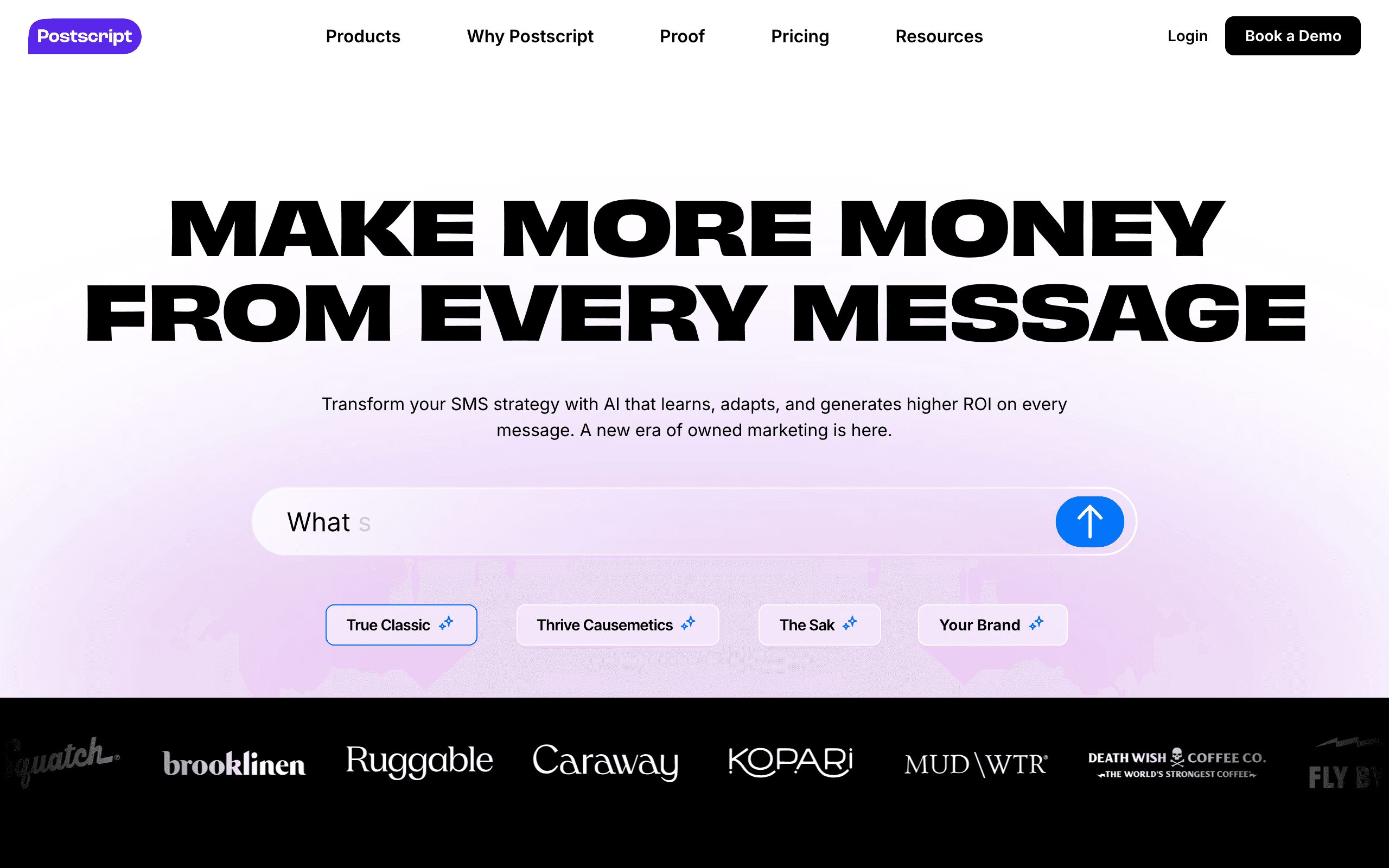
Best for: Shopify brands where SMS leads and email follows.
Pricing: Starter $0/month with a $49 minimum spend at about $0.009/SMS, Growth $100/month at about $0.008, Professional $500/month at about $0.007. Average US carrier fees of about $0.00418/SMS are billed separately. Email is a newer product with separate pricing.
Postscript is the strongest self-serve SMS specialist, and it has added email. The order matters: this is an SMS platform that also sends email, not a combined platform in the sense the rest of this list means.
If your program is SMS-led, that is an advantage. Flows, segmentation, capture, and reply management are all built around text, and the published rates make budgeting straightforward.
If email is your larger channel, evaluate its email product on its own merits rather than assuming parity with a mature ESP. Many brands run Postscript alongside Klaviyo, which works but reintroduces the two-platform suppression problem.
- Pros: Best self-serve SMS tooling, published transparent rates, deep Shopify flows, real reply management.
- Cons: Email is newer and less proven, carrier fees add meaningfully, minimum spend at the entry tier, Shopify-centric.
Verdict: A great SMS platform with email attached, rather than a true dual-channel platform.
9. ActiveCampaign
Best for: Businesses whose hard problem is branching journey logic rather than merchandising.
Pricing: Starter from about $15/month at 1,000 contacts on annual billing, with automation, CRM, and advanced features gated by tier. SMS generally runs through a connected provider.
ActiveCampaign has the most expressive automation builder in this comparison. Conditions, goals, scoring, waits, and CRM tasks let you model journeys that commerce-first tools cannot, which matters for hybrid businesses with wholesale, B2B, or sales-assisted motions.
Its commerce integrations bring order and product data into that builder, so purchase behavior can drive complex logic.
SMS is the weak point for this list specifically. It is not a native specialty, cross-channel suppression is limited, and the combined-channel story is noticeably less coherent than Klaviyo's or Omnisend's.
- Pros: Best conditional automation here, CRM and sales workflows, works well beyond commerce, large integration ecosystem.
- Cons: SMS is not a core product, limited cross-channel suppression, contact billing climbs, more build-from-scratch.
Verdict: Choose it for the journey logic, not for the SMS.
10. Mailchimp
Best for: Small businesses that mainly need familiar campaigns and occasional texts.
Pricing: Free tier for small lists, then paid marketing plans from about $13/month, billed by contacts. SMS availability and pricing vary by geography and account eligibility.
Mailchimp is the most familiar tool in the category and still a reasonable choice for a small business whose email program is campaigns and templates rather than lifecycle automation.
The template ecosystem, form tooling, and integration breadth remain genuine advantages, and the learning curve is the lowest here.
For this comparison specifically, it is weak. SMS is not a dependable global capability, cross-channel suppression is limited, and commerce automation is shallow. If both channels are purchase criteria, this is not the platform.
- Pros: Familiar, huge template library, broad integrations, low learning curve.
- Cons: SMS varies by region and eligibility, limited cross-channel logic, shallow commerce automation, contact billing climbs.
Verdict: Fine for email campaigns. Not a serious dual-channel platform.
11. Emotive
Best for: Brands where the SMS mechanic is genuine conversation, paired with a separate ESP.
Pricing: Published tiers run roughly $100/month for Starter, $200/month for Pro, and $300/month for Advanced, plus per-message costs, with enterprise pricing on request.
Emotive is an SMS platform rather than a combined one, included because teams evaluating "email and SMS" frequently end up pairing an ESP with a conversational SMS tool.
Its focus is two-way conversation with human-assisted responses, which converts well for considered purchases and high-AOV categories where customers have real questions before buying.
Paired with an ESP, you get strong conversational SMS and no shared suppression, so you need a deliberate rule about who gets messaged and when.
- Pros: Genuine conversational focus, human-assisted responses, transparent plan tiers, strong for considered purchases.
- Cons: Not an email platform, per-message costs on top of plans, no shared suppression with your ESP.
Verdict: A conversational SMS layer, not a combined platform.
12. Recart
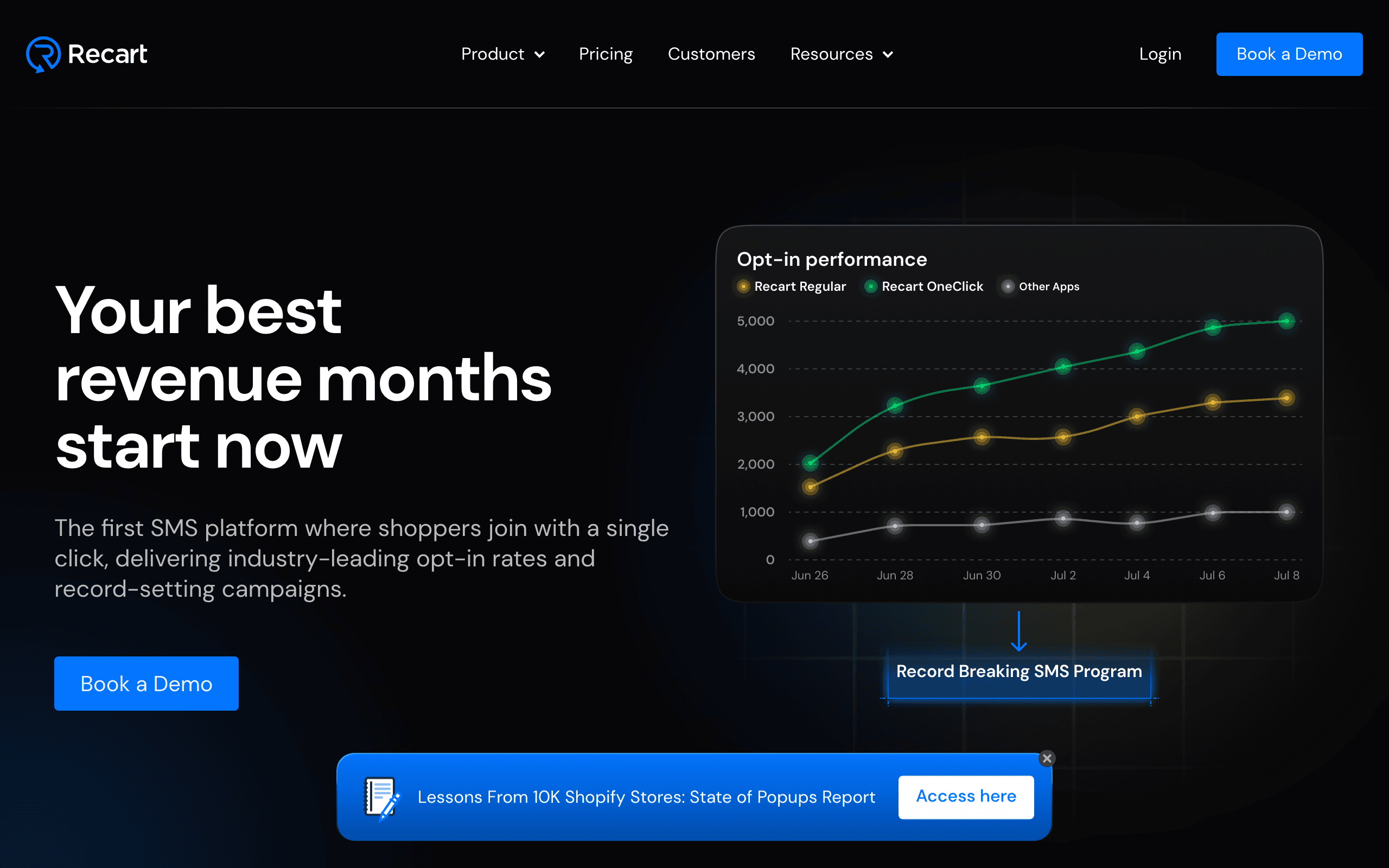
Best for: Shopify brands that want SMS run for them alongside their existing ESP.
Pricing: Plans from about $299/month with unlimited subscribers, a dedicated strategist, and a toll-free number included. Higher tiers around $999/month bundle substantial message volume.
Recart sells a managed SMS program rather than software you operate. Every account gets a strategist handling copy, scheduling, testing, and reporting.
For this list, that means it fills the SMS half of a two-platform setup for teams with no internal SMS owner. It does not solve cross-channel suppression, and you will still need an ESP.
Evaluate it against what the managed service replaces rather than against a self-serve platform's feature list.
- Pros: Managed service at every tier, strong Shopify capture and recovery, unlimited subscribers, number included.
- Cons: Not an email platform, high monthly floor, no shared suppression with your ESP, less self-serve control.
Verdict: A managed SMS half. Useful when nobody internally will own the channel.
What a combined bill actually looks like
Entry prices are misleading because email and SMS are billed on different axes. Here are three realistic monthly scenarios.
| Scenario | Klaviyo | Omnisend | Sendlane | Brevo |
|---|---|---|---|---|
| 5,000 contacts, 20,000 emails, 5,000 texts | Email tier plus about $45 in SMS | Standard tier plus about $45 in SMS | $100 plan covers sends, plus about $45 in SMS | Low email tier plus SMS credits by country |
| 10,000 contacts, 60,000 emails, 20,000 texts | About $150 email plus roughly $180 in SMS | About $115 to $132 plus roughly $180 in SMS | $100 plan plus roughly $180 in SMS | Mid email tier plus SMS credits by country |
| 25,000 contacts, 150,000 emails, 50,000 texts | Email tier climbs steeply, plus about $450 in SMS | Contact tier climbs, plus about $450 in SMS | Higher send tier, plus about $450 in SMS | Send tier plus SMS credits by country |
The structural lesson: email billing shape decides the winner at scale, not SMS rates. SMS costs are broadly similar across platforms because they are dominated by carrier economics. What diverges is whether you pay for stored contacts or for messages sent.
If most of your list is dormant, send-based platforms (Sendlane, Brevo, Sequenzy) get cheaper relative to profile-based ones (Klaviyo, Omnisend) as the database grows. If your list is small and highly engaged, profile-based pricing is fine and the extra depth is worth it.
Two more things that move the total:
Plan gates. Several platforms require a specific tier before SMS is available at all. Price the plan you need, not the plan you want.
Carrier fees. Some vendors quote inclusive rates and some bill carrier fees separately. Postscript publishes about $0.00418 per SMS in average US carrier fees on top of its platform rate, which is roughly a 45 percent uplift on a $0.009 rate. Always ask.
Deciding which message goes on which channel
The useful test is not "which channel performs better." It is "what does this message cost the customer?"
| Moment | Channel | Why |
|---|---|---|
| Welcome and brand introduction | Email, SMS confirmation only | Detail belongs in email; the text should only confirm the subscription and cadence. |
| Abandoned checkout | Email first, SMS to non-converters | The highest-intent SMS use case, but only for people the email did not reach. |
| Back in stock | SMS | Genuinely time-sensitive and genuinely wanted. See back-in-stock patterns. |
| Price drop | SMS | Short window, clear value, easy to act on. See price-drop alerts. |
| Shipping and delivery | SMS, transactional | Highest open rate, reduces support volume, separate consent basis. |
| Post-purchase education | Long-form, no urgency, no reason to interrupt. | |
| Review request | Nothing is lost by arriving tomorrow. | |
| Replenishment | Email, SMS if the window is tight | Depends entirely on product cadence. |
| Weekly newsletter | Never a text. | |
| Flash sale under 24 hours | SMS to a targeted segment | The one promotional case where interruption is defensible. |
| Win-back after 6 months | If they have gone quiet, a text is more likely to earn an opt-out than a purchase. |
The rule underneath the table: if a customer could read it tomorrow and lose nothing, it is an email.
Running two platforms without breaking things
Sometimes splitting is correct, usually when SMS needs specialist capabilities. If you do, decide these five things explicitly and write them down.
- Who owns the customer record. One system is the source of truth for identity. The other syncs from it.
- Who owns suppression. A global unsubscribe, a bounce, or a complaint in one system has to reach the other, on a schedule someone owns.
- Who owns the frequency cap. Without a shared cap, both systems will happily message the same customer on the same morning.
- How attribution is reconciled. Both platforms will claim the same order. Pick one as authoritative for reporting, or reconcile against store orders.
- What happens on migration. If either platform is replaced, the sync is the thing that breaks first and is noticed last.
Most teams that split do it well for three months and badly after the person who set it up moves on. That operational reality is a legitimate argument for a single platform even when the single platform is slightly worse at SMS.
Frequently asked questions
What is the best email and SMS marketing platform?
Klaviyo is the best true combined platform for most commerce teams because email and SMS operate from one profile, one segment definition, and one flow, which is what makes cross-channel suppression possible. Omnisend is the better value below roughly 10,000 contacts. Attentive is stronger when SMS is a specialist program with a dedicated owner. Sendlane is worth pricing if you have a large list and a moderate send calendar.
Is one platform for both channels better than two?
One platform is better whenever coordination matters more than depth, because shared suppression, shared frequency caps, and a single attribution model are hard to reproduce across two systems. Two platforms are better when SMS needs capabilities no bundled tool matches, such as RCS, two-tap signup units, or serious reply management. If you split, decide explicitly which system owns consent, suppression, and the send decision.
Does email consent cover SMS?
No. Email permission never transfers to SMS, and a phone number collected for shipping or account purposes is not marketing consent either. A combined platform should store the two consent states separately, let a subscriber be opted in to one and out of the other, and never infer SMS consent from the presence of a phone number.
How should I split messages between email and SMS?
Email carries detail and tolerates a weekly cadence; SMS interrupts and should be reserved for moments that are genuinely time-sensitive. A useful rule is that if a customer could read it tomorrow without losing anything, it is an email. Abandoned checkout, back in stock, price drops, delivery updates, and short-window drops are the messages that earn a text.
What does an email plus SMS bill actually look like?
Add four things: the email plan (usually contact-based or send-based), SMS credits or per-message rates, carrier fees where they are billed separately, and any plan gate that must be crossed before SMS unlocks. A store with 10,000 contacts sending 20,000 texts a month commonly lands between $250 and $500 all in, which is very different from the entry price on most pricing pages.
How do I avoid double-messaging a customer?
Use a platform that supports cross-channel suppression inside a single flow so an SMS step can be skipped when the email already converted or was opened, and set a global cap on total marketing messages per customer per week across both channels. If you run two platforms, you need a shared suppression mechanism, which in practice means an integration or a nightly sync that someone owns.
Which channel should I start with?
Almost always email. It is cheaper per message, carries more information, has no carrier registration step, and is easier to recover from when you get it wrong. Add SMS once email is working and you can name specific moments where a few hours of delay costs real money.
Can I migrate email and SMS at the same time?
You can, but it doubles the risk. Migrating email means rebuilding flows and preserving suppression lists; migrating SMS usually means a new sending number, re-registration, and a subscriber base that has to be told the number changed. Move email first, verify it, then move SMS in a separate window.
Final recommendation
- Most commerce teams that want real coordination: Klaviyo. One profile, one segment, one flow deciding the channel.
- Under 10,000 contacts: Omnisend. Best value, three channels, no implementation project.
- Large dormant database: Sendlane or Brevo. Send-based billing changes the math more than SMS rates do.
- Lifecycle-led team adding text: Sequenzy, where SMS is a step inside sequences you already run.
- Messaging as a department: Attentive. The capture units and support are what you are buying.
- SMS-led on Shopify: Postscript, with a deliberate plan for how email suppression stays in sync.
- Small SMS list relative to email: fix capture with Privy before changing platforms.
The platform that wins is rarely the one with the most channels. It is the one that can decide not to send.
Related resources
- Best SMS marketing tools - the SMS-only comparison
- Best SMS marketing tools for e-commerce - store-focused ranking
- Best Klaviyo alternatives - if the bill is the problem
- SMS and MMS in Sequenzy - how the add-on works
- E-commerce email revenue attribution - measuring the email half honestly