
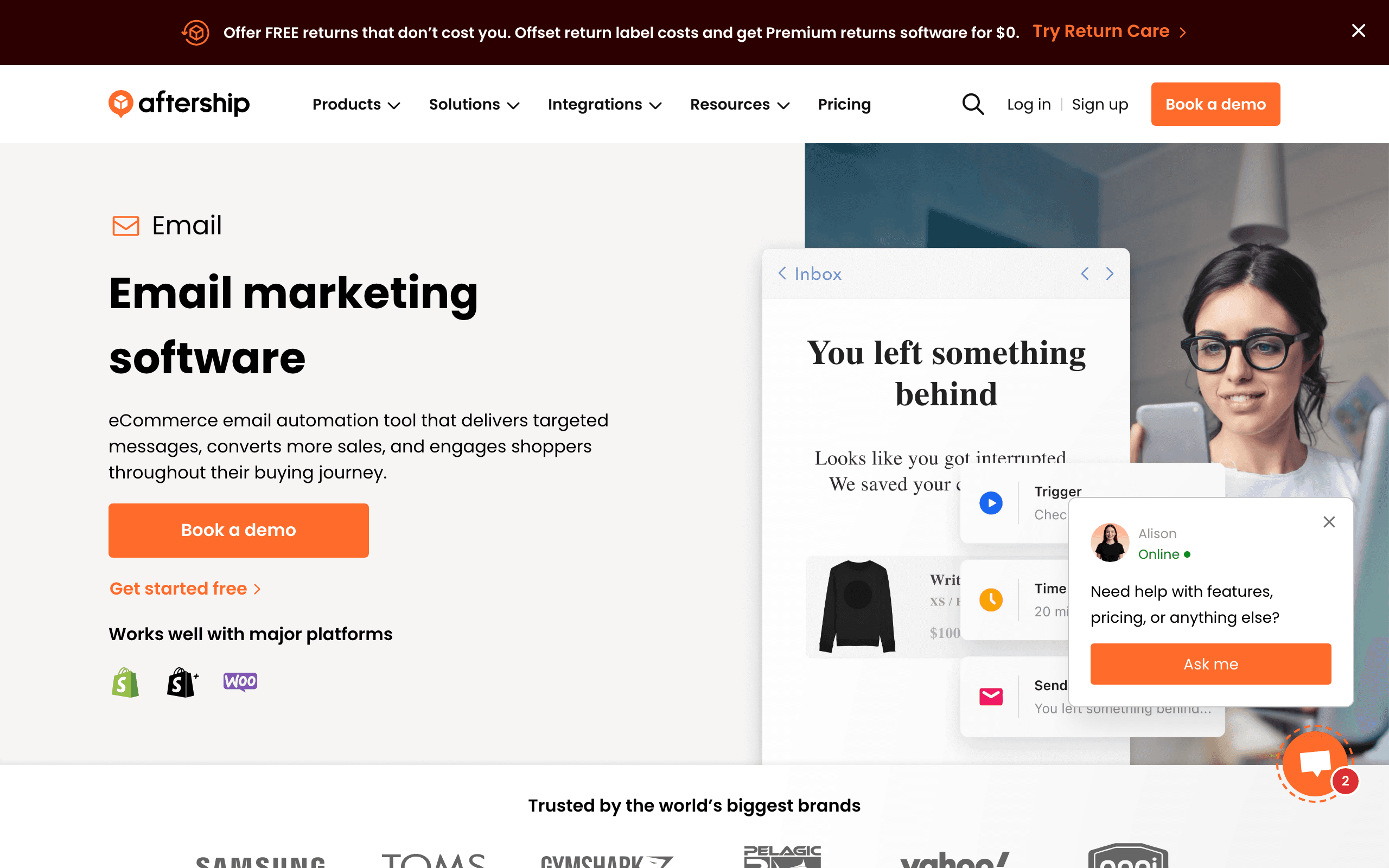
Shopify app workflow or event-driven lifecycle
Automizely and Customer.io can both send lifecycle messages, but they assume different operating models. If Shopify marketing automation, popups, forms, discounts, and basic recovery emails are central to your plan, Automizely deserves a closer look. If lifecycle logic depends on your own events, attributes, user IDs, billing state, subscription status, or product behavior, Customer.io is the more relevant category.
Use-case matchups
| Need | Better fit | Why |
|---|---|---|
| Shopify popups, forms, and basic recovery | Automizely | It maps to a simpler store app workflow. |
| Custom event and attribute-driven journeys | Customer.io | It is built around flexible lifecycle data and event-triggered messaging. |
| Subscription, billing, or product behavior messaging | Customer.io or Sequenzy | Customer.io is deeper for custom data; Sequenzy is simpler when Stripe lifecycle email is enough. |
| Cart recovery and newsletters only | Automizely or Sequenzy | Customer.io may be more setup than the team needs. |
| Transactional email beside marketing email | Sequenzy | That is closer to Sequenzy's combined lifecycle and transactional email use case. |
Best Fit by Data Model and Lifecycle Complexity
Best ecommerce email tool for Shopify popups and carts
Automizely is the better fit when the journey starts with Shopify capture, discount offers, simple forms, cart recovery, and store newsletters. It is most useful when the marketing team wants packaged ecommerce workflows instead of designing a custom event model.
Best lifecycle messaging platform for custom events and attributes
Customer.io is the better fit when lifecycle logic depends on user IDs, account attributes, billing state, product behavior, custom events, and branching journeys. It rewards teams that can define clean events and keep those signals accurate over time.
Best email tool for Stripe lifecycle and transactional messages
Sequenzy is the cleaner fit when the team needs Stripe lifecycle email, transactional messages, newsletters, and simpler Shopify or WooCommerce automation without building a fully custom messaging data model. It is especially relevant when speed and operational simplicity matter more than maximum event flexibility.
Pricing reality
The pricing comparison is directional, not a real quote. Automizely pricing depends on Shopify app plan, contacts, usage, and plan limits. Customer.io pricing depends on plan, contacts, messaging volume, selected features, and how much event/data work the team needs. Compare both vendors against actual contact count, monthly send volume, event volume, SMS usage if any, and the exact journeys you plan to rebuild.
Where Automizely wins
Automizely wins when you will actually use Shopify app simplicity, popups and forms, basic ecommerce automation. It is easiest to justify when those features are tied directly to revenue recovery or repeat purchase campaigns.
Where Customer.io wins
Customer.io wins when the data model is the advantage. It rewards teams that can send clean events and attributes and then use those signals to build precise journeys across email, SMS, push, webhooks, and transactional-style lifecycle messages.
Review signals
Do not stop at star ratings. Existing review themes for Automizely point to Shopify app simplicity, practical ecommerce workflows, and reporting, with cautions around plan limits, setup effort, and support expectations. Existing Customer.io review themes usually focus on campaign workflow, integrations, and day-to-day usability, with cautions that pricing and advanced features should be checked against real usage.
Evaluation checklist
| Question | Better fit | Why |
|---|---|---|
| Do you need Shopify popups, forms, and simple ecommerce flows? | Automizely | It is closer to the app-based store workflow. |
| Do custom events drive the customer journey? | Customer.io | It is built around event-triggered messaging. |
| Do you have engineering support for event tracking? | Customer.io | Clean identifiers and events are required. |
| Is WooCommerce or a custom store part of the setup? | Verify both | Do not assume Shopify-first workflows transfer cleanly. |
| Do Stripe lifecycle and transactional email matter most? | Sequenzy | It can reduce stack stitching for subscription email. |
Migration checklist
Moving between Automizely and Customer.io requires event and identity cleanup:
| Item | What to check |
|---|---|
| Contacts and consent | Export email/SMS consent, unsubscribes, bounces, complaints, and suppressions. |
| Identity | Map email, phone, user ID, anonymous ID, Shopify customer ID, and subscription ID. |
| Events | Document carts, purchases, product views, refunds, signups, billing events, and custom lifecycle events. |
| Popups and forms | Rebuild onsite capture, discounts, embedded forms, and display rules. |
| Journeys | Rebuild welcome, cart, browse, post-purchase, winback, onboarding, and billing flows. |
| Templates | Recreate email, SMS, webhook, and transactional templates with tested merge fields. |
| Reporting | Export popup, campaign, automation, and event-based performance reports. |
| QA | Test event delivery, suppressions, duplicate profiles, and opt-outs before production sends. |
Where Sequenzy fits
Sequenzy is the simpler route when ecommerce email is the job. It is built for Shopify, WooCommerce, Stripe lifecycle email, newsletters, and transactional messages without adding SMS, loyalty, or enterprise personalization you may not use.
Decision checklist
| Choose | When |
|---|---|
| Automizely | You mainly need Shopify capture, popups, forms, discounts, basic recovery, and simpler ecommerce email. |
| Customer.io | You need custom events, attributes, subscription state, product behavior, and flexible lifecycle journeys. |
| Sequenzy | You need simpler Shopify, WooCommerce, Stripe lifecycle, newsletter, and transactional email in one stack. |
| Re-check pricing | Contacts, message volume, data volume, SMS, feature tier, and implementation work can change the real cost materially. |









