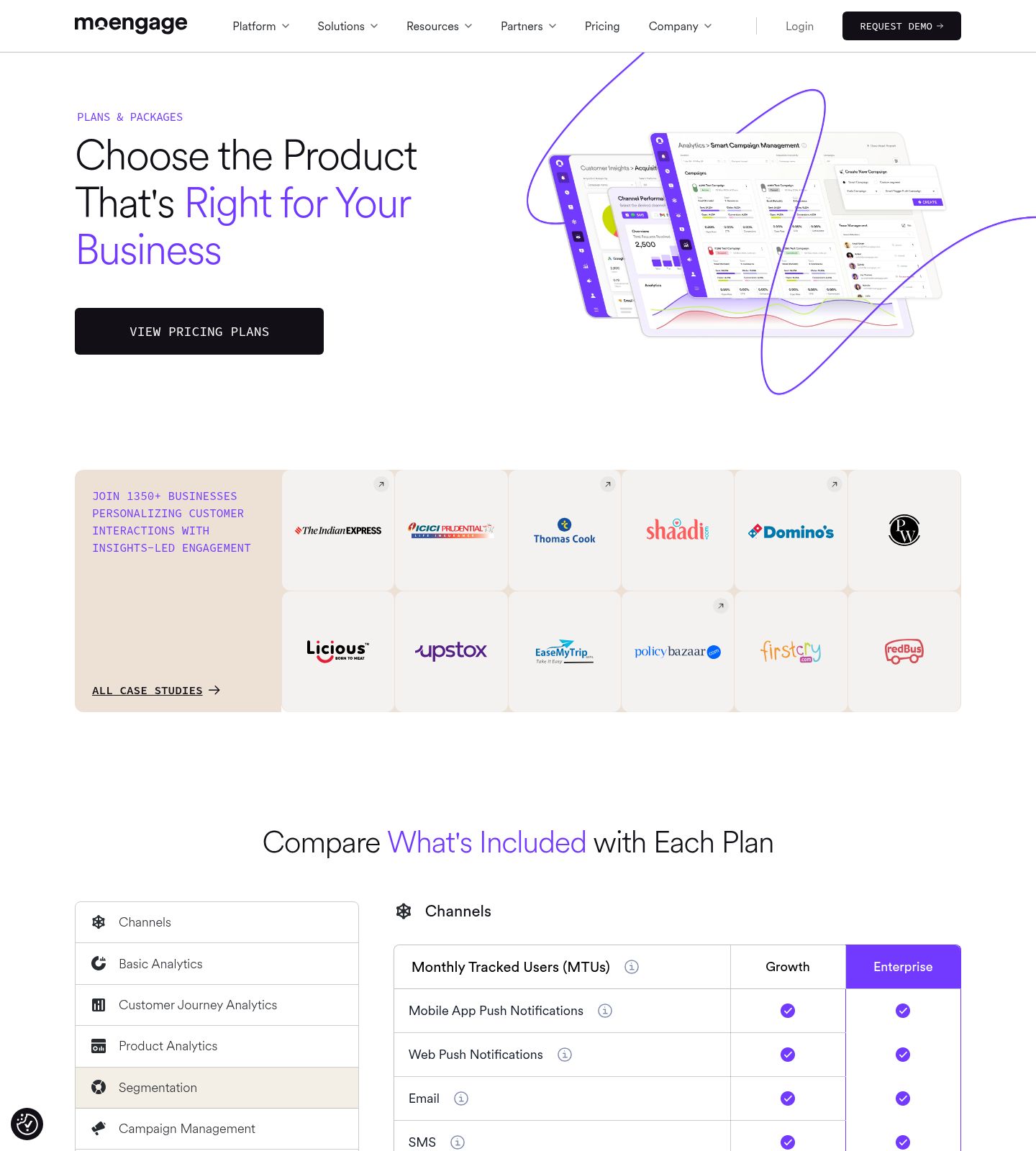
MoEngage's pricing page
Captured from moengage.com. Pricing changes often, so confirm the current numbers on the live page.
Buying shortcut
Which MoEngage plan should you choose?
Start here
Growth
Growing B2C brands that want cross-channel campaigns and flows. It is the first tier to check when you only need the core MoEngage workflow. Watch for: No device or business-event triggers, content blocks, template manager or tag-based frequency capping
Public price
Custom
Quote per MTU, annual contract with a 1-year minimum.
Main upgrade
Enterprise
Larger teams that need AI optimization, governance and catalog features. Inspect this tier when the lower tier starts blocking reporting, automation, collaboration, or support needs. Watch for: Analytics suite, Cards, messengers, Personalize and AI agents still cost extra
Public price
Custom
Quote per MTU, annual contract with a 1-year minimum.
Cost scenarios
Pricing pages show the entry point. These scenarios show what the plan means in real buying situations.
Subscription app with 50,000 monthly active users
MoEngage: Quote-only. Expect an annual contract with a 1-year minimum, plus your SMS provider's fees and any add-ons such as Cards or funnels.. Sequenzy: Push and in-app are unlimited and email is billed by sends. Two emails per user a month is 100,000 sends, which is the $99/mo plan.. For email, push and in-app driven by subscription events, Sequenzy is a fraction of a typical MoEngage contract.
Team that needs funnels and retention analytics
MoEngage: Funnels, retention, user paths and behavior analytics are add-ons on both MoEngage plans.. Sequenzy: Sequenzy has no product analytics, so you would pair it with Amplitude, Mixpanel or PostHog.. Neither includes product analytics by default. Price MoEngage's analytics add-on against a dedicated analytics tool.
Brand that wants WhatsApp, RCS and many channels in one contract
MoEngage: Messengers are a single add-on (WhatsApp, RCS, LINE, Viber and Telegram), with message fees on top.. Sequenzy: Sequenzy covers email, push, in-app and content cards, with SMS as a US and Canada add-on. It has no WhatsApp or RCS.. MoEngage wins when messenger channels are part of the program.
Anonymous users who never sign in
MoEngage: MoEngage tracks anonymous profiles, so you can push to users before they register.. Sequenzy: Every Sequenzy contact needs an email address, so users get push only after they sign in.. MoEngage is the better fit for apps with large logged-out audiences.
What to watch for
No public prices and no self-serve trial. You need a demo and a quote before you know the cost.
Every contract has a minimum one-year commitment, and cancelling early follows the contract's terms.
Funnels, retention, user paths and behavior analytics are add-ons on both plans, not part of the base product.
WhatsApp, RCS, LINE, Viber, Telegram and Cards (the app inbox) are add-ons, and SMS runs through your own provider, which bills you separately.
Vendr reports an average contract of about $187,000 a year, which is high for a team that mainly needs push and email.
How MoEngage pricing works
MoEngage pricing has three parts. You choose an edition (Growth or Enterprise), MoEngage quotes it on your monthly tracked users, and you add modules for anything outside the base plan. There is no slider and no checkout. The pricing page leads to a demo request, and both editions carry a minimum one-year commitment.
MTU counting is fairly generous. A user counts once a month if they open a session or fire a defined event, and anything MoEngage generates, such as sends, deliveries, uninstalls and attribute updates, is excluded. Users you only email but who never open the app may still count as tracked if you send events for them, so ask how your server-side events will be treated before you sign.
What both plans include, and what they do not
Both Growth and Enterprise include the channels most app teams need: mobile and web push, email, SMS, in-app and on-site messages, ad audience sync for Facebook and Google, and webhooks. Flows (MoEngage's journey builder), segmentation, A/B testing, control groups, frequency capping and campaign reporting are in both. Email works through MoEngage's own sending setup, so there is no separate ESP license, while SMS goes through your own provider, such as Twilio, Infobip or Sinch, which bills you directly.
These features are add-ons on both plans, a list that surprises many buyers:
| Area | Add-on |
|---|---|
| Analytics | Funnels, retention, user paths, behavior analytics, custom and workspace dashboards |
| Channels | Cards (app inbox), WhatsApp, RCS, LINE, Viber, Telegram |
| Personalization | MoEngage Personalize (web and app experiences, recommendations) |
| Data | Warehouse segments, connected segments, computed traits, streams |
| AI | Predictions, Merlin AI agents, offer and campaign decisioning, AI recommendations |
| Other | Landing pages, MoEngage Inform (transactional API with channel fallback) |
If your team relies on funnels and retention charts, price that module explicitly. Without it, MoEngage's built-in analytics stop at key metrics, acquisition and uninstall tracking.
Growth or Enterprise?
Growth covers broadcast, event-triggered and location-triggered campaigns with flows and standard segmentation. Enterprise adds device and business-event triggers, content blocks and a template manager, plus MoEngage's AI optimization: best time to send, most preferred channel, next best action and the intelligent path optimizer. Enterprise also includes governance tools that Growth sells separately, such as access roles, teams, approval workflows and PII encryption. In June 2026 MoEngage bought Aampe, which runs a per-user AI agent for each customer, so expect AI decisioning to become a larger part of Enterprise quotes.
What MoEngage contracts cost in practice
Vendr's data puts the average MoEngage contract around $187,000 a year, with annual payment upfront by default and monthly installments only on negotiation. Vendr says MoEngage's fiscal year ends on March 31, and suggests March and September as the best months to negotiate. Quotes from competitors such as CleverTap, Braze or Airship are your strongest leverage. CleverTap is the only one of these to publish prices.
For a broader shortlist, our MoEngage alternatives guide compares options for app teams, from free push tools to enterprise suites.
MoEngage vs Sequenzy on cost
MoEngage bills every tracked user on an annual contract. Sequenzy bills for emails sent and includes web push, iOS and Android push, in-app messages and content cards on every plan, monthly, with no demo. A subscription app with 50,000 monthly users sending two lifecycle emails per user a month needs 100,000 sends, which is the $99/mo plan. Sequenzy also connects natively to RevenueCat, Superwall and Adapty, while MoEngage relies on webhook connectors it built itself. RevenueCat's own integration list does not include MoEngage.
The trade-offs are real. Sequenzy has no WhatsApp, RCS or product analytics, and every contact needs an email address, so anonymous users who never sign in get no push. If those matter, MoEngage is the stronger product. For the full feature breakdown, see Sequenzy vs MoEngage.
MoEngage vs Sequenzy
How MoEngage compares with Sequenzy, which bills on emails sent rather than contact count.
How Sequenzy prices the same volume
Sequenzy price per 1k emails
$0.82 / 1k at $49/mo for 60k emails
Verdict
MoEngage is a capable cross-channel platform, and unlike CleverTap it includes managed email sending in both plans instead of selling it as an add-on. You pay for that breadth with no price transparency, a one-year minimum, analytics and messengers sold as add-ons, and an average contract Vendr puts around $187,000 a year. Teams that need email, push and in-app driven by subscription events can get there with Sequenzy for a published, send-based price.
FAQ
Sources checked · Nov 8, 2026
Written by Nic Polotnianko, co-founder of Sequenzy, which appears in this comparison. How we compare tools