
11 Best Omnisend Alternatives in 2026

Omnisend occupies an awkward position in the alternatives conversation. It is not the leader, so nobody defends it reflexively, and it is not weak, so most reasons for leaving are situational rather than damning.
In practice, stores leave for three specific reasons, and each has a different answer. Some hit a ceiling: the segments they want to build cannot be expressed, and the reporting cannot answer the question they are asking. Some hit a bill: contact-based pricing keeps climbing as dormant subscribers pile up. And some hit a gate: SMS sits behind the Pro plan on current pricing, which is an awkward upgrade for a store that wanted a few thousand texts a month.
None of those are "Omnisend is bad." They are all "Omnisend is the wrong shape for this store now." That distinction matters because a migration that swaps one contact-billed commerce platform for another achieves nothing.
This comparison is organized by the constraint you are trying to remove. I have also been direct about when staying is correct, because under about 10,000 contacts Omnisend is genuinely close to the best value available.
For a broader view, see the best email and SMS marketing platforms. If Klaviyo is the platform you are leaving instead, see Klaviyo alternatives.
Quick comparison table
| Alternative | Removes which constraint | Billing model | Cost at 10k contacts | SMS included |
|---|---|---|---|---|
| Klaviyo | Segmentation and data ceiling | Active profiles | About $150/mo email | Bundled plans from about $35/mo |
| Brevo | Contact-based billing | Sends, unlimited contacts | Tier depends on volume | Credits, priced per country |
| Sendlane | Contact billing, keeps depth | Sends, unlimited contacts | $100/mo for 50k sends | From about $0.009 per credit |
| Sequenzy | Contact billing, lifecycle focus | Sends | Paid plans from $19/mo | Add-on from $16/mo, no plan gate |
| MailerLite | Cost, for a simple program | Subscribers | Low | Limited |
| Shopify Email | Cost, for a simple Shopify store | Per email after allowance | Free under 10k emails | Via Shopify Messaging |
| Drip | Feature gating by tier | Contacts | About $154/mo | Not an SMS choice |
| ActiveCampaign | Automation expressiveness | Contacts | Varies by tier | Via connected provider |
| Postscript | SMS plan gate and depth | Per message | $0.007 to $0.009 plus carrier fees | SMS only |
| Mailchimp | Familiarity and templates | Contacts | Mid | Varies by region |
| Attentive | SMS became a department | Custom, committed | Custom | SMS-led, plus email |
Pricing changes frequently. Confirm current rates, plan gates, and SMS terms before committing.
Name the constraint first
Constraint 1: the segmentation ceiling
You want "customers who bought the starter kit, viewed the refill twice, have not purchased in 70 days, and have opened at least two of the last five emails." Omnisend can get close. It cannot get there with the same precision, and it has nothing resembling predicted lifetime value or churn risk.
The answer is Klaviyo. It is the only platform in this comparison that clearly beats Omnisend on data depth, and it is not close. Expect to pay roughly 20 to 30 percent more at 10,000 contacts.
Before migrating, check whether the segments you cannot build are ones you would actually use. Most stores that hit this ceiling want two or three specific audiences, not forty.
Constraint 2: contact-based billing
Omnisend bills by contacts. At 10,000 that is roughly $115 to $132 per month. At 40,000, most of whom have not opened anything in a year, it is considerably more for the same program.
The answer is a send-based platform: Brevo, Sendlane, or Sequenzy. All three charge for messages sent rather than contacts stored.
Before migrating, try hygiene. Sunsetting genuinely dead contacts often cuts the bill enough to make the migration unnecessary, and it improves deliverability at the same time.
Constraint 3: SMS is gated to Pro
On current pricing, SMS requires the Pro plan. For a store wanting 2,000 texts a month, that upgrade can cost more than the messages.
The answers are: Klaviyo, which bundles credits into email plus SMS plans from about $35 per month; Sequenzy, which sells SMS as a $16 per month add-on on any paid plan; Brevo, which sells SMS credits independently of the email tier; or Postscript, which has no email plan to gate.
Constraint 4: cost, for a genuinely simple program
If your program is a welcome email, a cart reminder, and a monthly campaign, you are paying a commerce platform price for a newsletter job.
The answers are MailerLite at about $12 per month or Shopify Email, which is free for the first 10,000 emails a month on eligible Shopify plans.
Constraint 5: none, you are just browsing
Then stay. Under 10,000 contacts with a prebuilt-automation program, Omnisend is close to the best value in this category, and three channels on one canvas is a real advantage that most alternatives do not match at that price.
How I evaluated these alternatives
- Rebuilt the same welcome, abandoned checkout, browse abandonment, and post-purchase automations on each platform.
- Attempted to reproduce three Omnisend segments and three segments Omnisend cannot express.
- Exported from Omnisend and imported into each platform, noting what was lost.
- Priced every option at 5,000, 10,000, 25,000, and 50,000 contacts with a realistic send volume.
- Checked which platforms required a tier upgrade before SMS was available.
- Tested the store integration with an order, a refund, and an abandoned checkout on both Shopify and WooCommerce.
- Compared attribution windows and reported revenue against actual store orders.
The 11 best Omnisend alternatives
1. Klaviyo
Best for: Stores that hit the segmentation ceiling and have data worth exploiting.
Pricing: Email from about $20/month at 251 to 500 active profiles, rising to roughly $150/month at 10,000. Email and SMS plans start around $35/month including 1,250 SMS or MMS credits.
Klaviyo is the only unambiguous upgrade on this list. Its commerce data model is the deepest available: orders, products, browse behavior, predicted lifetime value, and churn risk all feed segmentation, and the flow library encodes far more accumulated practice than Omnisend's templates.
Two specific things you gain that Omnisend cannot match: browse abandonment with real event fidelity on Shopify, and predictive fields that make VIP and win-back segments genuinely behavioral rather than rule-based.
It is more expensive, harder to learn, and easy to over-buy. Active-profile billing has the same shape problem as Omnisend's contact billing, so it does not solve a cost constraint. And on WooCommerce the integration advantage largely disappears.
- Pros: Deepest segmentation and predictive data, best flow library, strongest Shopify event fidelity, flow-level attribution, bundled SMS credits.
- Cons: Roughly 20 to 30 percent more at 10k contacts, real learning curve, still profile-based billing, WooCommerce advantage is small.
Verdict: The right upgrade when depth is the constraint. The wrong move when cost is.
2. Brevo
Best for: Large lists mailed infrequently, plus transactional email in the same account.
Pricing: Free plan with a daily send allowance, then Starter from around $9/month for 5,000 emails, with unlimited contacts. SMS is credit-based and priced per destination country.
Brevo removes the contact-billing constraint more completely than anything else here. Unlimited contacts mean the database costs nothing to hold, and you pay only for what you send.
Two extras matter for stores leaving Omnisend: transactional email lives in the same account, which Omnisend does not really cover, and SMS credits are sold independently of the email tier, so there is no Pro-plan gate.
The cost is capability. Commerce automation is noticeably thinner than Omnisend's, the prebuilt workflow library is weaker, reporting is basic, and there is nothing like a product picker driving catalog emails. This is a downgrade in everything except billing shape and breadth.
- Pros: Unlimited contacts, send-based pricing, transactional email included, SMS with no plan gate, broad international SMS.
- Cons: Shallower commerce automation than Omnisend, weaker prebuilt flows, basic reporting, SMS pricing varies sharply by country.
Verdict: The biggest billing win, with a real capability cost. Correct for simple programs on big lists.
3. Sendlane
Best for: Stores that want to escape contact billing without losing commerce depth.
Pricing: Professional from $100/month for 50,000 email sends with unlimited contacts. SMS from about $0.009 per credit, subject to destination rates.
Sendlane is the answer for a store facing the billing constraint that is not willing to accept Brevo's capability drop. Unlimited contacts on send-based pricing, with commerce depth that is competitive with Omnisend and in some areas better.
Behavior-based automation, segmentation, and revenue attribution are built for stores rather than adapted, and email and SMS share profiles and segments properly with no plan gate on SMS.
The $100 floor makes it a worse deal than Omnisend below roughly 8,000 contacts, and the ecosystem is smaller, so fewer agencies and freelancers know it well.
- Pros: Unlimited contacts on send-based pricing, commerce depth at least matching Omnisend, no SMS plan gate, strong multi-store support.
- Cons: $100/month floor, worse value at small list sizes, smaller ecosystem, regional SMS needs verification.
Verdict: The best of both constraints, provided you are past the $100 threshold.
4. Sequenzy
Best for: Lifecycle-led stores that want send-based pricing and SMS without a plan gate.
Pricing: Paid plans from $19/month with send-based email pricing, plus an SMS add-on from $16/month including 1,000 credits on any paid plan.
Disclosure: I build Sequenzy. Against Omnisend specifically, the honest comparison is that Omnisend has a broader prebuilt commerce workflow library and a more mature multichannel canvas including push, which Sequenzy does not offer.
Where it removes constraints is billing and the SMS gate. Send-based pricing means a large dormant list costs nothing to hold, and the SMS add-on works on any paid plan rather than requiring a tier upgrade. Catalog sync and dynamic product blocks cover product-driven emails, and Shopify plus Stripe both connect natively, which is useful for stores selling physical product alongside subscriptions.
Two other differences worth naming: transactional and marketing email live in the same platform, and the whole product is available through a full API, CLI, and MCP server. On the SMS side, a dedicated toll-free number is provisioned and verified for you, consent stays separate from email status, and quiet hours are enforced. Limits: WooCommerce sync is beta, there is no push channel, no in-app two-way SMS inbox, and no predictive analytics.
- Pros: Send-based pricing, SMS add-on with no plan gate, transactional plus marketing in one platform, Shopify and Stripe together, strong API, CLI, and MCP.
- Cons: No push channel, smaller prebuilt workflow library than Omnisend, WooCommerce sync is beta, no two-way SMS inbox.
Verdict: Removes the billing and SMS-gate constraints. Not an upgrade on multichannel breadth.
5. MailerLite
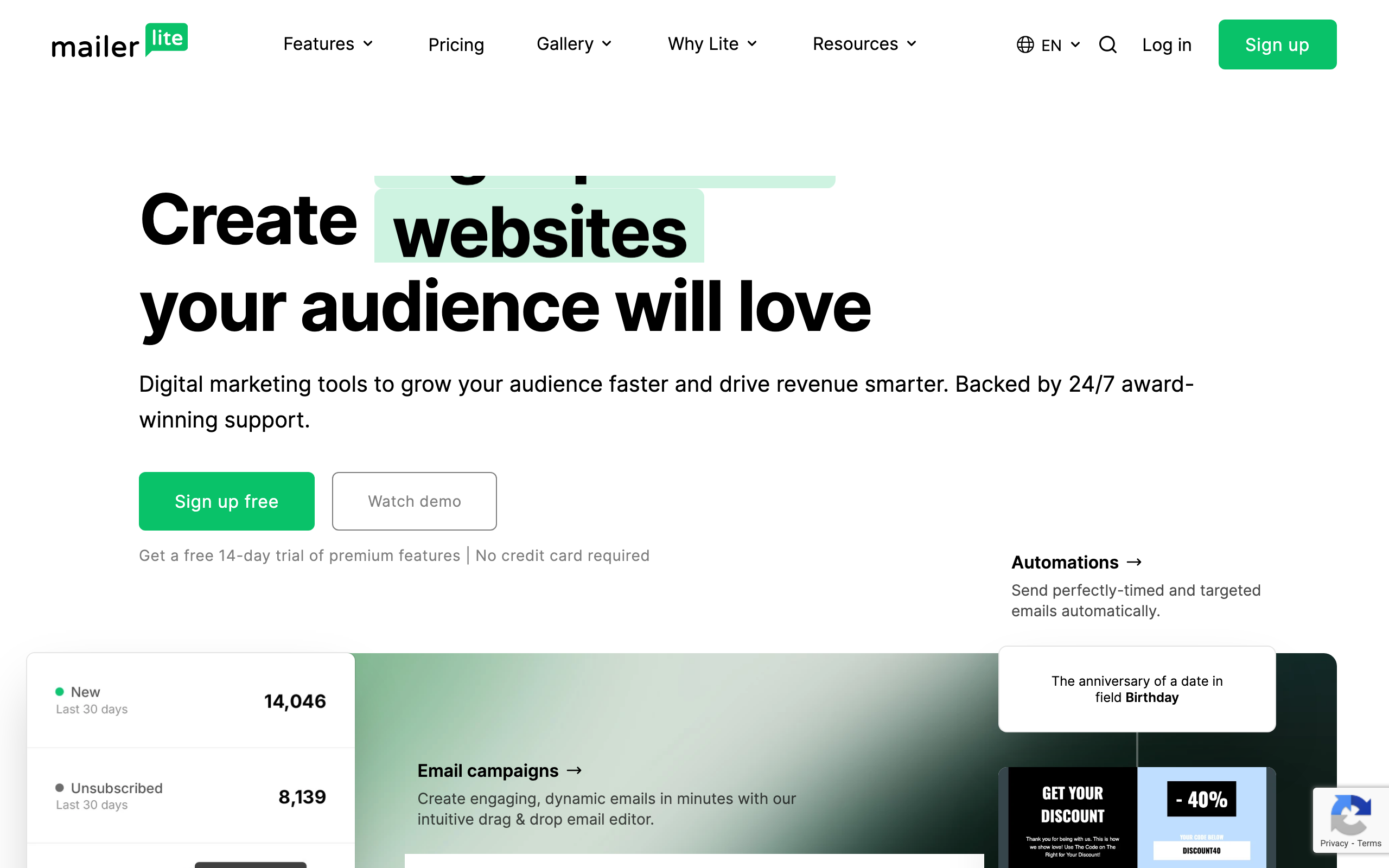
Best for: Small stores where Omnisend was always more platform than needed.
Pricing: Free up to 250 subscribers and 2,500 monthly emails, with Comfort from about $12/month.
MailerLite is the honest floor for a store with a small list and a simple program. The editor is genuinely nicer than most commerce platforms, landing pages and forms are included, and basic automations handle a welcome series and simple follow-ups.
For a store with 2,000 subscribers sending two campaigns a month, this is sufficient and the cost difference is the whole point.
The e-commerce integration is basic and SMS is limited. You will lose the prebuilt cart and browse automations, the product picker, and the multichannel canvas. Do not choose it if those are doing work.
- Pros: Very low cost, best-in-class editor for the price, landing pages and forms included, generous free tier.
- Cons: Basic commerce integration, no meaningful SMS, loses prebuilt cart and browse flows, shallow segmentation.
Verdict: Right when the program is genuinely simple and the list is genuinely small.
6. Shopify Email
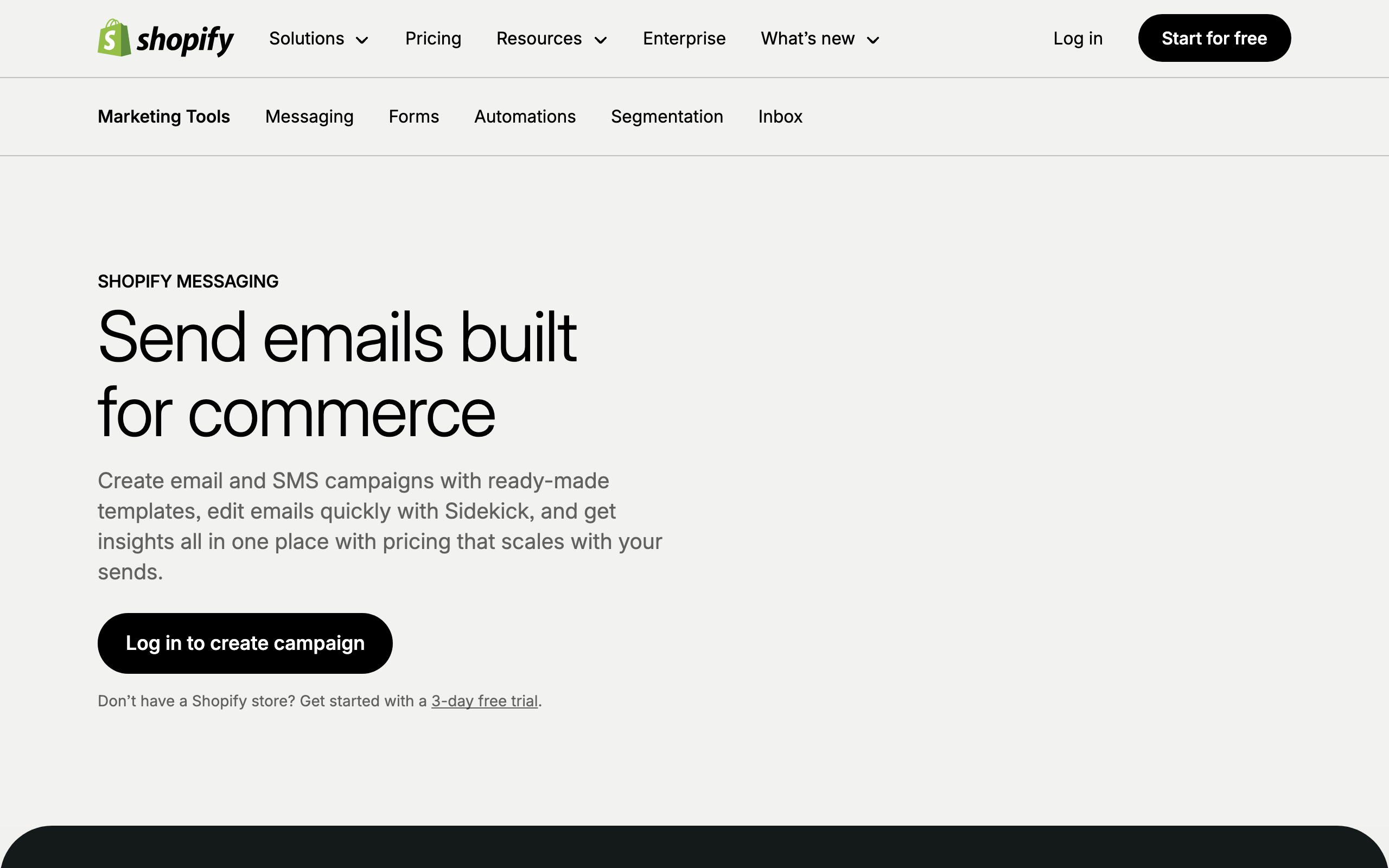
Best for: Shopify stores under 10,000 monthly emails with a campaign-led program.
Pricing: Included with eligible Shopify plans, with the first 10,000 marketing emails each month at no charge and additional volume billed per Shopify's current rules.
If your Omnisend account is mostly campaigns and one lightly tuned cart flow, Shopify Email can eliminate the line item entirely. No integration, no second login, native catalog and customer data.
Paired with Shopify Messaging at $2.15 per month per toll-free number, a Shopify store can run basic email and SMS for close to nothing.
The ceiling is much lower than Omnisend's: basic segmentation, narrow automation, no browse behavior, no multichannel canvas, and no meaningful attribution. Shopify's own abandoned-checkout messaging is not equivalent to a tuned three-message recovery flow.
- Pros: No platform bill under 10k emails, zero integration risk, native store data, pairs with Shopify Messaging for cheap SMS.
- Cons: Shopify only, minimal automation and segmentation, no attribution worth the name, low ceiling.
Verdict: The cheapest honest answer for a simple Shopify program.
7. Drip
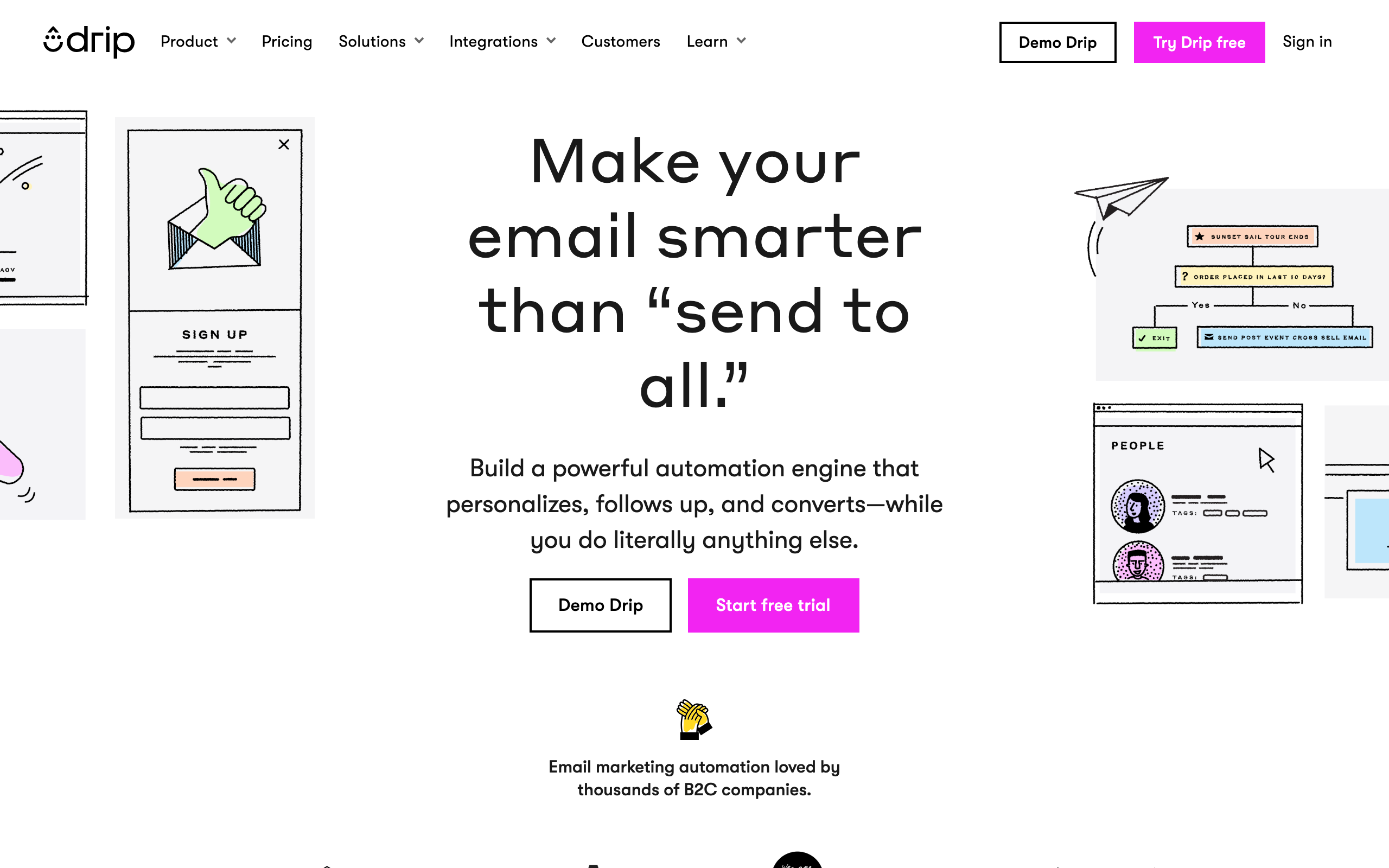
Best for: Stores frustrated by feature gating who want everything on one plan.
Pricing: From about $39/month at 2,500 contacts, rising to roughly $154/month at 10,000 contacts, with all features included at every tier.
Drip's distinguishing quality against Omnisend is that nothing is gated. Every automation capability, every segmentation option, and every reporting view is available on the entry plan. For a store that resents upgrading to unlock a feature, that is genuinely appealing.
The visual workflow builder is more expressive than Omnisend's, and revenue reporting answers which flow made money.
It is not cheaper at 10,000 contacts, it is contact-billed so it does not solve that constraint, and it is email-first with no real SMS story. Verify the current SMS path for your market before selecting it for a text program.
- Pros: All features on every plan, more expressive workflows than Omnisend, good revenue attribution, e-commerce oriented.
- Cons: Not cheaper at 10k contacts, still contact-based billing, no SMS focus, no free tier.
Verdict: Choose it for the flat feature access, not for cost or channels.
8. ActiveCampaign
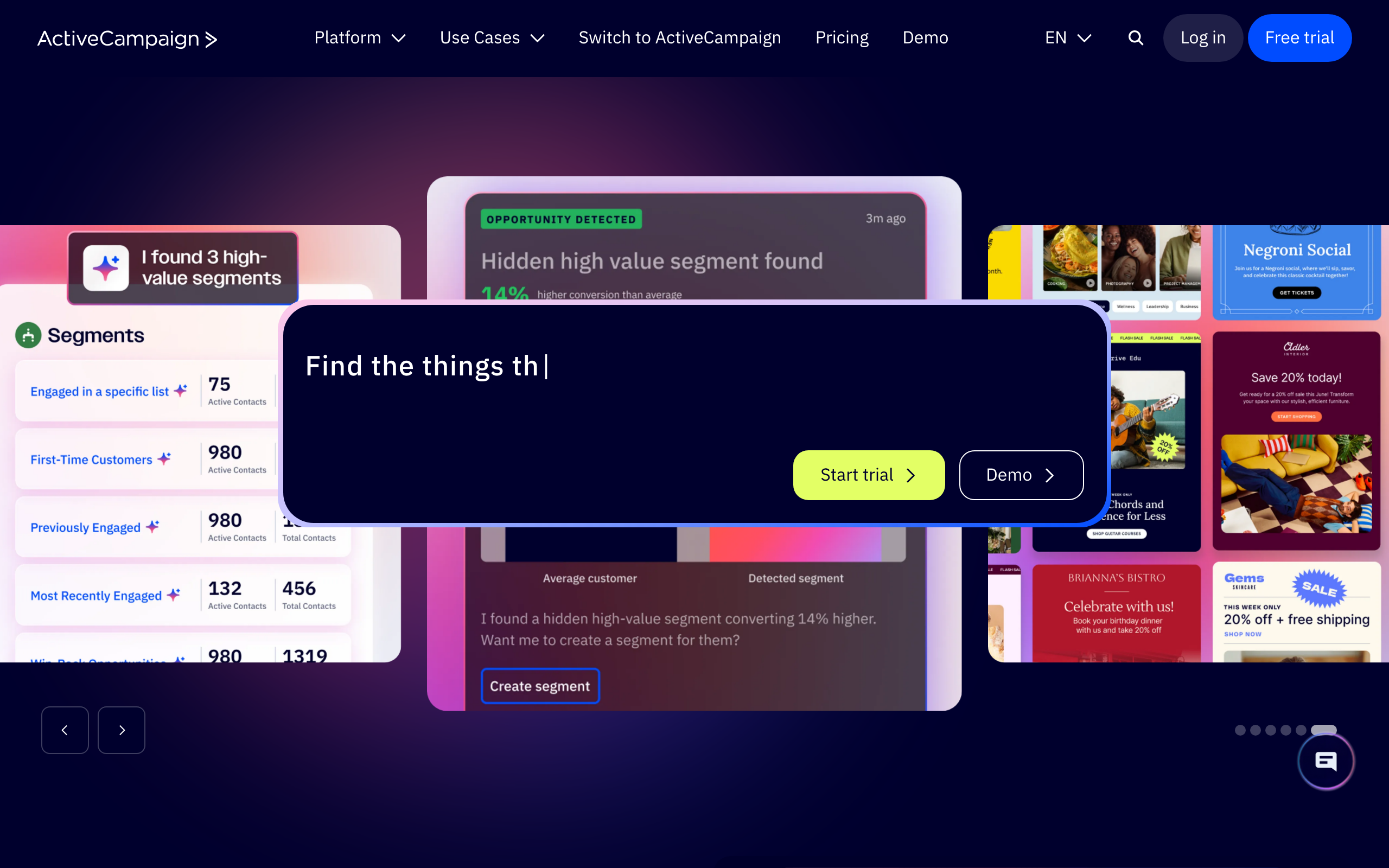
Best for: Stores whose constraint is automation expressiveness rather than commerce data.
Pricing: Starter from about $15/month at 1,000 contacts on annual billing, with automation, CRM, and advanced features gated by tier.
ActiveCampaign has the most capable automation builder in this comparison. Conditions, goals, scoring, waits, and CRM tasks let you model journeys that Omnisend cannot express, which matters for stores with wholesale accounts, B2B lines, or a sales-assisted motion.
Its Deep Data integrations bring order and product information into that builder.
It is not commerce-first. You build more from scratch than in Omnisend, the product merchandising is weaker, SMS is not a native specialty, and useful features sit behind higher tiers, which is the same gating complaint that drives some stores away from Omnisend.
- Pros: Best conditional automation here, CRM and sales workflows, works beyond commerce, enormous integration list.
- Cons: Not commerce-first, features gated by tier, weaker merchandising, SMS is not native, contact billing climbs.
Verdict: Right only when journey logic, not commerce data, is the limit.
9. Postscript
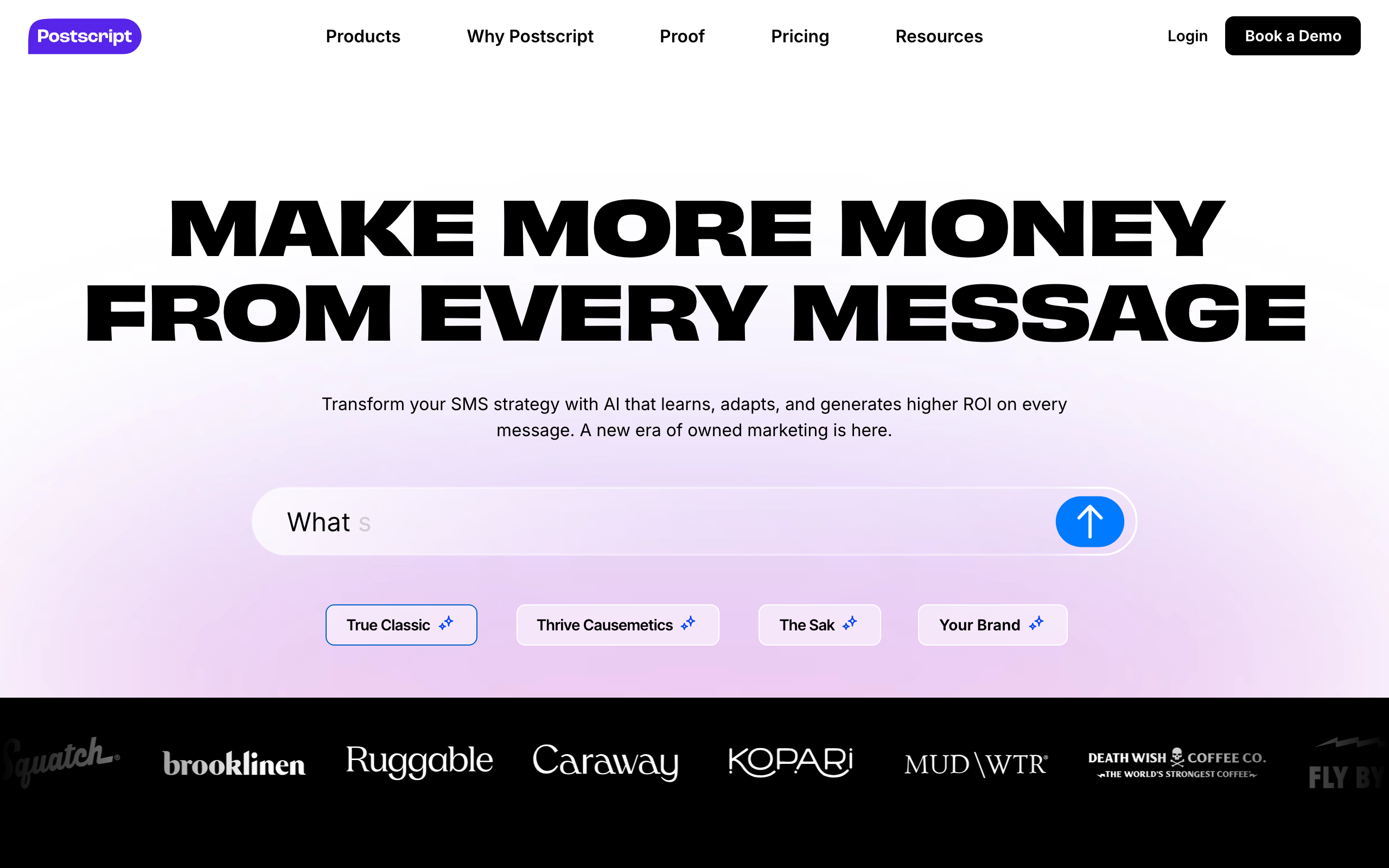
Best for: Stores whose Omnisend complaint is specifically about SMS.
Pricing: Starter $0/month with a $49 minimum monthly spend at about $0.009/SMS. Growth $100/month at about $0.008. Professional $500/month at about $0.007. Average US carrier fees of about $0.00418/SMS are billed separately.
If your issue is that Omnisend gates SMS behind Pro and its reply handling is thin, Postscript solves both. There is no email plan to upgrade, the rates are published, and reply management is a genuine workflow.
Shopify-native flows branch on product, order frequency, and lifetime value, which is more than Omnisend's SMS steps can do.
The catch is that this is not an Omnisend replacement, it is an addition. You will still need an email platform, so you are moving from one bill to two, and the $49 minimum spend wastes money below roughly 5,000 messages a month.
- Pros: No email plan gate on SMS, published transparent rates, deep Shopify SMS flows, real reply management.
- Cons: Not an email platform, adds a second bill, minimum spend at low volume, Shopify-centric.
Verdict: Fixes the SMS constraint by adding a platform rather than replacing one.
10. Mailchimp
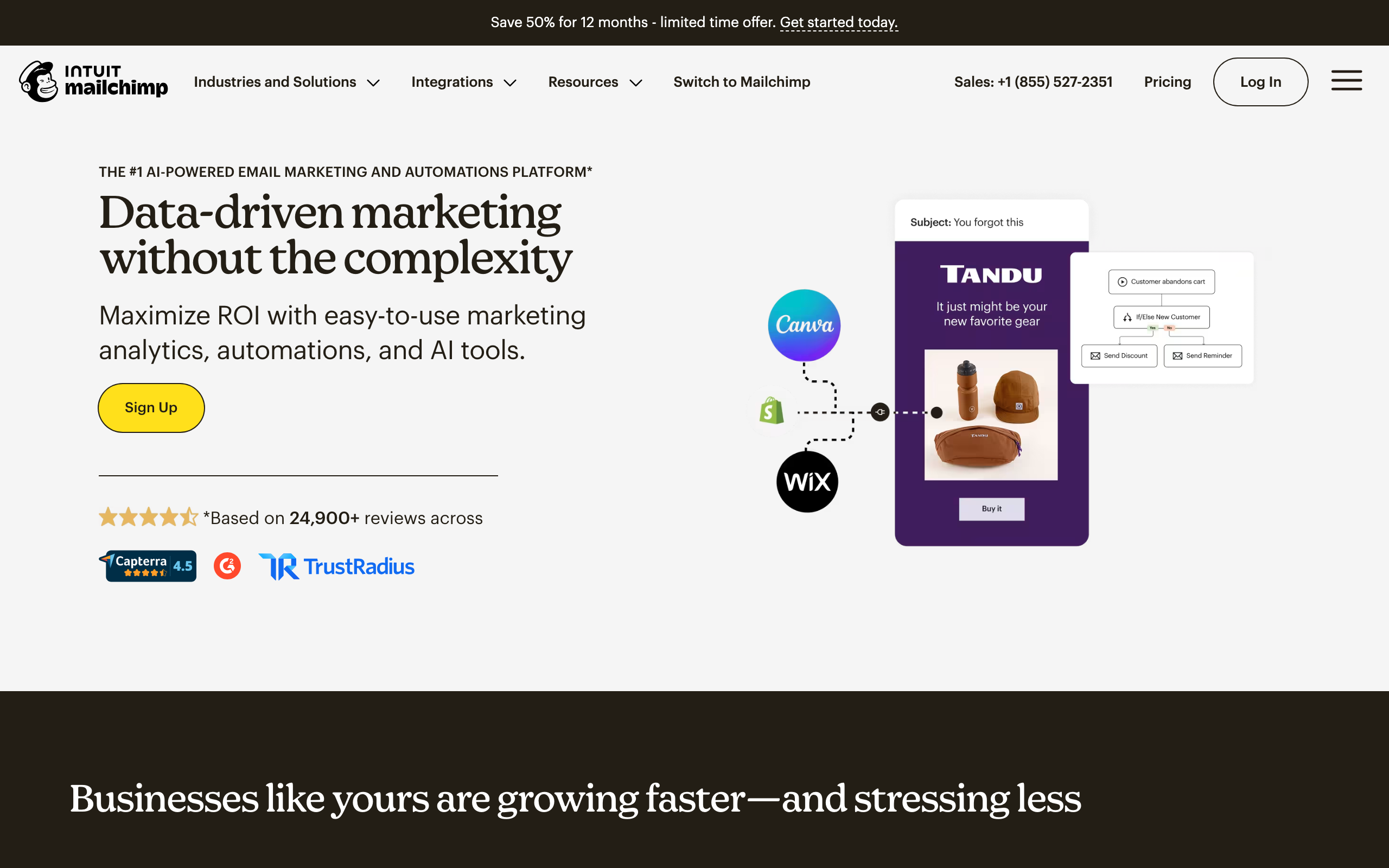
Best for: Teams that want familiarity, templates, and a wider marketing surface.
Pricing: Free tier for small lists, then paid marketing plans from about $13/month, billed by contacts.
Mailchimp is chosen for non-technical reasons: a freelancer already knows it, the template library is the best available, and it covers landing pages, forms, and ads beyond email.
Its Shopify and WooCommerce connectors sync customers and orders well enough for basic segmentation and campaigns.
Against Omnisend specifically this is a downgrade in commerce capability. Cart, browse, product, and revenue workflows are all less central, contact billing climbs at least as fast, and SMS is not dependable globally. It solves none of the three main Omnisend constraints.
- Pros: Familiar to almost everyone, best template ecosystem, broad marketing surface, easy to hire for.
- Cons: Weaker commerce automation than Omnisend, contact billing still climbs, SMS varies by region, solves no stated constraint.
Verdict: A comfort choice rather than a technical one.
11. Attentive
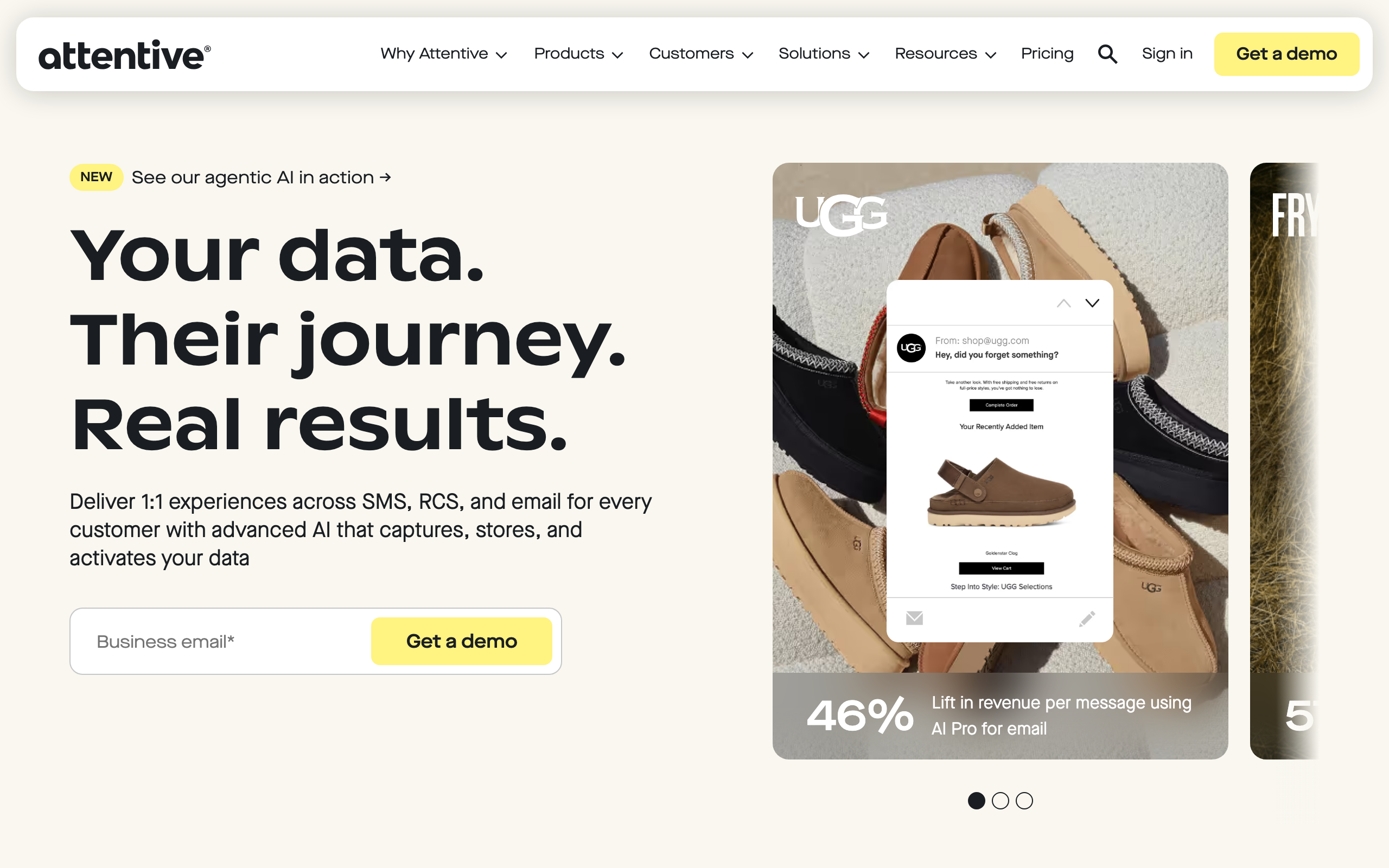
Best for: Stores where SMS grew into a department while on Omnisend.
Pricing: Custom and consumption-based. Reported minimums commonly sit around $2,000 to $3,000 per quarter, with roughly $0.01 per SMS and volume commitments often starting near 50,000 messages a month.
This is the upward exit. If your Omnisend SMS program grew large enough that capture units, RCS, and conversational commerce would move the number, Attentive is the platform that has them.
The signup units alone often justify the move for brands where subscriber growth is the limiting factor, and the strategic support meaningfully offsets internal work.
It is enormously more expensive, sales-led, and contract-based. Below roughly $5M in revenue it is very hard to justify, and it does not replace Omnisend's low-cost multichannel simplicity.
- Pros: Best-in-class capture, RCS and conversational commerce, cross-channel journeys, strategic support included.
- Cons: Enterprise minimums and commitments, no published pricing, never a saving, excessive for most Omnisend users.
Verdict: Only relevant if SMS became the main channel and has real volume.
Cost at every list size
Email plans only, before SMS.
| Contacts | Omnisend | Klaviyo | Brevo | Sendlane | MailerLite | Shopify Email |
|---|---|---|---|---|---|---|
| 1,000 | About $16/mo | Free or about $20/mo | Free to about $9/mo | $100/mo floor | About $12/mo | Free under 10k emails |
| 5,000 | Roughly $50 to $65/mo | Roughly $70 to $100/mo | Tier by send volume | $100/mo for 50k sends | Low tier | Free under 10k emails |
| 10,000 | About $115 to $132/mo | About $150/mo | Tier by send volume | $100/mo for 50k sends | Mid tier | Per email after 10k |
| 25,000 | Climbs | Climbs steeply | Send-volume tier | Higher send tier | Higher tier | Per email after 10k |
| 50,000, mostly dormant | Full contact count billed | Full profile count billed | Unlimited contacts | Unlimited contacts | Full subscriber count | Per email after 10k |
The crossover to watch: Sendlane's $100 floor beats Omnisend somewhere around 8,000 to 10,000 contacts and the gap widens fast if your list is dormant. Below that, Omnisend is better value and there is no cost reason to move.
Note that Omnisend and Klaviyo have the same billing shape. Migrating between them never solves a cost problem; it only changes what you get for the money.
Migrating off Omnisend
This is one of the easier migrations in the category, because Omnisend programs tend to be simpler than the platform allows.
1. Inventory what is actually running. List every active automation with its attributed revenue. Most stores find two or three flows produce almost everything and the rest can be abandoned rather than rebuilt.
2. Export contacts with consent state. Email consent, SMS consent separately, source, and timestamp. Do not let the two channels' consent collapse into one field during export.
3. Export the suppression list separately. Unsubscribes, bounces, and complaints.
4. Export reporting history. Campaign and automation performance does not migrate. Pull at least 12 months before you cancel.
5. Import suppressions before contacts. Always, in every migration. This is the error that mails someone who unsubscribed two years ago.
6. Rebuild the top flows only. Welcome, abandoned checkout, and post-purchase first, left switched off.
7. Verify the store integration. Place an order, a refund, and an abandoned checkout, and confirm each event arrives correctly. Refund suppression is the test most people skip.
8. Run in parallel for two weeks. New welcome flow on, Omnisend equivalent off, everything else unchanged. Compare before moving anything else.
9. Cancel last. One extra month of overlap is cheaper than one broken cart flow.
Frequently asked questions
What is the best Omnisend alternative?
Klaviyo is the best upgrade if you hit a segmentation or data ceiling, because its commerce data model and flow library are deeper than anything else in the category. Brevo and Sendlane are better if contact-based billing on a large dormant list is the problem, since both price by send volume with unlimited contacts. MailerLite and Shopify Email are the honest answers if you simply want to spend less on a simple program.
Why do stores leave Omnisend?
Three reasons dominate. Segmentation and reporting hit a ceiling once the store's data gets interesting. Contact-based billing keeps climbing as dormant subscribers accumulate. And SMS sits behind the Pro plan on current pricing, which forces an upgrade for stores that only wanted a few thousand texts a month.
Is Klaviyo worth upgrading to from Omnisend?
It is worth it when segmentation genuinely changes what you send. Predictive lifetime value, churn risk, browse behavior, and layered conditions let you build audiences Omnisend cannot express. If your program is a welcome series, a cart flow, and a weekly campaign, you will pay roughly 20 to 30 percent more at 10,000 contacts for depth you will not use.
Which Omnisend alternative is cheapest?
Shopify Email is cheapest for a Shopify store under 10,000 monthly emails, because Shopify includes that allowance. Below that, MailerLite from about $12 per month and Brevo from about $9 per month for 5,000 emails are the lowest real costs. Brevo is the strongest option specifically when you have a large list you rarely message.
Does any alternative include SMS without a plan upgrade?
Klaviyo bundles SMS credits into its email plus SMS plans from about $35 per month. Sequenzy sells SMS as a $16 per month add-on with 1,000 credits on any paid plan. Brevo sells SMS credits independently of the email tier. Postscript has no email plan gate at all because it is SMS-only, though it carries a $49 minimum monthly spend on its entry tier.
How hard is it to migrate off Omnisend?
Easier than most migrations, because Omnisend programs are usually simpler. Contacts and suppression lists export cleanly, and the prebuilt automations map onto equivalents elsewhere without much translation. Budget one to three weeks, import suppressions before contacts, and rebuild your two highest-revenue flows first.
Is Klaviyo's Shopify integration really better?
Yes, meaningfully. Klaviyo captures more events with higher fidelity, including browse behavior and richer catalog data, and its predictive fields have no equivalent in Omnisend. On WooCommerce the gap narrows sharply and Omnisend's plugin is arguably better maintained, so the advantage is Shopify-specific.
When should I stay with Omnisend?
Stay when your list is under roughly 10,000 contacts, your program runs on prebuilt commerce automations, and you value one canvas for email, SMS, and push. At that size Omnisend is close to the best value in the category, and migrating for depth you will not use costs more in team time than it saves in subscription.
Final recommendation
- Segmentation ceiling: Klaviyo. The only genuine upgrade, and worth it only if you will use the depth.
- Contact billing on a large dormant list: Sendlane if you want to keep commerce depth, Brevo if you will trade it for the biggest saving, Sequenzy if your program is lifecycle sequences.
- SMS gated behind Pro: Klaviyo's bundled plans, Sequenzy's add-on, or Brevo's independent credits. Postscript if SMS depth is also the issue.
- Simple program, small list: MailerLite, or Shopify Email if you are on Shopify.
- Feature gating frustration: Drip, where everything is on every plan.
- Journey logic is the limit: ActiveCampaign.
- SMS became the main channel: Attentive, at real scale only.
- No clear constraint: stay, run list hygiene, and spend the saved effort on capture.
Omnisend loses customers mostly to its own billing shape rather than to its features. Before you migrate, sunset your dead contacts and re-price. A surprising number of stores find the constraint disappears.
Related resources
- Best Klaviyo alternatives - if you are considering the upgrade in reverse
- Best email and SMS marketing platforms - the wider category
- Omnisend pricing explained - how the bill is built
- Omnisend alternatives - the wider alternatives page
- Best email marketing platforms for e-commerce - email-only comparison