
Overview
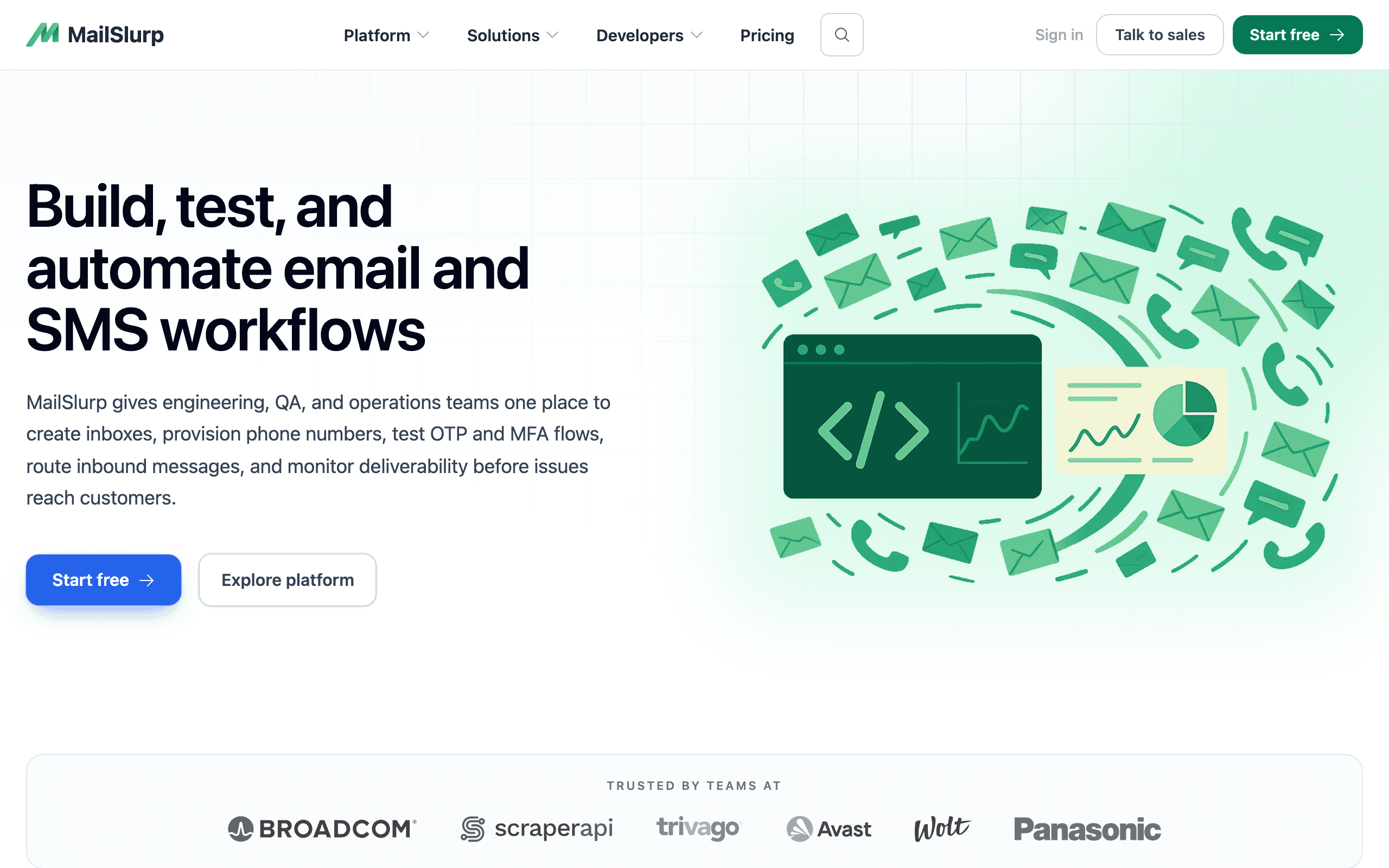
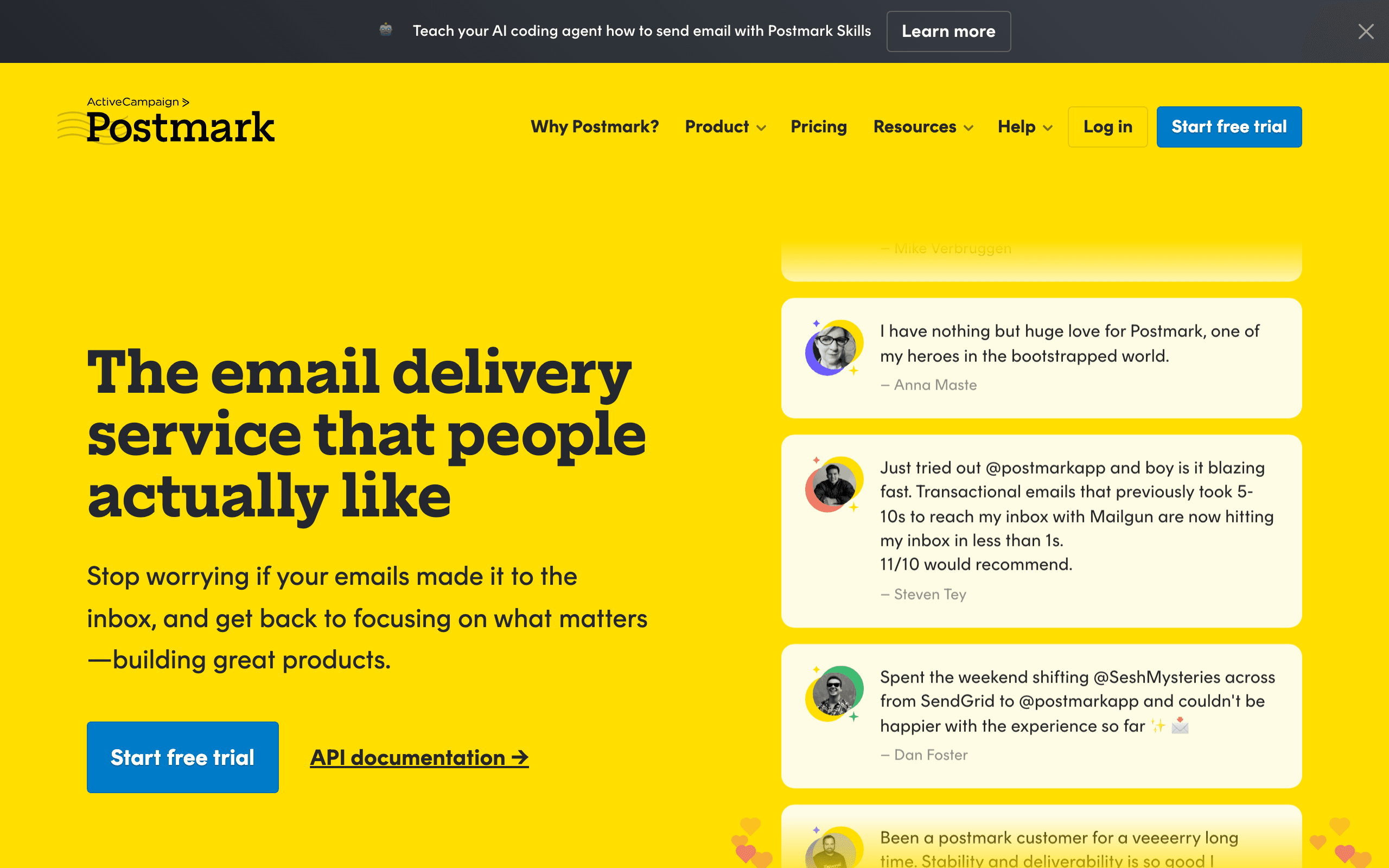
MailSlurp and Postmark serve completely different purposes in the email world. MailSlurp is an email testing API that creates programmable inboxes for verifying email flows in CI/CD pipelines. Postmark is a transactional email service famous for the fastest delivery times in the industry. See our MailSlurp comparison and Postmark comparison.
Postmark consistently delivers emails in under 10 seconds - they publish real-time stats to prove it. That speed matters for time-sensitive emails like OTP codes and password resets. MailSlurp, on the other hand, makes sure those emails work correctly before they ever reach production.
Pricing Comparison
Different services, different pricing models:
- MailSlurp: Free (200 inbound), Starter $19/mo (5k/1k), Team $207/mo (20k/5k)
- Postmark: $15/mo for 10k emails, volume discounts at scale
- Sequenzy: $99/mo for 120k emails, marketing + transactional. See pricing
Postmark's pricing is simple and transparent - pay per email volume. MailSlurp charges for testing infrastructure. Sequenzy offers dramatically more volume with marketing features included.
Where MailSlurp Wins
Programmable test inboxes
Create email addresses on-demand in test suites. Trigger your app's email flows, then verify the right emails arrive with the correct content. This is something Postmark doesn't do.
CI/CD integration
MailSlurp is built specifically for automated testing in CI/CD pipelines. Write tests that create an inbox, trigger an email, wait for delivery, and assert on content - all programmatically.
SDK breadth
18+ official SDKs mean MailSlurp integrates with virtually any tech stack. Postmark has good SDK coverage too, but MailSlurp covers more languages.
Email testing automation
MailSlurp's entire architecture serves the testing use case. Every feature is designed for programmatic email verification in development environments.
Where Postmark Wins
Delivery speed
Postmark's average delivery time is under 10 seconds - the fastest in the industry. They achieve this through dedicated infrastructure and strict sending policies. For OTP and 2FA emails, speed is critical.
Deliverability excellence
By focusing exclusively on transactional email and maintaining strict sender policies, Postmark achieves exceptional inbox placement rates. Their deliberate refusal to handle marketing email protects transactional deliverability.
Inbound email processing
Postmark handles inbound email for production use cases - parsing customer replies, processing support emails, and extracting structured data from incoming messages.
Simple, transparent pricing
$15/mo for 10k emails with predictable volume discounts. No tiers, no feature gates, no surprises. Every feature is available at every level.
Message streams
Postmark's message streams let you separate different types of email (receipts vs notifications vs alerts) with dedicated tracking and management for each.
Why Sequenzy Beats Both for SaaS
For SaaS founders, MailSlurp and Postmark each solve one piece of the puzzle:
Complete email platform
Postmark only does transactional. MailSlurp only does testing. Sequenzy does campaigns, automation sequences, transactional email, and subscriber management from one platform.
Stripe-native billing integration
Stripe integration automatically triggers emails on subscription events. Trial expiration, payment failure, plan change - all handled without webhook code.
20x the email volume
Postmark charges $15/mo for 10k emails. Sequenzy gives you 300k for $49/mo. If you're sending marketing AND transactional email, the math is simple.
AI-powered content creation
Tell Sequenzy what your onboarding flow should achieve, and it generates the complete email sequence. Postmark delivers emails - it doesn't write them.
One platform, one dashboard
Instead of MailSlurp for testing, Postmark for transactional, and yet another tool for marketing - Sequenzy handles all your production email needs in one place.
Quality-Focused Email Infrastructure
Teams that choose both MailSlurp and Postmark tend to be quality-focused. They test rigorously before deploying and demand fast, reliable delivery in production. This combination represents a premium approach to email infrastructure where both the development process and the production delivery meet high standards.
Postmark's transparency about deliverability metrics and MailSlurp's ability to verify email content programmatically create a quality assurance pipeline that catches issues at multiple stages.
Testing Postmark Templates
Postmark's template system supports layouts, dynamic content, and conditional sections. When these templates grow complex, the risk of rendering issues increases. MailSlurp can test each template variation by creating inboxes, sending test messages through Postmark's API, and verifying the received email matches expectations.
This automated testing approach is especially valuable before deploying template changes to production where Postmark's delivery speed means errors reach customers almost instantly.
Unified vs Specialized Email
Postmark specializes in transactional delivery with recent additions for marketing. MailSlurp specializes in testing. Using both means managing two specialized tools. For SaaS teams preferring a unified approach, Sequenzy combines transactional delivery and marketing campaigns with Stripe-triggered automation, though it trades Postmark's delivery speed specialization for platform unification.
Delivery Speed and Reliability
MailSlurp does not compete on delivery speed because it is not a sending service. It creates disposable inboxes so your CI pipeline can verify that an email was generated and received correctly during a test run. Postmark is the one actually optimizing delivery speed in production, publishing real-time stats and averaging under 10 seconds to inbox. The two are not really rivals on this point; MailSlurp checks that the email fired, Postmark makes sure it arrives fast.
API Design and Developer Experience
MailSlurp's documentation and SDKs are built around test scenarios: creating inboxes, waiting for messages, and asserting on their content across CI/CD pipelines. Postmark's docs focus on production sending, message streams, and template management for transactional flows. A team typically ends up using both: MailSlurp's SDKs to verify sends before deploying, and Postmark's API to actually deliver the email once the code ships.
Scaling and Cost at Volume
Postmark's pricing, around $15 a month for 10,000 emails with volume discounts at scale, is what you pay for production delivery. MailSlurp's plans, from free up to $207 a month for a Team plan, price the testing infrastructure itself rather than email volume. Comparing them purely on cost misses the point since one bills for sending and the other for verifying that sending works.
Use-case matchups
| Need | Better fit | Why |
|---|---|---|
| Testing email flows with disposable inboxes | MailSlurp | MailSlurp is cited for testing, disposable addresses, QA APIs, inbound processing, webhooks, and SDKs. |
| Production transactional email with strong delivery quality | Postmark | Postmark is cited for fastest delivery, deliverability, message streams, logs, templates, and dedicated infrastructure. |
| Production transactional sending | Postmark | MailSlurp is primarily a testing tool, while Postmark is purpose-built for transactional delivery. |
| SaaS marketing plus transactional email in one platform | Sequenzy | Sequenzy is listed with 120k emails/month, unlimited subscribers, marketing, and transactional email. |
Pricing reality
MailSlurp is listed from free to $207/month. Postmark is listed at $15/month for 10k emails, with volume discounts at scale. Sequenzy is listed at $99/month for 120k emails/month, unlimited subscribers, marketing, and transactional email.
Postmark is the production sending platform. MailSlurp can complement it by testing templates and flows, but it is not a deliverability-focused transactional sender replacement.
Review signals
MailSlurp reviews cited here highlight testing, QA automation APIs, and disposable email addresses. The limitation is that it is primarily a testing tool.
Postmark reviews cited here highlight fastest delivery, excellent deliverability, and message stream separation. The tradeoffs are no marketing email and higher per-email cost.
Best Fit by Testing vs Production Delivery
Best email testing API for disposable inbox QA
MailSlurp fits engineering teams that need disposable inboxes, inbound processing, QA APIs, webhooks, SDKs, and automated assertions. It should be evaluated first when the problem is testing email behavior before release.
Best transactional email service for production delivery
Postmark fits teams that need fast production email delivery, templates, message streams, logs, and high-confidence deliverability. Choose it when real users depend on password resets, receipts, invitations, or notifications arriving reliably.
Best SaaS email platform for marketing and transactionals together
Sequenzy fits when production email also needs campaigns, lifecycle automation, subscriber state, and billing-triggered messages. It is the practical option when testing can stay separate and the customer email platform needs to own journeys.
Migration checklist
- Export domains, sender signatures, message streams, templates, API keys, webhooks, suppressions, logs, MailSlurp inboxes, and test scenarios.
- If moving to Postmark, separate transactional streams and rebuild templates with production delivery policies in mind.
- If adding MailSlurp, test password resets, receipts, invites, notifications, and stream-specific templates before releases.
- Reconfigure SPF, DKIM, DMARC, return-path, tracking domains if used, sender identities, and webhook destinations.
- Verify message streams, bounce handling, suppressions, delivery speed, and disposable-inbox assertions before cutover.
Decision checklist
- Choose MailSlurp if testing transactional flows is the requirement.
- Choose Postmark if production transactional deliverability is the requirement.
- Avoid MailSlurp as the main transactional sender.
- Avoid Postmark if marketing campaigns and automation are required in the same tool.
- Choose Sequenzy if SaaS teams need marketing plus transactional email connected to lifecycle events.








