
Overview
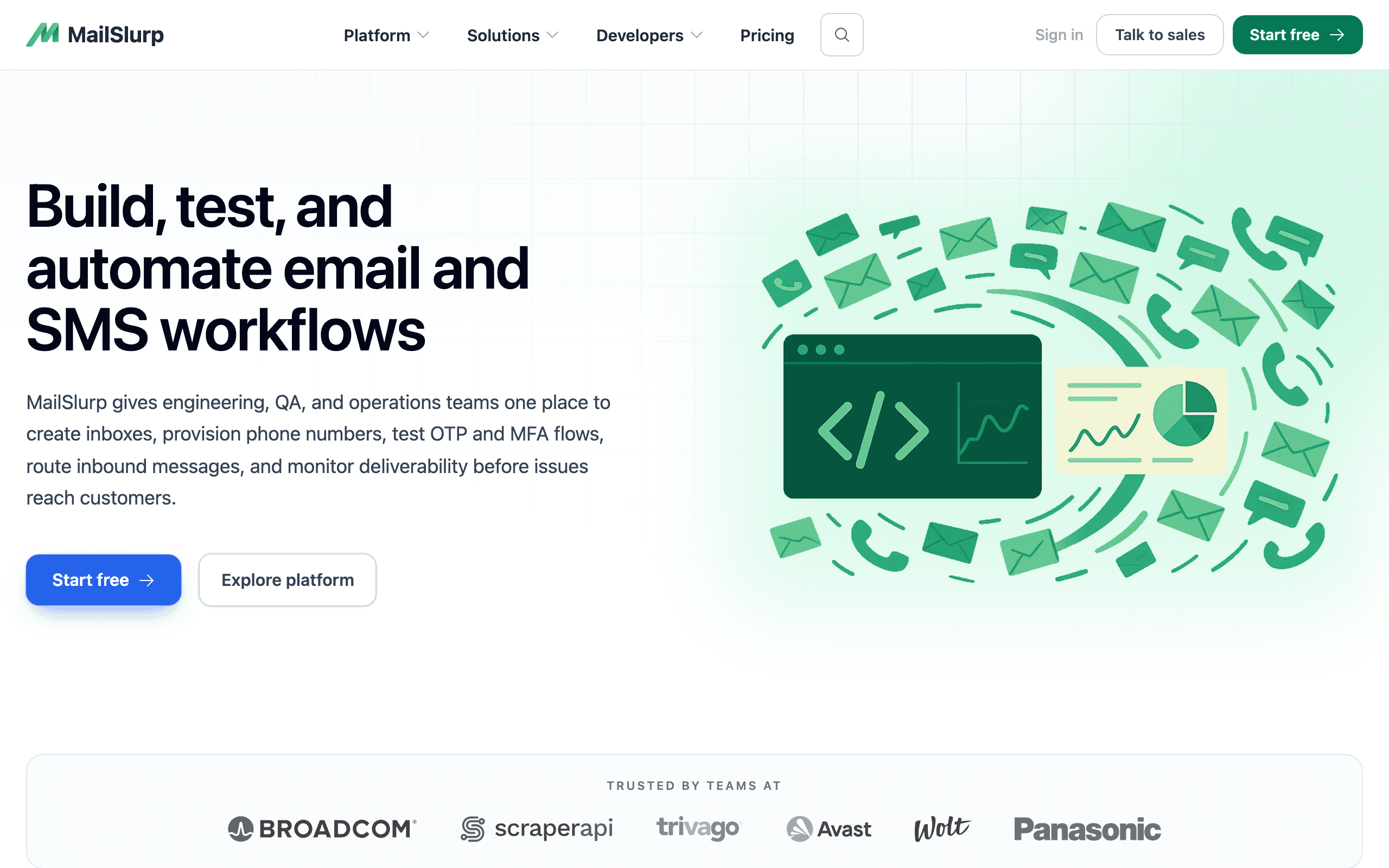
MailSlurp and Resend are both developer-focused email tools, but they solve completely different problems. MailSlurp creates programmable inboxes you can use in automated test suites to verify your app sends emails correctly. Resend is a modern transactional email API that actually delivers emails to real users in production. See our MailSlurp comparison and Resend comparison.
Think of it this way: MailSlurp verifies your signup confirmation email works in your test suite. Resend delivers that confirmation email to the actual user who signed up. They're complementary tools, not alternatives.
Pricing Comparison
The pricing models reflect their different purposes:
- MailSlurp: Free (200 inbound test emails), Starter $19/mo (5k/1k), Team $207/mo (20k/5k)
- Resend: Free (100 emails/day, 3k/month), Pro $20/mo (50k emails)
- Sequenzy: $99/mo for 120k emails and 120k emails with marketing + transactional. See pricing
Resend offers exceptional value for transactional sending. MailSlurp's pricing is for testing infrastructure. Sequenzy gives you 120k emails/month with full campaign and automation features.
Where MailSlurp Wins
Programmable test inboxes
Create fresh email addresses on-demand in your test suites. Send a signup confirmation, then verify the email arrived with the right content, links, and formatting - all programmatically in CI/CD.
SDK breadth
MailSlurp supports 18+ languages including TypeScript, Python, Java, C#, Go, PHP, Ruby, Kotlin, and Swift. Whatever your tech stack, there's an SDK for it.
Email testing automation
MailSlurp is purpose-built for automated testing. Test OTP flows, password resets, signup confirmations, and email notifications in your CI/CD pipeline without manual intervention.
Webhook routing
Advanced webhook routing lets you build complex test pipelines that react to email events in real-time. More powerful than Resend's webhook support for testing scenarios.
Where Resend Wins
Modern API design
Built by the React Email team, Resend has one of the cleanest email APIs available. Great TypeScript types, intuitive methods, and excellent error handling.
Production deliverability
Resend is built for production email delivery with strong deliverability, domain verification, and reputation management. MailSlurp's sending is for testing, not production.
React Email integration
Native React Email support means you can build email templates as React components with full TypeScript support. This is a unique advantage for React developers.
Documentation quality
Resend's documentation is exceptional - clean, modern, with great examples and guides. It sets a high bar for developer docs.
Pricing for sending
$20/mo for 50k emails is excellent value for transactional sending. MailSlurp doesn't compete on sending volume or pricing since it's not designed for production delivery.
Why Sequenzy Beats Both for SaaS
If you're building a SaaS product, you need more than testing and transactional sending. You need a complete email platform:
Everything in one place
Campaigns, automated sequences, transactional emails, subscriber management - Sequenzy handles it all. No need for Resend for sending + another tool for marketing.
Stripe integration that just works
Stripe integration automatically handles subscription lifecycle emails. Trial expirations, payment failures, upgrades, cancellations - the right email goes out without custom webhook code.
AI-powered content
Tell Sequenzy what you want to achieve and it generates complete email sequences. Neither MailSlurp nor Resend creates email content for you.
Subscriber intelligence
Segments, tags, lifecycle stages, engagement scores. Sequenzy understands your subscribers as people, not just email addresses. Both MailSlurp and Resend are stateless - they don't maintain subscriber state.
Cost-effective at scale
Sequenzy gives you 120k emails/month for $49 - that's 6x Resend's volume for 2.5x the price, and you get full marketing automation included.
The Modern Developer Email Stack
MailSlurp and Resend represent the modern approach to email infrastructure. Both prioritize developer experience with clean APIs, comprehensive documentation, and framework integration. Together they cover the development-to-production email pipeline for teams that value code quality and developer productivity.
The React Email ecosystem adds another dimension. Templates built as React components can be tested with MailSlurp and sent through Resend, creating a JavaScript-native email workflow from design to delivery.
Testing React Email Templates
Resend's tight integration with React Email means templates are JSX components that can produce different output based on props. MailSlurp can verify these template variations by creating test inboxes, rendering templates with different prop combinations through Resend's API, and checking the received HTML.
This is particularly powerful in CI/CD where you can test every template with every common prop variation automatically, catching rendering issues before they reach production.
The Marketing Gap in Developer Tools
Both MailSlurp and Resend are developer-focused tools that lack marketing capabilities. MailSlurp tests. Resend sends transactional email. Neither handles campaigns, subscriber management, or marketing automation. For SaaS teams, this creates a gap that requires a third tool.
Sequenzy fills this gap with marketing campaigns, AI-powered sequences, and Stripe integration alongside transactional sending. Some teams use MailSlurp for testing and Sequenzy for both transactional and marketing, eliminating the need for Resend as a separate service.
Delivery Speed and Reliability
MailSlurp and Resend rarely compete directly, since MailSlurp only creates test inboxes for verifying emails in development, while Resend actually delivers transactional email to real users in production. Delivery speed is a meaningful question only for Resend, which prioritizes fast, reliable sending backed by a modern API. MailSlurp's job is catching formatting or content problems before those emails ever reach Resend or any other sending service, which is why many teams run both together.
API Design and Developer Experience
Resend was built by the React Email team specifically around developer experience, with a clean modern API, native React Email support, and documentation reviewers describe as excellent. MailSlurp covers more languages with 18-plus official SDKs, useful if your test suite spans several stacks, but its API design is more traditional. For sending production email with a great developer experience, Resend leads; for broad language coverage in test tooling, MailSlurp's SDK list is harder to match.
Scaling and Cost at Volume
Resend's free tier covers 100 emails a day, about 3,000 a month, for production sending, with its Pro plan at $20 a month for 50,000 emails offering strong value. MailSlurp's free tier covers 200 inbound test emails instead, since it is priced around testing volume rather than production sends, scaling up to $207 a month for its Team plan. Because they serve different purposes, comparing their prices directly matters less than budgeting for both if your workflow needs testing and sending.
Use-case matchups
| Need | Better fit | Why |
|---|---|---|
| Email testing, disposable inboxes, and QA automation | MailSlurp | MailSlurp is cited for testing, disposable addresses, API automation, inbound processing, webhooks, and SDKs. |
| Modern production sending with React Email support | Resend | Resend is cited for React Email, modern developer experience, clean API, fast delivery, and audience management. |
| Production transactional email for developers | Resend | MailSlurp is a testing tool, while Resend is a sending platform. |
| SaaS marketing plus transactional email | Sequenzy | Sequenzy is listed with 120k emails/month, unlimited subscribers, marketing, and transactional email. |
Pricing reality
MailSlurp is listed from free to $207/month, with Starter at $19/month and Team at $207/month. Resend is listed from free to $20/month, with Pro at $20/month for 50k emails. Sequenzy is listed at $99/month for 120k emails/month, unlimited subscribers, marketing, and transactional email.
Resend is the lower-cost production sending choice in this comparison. MailSlurp adds QA capabilities around inbox testing and inbound flow verification.
Review signals
MailSlurp reviews cited here highlight testing capabilities, API-based QA, and disposable addresses. The limitation is that it is primarily a testing tool.
Resend reviews cited here highlight React Email integration, modern developer experience, and clean API design. The cautions are newer-platform maturity and limited marketing features.
Best Fit by Testing and Production Email
Best email testing tool for disposable inboxes and QA automation
MailSlurp is the better fit when the team needs programmable inboxes, disposable addresses, inbound parsing, and end-to-end tests for signup or billing flows. It is a QA tool first, so it should be evaluated on test coverage rather than production sending polish.
Best production email API for React and Next.js apps
Resend is the better fit when the task is sending real transactional email from a modern application. React Email, SDKs, webhooks, and developer-friendly logs make it stronger for production password resets, receipts, invites, and system notifications.
Best SaaS email platform for lifecycle messaging and transactionals
Sequenzy fits teams that need production email plus customer lifecycle workflows. It is not a replacement for MailSlurp's automated inbox testing, but it can replace the separate marketing and transactional stack that often sits behind those tests.
Migration checklist
- Export domains, sender identities, API keys, React Email templates if used, webhooks, suppressions, MailSlurp inboxes, and test scenarios.
- If moving to Resend, map transactional API calls, template rendering, webhooks, and audience-management needs.
- If adding MailSlurp, write automated tests for signup, authentication, billing, and lifecycle messages sent through Resend.
- Reconfigure SPF, DKIM, DMARC, return-path, tracking domains if used, sender identities, and webhook destinations.
- Test template rendering, delivery, bounce handling, suppressions, and inbox assertions before changing production traffic.
Decision checklist
- Choose MailSlurp if the need is QA automation for email.
- Choose Resend if the need is production developer email sending.
- Avoid MailSlurp as a Resend replacement.
- Avoid Resend if you need a mature marketing automation suite.
- Choose Sequenzy if SaaS teams need marketing and transactional email in one lifecycle platform.








