
10 Best SMS Marketing Tools for E-Commerce in 2026

E-commerce SMS is not "SMS marketing" with a product image pasted in.
The message has to know what was in the cart, whether it sold, whether it shipped, whether the SKU is back, and whether the person already bought on their phone after abandoning on a laptop. A tool that can blast a coupon to a CSV cannot do that job, no matter how good its keyword inbox is. A Shopify-only specialist cannot do that job on WooCommerce, no matter how good its App Store listing is.
I ranked ten tools as store systems: catalog and order context, which platforms they honestly support, whether email can suppress the text, and which commerce moments deserve a text at all. For Shopify-native program design see SMS tools for Shopify. For WooCommerce breakage see WooCommerce SMS. For brand-stage DTC economics see DTC SMS.
Quick comparison table
| Tool | Store platforms, honestly | Catalog / order depth | Email in the same brain | Typical entry |
|---|---|---|---|---|
| Klaviyo | Shopify deepest; WooCommerce shallower; others via connectors | Best in class | Yes | Email + SMS from ~$35/mo |
| Omnisend | Shopify and WooCommerce both practical | Strong prebuilt | Yes, plus push | From ~$16/mo |
| Postscript | Shopify | Strong Shopify objects | No | $49/mo minimum |
| Attentive | Shopify-led retail; confirm others | Deep when implemented | Email exists, SMS-led | Custom, often $2k–$3k/quarter |
| Sendlane | Shopify-oriented | Strong Shopify | Yes | From $100/mo |
| Sequenzy | Shopify native; WooCommerce beta; API elsewhere | Sequences on store events | Yes | SMS add-on from $16/mo |
| Brevo | Broad, not merchandising-first | Thin commerce objects | Email yes, SMS credits | From ~$9/mo plus SMS |
| Recart | Shopify | Checkout-led | No | From ~$299/mo |
| Privy | Shopify-focused capture | Cart saver, not a catalog CDP | Light | From ~$24–$30/mo |
| Shopify Messaging | Shopify only | Native, shallow journeys | Shopify Email, not one canvas | $2.15/mo per toll-free number |
If your cart lives on BigCommerce, Magento, or a custom checkout, the shortlist shrinks to tools with a documented event API and a proof-of-concept order. Logos are not connectors.
What an e-commerce text is for
| Moment | SMS earns the interruption? | Why |
|---|---|---|
| Opt-in confirmation | Yes | Expectation and a paper trail |
| Abandoned checkout | Yes, if consented | Time-sensitive, high intent |
| Back in stock / low stock they asked for | Yes | They requested the ping |
| Shipped / out for delivery | Yes, transactional | Reduces "where is my order?" |
| Replenishment with a real usage cycle | Sometimes | Consumables, food, refills |
| Browse abandonment | Rarely | Window shopping is not a checkout |
| Weekly newsletter duplicate | No | Email exists |
| Sitewide 10% off to the whole list | Almost never | Trains people to ignore texts |
If a customer could read it tomorrow without losing the product, the sale, or the delivery window, it is an email. That filter eliminates most "SMS campaigns" stores want to run.
Store platform is the first filter
| You run | Usually shortlist | Usually avoid as the SMS core |
|---|---|---|
| Shopify | Klaviyo, Postscript, Omnisend, Messaging, Attentive, Sendlane, Sequenzy | Generic inbox tools, Woo-only plugins |
| WooCommerce | Omnisend first, then Klaviyo PoC, Brevo, Sequenzy API | Postscript, Recart, Shopify Messaging |
| Shopify + wholesale / CRM | Klaviyo or ActiveCampaign email plus a named SMS path | Assuming Shopify-only specialists cover B2B |
| Headless / custom | Klaviyo events API, Sequenzy API, or CPaaS | Theme popup apps as the event bus |
| Multi-country catalog | Whoever prices destinations in-product | Anyone quoting only US SMS |
Postscript on WooCommerce is not a strategy. Omnisend on a custom Next.js checkout with no events is also not a strategy.
How I evaluated e-commerce SMS tools
- Required a catalog-aware or order-aware message, not a merge-tag first name plus a URL.
- Checked purchase-exit when the order completed on a second device.
- Asked which store platforms are production versus "coming soon."
- Priced a mix of 70 percent US and 30 percent other destinations where relevant.
- Looked for inventory or fulfillment events, not only "campaigns."
- Noted whether email could skip the SMS step after a click or conversion.
The 10 best SMS marketing tools for e-commerce
1. Klaviyo
Best for: Stores whose product, checkout, and order data should decide whether a text goes out.
Pricing: Email plus SMS from about $35/month at small profile counts; SMS credits extra. Profile billing grows with the database.
Klaviyo is the e-commerce default because the objects a store cares about — SKU, collection, checkout, refund, predicted value — are first-class. SMS is a send action on that graph, which is why it beats a prettier SMS composer that cannot see the order.
Shopify is the integration that matches the reputation. WooCommerce is usable and not equivalent; treat it as a proof of concept. Custom stacks need event work. If you only needed a blast tool, the bill will feel insulting.
- Pros: Best commerce graph, email and SMS together, mature store journeys.
- Cons: Cost at scale, Shopify-skewed depth, easy to over-automate.
Verdict: Best e-commerce SMS platform when you will use store data.
2. Omnisend
Best for: Shopify or WooCommerce teams that need working store journeys without a CDP project.
Pricing: From about $16/month; SMS on Pro about $0.007–$0.009 per US message.
Omnisend is the e-commerce shortcut: welcome, checkout, browse, post-purchase, product blocks, both major open platforms. That WooCommerce practicality is why it sits above Postscript on this list even though Postscript is a better Shopify SMS specialist.
You give up Klaviyo's predictive layer and Postscript's inbox. For most stores that is unused capability, not a loss.
- Pros: Two store platforms, prebuilt commerce SMS, bundled email, speed.
- Cons: SMS gated, thinner data, weak two-way.
Verdict: Best e-commerce starting point when the store is Shopify or WooCommerce and the team is small.
3. Postscript
Best for: Shopify e-commerce where SMS is a revenue channel, not an ESP checkbox.
Pricing: $49/month minimum on Starter at about $0.009/SMS plus carrier fees.
On an e-commerce list this is the specialist column, with a hard platform constraint. If the store is Shopify, product-aware flows, coupons, and replies are the real catalog integration. If the store is not Shopify, stop reading this row.
- Pros: Shopify commerce SMS done properly, inbox, discounts.
- Cons: Shopify-only, minimum spend, no email brain.
Verdict: Best Shopify e-commerce SMS specialist. Invisible everywhere else.
4. Attentive
Best for: Large retail e-commerce where capture and conversations are part of merchandising.
Pricing: Custom, often $2,000–$3,000 per quarter minimums plus usage.
E-commerce at this scale is not "send the cart text." It is subscriber growth as a channel and conversational conversion on high-AOV catalogs. Attentive is built for that. It is not built for a 200-order-a-month WooCommerce shop.
- Pros: Capture and messaging depth, retail-grade programs.
- Cons: Enterprise motion, wrong economics for thin catalogs.
Verdict: Best scaled e-commerce messaging suite.
5. Sendlane
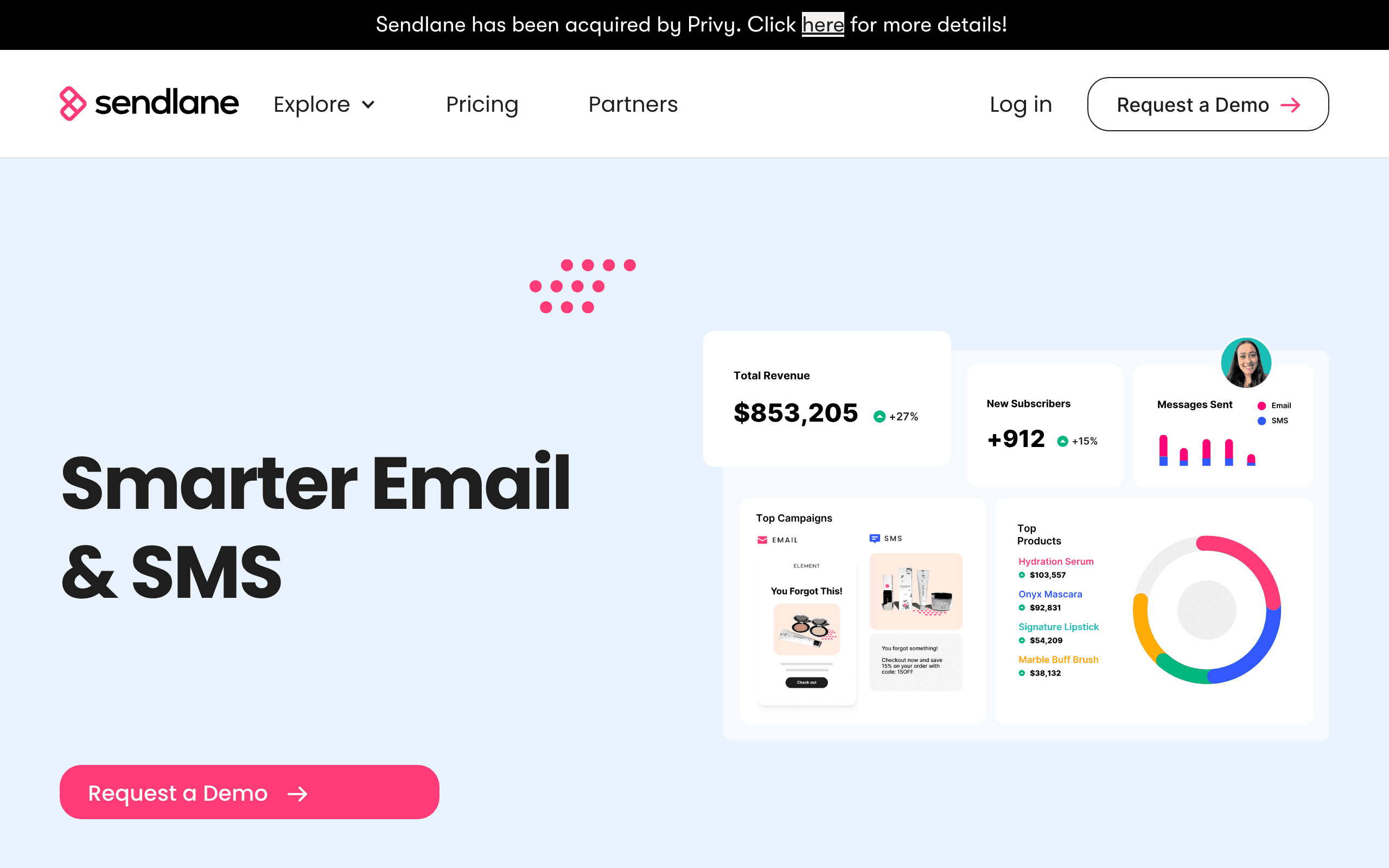
Best for: Shopify e-commerce that wants both channels without Klaviyo profile math.
Pricing: From $100/month for 50,000 emails; SMS around $0.009 per credit.
Middle-market commerce bundle. Treat it as a Shopify-shaped Klaviyo alternative on billing, then QA store events like you would Klaviyo.
- Pros: Email plus SMS, unlimited contacts, commerce journeys.
- Cons: Not multi-platform in the Omnisend sense, higher floor.
Verdict: E-commerce option when stored contacts are the tax.
6. Sequenzy
Best for: E-commerce teams that think in sequences and want SMS on the same order goal as email.
Pricing: SMS add-on from $16/month with 1,000 credits.
Disclosure: I build Sequenzy. Shopify syncs store objects into sequences; WooCommerce is a beta plugin; everyone else can emit events through the API. A Send SMS step shares attribution, keeps SMS consent separate, and defers quiet hours. It will not out-merchandising Klaviyo and will not out-inbox Postscript.
The e-commerce fit is a store that already recovers carts by email and wants a later text, or a hybrid catalog-plus-subscription business that should not run two marketing databases.
- Pros: Store events in sequences, API for non-Liquid, no SMS minimum.
- Cons: Capture and inbox are not specialist-grade, WooCommerce behind Shopify.
Verdict: E-commerce SMS as a sequence step, including custom event sources.
7. Brevo
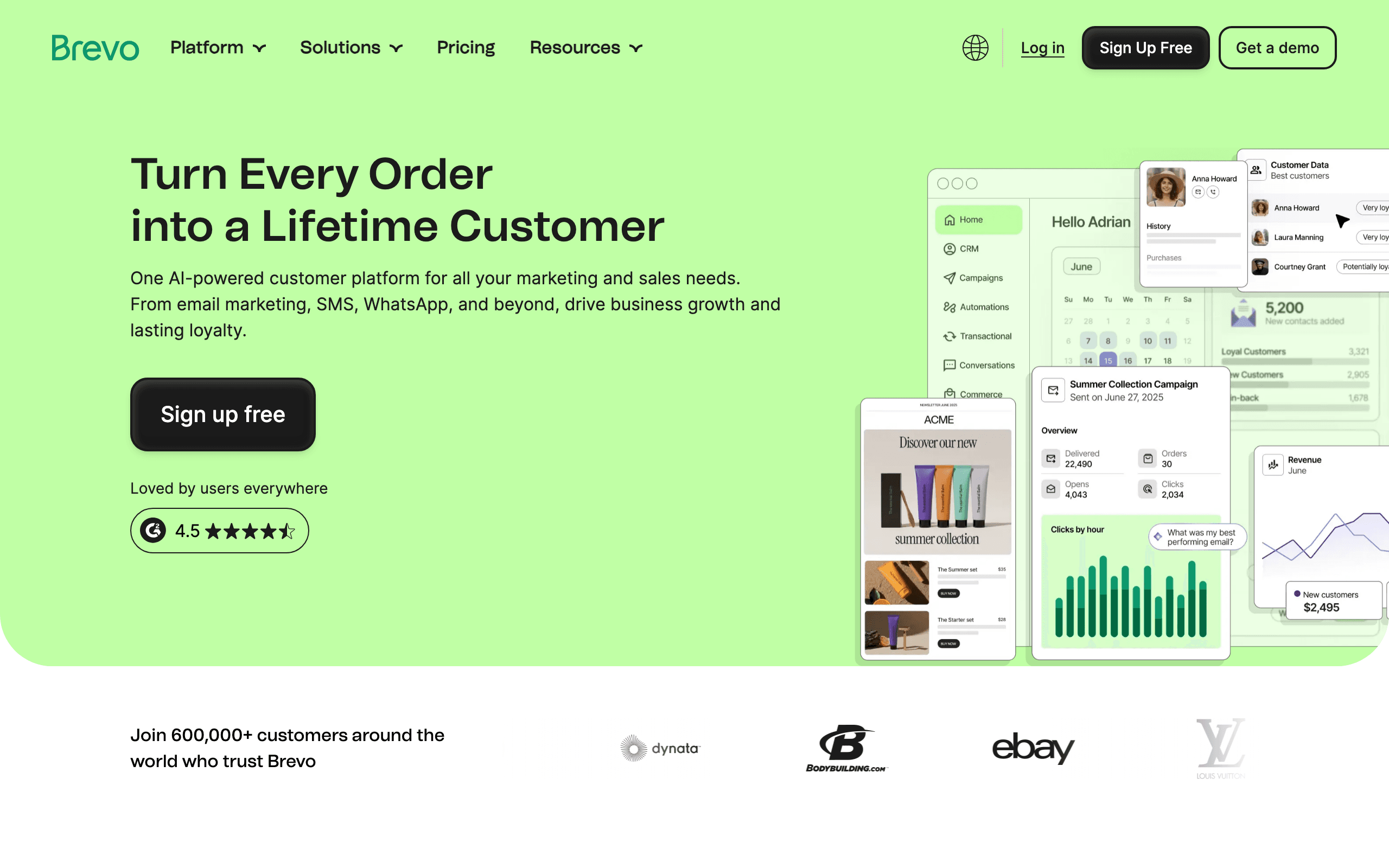
Best for: E-commerce with international buyers and send-based email, where US-centric merchandising platforms are the wrong shape.
Pricing: Email from about $9/month or a free daily cap; SMS credits by country.
This is the anti-Shopify-specialist row. Transactional email plus destination-priced SMS can beat a commerce suite that quotes US cents and then bills Europe. Cart reconstruction and product blocks will feel thin. Use it when the store is a catalog plus a list, not when merchandising automation is the company.
- Pros: Destinations, send-based email, transactional included.
- Cons: Shallow store objects, SMS cost variance.
Verdict: Best generalist e-commerce SMS economics. Weak merchandising.
8. Recart
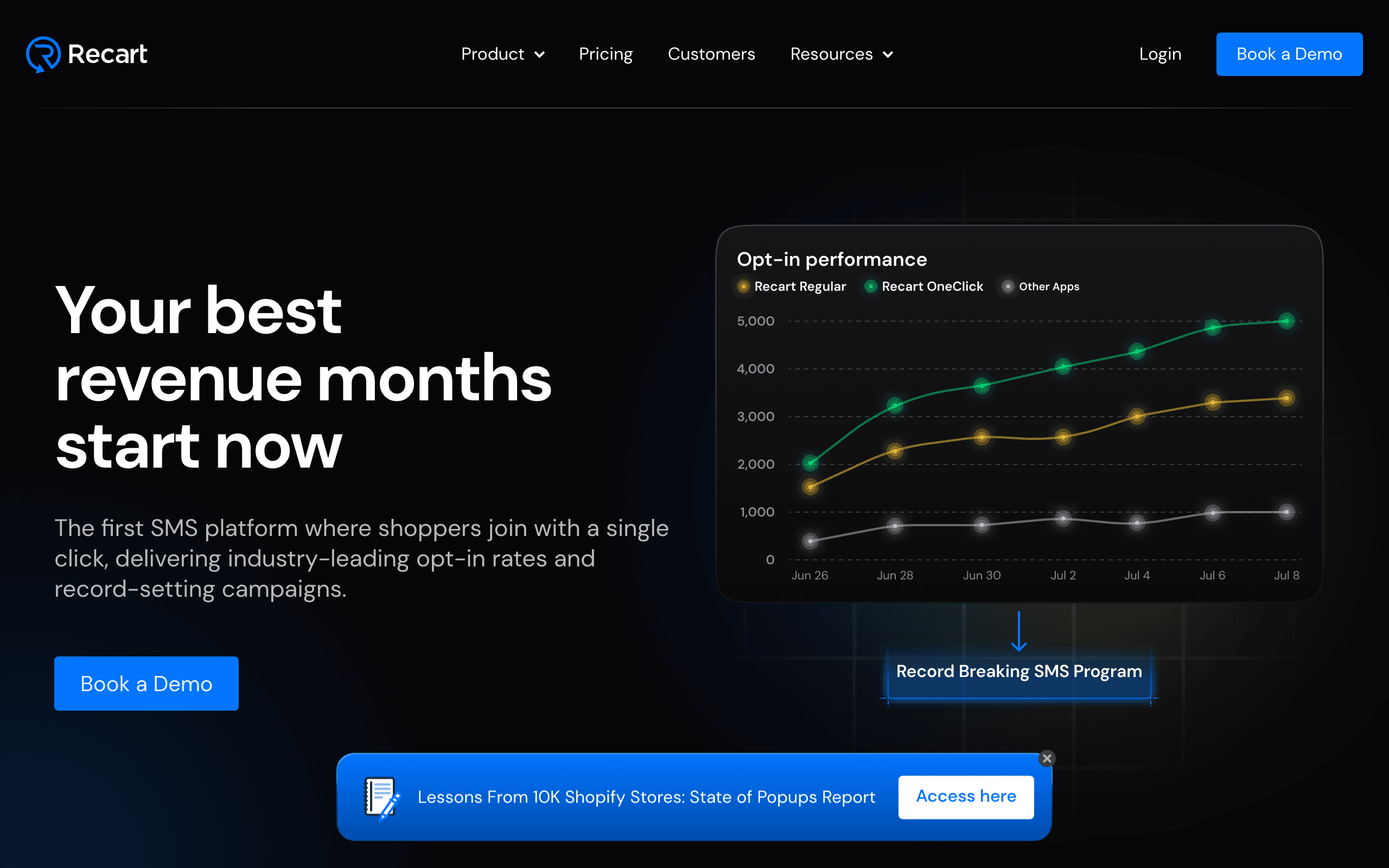
Best for: Shopify e-commerce that needs recovery operated.
Pricing: From about $299/month.
Checkout-led Shopify SMS as a managed service. Not a multi-platform e-commerce platform. If the store's only incremental SMS is recovery and nobody will build it, this is the row.
- Pros: Managed Shopify recovery.
- Cons: Shopify-only, high floor, not email.
Verdict: E-commerce SMS by operator, Shopify only.
9. Privy
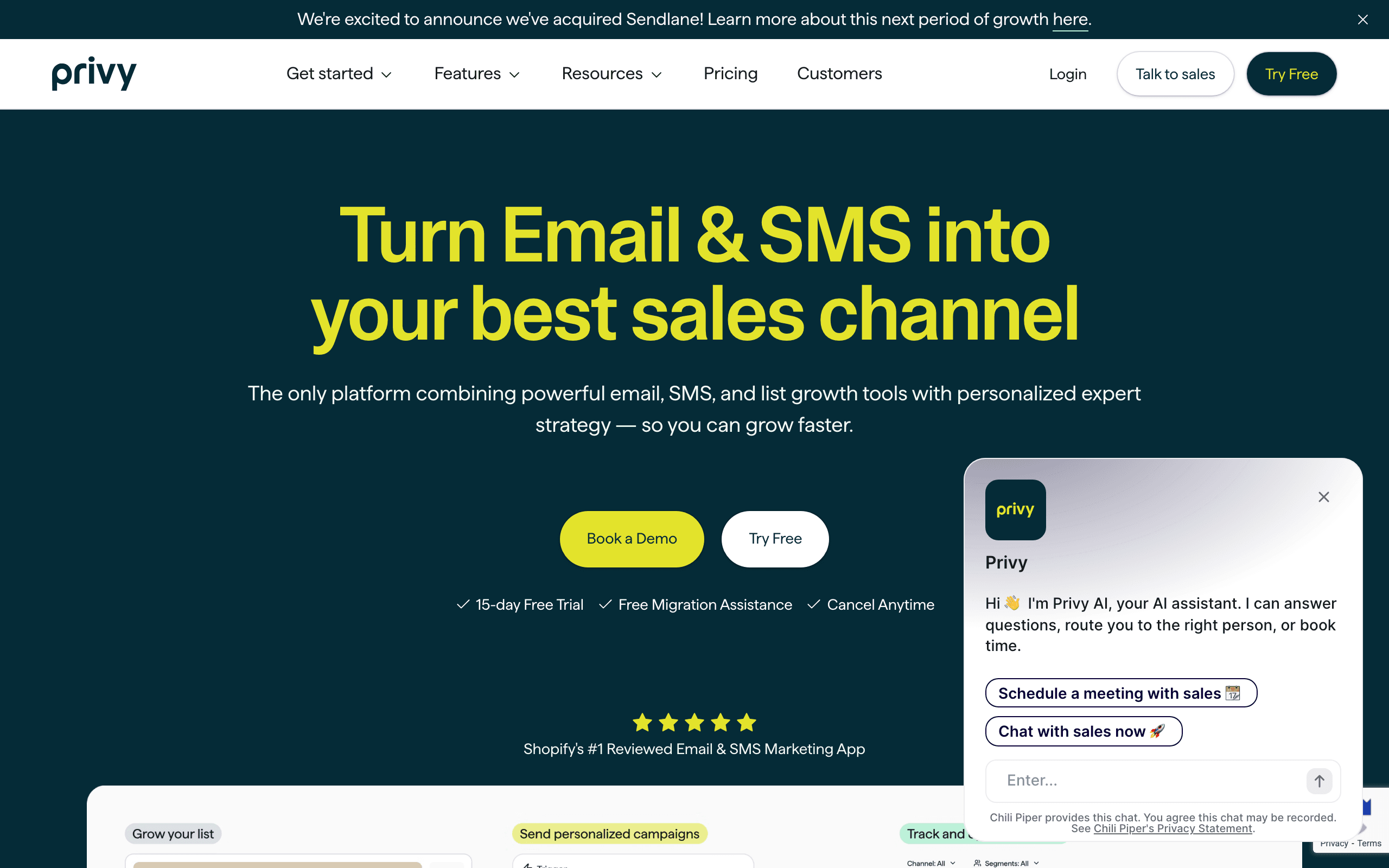
Best for: E-commerce storefronts whose SMS list is too small for any sending tool to matter.
Pricing: From about $24–$30/month; SMS extra.
Capture and cart savers, mostly Shopify. The sending layer is not a commerce automation platform. Put it in front of a real sender.
- Pros: List growth, cart-level on-site.
- Cons: Not catalog SMS, extra system.
Verdict: E-commerce input (subscribers), not e-commerce SMS.
10. Shopify Messaging
Best for: Shopify e-commerce validating whether store texts convert, with native checkout context.
Pricing: $2.15/month per US/Canada toll-free number plus usage.
Native store objects, shallow journeys, zero connector risk. Non-Shopify stores should ignore this row. Shopify stores should not skip it as a measurement tool.
- Pros: Native checkout and customers, cheap experiment.
- Cons: Not a commerce automation suite, Shopify only.
Verdict: E-commerce SMS minimum on Shopify. Not a category winner.
Frequently asked questions
What is the best SMS marketing tool for e-commerce?
Klaviyo if catalog, checkout, and email should share one profile. Omnisend if you want prebuilt store journeys on Shopify or WooCommerce without a long implementation. Postscript if you are Shopify and SMS is the program. Brevo if destinations and send-based email matter more than merchandising. Attentive if SMS is a staffed growth channel. The store platform you run is the first filter, not the last.
Which e-commerce platforms do these tools actually support?
Shopify is the deepest for Klaviyo, Postscript, Attentive, Recart, and Shopify Messaging. Omnisend is the most practical Shopify-plus-WooCommerce pair. Klaviyo's WooCommerce plugin exists and is shallower than its Shopify integration. BigCommerce, Magento, custom, and headless need an API or a vendor who will say so on a recorded call. "E-commerce integration" on a homepage is not a checkout object.
What SMS automations should an online store run?
Opt-in confirmation, abandoned checkout (not vague "cart" unless you have the event), back in stock for requested SKUs, and shipping as a separate transactional stream. Replenishment if the product has a real usage cycle. Browse abandonment and generic win-back are where opt-outs cluster. Do not clone the entire email map onto text.
Should e-commerce SMS live in the same tool as email?
Usually yes, because purchase-exit and frequency caps fail across two databases. Split only when SMS needs capture, RCS, or an inbox no ESP matches, and then write who owns STOP. Stores that run Postscript plus Klaviyo can win; stores that install both and hope do not.
How do I stop SMS from fighting email on the same order?
One flow, or a documented split: email first, SMS later only if still unpurchased and consented. Cap marketing texts per week. Hold out 10 percent of SMS-eligible checkout abandoners if you add a specialist on top of an ESP cart flow. Last-click "SMS revenue" on a high-intent audience is not incrementality.
Is e-commerce SMS useful outside the US?
Yes, and the rate card will punish you if you budget US cents. UK, EU, AU, and CA differ in price, encoding, and rules. Quiet hours and consent expectations differ. Price your actual destination mix, and prefer tools that show country cost before send. MMS is often North America only.
Can I use a generic texting service with my store?
You can Zapier a new-order event into SimpleTexting. You will then own consent, purchase-exit, catalog, quiet hours, and every plugin update. It is a reasonable transactional hack for "shipped" and a poor marketing program. Commerce SMS tools exist because that stitch fails at the first sale on another device.
How is this different from the DTC and Shopify lists?
This page is store-platform and catalog-first: what an e-commerce text is for, and which tools still work if you are not a Shopify DTC brand. Shopify capture and App Store program design are the Shopify list. Brand stage, two-tap units, and incrementality theater are the DTC list. Local inbox tools are excluded here on purpose.
Final recommendation
- Default commerce graph: Klaviyo.
- Shopify or WooCommerce, small team: Omnisend.
- Shopify SMS as the channel: Postscript.
- Not US-centric: Brevo, after destination quotes.
- Sequences already exist: Sequenzy.
- Shopify profile-bill pain: Sendlane.
- No owner, Shopify recovery: Recart.
- List too small: Privy, then a sender.
- Scaled retail messaging: Attentive.
- Shopify experiment: Messaging.
- Everyone: filter by store platform first, then by whether the text needs catalog context.
The best e-commerce SMS tool is the one that can see the order in time to not send. Platform logos without checkout objects do not qualify.