Overview
Mailtrap and SendGrid serve different needs in the email space. Mailtrap uniquely combines email sandbox testing with production sending - test in development, send in production, all from one platform. SendGrid (owned by Twilio) is pure enterprise infrastructure focused on scale and deliverability. The choice depends on whether you value unified dev workflow or proven enterprise scale.
Mailtrap's Unique Position
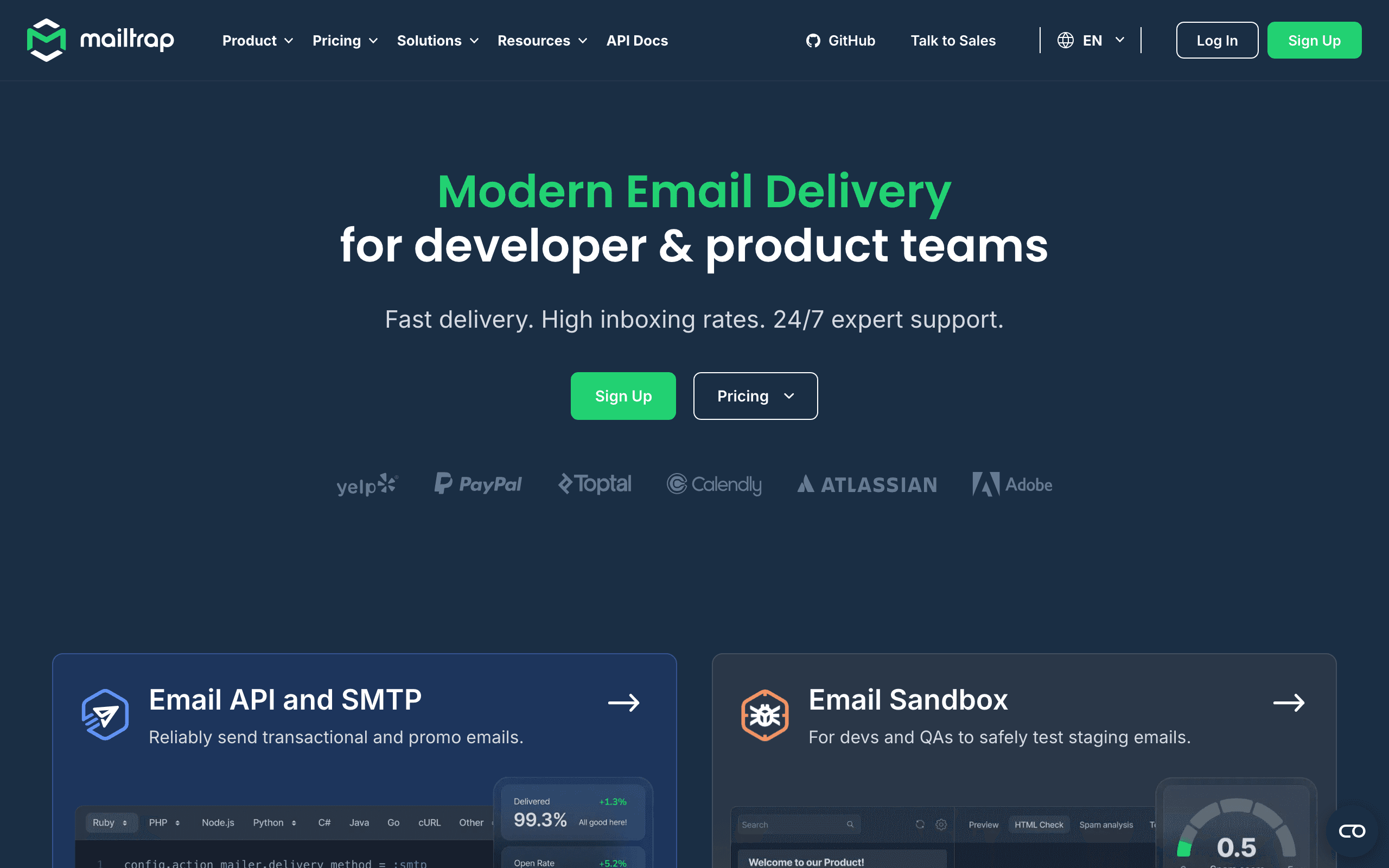
Mailtrap's differentiator is combining email testing with production sending. The Email Sandbox captures emails from dev/staging environments so you can test without sending to real inboxes. Email Sending handles production. Having both from one vendor creates a seamless dev-to-production workflow that SendGrid can't match.
Enterprise Credibility
SendGrid wins on proven scale. They process 100+ billion emails monthly with 15+ years of reputation. Twilio backing means serious infrastructure. Mailtrap's production sending is newer and smaller scale. For mission-critical enterprise volume, SendGrid has more track record.
Developer Workflow
With Mailtrap, your workflow stays in one tool: test emails in sandbox environments during development, then send from production when ready. With SendGrid, you need separate testing tools (Mailhog, MailCatcher, etc.) - more vendors, more complexity.
Pricing Comparison
Mailtrap is competitive on pricing. Email Sending Basic starts at $10/month for 10k emails. SendGrid Essentials starts at $20/month for 50k emails. At low volumes, Mailtrap is cheaper. Note: Mailtrap Email Sandbox is a separate product with its own pricing (free tier available).
Developer Resources
SendGrid has larger ecosystem - more SDKs (7+ languages), more documentation, more community answers. More developers have SendGrid experience. If you value raw resources and community support, SendGrid has the edge.
Marketing Features
Neither is primarily a marketing platform. Mailtrap doesn't offer marketing features. SendGrid has Marketing Campaigns as a separate product (additional cost). If you need both transactional and marketing, factor this in.
The Sequenzy Alternative
Both tools are transactional-focused without SaaS-specific features. Sequenzy offers unified marketing and transactional built for SaaS, with native Stripe integration and features like trial-to-paid sequences.
Making the Choice
Choose Mailtrap for unified dev-to-production workflow with testing built-in. Choose SendGrid for proven enterprise scale and largest developer ecosystem. For SaaS needing marketing automation and transactional email with Stripe triggers, consider Sequenzy.
The Testing Gap in Enterprise Infrastructure
SendGrid has 15 years of enterprise reputation but zero email testing features. Development teams using SendGrid need Mailtrap, Mailhog, or a custom solution for testing. This gap is surprising for such a mature platform and represents an opportunity that Mailtrap specifically addresses.
Mailtrap's unified approach eliminates vendor juggling. Test in the sandbox, deploy to production sending, all from one account. For teams that value workflow simplicity, this integration matters more than enterprise scale they may never need.
Scale as a Requirement vs Aspiration
SendGrid processes 100+ billion emails monthly. That scale is proven and genuine. But most companies sending under a million emails monthly will never need that capacity. Choosing SendGrid for its scale when you send 50,000 emails monthly is like buying a semi-truck for grocery shopping.
Mailtrap's production sending handles moderate volumes well. For startups and growing companies, Mailtrap's scale is more than adequate. Consider your actual sending volume and realistic growth trajectory rather than theoretical maximum capacity when evaluating.
Developer Ecosystem Comparison
SendGrid has the largest developer ecosystem in email: more Stack Overflow answers, more tutorials, more SDKs, more developers with SendGrid on their resume. This ecosystem advantage is real and measurable. When you encounter an integration challenge, help is more readily available.
Mailtrap has a growing but smaller community. Their documentation is comprehensive for common use cases but you may find fewer community solutions for edge cases. For standard integrations, both platforms provide adequate support. For unusual requirements, SendGrid's ecosystem provides more reference material.
Delivery Speed and Reliability
For transactional email, delivery speed is non-negotiable. Receipts, password resets, and verification codes need to arrive in seconds. Both Mailtrap and SendGrid prioritize fast delivery, but their approaches differ in infrastructure and routing.
Transactional email reliability involves more than just speed. It requires consistent inbox placement, proper authentication, and monitoring. Compare how each platform handles DKIM, SPF, and DMARC setup, and which provides better tools for ongoing email deliverability monitoring.
API Design and Developer Experience
Mailtrap and SendGrid both target developers, but with different philosophies. The quality of API documentation, SDK support, and error handling directly impacts how quickly your team can integrate and how much ongoing maintenance is needed.
Developer experience goes beyond the API itself. Consider webhook support for tracking delivery events, sandbox environments for testing, and how each platform handles rate limiting and error recovery. These details matter when your application depends on email delivery.
Scaling and Cost at Volume
Email costs become significant at scale. What starts as a few hundred emails per day can grow to millions. Understanding how Mailtrap and SendGrid price at different volume tiers helps you plan for growth without budget surprises.
Beyond per-email pricing, consider dedicated IP costs, email validation charges, and support tier pricing. Some platforms offer volume discounts that significantly change the economics at higher sending volumes. For SaaS companies needing both transactional and marketing email, explore Sequenzy's unified approach.
Use-case matchups
| Need | Better fit | Why |
|---|---|---|
| Email sandbox testing, spam analysis, and HTML/CSS checks | Mailtrap | Mailtrap's cited strengths are testing sandbox, spam score analysis, HTML/CSS checking, and team collaboration. |
| High-volume production sending and validation | SendGrid | SendGrid is cited for high-volume sending, transactional plus marketing, validation API, dynamic templates, and Twilio ecosystem. |
| Enterprise-scale sending infrastructure | SendGrid | SendGrid has broader production sending scale and ecosystem depth. |
| SaaS marketing plus transactional email in one workflow | Sequenzy | Sequenzy is listed with 10k contacts, unlimited sends, and transactional plus marketing unified. |
Pricing reality
Mailtrap is listed at $10/month for the Basic Email Sending plan, with Email Sandbox testing as a separate product. SendGrid is listed at $20/month for Essentials, with Pro plus dedicated IP at $90/month and marketing separate. Sequenzy is listed at $49/month for 10k contacts, unlimited sends, and unified transactional plus marketing email.
Mailtrap is cheaper for basic sending and testing-led workflows. SendGrid costs more but is stronger when scale, validation, and enterprise sending infrastructure matter.
Review signals
Mailtrap reviews cited here highlight the email testing sandbox, spam score analysis, and HTML/CSS checking. The tradeoffs are that sending is newer and the testing focus limits marketing.
SendGrid reviews cited here highlight high-volume sending, transactional plus marketing coverage, and email validation API. The cautions are inconsistent support quality and basic marketing features.
Best Fit by Developer Workflow
Best email sandbox and QA tool for development teams
Mailtrap fits teams that need sandbox testing, spam analysis, HTML/CSS checks, inbox previews, and collaboration before production sends go live. It should be evaluated first when the biggest pain is email QA and developer workflow.
Best email infrastructure platform for production scale
SendGrid fits teams that need mature production sending, validation, dynamic templates, webhooks, and high-volume delivery tooling. Choose it when infrastructure scale matters more than sandbox-first testing.
Best unified SaaS email platform for lifecycle and transactionals
Sequenzy fits teams that want marketing, transactional, and lifecycle email in one product rather than a separate testing stack plus sending stack. It is most relevant when subscriber state and billing events should drive production emails.
Migration checklist
- Export domains, sender identities, API keys, templates, test inboxes, sandbox rules, dynamic templates, validation settings, webhooks, and suppressions.
- If moving to SendGrid, map API calls, dynamic templates, validation usage, suppression handling, and production sending tiers.
- If moving to Mailtrap, recreate sandbox tests, spam checks, HTML/CSS QA, and production sending credentials.
- Reconfigure SPF, DKIM, DMARC, return-path, tracking domains, webhook endpoints, unsubscribe handling, and sender identities.
- Ramp production traffic gradually and compare delivery, bounces, suppressions, test captures, and webhook counts.
Decision checklist
- Choose Mailtrap if email QA, sandbox testing, and developer workflow are the priority.
- Choose SendGrid if production scale, validation, and infrastructure maturity matter more.
- Avoid Mailtrap if the main need is enterprise-scale marketing and transactional sending.
- Avoid SendGrid if testing workflows and support quality risks are bigger concerns than scale.
- Choose Sequenzy if SaaS teams need marketing and transactional email unified around lifecycle events.