Overview
Encharge and Userlist are both email platforms built specifically for SaaS. They target similar audiences but with different strengths. Encharge offers enterprise-grade automation with deep integrations. Userlist focuses on B2B SaaS with native company account support. See our Encharge and Userlist comparisons for more context.
The Price Difference
At 10,000 contacts/users, Userlist costs $99-149/month vs Encharge at $179/month. That's 17-45% cheaper for Userlist at scale. However, Encharge starts lower at $79/month vs Userlist at $99/month. For SaaS founders watching costs, the better deal depends on your growth trajectory.
Use-case matchups
| Use case | Better fit | Why |
|---|---|---|
| Advanced SaaS automation and user scoring | Encharge | Encharge has deeper branching, scoring, and integration options. |
| B2B SaaS with company accounts | Userlist | Userlist models companies, users, and company-level triggers natively. |
| Segment-centered data stack | Encharge | Native Segment integration matters when the CDP owns event routing. |
| Email plus in-app onboarding | Userlist | Userlist includes in-app messages alongside email. |
| Stripe-triggered lifecycle and transactional email | Sequenzy | Sequenzy is cheaper and more Stripe-native, but does not replace in-app messaging. |
Best Fit by SaaS Lifecycle Data Model
Best SaaS email automation tool for advanced user scoring
Choose Encharge when lifecycle work depends on product events, score thresholds, Segment data, and integration-driven branches. It is the stronger fit for SaaS teams that need marketing automation to identify high-intent users and route them into different activation, sales, or retention paths.
Best email and in-app tool for B2B SaaS company accounts
Choose Userlist when the product is account-based and company behavior matters as much as individual user behavior. Team invites, workspace activation, company milestones, and account-level onboarding are cleaner when companies are first-class records instead of custom fields.
Best Stripe lifecycle email platform for lean SaaS teams
Choose Sequenzy when the most important automation source is billing state. If trial starts, upgrades, failed payments, renewals, cancellations, and transactional messages matter more than in-app prompts or account modeling, a Stripe-native email tool keeps the stack simpler.
Pricing reality
Userlist can be cheaper at the 10,000-user benchmark, especially if the startup discount applies. That price advantage matters most for B2B SaaS teams that actually need company accounts and in-app messaging.
Encharge costs more at this benchmark, but the premium buys deeper automation, scoring, and integrations. If scoring, Segment, or complex lifecycle logic is not needed, that premium may be wasted.
Sequenzy's $49/month benchmark is relevant when Stripe-triggered email and transactional messages are the core need. It does not replace Userlist's in-app messages or Encharge's broader integration depth.
Review signals
The review snippets show a real product split: Encharge users praise automation depth and behavior-based scoring, while Userlist users praise B2B company modeling and in-app messaging. The strongest buying signal is whether your lifecycle logic is user-level, company-level, or billing-event-level.
Migration checklist
| Workstream | Moving toward Encharge | Moving toward Userlist | Moving toward Sequenzy |
|---|---|---|---|
| People and companies | Map users, attributes, segments, scoring fields, and company identifiers. | Map users, companies, relationships, roles, company events, and suppressions. | Map subscribers, attributes, tags, suppression status, and billing/product events. |
| Event tracking | Define product events, scoring rules, lifecycle stages, and integration sources. | Define user and company events separately so company-level triggers work. | Focus on Stripe, product, and transactional email events. |
| Channels | Keep channel scope email-only unless other tools handle in-app. | Rebuild email and in-app messages from one timeline. | Keep scope to marketing and transactional email. |
| Automations | Rebuild scoring, activation, trial, lifecycle, and product-behavior flows. | Rebuild company onboarding, user invites, in-app prompts, lifecycle, and team-level triggers. | Rebuild trial, payment, onboarding, retention, and transactional paths. |
| Integrations | Reconnect Segment, Stripe/Chargebee, CRM, support, analytics, and product tools. | Reconnect SaaS tools, Zapier/API paths, product events, and company/account data. | Connect Stripe and required product/store integrations. |
| Reporting | Export segment, score, flow, conversion, and engagement reports. | Export user, company, in-app, lifecycle, and campaign reports. | Export lifecycle, campaign, and transactional metrics. |
Decision checklist
- Are company accounts first-class in the product and lifecycle?
- Is in-app messaging part of onboarding, or is email enough?
- Does user scoring drive meaningful sales or marketing actions?
- Will Segment-native integration reduce real implementation work?
- Is Stripe-triggered email the main requirement?
B2B Company Accounts
Userlist's standout feature is native company account support. You can track both individual users and the companies they belong to. Trigger automations based on company-level behavior - like "company completed onboarding" or "company hit usage milestone". Encharge handles company data via segments, but it's not as native or powerful.
Automation Depth
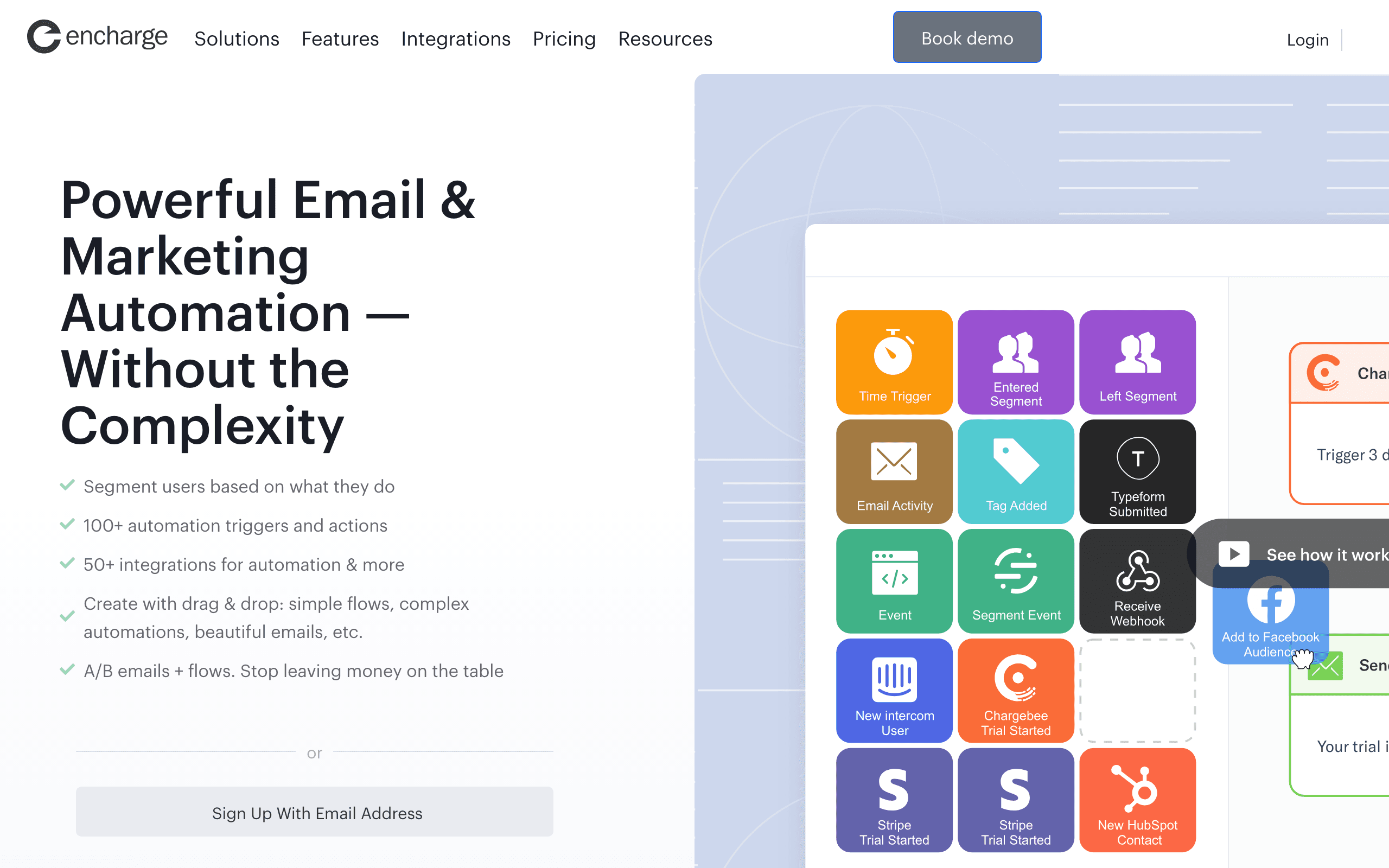
Encharge has more sophisticated automation. User scoring, complex flow branching, 50+ native integrations including Segment. For intricate lifecycle marketing flows, Encharge has more power. Userlist's automation is simpler - it covers core use cases but with less advanced options.
In-App Messages
Userlist includes in-app messaging for product onboarding and announcements. Encharge focuses on email only. If you want both email and in-app from one tool, Userlist delivers unified messaging. If email-only works for you, this doesn't matter.
The Integration Question
Encharge connects natively to Segment, Intercom, HubSpot, and 50+ other tools. This matters if you're building a complex data stack. Userlist integrates with key SaaS tools but requires Zapier for some connections. Neither has native Stripe integration - both require workarounds.
Making the Choice
Choose Encharge for: advanced automation, user scoring, deep integrations, sophisticated flows. Choose Userlist for: B2B company accounts, in-app messaging, simpler approach, user-company relationships. For SaaS with Stripe billing, consider Sequenzy as a focused alternative with native payment integration at 67-73% lower cost.
The B2B Company Account Gap
The most meaningful difference between these platforms is how they handle B2B relationships. In B2B SaaS, you do not just have users - you have companies with multiple users, each at different roles and engagement levels. Userlist models this natively: companies are first-class objects with their own attributes, events, and automation triggers. You can trigger an email when "Company X has 3 active users" or "Company Y has not logged in for 30 days."
Encharge handles this through segments and custom attributes, which works but requires more manual configuration. You can approximate company-level behavior by filtering users with matching company identifiers, but it is not the same as native company objects with their own lifecycle triggers. For B2B SaaS where company-level behavior drives your email strategy, Userlist's architecture is fundamentally better suited.
In-App Plus Email Orchestration
Userlist includes in-app messaging alongside email, enabling coordinated onboarding experiences. A new user might see an in-app tooltip when they first visit a feature page, followed by an email the next day if they did not engage with it. This orchestration between channels happens within one platform, using one set of behavioral triggers and one subscriber timeline.
Encharge focuses exclusively on email. If you need in-app messaging, you add a separate tool like Intercom or Appcues, then coordinate triggers across platforms. This works but adds complexity and cost. For teams that view in-app and email as two parts of the same onboarding experience, Userlist's unified approach removes the integration overhead.
The Startup Discount Factor
Userlist offers a 50% discount for early-stage startups that have raised less than $500,000. At $99/month, that drops to roughly $50/month - competitive with budget-focused tools. Encharge has no comparable startup program. For pre-seed and seed-stage SaaS companies, this discount can make Userlist the more affordable option despite its higher list price. Factor in the startup discount when comparing total cost of ownership at your current stage.