
11 Best Abandoned Cart SMS Tools in 2026

Abandoned cart SMS looks like the easiest revenue automation in e-commerce. The shopper already wanted the product. Texting is fast. Dashboards report impressive recovery. Then you look closer and find three different problems hiding under one label.
First, most of the people you want to text never gave SMS consent. Cart abandoners often never typed a phone number. Checkout abandoners might have, but a shipping number is not marketing permission. Second, a large share of "recovered" orders would have completed anyway; last-click attribution on a high-intent audience is the most inflated number in retention. Third, the message that actually matters is the one you do not send: the purchase-exit that stops a text after the order lands, and the quiet-hour deferral that stops you texting someone at 11pm because they abandoned at 10:50.
I compared 11 tools on those jobs, not on who can broadcast a coupon. The ranking favors purchase-exit, cart versus checkout event fidelity, restore links, consent handling, and whether SMS can sit behind email instead of next to it. For the email-only version of this problem, see how to recover abandoned carts with email. For the wider channel decision, see the best SMS marketing tools for e-commerce.
Quick comparison table
| Tool | Recovery model | Cart vs checkout events | Purchase-exit | Coordinates with email | Typical entry cost |
|---|---|---|---|---|---|
| Klaviyo | Shared email + SMS flow | Both, plus browse | Native in the same flow | Best in class | Email + SMS from about $35/mo |
| Postscript | SMS-native Shopify flows | Strong checkout, solid cart | Strong inside Postscript | Needs an ESP + suppression plan | $49/mo minimum spend |
| TxtCart | Specialist cart/checkout SMS | Purpose-built around both | Inside TxtCart | Overlaps unless you split | Starter $29/mo, Growth $79/mo |
| Omnisend | Prebuilt email + SMS + push | Both on Shopify and WooCommerce | In the same workflow | Good enough for lean teams | Standard from about $16/mo |
| Attentive | Conversational recovery at scale | Deep, plus list growth around it | Strong | Possible, sales-led | Custom, often $2k–$3k/quarter min |
| Sequenzy | SMS step inside a lifecycle sequence | Checkout/cart via store sync | Sequence goal / order event | Native, same sequence | SMS add-on from $16/mo |
| Recart | Managed Shopify recovery | Checkout-led | Inside Recart | Needs an ESP | From about $299/mo |
| Emotive | Two-way objection handling | Checkout-led | Conversation-aware | Needs an ESP | From about $100/mo plus usage |
| Sendlane | Bundled Shopify email + SMS | Strong Shopify events | In shared journeys | Yes | From $100/mo for 50k emails |
| Shopify Messaging | Native one-off recovery | Checkout, limited cart depth | Basic | Shopify Email, not a real flow | $2.15/mo per toll-free number |
| Privy | Cart saver + capture, light SMS | Popup-time cart, not a flow engine | Weak | Usually a second tool | From about $24–$30/mo |
Pricing, carrier fees, and country coverage change. Confirm the current quote, whether carrier fees are extra, and how each tool treats a purchase that lands between trigger and send.
Cart, checkout, and browse are three different jobs
Stores, apps, and vendors use "abandoned cart" to mean whatever event they can fire. They are not interchangeable.
| Event | What actually happened | What data you usually have | SMS realistic? |
|---|---|---|---|
| Browse abandonment | Viewed a product, never added to cart | Email only if they were already identified | Almost never. Too low intent for the cost. |
| Cart abandonment | Added to cart, never started checkout | Often a product list, often no phone, often no email | Only if they opted in earlier on-site. |
| Checkout abandonment | Started checkout, did not pay | Email commonly, phone sometimes, shipping address | This is the SMS use case. |
On Shopify the distinction is operational, not semantic. checkout_started / abandoned checkout is a first-class object with contact fields. added_to_cart is a storefront event that many apps only see if their pixel or App Pixel is working. A tool that recovers "carts" by listening only to checkouts will miss true cart abandoners and will look more effective than it is, because checkout abandoners were already further along.
On WooCommerce the same split exists, and it is less reliable. Checkout plugins, custom fields, and caching all change whether the cart event, the checkout event, and the order event arrive, and in what order. If you are on WooCommerce, read the WooCommerce SMS comparison before trusting any recovery vendor's Shopify demo.
The practical rule: build checkout recovery first. That is where consent, contact details, and intent overlap. Add true cart-abandonment SMS only after on-site capture is producing opted-in subscribers who abandon before checkout.
The consent hole nobody puts on the pricing page
Abandoned cart SMS fails most often before the first message, because the audience is smaller than the abandonment report.
A typical Shopify store might see 70 percent of checkouts abandoned. Of those, perhaps a third have a phone number on the checkout. Of those, a smaller fraction checked an explicit SMS marketing box. The rest are not a texting audience. They are an email audience, or they are nobody's audience until you capture them properly.
What does not count as SMS consent:
- A phone number entered so the order can ship
- A phone number on a previous order
- Email newsletter permission
- An account created to save a cart
- A pre-ticked box, a bundled "agree to terms and marketing" checkbox, or a footer form with no SMS disclosure
What does:
- An unticked checkbox with visible SMS disclosure at checkout or in a signup unit
- Keyword or tap-to-join opt-in
- A documented source, timestamp, and disclosure you can export
This is why capture tools belong on a recovery list. Privy, Attentive's signup units, Postscript's checkout and on-site capture, and Shopify's own SMS marketing checkbox all do more for recovery revenue than a clever second text. If fewer than roughly 10 to 20 percent of email subscribers are SMS-consented, you have a list problem, not a flow problem.
How I evaluated these tools
- Confirmed whether the trigger is cart, checkout, or both, and what happens if the pixel or webhook is late.
- Checked that a purchase between trigger and send cancels the text, including purchases that complete on a different device or via Shop Pay / wallet.
- Looked at whether SMS can wait until after an email, or only run as a parallel program.
- Tested, or required evidence of, a restore link that reopens the same cart or checkout rather than the homepage.
- Priced a store sending 2,000 recovery texts a month, including platform fees, credits, and typical US carrier fees.
- Asked whether the vendor's "recovery rate" is a holdout or an attribution window.
- Noted two-way handling, because a recovery text that says "reply if you have a question" with nobody reading replies is worse than a one-way reminder.
The 11 best abandoned cart SMS tools
1. Klaviyo
Best for: Stores that already use Klaviyo for email and want recovery to be one flow, not two apps.
Pricing: Email plus SMS commonly starts around $35/month at small profile counts, with SMS sold as credit bundles (US plans have started at $15/month for 1,250 SMS/MMS credits). Profile billing and overages both matter at scale.
Klaviyo wins this list because recovery is a coordination problem. The correct sequence is almost never "text everyone who abandoned." It is "email the people with email, text the consented subset who did not convert, and stop the moment they buy." Doing that in one profile and one flow is worth more than a slightly better SMS composer.
Shopify's added-to-cart, started-checkout, and placed-order events are first-class, so you can run a true cart flow and a checkout flow without pretending they are the same. Conditional splits on SMS consent, cart value, and whether the email was opened or clicked are the difference between a recovery program and a second interruption.
The cost and complexity are real. A small store that only needs one reminder should not buy Klaviyo for SMS. A store already paying for Klaviyo email and still bolting on TxtCart is usually paying twice to argue over the same order.
- Pros: Best purchase-exit and channel logic, both cart and checkout events, restore-ready product data, reporting that can be flow-level rather than account-level.
- Cons: Profile billing, real setup time, SMS is good rather than specialist, easy to over-message if you clone email cadence onto text.
Verdict: The default if Klaviyo is already the email system of record. Do not add a second recovery SMS app on top of it without a holdout that beats this flow.
2. Postscript
Best for: Shopify stores that want SMS-native checkout recovery, including replies, without making email the center of the product.
Pricing: Starter is $0/month with a $49 minimum spend, at about $0.009 per SMS plus published average US carrier fees around $0.00418. Growth is $100/month at about $0.008/SMS; Professional is $500/month at about $0.007/SMS.
Postscript treats recovery as a Shopify SMS job: subscriber capture at checkout and on-site, flows that branch on products and customer data, coupons, and a real inbox when someone replies "is this still 15% off?" That last part is not decorative. Recovery texts generate questions, and unanswered questions become abandoned recoveries.
It is the right specialist when SMS is the recovery channel and email already lives somewhere else. It is the wrong specialist when you expected shared suppression with Klaviyo or Omnisend to happen automatically. It does not. You have to design which tool sends the SMS, which sends the email, and what happens when both would fire.
The $49 minimum is only cheap if you actually send. At roughly $0.013 all-in per US SMS, $49 is about 3,700 messages. A young store sending 400 recovery texts a month is buying idle minimums.
- Pros: Shopify-native recovery flows, genuine reply handling, strong capture, published rates, coupons that the store actually understands.
- Cons: Minimum spend, carrier fees on top, Shopify-centric, email coordination is your problem.
Verdict: Best self-serve Shopify SMS recovery. Pair it with an ESP only if you have named an owner for suppression.
3. TxtCart
Best for: Stores that have audited their SMS program and found that cart and checkout recovery produce almost all of the incremental revenue.
Pricing: Current self-serve plans are Starter at $29/month ($0.009/SMS, $0.045/MMS), Growth at $79/month ($0.008/SMS, $0.030/MMS), and Pro at $399/month ($0.007/SMS). There is a 14-day trial with starting credits. Carrier fees are extra. Performance fees on recovered checkouts were discontinued for new customers after January 18, 2026; legacy accounts may still see them.
TxtCart exists because most SMS platforms are built to send campaigns, and most stores only make money from one automation. If that is your situation, a narrower tool at a lower floor is rational.
The product is conversational recovery: timed messages plus AI-assisted replies aimed at objections (shipping, size, discount stacking). That can outperform a static "you left something behind" text, especially in categories where a question blocks the purchase.
The evaluation is simpler than vendors want it to be. Keep your existing email cart flow. Hold out 10 percent of SMS-eligible abandoners from TxtCart. If incremental orders minus message cost, discounts, and the subscription do not beat the holdout, you do not have a TxtCart problem. You have an attribution story.
- Pros: Built for this one job, low floor on Starter/Growth, conversational recovery, current per-message rates are published, no performance fee for new accounts.
- Cons: Overlaps any existing cart flow, not a lifecycle platform, carrier fees extra, pricing model has changed so quotes need a date on them.
Verdict: A tactical specialist. Install it against a holdout, not as a second source of truth.
4. Omnisend
Best for: Lean Shopify or WooCommerce stores that want a prebuilt email-plus-SMS cart workflow without a specialist stack.
Pricing: Standard from about $16/month at small contact counts. US and Canada SMS on current Pro plans runs roughly $0.007 to $0.009 per message depending on spend, sold in bundles.
Omnisend is the most practical "just make recovery exist" option on this list. Welcome, abandoned cart, abandoned checkout, and browse flows are already there. Adding an SMS step after an email step does not require a second subscriber database or a suppression spreadsheet.
That architecture is the reason it sits above the specialists for smaller stores. You will not get Attentive's conversational depth or Postscript's inbox, but you will get a flow that can email at one hour, text later if consented and unpurchased, and stop on purchase. For a store sending a few thousand recovery messages a month, that is the whole product.
SMS is gated to higher plans on current pricing, contact-based billing grows with a dormant list, and two-way messaging is thin. WooCommerce support is a real advantage versus several Shopify-only specialists.
- Pros: Prebuilt cart and checkout workflows, email and SMS in one canvas, Shopify and WooCommerce, low per-message cost, fast to launch.
- Cons: SMS plan gating, weaker inbox, less data depth than Klaviyo, contact billing.
Verdict: The best bundled starting point. Build the flow here before paying a specialist to rebuild it.
5. Attentive
Best for: Large retail programs where recovery is one journey inside a serious SMS, RCS, and conversational channel.
Pricing: Custom and sales-led. Reported minimums commonly sit around $2,000 to $3,000 per quarter before message costs, with volume commitments often starting near 50,000 messages a month.
Attentive is on a cart-recovery list because its list-growth units and conversational tools change the denominator. More consented subscribers at checkout and on-site means more of your abandoners are legally and practically textable. Two-way recovery that can answer "does this include shipping?" is a different product from a scheduled reminder.
It is not on this list for small stores. The minimums exceed what a thin recovery program can return, and you do not need RCS to send a checkout reminder. Revisit it when SMS already has an owner, recovery is not the only automation, and capture rate is a board-level metric.
- Pros: Best capture units in the category, conversational and RCS depth, genuine strategic support, recovery as part of a real program.
- Cons: Enterprise commercial motion, overkill for recovery-only, custom pricing.
Verdict: The scaled answer. Wrong as a cart-recovery app; right as the SMS platform a recovery flow lives inside.
6. Sequenzy
Best for: Teams whose cart email already works and who want a consented SMS step in the same sequence, with shared attribution.
Pricing: SMS is a paid add-on from $16/month including 1,000 credits, on paid plans. One US or Canada SMS segment uses one credit; international credits are cost-weighted by destination.
I build Sequenzy, so read this as disclosed. The case it is designed for is not "replace Postscript." It is "do not stand up a second contact database to send one recovery text."
A Send SMS step sits in the same sequence as the cart email, using the same subscribers, the same order-based goals, and the same consent model. SMS consent is a separate field from email status and is never inferred from a phone number. Sequenzy provisions a dedicated toll-free number, guides carrier verification, handles STOP, START, and HELP per number, and defers sends outside quiet hours rather than dropping them or sending at midnight. The restore link is a shortened, tracked URL, so SMS clicks land in the same reporting as the email.
Limits that matter for recovery specifically: there is no in-app two-way inbox yet (replies forward to account email), capture units are basic compared with Attentive or Postscript, and it will not run a conversational objection flow. If recovery is your entire SMS program and you need an inbox, buy TxtCart or Postscript.
- Pros: SMS after email in one sequence, managed number and verification, separate consent, quiet hours deferred not dropped, shared attribution, API / CLI / MCP.
- Cons: No two-way inbox yet, not a capture specialist, paid add-on on paid plans, MMS is US and Canada only.
Verdict: Right when recovery SMS is a step. Wrong when recovery SMS is a department.
7. Recart
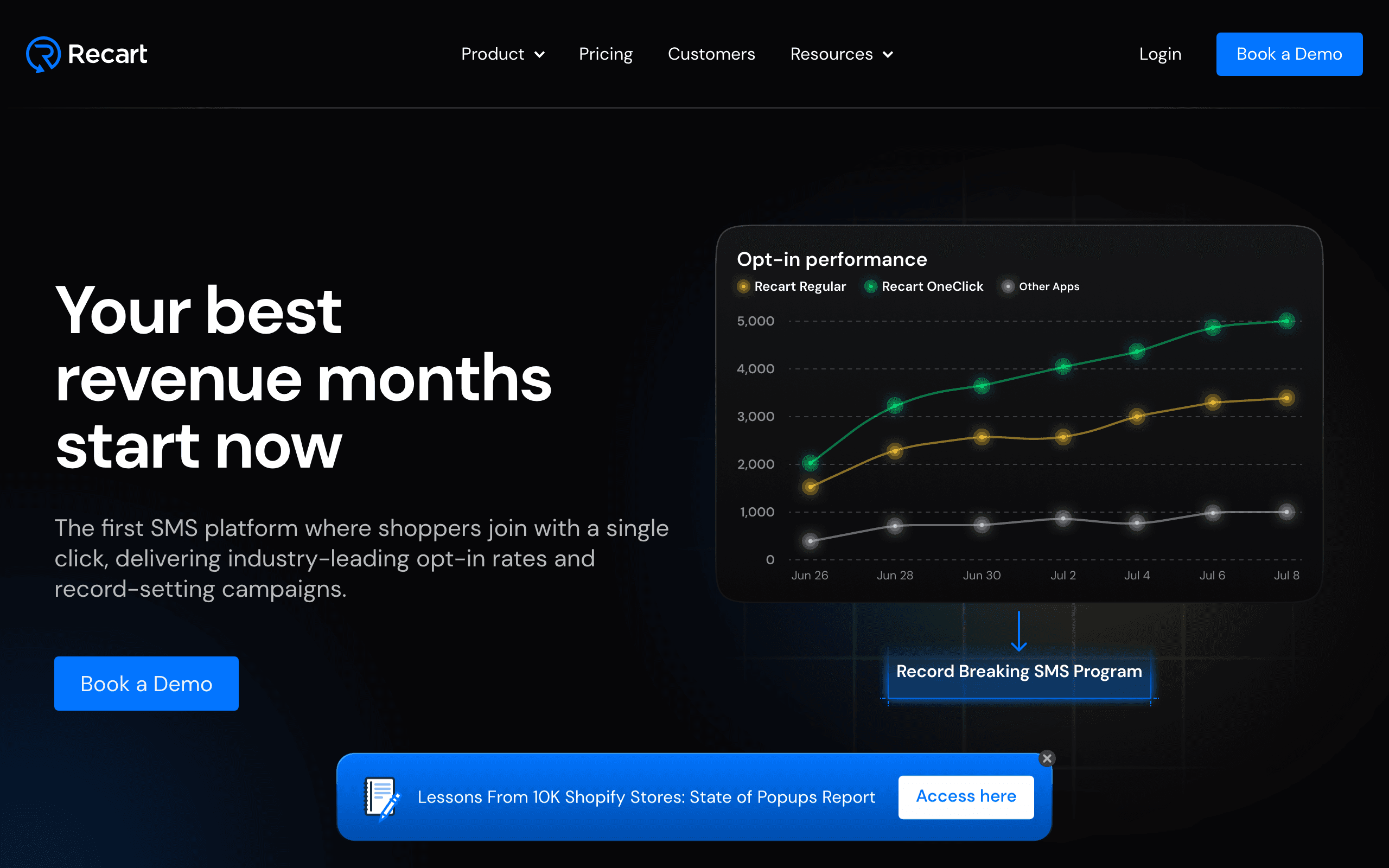
Best for: Shopify brands that want checkout recovery managed by someone else.
Pricing: Shopify App Store paid plans commonly start around $299/month; Recart's own site has quoted higher bundled starting points. Monthly fees convert into message credits, with overages if you exceed them. Confirm which quote you are on.
Recart's original reputation was cart recovery, and that is still the center of the product even as the company sells a broader managed SMS program. You are buying a strategist plus flows: capture units, abandoned checkout sequences, restore links, and weekly reporting. For a store with no internal owner, that package is more honest than a cheaper seat nobody logs into.
It is not an email platform. Attribution on lower tiers has been click-only rather than a full revenue model. Shopify-only. The floor is high for a store that only wanted two reminder texts.
Evaluate the human, not the flow template. If the named contact is the reason recovery will actually get iterated, Recart can beat a better tool that sits idle. If you already have an owner, Postscript or Klaviyo will usually give you more control per dollar.
- Pros: Managed recovery, Shopify capture, restore-oriented flows, someone accountable for the calendar.
- Cons: High monthly floor, not email, Shopify-only, quote and listing prices differ, suppression with your ESP is extra work.
Verdict: Buy the strategist. If you do not need one, do not buy Recart to send reminders.
8. Emotive
Best for: Higher-AOV catalogs where a question, not a reminder, is what blocks checkout.
Pricing: Published tiers around $100/month for Starter, $200/month for Pro, and $300/month for Advanced, plus per-message costs.
Abandoned cart SMS is usually a one-way nudge. Emotive is useful when that model is wrong: furniture, specialty apparel, equipment, anything where "does this come in walnut?" is the actual objection. Human-assisted two-way recovery can close those carts. A 160-character reminder cannot.
It is a poor fit for low-AOV replenishment, impulse products, or stores that will not staff the inbox. Conversation that nobody answers is more damaging than silence. It also needs an ESP, so you must prevent the email cart flow and the Emotive conversation from stacking.
- Pros: Real conversational recovery, transparent-ish tiers, better match for considered purchases.
- Cons: Usage on top of the plan, not an ESP, weaker as a broadcast/automation suite, needs staffing.
Verdict: The objection-handling specialist. Skip it if your carts die from distraction rather than doubt.
9. Sendlane
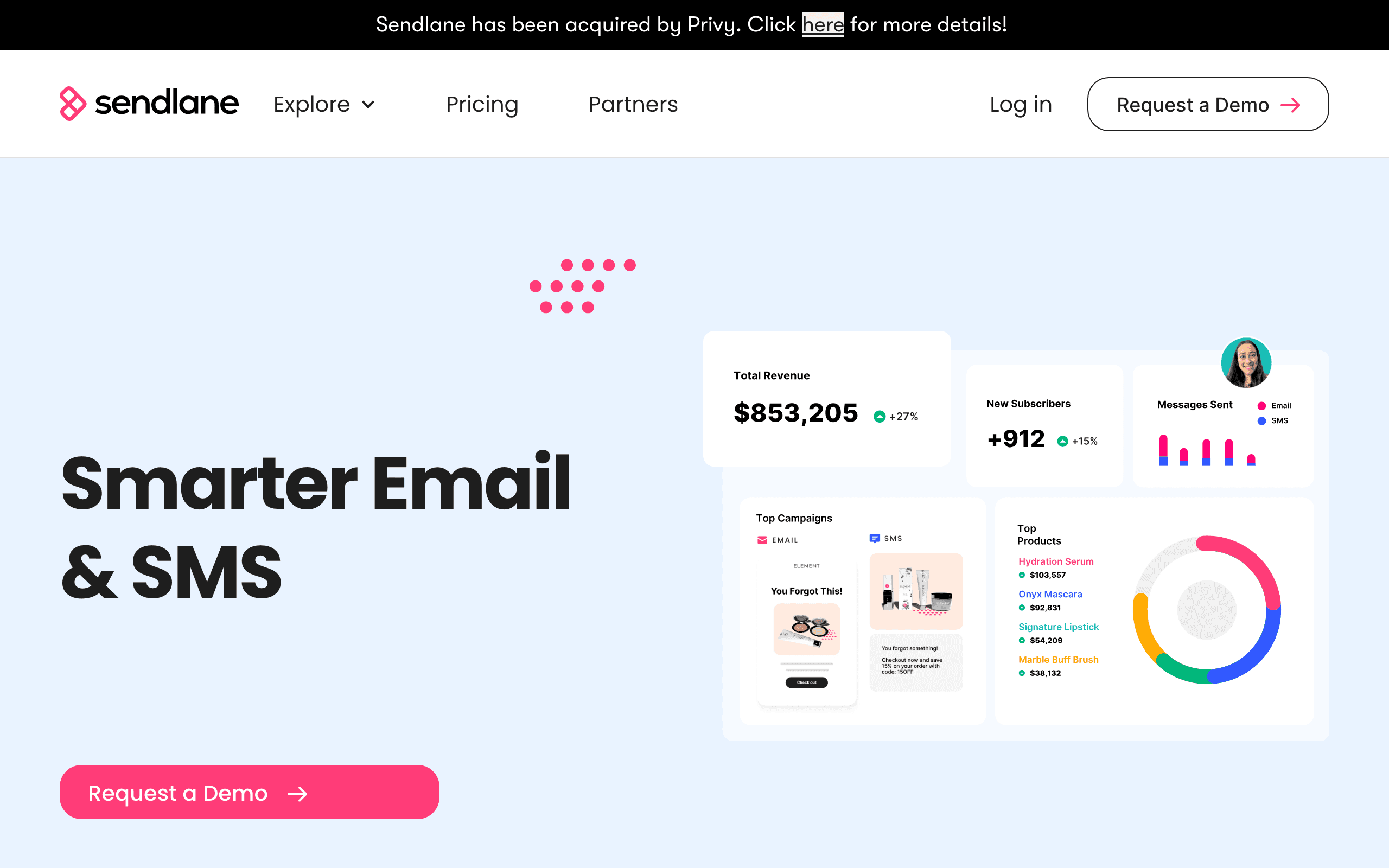
Best for: Shopify stores that want email and SMS recovery together but dislike Klaviyo's profile billing.
Pricing: Email plans start at $100/month for 50,000 emails with unlimited contacts on current plans. SMS starts around $0.009 per credit, with destination rates and promotions subject to change.
Sendlane belongs here as the middle-market bundled option. Shopify cart and checkout data can drive journeys that include both channels, and send-based email pricing is kinder than profile billing if your historical list is large and your recovery audience is small.
It is not as operationally mature as Klaviyo at the high end, and it is a more expensive starting point than Omnisend. Confirm regional SMS economics before you assume the headline credit rate.
- Pros: Email plus SMS on Shopify data, unlimited contacts on current email plans, recovery can live in one journey.
- Cons: Higher floor than Omnisend, smaller ecosystem, SMS rates need a destination check.
Verdict: Worth the demo when Klaviyo's profile bill is the reason recovery SMS never got turned on.
10. Shopify Messaging
Best for: New Shopify stores testing whether a checkout reminder by text is worth a real tool.
Pricing: $2.15/month per approved US/Canada toll-free number, plus per-message charges by country. Shopify Email, separately, includes the first 10,000 marketing emails each month on eligible plans.
Shopify Messaging is the honest minimum. Native checkout context, no second login, no integration to go stale, and a bill that is mostly messages. Combined with Shopify's own abandoned checkout email, a young store can recover carts without a platform project.
It is one message, not a recovery system. No serious branching, no "email first, SMS if they did not click," no conversational inbox, limited segmentation. International per-message rates can surprise you. Treat it as a measurement tool: if native recovery already pays, you have a case for Postscript, Omnisend, or Klaviyo. If it does not, a more expensive app will not magically create consent or intent.
- Pros: Cheapest real Shopify option, native data, no integration, easy to shut off.
- Cons: Shallow automation, weak multi-step recovery, Shopify only, limited coordination with email.
Verdict: The correct first experiment. The incorrect long-term program.
11. Privy
Best for: Stores whose recovery SMS cannot fire because almost nobody has opted in.
Pricing: Around $24/month for popups and displays, or about $30/month with email. SMS credits are sold separately. Display pricing can scale with page views.
Privy is here because cart saver popups and on-site capture change recovery more than a third reminder does. Exit-intent, cart-level offers, and combined email-plus-SMS units increase the number of identified, consented shoppers. That is the input every tool above is starving for.
The messaging layer can send a basic cart reminder. It should not be your recovery platform. Most stores that use Privy well run it in front of Klaviyo, Omnisend, or Postscript, and then have to decide which system owns consent. Make that decision in writing.
- Pros: Cart savers and capture units, cheap relative to the revenue of a larger consented list, fast to launch.
- Cons: Not a recovery engine, SMS extra, usually a second app, popup performance needs testing.
Verdict: Fix the audience. Then pick a recovery tool from higher on this list.
A recovery sequence that does not pick a fight with itself
Do not start from a vendor template that emails and texts on the same trigger at the same minute. Use a sequence that assumes most people either needed a reminder or were going to buy anyway.
| Step | Timing | Audience | Channel | Job |
|---|---|---|---|---|
| 1 | 45–60 minutes after checkout abandonment | Has email, no purchase | Restore link, items, no discount | |
| 2 | 2–4 hours, deferred to local 8am–8pm | SMS consented, no purchase, did not click email, cart above your floor | SMS | Short reminder + restore link |
| 3 | 24 hours | Still no purchase | Objection: shipping, returns, a review | |
| 4 | 48 hours, optional | Still no purchase, first-time buyer or cart above a higher floor | Email or SMS, not both | Last touch. Discount only if you can afford to train the behavior |
Rules that matter more than copy:
- Exit on purchase immediately, including Shop Pay, wallets, and a later purchase of the same SKU on another device.
- Minimum cart value. If the all-in SMS cost is $0.013 and you offer 10 percent off an $18 cart, you can lose money on "wins."
- One recovery owner. If Klaviyo emails and TxtCart texts, Klaviyo must suppress SMS-eligible people from any SMS step, or TxtCart must only see people Klaviyo will not text.
- Turn off duplicates. Shopify's native abandoned checkout email plus Klaviyo plus an SMS app is three programs. Disable the ones you are replacing.
- Hold out 10 percent of eligible SMS abandoners for at least a month before you believe the dashboard.
For email copy and timing in more detail, use the abandoned cart email templates and the email recovery guide. SMS copy should be shorter, named, and free of fake urgency.
Quiet hours versus the "send in 15 minutes" myth
Recovery vendors love short delays because recency sounds like conversion. Two constraints override that instinct.
Consent and the clock. In the US, marketing texts outside reasonable hours create complaints and, in some states, specific risk. Sequenzy defers to 8am–8pm local (with stricter Sunday rules in Texas and CRTC hours in Canada). Whatever you use, overnight abandoners should wake up to one deferred text, not a 12:07am interruption.
You do not yet know they abandoned. A 10-minute delay catches people who are still on the payment screen, switching to a laptop, or waiting on a 3D Secure prompt. Texting them "you left your cart" while they are checking out is how recovery earns its creepy reputation.
A 45–60 minute email and a 2–4 hour SMS, both canceled by purchase, is slower than the landing page and more likely to still be welcome. Speed is not the bottleneck. Consent and suppression are.
What the dashboard will lie about
Cart recovery is the worst place in e-commerce to trust attributed revenue.
The audience already had intent. Many would have completed the order that evening or the next day. A 7-day click window will happily give your SMS credit for a purchase that the customer finished after dinner, unprompted. Vendors know this. "12 percent recovery" is often "12 percent of messaged checkouts placed an order inside our window."
Measure it like this:
- Hold out a random 10 percent of SMS-eligible abandoners.
- Keep email recovery running for both groups, or you will confound the test.
- Compare purchase rate and revenue per abandoner over a fixed window (48 hours and 7 days).
- Subtract message cost, carrier fees, and the cost of any discount.
- Keep the specialist only if the increment clears that hurdle by enough to justify the operational overlap.
If you cannot hold out, you cannot know whether TxtCart, Postscript, or Klaviyo SMS is doing anything. You can only know that people who abandon checkouts sometimes buy.
Cost of a recovery text versus cost of a recovered order
Model the channel at your numbers, not the vendor's.
| Conservative store | Healthier SMS list | |
|---|---|---|
| Abandoned checkouts / month | 4,000 | 4,000 |
| With valid SMS consent | 400 (10%) | 1,200 (30%) |
| Texts sent after email and purchase-exit | 320 | 960 |
| All-in US SMS cost at ~$0.013 | ~$4 | ~$12 |
| Platform fee (Omnisend add-on vs Postscript min vs TxtCart Growth) | $16 to $79 | $16 to $79 |
| Incremental recoveries at +2 percentage points | 6 orders | 19 orders |
| Revenue at $75 AOV | $450 | $1,425 |
Message cost is rarely the reason recovery SMS fails. Platform minimums, discounts, and double-sending are. A $49 or $299 floor on 320 texts is a terrible rate. A 10 percent code on every recovery text can erase the increment in the table above. Capture rate is the lever: moving from 10 percent to 30 percent SMS consent does more than switching vendors.
Frequently asked questions
What is the best abandoned cart SMS tool?
Klaviyo if email and SMS should share one recovery flow, because purchase exit, channel choice, and attribution live in one place. Postscript if SMS is the recovery channel and Shopify is the store. TxtCart if you only want cart recovery and will measure it against a holdout. Omnisend if you want a prebuilt email-plus-SMS cart flow without a specialist rollout. The wrong answer is stacking two recovery tools on the same checkout event.
Is abandoned cart SMS the same as abandoned checkout SMS?
No, and treating them as the same is how stores text the wrong people. Cart abandonment is "added to cart, never started checkout." Checkout abandonment is "started checkout, did not pay." Checkout events usually include an email and often a phone number. Cart events often include neither. Most "cart recovery" SMS programs are actually checkout recovery, because that is when consent and contact details exist.
Can I text someone who abandoned a cart but never opted in to SMS?
No, not for marketing recovery. A phone number collected for shipping, an account, or a previous order is not SMS marketing consent. Email permission never transfers. If the shopper never checked an explicit SMS box, the legal recovery channel is email, not text. Build capture at checkout and on-site; do not import phone numbers from orders and blast them.
Should I send SMS before email for cart recovery?
Usually no. Email is cheaper, carries the product image and restore link cleanly, and does not interrupt. SMS earns its cost as a later step for consented, still-unpurchased, high-enough-value carts that ignored the email. SMS-first can make sense for a genuine time-limited drop or a high-AOV cart that will not wait 24 hours, but it should be the exception you can defend, not the default.
How soon should an abandoned cart text go out?
After you know they did not buy, and inside quiet hours. A common working pattern is email at 45 to 60 minutes, SMS at 2 to 4 hours if they still have not purchased and have SMS consent, then a second email at 24 hours. Sending at 10 minutes feels like surveillance. Sending at 10pm because the cart was abandoned at 9:50pm is how you generate opt-outs. Defer overnight carts to local morning.
What recovery rate should I expect from SMS?
Platform dashboards often show 8 to 15 percent of messaged carts converting inside the attribution window. That number is not incremental. Hold out 10 percent of eligible, consented abandoners, compare purchase rate against the treated group, and treat the difference as the real result. For many stores the incremental lift is 1 to 4 percentage points on top of email, not a replacement for it.
Should I offer a discount in the cart recovery text?
Not in the first message, and not as a default. A reminder plus a restore link recovers people who got distracted. A discount recovers people who were waiting for a discount, and trains the rest to abandon on purpose. If you use an offer, gate it: cart value above a threshold, first-time buyers only, or the last step after email already failed. Track offer cost against incremental orders, not against attributed revenue.
Can I run TxtCart or Recart alongside Klaviyo cart emails?
You can, and you will double-message unless you design the split. Two tools firing on the same checkout event will both claim the order. Either let one system own recovery entirely, or put SMS in the second tool and suppress anyone who received or clicked the email in the first. Test it with a holdout. If the specialist does not beat the existing flow by more than its cost, uninstall it.
Final recommendation
- Already on Klaviyo email: turn on SMS inside the existing checkout flow. Do not add TxtCart until a holdout says you should.
- Shopify, SMS-first recovery: Postscript, and keep email in whichever ESP you already have, with suppression named in writing.
- Recovery is the only SMS you will send: TxtCart on Growth or Starter, measured against a holdout for 30 days.
- Need email plus SMS and a low floor: Omnisend.
- Email sequences already run elsewhere: Sequenzy, so the SMS step and the email step share a goal.
- Nobody will operate the flow: Recart, and judge the strategist.
- High AOV, questions block purchase: Emotive.
- Profile billing is why SMS is off: Sendlane.
- Brand new Shopify store: Shopify Messaging plus native checkout email. Spend the savings on a checkout SMS checkbox that is actually visible.
- List is tiny: Privy (or better on-site units) before any of the above.
- Everyone: disable duplicate native emails, set a cart-value floor, defer quiet hours, and hold out 10 percent.
The best abandoned cart SMS tool is the one that texts fewer people than your abandonment report, stops when they buy, and can prove the rest with a holdout. Everything else is a vendor attributing a purchase that was already going to happen.
Related resources
- Recover abandoned carts with email - the email sequence this SMS step should sit behind
- Abandoned cart email templates - copy you can adapt
- Best SMS marketing tools for e-commerce - the wider store ranking
- Best SMS marketing tools for Shopify - Shopify-only tools
- Best SMS automation tools - flows beyond recovery
- SMS and MMS in Sequenzy - how a Send SMS step works