
Overview
Encharge and Mailchimp serve different markets. Encharge is a SaaS marketing automation platform built for behavioral triggers and user lifecycle campaigns. Mailchimp is a general email platform serving creators, small businesses, and e-commerce. See our Mailchimp comparison for broader context.
Different Markets
Encharge asks "how do I send the right email when a SaaS user does X?" Mailchimp asks "how do I send newsletters and promotions to my audience?" Both are valid questions - they're just different questions. Picking the right tool depends on which question you're answering.
Behavioral Automation
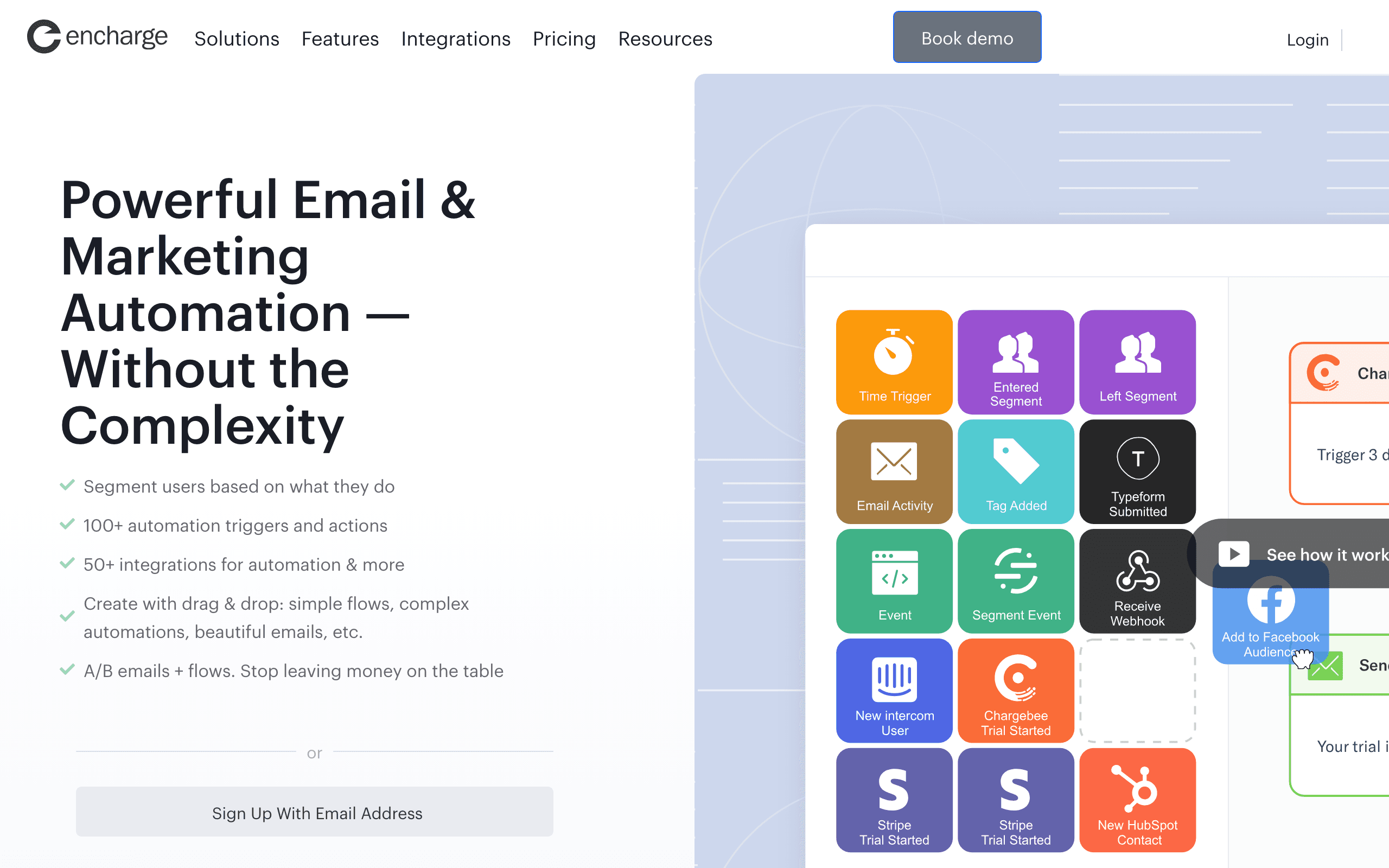
This is where Encharge shines. Build onboarding sequences triggered by user actions. Create lifecycle campaigns based on product usage. Segment dynamically based on events. Mailchimp's automation is mostly time-based with basic triggers - fine for newsletters, limited for SaaS user journeys.
Platform Breadth
Mailchimp is more than email - landing pages, website builder, social media posting, e-commerce integrations. Encharge focuses narrowly on email automation for SaaS. If you need a marketing Swiss army knife, Mailchimp has more tools. If you need deeper SaaS automation, Encharge is more focused.
SaaS Integrations
Encharge connects natively to Stripe, Chargebee, Intercom, and 45+ other SaaS tools. Trigger campaigns when subscriptions change or users interact with support. Mailchimp relies on Zapier for most SaaS integrations - workable but not native.
Pricing Comparison
At 10k contacts: Encharge is $179/month (Growth), Mailchimp is $130/month (Standard). Mailchimp looks cheaper but counts unsubscribed contacts toward limits. Encharge is pricier but purpose-built for SaaS. Both are more expensive than Sequenzy's $49/month.
E-commerce vs SaaS
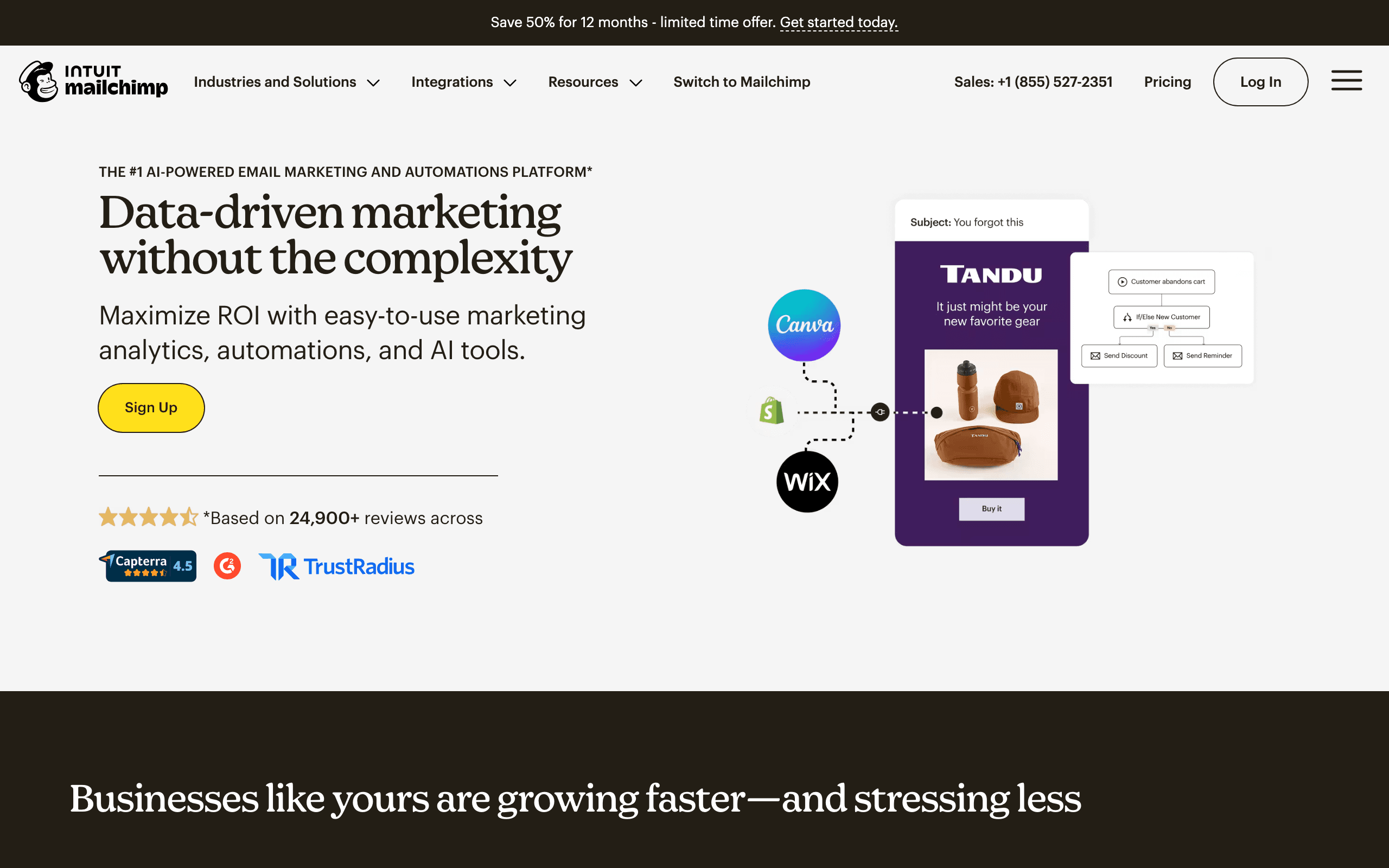
Mailchimp excels for e-commerce with deep Shopify/WooCommerce integrations, abandoned cart, product recommendations. Encharge excels for SaaS with behavioral triggers, onboarding flows, and subscription management. Choose based on your business model.
The SaaS-Focused Alternative
Sequenzy offers SaaS marketing automation like Encharge at a fraction of the price. With native Stripe OAuth for payment triggers and unified transactional email, it's built for SaaS founders who find Encharge too expensive.
Making the Choice
Choose Encharge for advanced SaaS behavioral automation with native integrations. Choose Mailchimp for general email marketing with landing pages and social features. For SaaS-focused email with Stripe integration at simpler pricing, consider Sequenzy.
Specialist vs Generalist Trade-off
This comparison highlights a fundamental choice: do you want a tool built specifically for your SaaS business model, or a general marketing platform that covers more ground? Encharge understands trial conversions, feature adoption, and churn prevention natively. Mailchimp understands email marketing broadly but requires custom work for SaaS-specific workflows.
For SaaS companies with product-led growth motions, Encharge's specialization reduces setup time and provides more relevant automation templates. For SaaS companies that also need landing pages, social media, and broad marketing tools, Mailchimp's breadth may outweigh Encharge's depth.
Landing Pages and Growth Tools
Mailchimp includes landing pages, forms, social media posting, and advertising tools that Encharge completely lacks. For SaaS companies running paid acquisition campaigns, these tools consolidate your marketing stack. With Encharge, you need separate tools for landing pages (Unbounce, Leadpages) and social management, adding cost and complexity.
This gap matters most for early-stage SaaS companies that handle marketing broadly. As companies mature and use specialized tools for each function, the landing page gap becomes less relevant and automation depth becomes more important.
Pricing and Value Perspective
Encharge at $179/month is more expensive than Mailchimp's Standard plan but includes SaaS-specific features Mailchimp cannot match. The value equation depends on how much you benefit from behavioral automation tied to product events. If your conversion funnel relies on tracking user behavior and triggering targeted sequences, Encharge's premium is justified. If your email marketing is primarily newsletters and campaigns, Mailchimp delivers more overall value.
Pricing reality
At 10,000 contacts, this page lists Encharge at $179/month and Mailchimp Standard at $130/month. Mailchimp is cheaper in the listed comparison, but the cost advantage only matters if general email, landing pages, social tools, and ecommerce features are the work to be done.
Encharge's higher price should be justified by behavioral SaaS automation: product events, lifecycle journeys, Stripe or Chargebee data, and lead scoring. If those signals are not part of the funnel, Mailchimp's broader toolkit is likely the more practical buy.
Sequenzy's $49/month price is relevant only when the team wants a smaller SaaS email stack with Stripe-triggered lifecycle and transactional email instead of Mailchimp's broader marketing suite or Encharge's deeper automation product.
Review signals
The Encharge reviews here describe a real switch reason: behavior-based SaaS automation, Stripe integration, and lead scoring. The negative signal is breadth loss: one reviewer missed Mailchimp's landing pages and social features after moving to Encharge.
The Mailchimp reviews show the opposite tradeoff. Users value the free tier, ecosystem, newsletters, and basic automation, but also say product-event workflows require custom work or supplemental tools. That makes Mailchimp a better general marketing platform than a native SaaS lifecycle engine.
Use-case matchups
| Use case | Better fit | Why |
|---|---|---|
| Product-led SaaS onboarding | Encharge | Encharge is built around behavioral triggers, SaaS integrations, and lifecycle flows tied to product actions. |
| General newsletters and promotions | Mailchimp | Mailchimp is stronger when the team needs broad email marketing, templates, forms, landing pages, and a large ecosystem. |
| Ecommerce campaigns | Mailchimp | Mailchimp has deeper Shopify/WooCommerce support and more ecommerce marketing patterns than Encharge. |
| Native SaaS integrations | Encharge | Encharge connects more directly to tools like Stripe, Chargebee, Intercom, and Segment for lifecycle automation. |
| Stripe-aware SaaS email at lower cost | Sequenzy | Sequenzy is better when Stripe events, transactional email, and lifecycle campaigns need one focused workspace. |
| Early-stage marketing breadth | Mailchimp | Mailchimp is easier to justify when the team also needs landing pages, social posting, ads, and basic audience growth tools. |
Best Fit by SaaS Automation Need
Best email automation tool for SaaS onboarding flows
Encharge fits SaaS teams that want behavior-based journeys, trial nurture, and CRM-connected automation without using a generic newsletter-first tool. It is strongest when the marketing team already knows exactly which lifecycle paths need automation.
Best email marketing platform for broad small-business campaigns
Mailchimp fits companies that need newsletters, templates, landing pages, and general campaigns more than SaaS-specific lifecycle logic. It remains the easier fit when the business is not centered on product events or trial conversion.
Best SaaS email platform for Stripe-connected lifecycle email
Sequenzy fits SaaS teams that need signup, activation, billing, failed-payment, and upgrade emails in one place. It is the more direct choice when revenue events should drive the email program without extra integration work.
Migration checklist
- Decide whether the target system should optimize for SaaS behavior data or broad marketing operations before moving contacts.
- Export contacts, custom fields, tags, segments, campaigns, templates, automations, forms, landing pages, product events, integrations, suppressions, and reports.
- If moving to Encharge, define product events, user attributes, lifecycle stages, and SaaS integrations before rebuilding automations.
- If moving to Mailchimp, map Encharge users, tags, attributes, and journeys into audiences, tags, customer journeys, and available ecommerce or Zapier integrations.
- Rebuild priority flows first: welcome, onboarding, activation, trial conversion, newsletter, re-engagement, and churn-prevention sequences.
- Reconnect forms, landing pages, product tracking, billing integrations, ecommerce syncs, webhooks, analytics, and suppression syncing.
- Authenticate SPF, DKIM, and DMARC, then test one broadcast, one product-triggered automation, and one unsubscribe path before full migration.
- Preserve historical event, campaign, automation, revenue, deliverability, and cost reports so the team can compare SaaS depth against platform breadth.
Decision checklist
- Is the email program driven by SaaS product events or general marketing campaigns?
- Would Mailchimp's landing pages, social tools, and ecommerce integrations replace separate tools?
- Does Encharge's behavioral automation justify losing Mailchimp's broader marketing toolkit?
- Will Mailchimp require too many custom integrations for product usage and billing events?
- Is a smaller Stripe-native email stack enough for the SaaS lifecycle work?








