
Overview
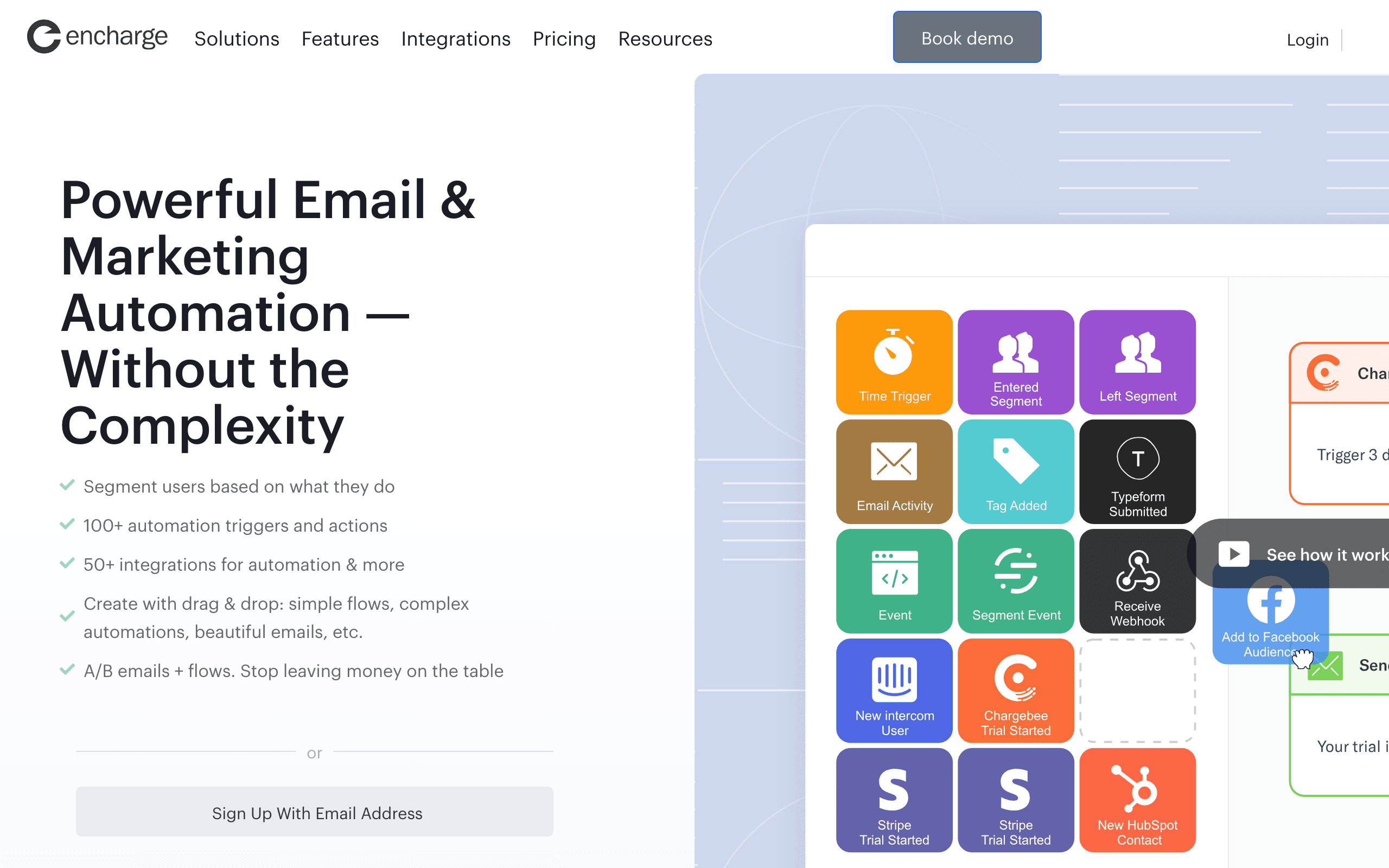
Encharge and Customer.io both serve SaaS companies with behavior-based email automation. Encharge positions itself as a powerful yet affordable option for B2B SaaS. Customer.io is the enterprise choice with multi-channel capabilities and advanced features. Both are solid platforms - the choice depends on your scale and requirements.
Multi-Channel Difference
The biggest functional difference is channel support. Customer.io offers email, push notifications, SMS, and in-app messages from one platform. Encharge is email-only. If you need to reach users across multiple channels, Customer.io is the clear choice. For email campaigns alone, Encharge works great.
SaaS Integrations
Both platforms integrate with SaaS tools. Encharge has native connections to Stripe, Chargebee, Intercom, and 45+ other tools. Customer.io has more integrations (200+) but often requires Segment as middleware for payment platforms. Encharge's direct Stripe integration is an advantage for SaaS billing.
Automation Capabilities
Both have visual flow builders for automation. Customer.io's is more powerful with advanced branching, webhooks, and API actions. Encharge's is simpler but covers most SaaS use cases. For complex segmentation workflows, Customer.io has the edge.
Pricing comparison
At 10,000 contacts, Encharge costs around $179/month and Customer.io's Essentials is $150/month. However, Customer.io's Premium tier (needed for advanced features) starts at $1,000/month. Encharge includes all features at their Growth tier. For comparison, see our Sequenzy pricing at $49/month for 10k contacts with Stripe billing included.
Use-case matchups
| Use case | Better fit | Why |
|---|---|---|
| SaaS email automation with native billing integrations | Encharge | Encharge is purpose-built for SaaS email flows and has direct Stripe and Chargebee connections. |
| Enterprise multi-channel lifecycle messaging | Customer.io | Customer.io supports email, push, SMS, in-app, advanced segmentation, and enterprise-scale workflows. |
| Email-only onboarding and trial conversion | Encharge | The product is simpler when email is the main channel and payment events drive the journey. |
| Data-heavy customer engagement program | Customer.io | It is a better fit when event instrumentation, data warehouse sync, and multi-channel orchestration matter. |
| Simple Stripe lifecycle plus transactional email | Sequenzy | Sequenzy is narrower and cheaper when the need is billing-triggered email rather than broad engagement infrastructure. |
Pricing reality
The headline numbers are not enough for this comparison. Encharge's $179/month benchmark includes its Growth-tier feature set, which can be attractive if you need SaaS email automation and billing integrations without enterprise messaging infrastructure.
Customer.io's Essentials benchmark may look close at 10,000 contacts, but the Premium tier starts much higher and is where many enterprise capabilities become relevant. Price the exact channels, message volume, support tier, data needs, and implementation work before treating it as comparable to Encharge.
Sequenzy's $49/month benchmark is only relevant if the team can stay email-first and does not need SMS, in-app messaging, data warehouse sync, or Customer.io's broader enterprise controls.
Review signals
The sourced review snippets align with the product split: Encharge is praised for value and native Stripe automation, while Customer.io is praised for power, multi-channel journeys, and segmentation. The cautions are also important: Encharge may be outgrown when push or in-app messaging becomes important, while Customer.io can become expensive and technically involved.
Best Fit by SaaS Automation Maturity
Best SaaS email automation tool for native billing integrations
Encharge fits SaaS teams that want email-first onboarding, trial conversion, and payment-triggered workflows with native Stripe or Chargebee connections. It should be tested first when payment events are central and the team does not need push, SMS, or in-app channels yet.
Best customer messaging platform for enterprise multi-channel journeys
Customer.io fits teams that have enough product data, engineering ownership, and budget to operate advanced lifecycle messaging across multiple channels. Choose it when segmentation, data pipelines, API actions, push, SMS, and in-app journeys justify the higher setup effort.
Best email platform for lean Stripe lifecycle automation
Sequenzy fits when the team wants Stripe-triggered lifecycle and transactional email without broader engagement infrastructure. It is the cleaner fit for a lean SaaS stack where email is the primary channel and billing events are the most important automation source.
Migration checklist
| Workstream | Moving toward Encharge | Moving toward Customer.io | Moving toward Sequenzy |
|---|---|---|---|
| People and attributes | Export contacts, companies, attributes, subscription fields, tags, and suppression status. | Map people, objects, attributes, identifiers, and event schema carefully. | Map subscribers, billing attributes, tags, and suppression status. |
| Event tracking | Keep only events needed for email journeys and billing automation. | Instrument product, billing, mobile, web, and lifecycle events with naming discipline. | Focus on Stripe, product, and transactional email events. |
| Channels | Accept an email-only operating model. | Define ownership for email, push, SMS, in-app, and content cards. | Keep channel scope to marketing and transactional email. |
| Automations | Rebuild onboarding, activation, trial, payment, and lifecycle email flows. | Rebuild journeys with channel branching, API actions, and advanced segmentation. | Rebuild billing, lifecycle, campaign, and transactional paths. |
| Integrations | Reconnect Stripe, Chargebee, CRM, support, analytics, and product tools. | Reconnect CDP, warehouse, analytics, mobile, product, and messaging integrations. | Connect Stripe and required store/product integrations. |
| Reporting | Export flow performance, conversion, segment, and engagement history. | Export campaign, journey, channel, segment, and data warehouse reporting. | Export lifecycle and transactional metrics needed for continuity. |
Decision checklist
- Is email enough, or are push, SMS, and in-app already required?
- Does Stripe or Chargebee integration need to be direct and simple?
- Will the team maintain Customer.io's event schema and segmentation complexity?
- Is the Premium-tier capability worth the procurement and implementation cost?
- Is the real goal a smaller Stripe-triggered email stack?
Making the Choice
Choose Encharge if you need solid email automation for SaaS at a reasonable price with good payment tool integrations. Choose Customer.io if you need enterprise-grade features, multi-channel messaging, or have complex segmentation requirements. Or explore Sequenzy's behavioral targeting for a simpler, more affordable option with transparent pricing.
Multi-Channel vs Email-Only Trade-off
The most significant architectural difference is channel support. Customer.io orchestrates email, push notifications, SMS, and in-app messages from unified workflows. Encharge sends email only. For SaaS companies that communicate primarily through email, this is not a limitation. For companies that need to reach users across multiple touchpoints, Customer.io's multi-channel capability is essential.
Consider how your users interact with your product. If they check email regularly and your communication is primarily marketing and lifecycle messaging, Encharge covers your needs. If you need to send real-time push notifications, in-app messages, or SMS alerts, Customer.io is the only option here.
Enterprise Scale Considerations
Customer.io is built for scale. Data warehouse sync, advanced API actions within workflows, and enterprise security features support large SaaS companies with millions of users. Encharge targets mid-market SaaS companies and may show limitations at enterprise scale.
The pricing reflects this difference. Customer.io's Premium plan at $1,000/month is designed for companies that need enterprise-grade infrastructure. Encharge's Growth plan at $179/month serves companies that need solid automation without enterprise complexity. Know your growth trajectory before committing.
Payment Integration Approaches
Encharge connects natively to Stripe and Chargebee, making payment event triggers straightforward to implement. Customer.io typically requires Segment as middleware to receive payment data, adding complexity and cost to the setup. For SaaS companies where subscription events drive automation, Encharge's direct payment integrations are a genuine advantage over Customer.io's more complex approach.









