
12 Best Shopify Email and SMS Marketing Apps in 2026

The Shopify App Store makes it easy to install an email app and an SMS app in the same afternoon, and hard to notice that you have just created two customer databases that will disagree with each other by Christmas.
That is the real decision here. Not which app has better templates, but whether you run one app that owns both channels or two apps that each own one. Everything else follows from that: how consent is stored, whether a text can be suppressed because an email already worked, whether your reported revenue double-counts, and whether a customer who unsubscribes actually stops hearing from you.
I compared 12 apps on that basis first, then on the usual things: Shopify event fidelity, capture tooling, automation depth, and stacked cost at real store sizes. I have been specific about what breaks in two-app setups, because that failure mode is common, expensive, and almost never discussed in app listings.
For the email-only version, see the best Shopify email marketing apps. For the SMS-only version, see the best SMS marketing tools for Shopify.
Quick comparison table
| App | One app or two | Email cost at 10k | SMS cost | Cross-channel suppression |
|---|---|---|---|---|
| Klaviyo | One | About $150/mo | Credit bundles, from about $35/mo bundled | Yes, inside a single flow |
| Omnisend | One, plus push | About $115 to $132/mo | $0.007 to $0.009 per US SMS on Pro | Yes, on one canvas |
| Attentive | One, at scale | Bundled in a custom quote | Custom, roughly $0.01/SMS with commitments | Yes, cross-channel journeys |
| Sendlane | One | $100/mo for 50k sends, unlimited contacts | From about $0.009 per credit | Yes |
| Sequenzy | One | Send-based, paid plans from $19/mo | Add-on from $16/mo with 1,000 credits | Yes, steps in one sequence |
| Postscript | SMS half of two | Newer email product | $0.007 to $0.009 plus carrier fees | Within its own flows only |
| Recart | SMS half of two | Not an email app | From about $299/mo managed | Within its own flows only |
| Emotive | SMS half of two | Not an email app | From about $100/mo plus usage | Within its own flows only |
| TxtCart | SMS half of two | Not an email app | Growth around $79/mo, about $0.008/SMS | Single use case |
| Privy | Capture plus light messaging | From about $30/mo with email | Credits sold separately | Limited |
| Shopify Email plus Messaging | Native pair | Free under 10k emails | $2.15/mo per toll-free number plus messages | Minimal |
| Yotpo | Retention data source | Native email retired end of 2025 | Native SMS retired end of 2025 | Not applicable |
Pricing and product availability change frequently. Confirm current rates, plan gates, and carrier fee treatment before committing.
Decide one app or two before anything else
This choice determines your architecture, your bill, and your failure modes. Make it deliberately.
The case for one app
Shared suppression works by default. An unsubscribe, a bounce, a complaint, or a global opt-out applies to the customer, not to a channel silo.
One flow can decide the channel. Send an email, wait six hours, check whether it converted, and text only the people it did not reach. This is the single most valuable capability in cross-channel messaging and it is effectively impossible across two apps without engineering.
One frequency cap. Customers experience total interruptions per week, not your email calendar and your SMS calendar separately.
One attribution model. Two apps will both claim the same order, which inflates your reported revenue and corrupts the channel decisions you make from it.
One bill and one integration to maintain. Fewer scopes, fewer theme extensions, fewer things to re-test after a Shopify update.
The case for two apps
Specialist SMS is genuinely better. Postscript's reply management is a workflow, not a forwarded inbox. Attentive's capture units convert materially better than an email form with a phone field.
Independent scaling. An SMS specialist's per-message rate drops at higher tiers in a way bundled platforms rarely match.
Migration risk is contained. Changing your ESP does not mean re-registering a phone number and re-introducing yourself to your SMS list.
The honest test
Ask which channel produces more revenue today. If email does, use one app and accept slightly weaker SMS. If SMS does, a specialist is probably worth the operational cost, but only if you will actually maintain the sync.
Most stores that split do it well for three months and badly after the person who set it up moves on.
What breaks in a two-app setup
Every item here is something I have watched happen on a real store.
The unsubscribe that does not propagate. A customer replies STOP to a text. The SMS app suppresses them. The email app never hears about it and keeps mailing. Legally these are separate consents, so this is not always wrong, but it is almost never what the customer expects.
The duplicate promotion. Both apps have a segment called "VIP." They diverge over six months. A Black Friday campaign goes out from both, and your best customers get an email and a text about the same offer twenty minutes apart.
The double-counted order. Email attributes the order because of a click three days ago. SMS attributes it because of a click an hour ago. Your reported revenue exceeds your actual revenue, and you allocate budget accordingly.
The refund that only one app knows about. The email app suppresses the review request. The SMS app sends "how are you enjoying your order?" to someone who returned it.
The customer record that forks. One app keys on email address, the other on phone number. A customer who changes one of them becomes two people.
The Shopify consent field nobody reads. Shopify stores an SMS marketing consent state on the customer record. Some apps read and write it faithfully; others maintain their own database and treat Shopify's field as advisory. Test this directly rather than assuming.
If you run two apps, write down who owns identity, who owns consent, who owns suppression, who owns the frequency cap, and who owns attribution reconciliation. If you cannot name a person for each, use one app.
How I evaluated these apps
- Installed each on a test store, recorded the scopes requested, and checked whether Shopify's SMS consent field was read and written.
- Built a cross-channel flow: email, wait, branch on open and purchase, SMS to non-converters, exit on purchase.
- Opted out of SMS and checked whether email was affected, and vice versa.
- Placed a refund and confirmed which downstream messages were suppressed.
- Sent overlapping campaigns from two-app setups and measured the duplicate rate.
- Compared the sum of channel-attributed revenue against actual store orders.
- Priced single-app and two-app setups at 5,000, 10,000, and 25,000 contacts with realistic message volumes.
The 12 best Shopify email and SMS apps
1. Klaviyo
Best for: Stores that want one app making every channel decision.
Pricing: Email from about $20/month, roughly $150/month at 10,000 active profiles. Email and SMS plans start around $35/month including 1,250 SMS or MMS credits, with usage beyond that billed separately.
Klaviyo is the strongest single-app answer, and the reason is architectural rather than feature-by-feature. Email and SMS share one profile, one segment builder, and one flow canvas, so the conditional "text only the people the email did not convert" pattern is native.
The Shopify data underneath is the deepest available: browse behavior with product identity, checkout events with full cart contents, refunds, fulfillment, discounts, and consent. Both channels get to use all of it, and reporting is flow-level rather than channel-level, so you can evaluate an individual SMS step.
Where it loses is SMS specialization. Capture units are good rather than exceptional, reply handling is functional rather than a workflow, and there is no RCS. Active-profile billing also means a dormant list costs money before you send anything.
- Pros: True shared profile and segments, genuine cross-channel suppression, deepest Shopify data, flow-level attribution, one bill.
- Cons: SMS capture and replies trail the specialists, active-profile billing, SMS credits stack on the email plan, learning curve.
Verdict: The default single-app choice when coordination matters more than SMS depth.
2. Omnisend
Best for: Stores under roughly 10,000 contacts that want three channels for one price.
Pricing: Standard from about $16/month, roughly $115 to $132/month at 10,000 contacts. On current Pro plans, US and Canada SMS runs from about $0.009 down to $0.007 per message, with bundles from around $10/month and credits rolling over for 60 days.
Omnisend is the best value in this comparison and genuinely multichannel rather than email with a text bolt-on. Email, SMS, and web push share one canvas and one subscriber record, so a three-channel journey is a few clicks rather than a rebuild.
Prebuilt commerce automations cover welcome, cart, browse abandonment, and post-purchase, and the included signup forms mean many stores skip a separate capture app entirely.
Its limits are segmentation depth, thin reply handling, and the fact that SMS sits behind the Pro plan on current pricing, which is an awkward gate for a store wanting a couple of thousand texts a month.
- Pros: Three channels on one canvas, best value under 10k contacts, strong prebuilt flows, forms included, credits roll over.
- Cons: SMS gated to Pro, segmentation ceiling, weak reply handling, contact-based billing.
Verdict: The best-value single app, and the right first install for most growing stores.
3. Attentive
Best for: Stores where messaging has a dedicated owner and real budget.
Pricing: Custom and consumption-based across SMS, email, RCS, and push. Reported minimums commonly sit around $2,000 to $3,000 per quarter, with roughly $0.01 per SMS and volume commitments often starting near 50,000 messages a month.
Attentive is the premium single-vendor option. Its cross-channel journeys are real, its email product is credible enough that some brands consolidate onto it entirely, and its SMS is the best in the category.
What you are actually buying sits upstream of messaging: the best signup units available, two-tap mobile capture, RCS, conversational commerce at scale, and strategic support that meaningfully offsets internal headcount.
It is sales-led with no published rate card, contract-based, and priced for volume with commitments that survive a volume drop. Below roughly $5M in revenue it is very hard to justify.
- Pros: Best-in-class capture, RCS and conversational commerce, genuine cross-channel journeys, strategic support, one vendor for both channels.
- Cons: Enterprise minimums and commitments, no published pricing, contract complexity, excessive for most Shopify stores.
Verdict: The premium one-app answer, and only at scale.
4. Sendlane
Best for: Established stores with large databases that want both channels in one place.
Pricing: Professional from $100/month for 50,000 email sends with unlimited contacts. SMS from about $0.009 per credit, subject to destination rates.
Sendlane is the single-app option that fixes a billing problem at the same time. Unlimited contacts on send-based email pricing means a large accumulated Shopify database costs nothing to hold, and SMS is priced competitively on top with no plan gate.
Email and SMS share profiles and segments properly, so cross-channel suppression works, and the commerce depth is genuinely competitive for most practical purposes.
The $100 floor makes it poor value below roughly 8,000 contacts, the ecosystem is smaller, and international SMS economics need checking against your destination mix.
- Pros: Unlimited contacts on send-based pricing, real cross-channel suppression, no SMS plan gate, strong multi-store support.
- Cons: $100/month floor, smaller ecosystem, less recognition with agencies, regional SMS needs verification.
Verdict: The best one-app choice for a store with a big dormant list.
5. Sequenzy
Best for: Stores that want SMS as a step inside lifecycle sequences, especially with non-Shopify revenue.
Pricing: Paid plans from $19/month with send-based email pricing and unlimited contacts, plus an SMS add-on from $16/month including 1,000 credits on any paid plan.
Disclosure: I build Sequenzy. Against the specialists this is a step down in SMS depth, and against Klaviyo it is a step down in merchandising. Worth saying plainly before the case for it.
Where it fits is a store that wants one subscriber record covering both channels and, often, more than one revenue system. The Shopify integration handles store events while Stripe, Paddle, Polar, Creem, and Dodo Payments handle subscription and digital revenue, so a store selling product plus memberships is not running two platforms.
For messaging specifically: a Send SMS step drops into any sequence beside email steps, using the same subscribers, segments, and revenue attribution. SMS consent is a separate field from email status and is never inferred from a phone number, so a customer can be email-only or SMS-only without ambiguity. Sequenzy provisions a dedicated toll-free number, guides carrier verification, handles STOP, START, and HELP per number, and defers sends outside local quiet hours. All of it is exposed through a full API, CLI, and MCP server.
Honest limits: no in-app two-way SMS inbox, MMS is US and Canada only, no predictive analytics, and it is an external platform rather than an embedded Shopify app.
- Pros: Email and SMS in one sequence, separate consent per channel by design, send-based pricing with unlimited contacts, SMS add-on with no plan gate, Shopify plus billing platforms in one profile, full API, CLI, and MCP.
- Cons: No two-way inbox, MMS US and Canada only, lighter merchandising than Klaviyo, not an embedded app.
Verdict: Right when email leads and SMS supports. Wrong when SMS needs to be a specialist program.
6. Postscript
Best for: The SMS half of a two-app setup, when SMS is the priority.
Pricing: Starter $0/month with a $49 minimum monthly spend at about $0.009/SMS and $0.045/MMS. Growth $100/month at about $0.008/SMS. Professional $500/month at about $0.007/SMS. Average US carrier fees of about $0.00418/SMS and $0.00841/MMS are billed separately.
Postscript is the strongest self-serve SMS app on Shopify. Flows branch on product, order frequency, and lifetime value with less setup than a general platform requires, reply management is a genuine workflow, and the published rate card removes the quote comparison entirely.
It has an email product, but it is newer and should be evaluated on its own merits rather than assumed to be at parity with a mature ESP. Most stores run it alongside Klaviyo or another platform.
That pairing is where the two-app problems in this article come from. If you choose it, solve suppression and frequency capping deliberately before launch.
- Pros: Best self-serve Shopify SMS, published transparent rates including carrier fees, deep commerce branching, real reply management.
- Cons: Usually means a second app and a second database, minimum spend at low volume, email product is newer, Shopify-centric.
Verdict: The best SMS half of a two-app setup, with a real operational cost attached.
7. Recart
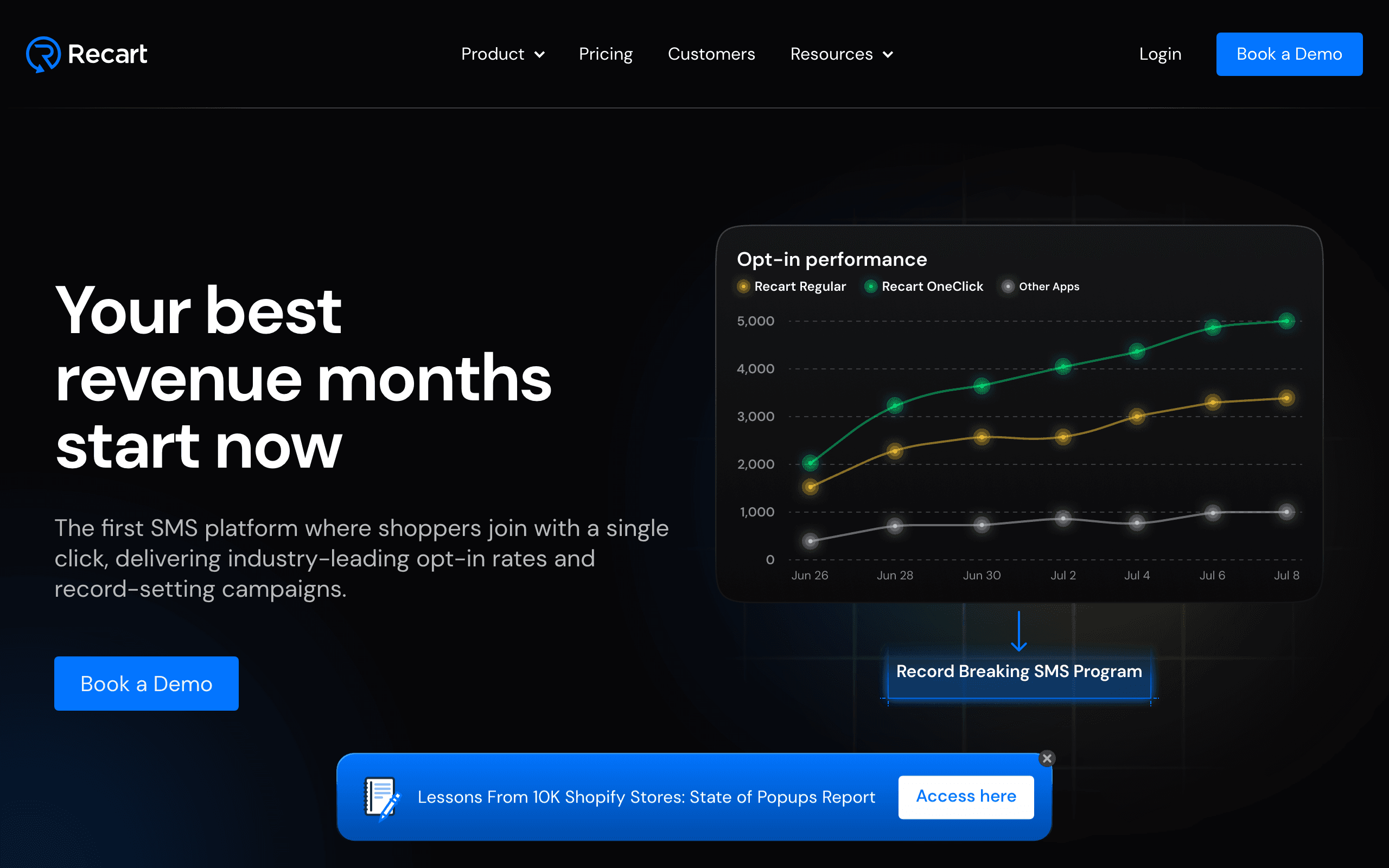
Best for: Stores that want the SMS half run for them.
Pricing: Plans from about $299/month with unlimited subscribers, a dedicated strategist, and a toll-free number included. Higher tiers around $999/month bundle substantial message volume.
Recart sells a managed SMS program rather than software. Every account gets a customer success manager handling strategy, copy, scheduling, testing, and weekly reporting, which is often worth more than a better interface for a store with no internal SMS owner.
The platform is built around Shopify list growth and recovery, with solid capture units and abandoned-checkout programs.
It is not an email app, so it is always the SMS half of a pair, and attribution differs by tier, with click-only attribution on the entry plan. Evaluate the strategist, because that is the product.
- Pros: Managed program at every tier, unlimited subscribers, number included, strong Shopify capture and recovery.
- Cons: Not an email app, high monthly floor, no shared suppression with your ESP, attribution varies by tier.
Verdict: Buy it when nobody internally will own SMS.
8. Emotive
Best for: Stores whose SMS mechanic is genuine conversation.
Pricing: Published tiers around $100/month for Starter, $200/month for Pro, and $300/month for Advanced, plus per-message costs.
Emotive centers on two-way conversation with human-assisted responses rather than broadcast with replies attached. For considered purchases and high-AOV categories, that converts better than another discount.
It pairs with an ESP rather than replacing one, and its lower floor makes it a cheaper SMS half than Recart for stores that want conversation without a managed calendar.
Automation depth and Shopify branching do not match Postscript, and per-message costs sit on top of the plan.
- Pros: Genuine conversational model, human-assisted responses, transparent tiers, lower floor than managed options.
- Cons: Not an email app, usage on top of plans, less Shopify branching depth, no shared suppression with your ESP.
Verdict: The conversational SMS half, for categories where questions block purchases.
9. TxtCart
Best for: Stores where cart recovery is the only SMS worth running.
Pricing: Recent published pricing shows a Growth plan around $79/month at about $0.008/SMS and $0.030/MMS, with a trial and starting credits. Older plans charged a percentage of attributed sales, so confirm which model you are quoted.
TxtCart does one job: recover abandoned carts and checkouts with AI-assisted conversational messages.
If your audit shows that cart recovery produces almost all of your incremental SMS revenue while campaigns mostly produce opt-outs, adding a narrow tool at a low floor beats a full SMS platform.
Measure it against a holdout, and be clear that it overlaps with your email cart flow. The question is not whether it recovers carts, it is whether it recovers carts your email did not.
- Pros: Low floor, focused on the highest-intent use case, conversational recovery, transparent current rates.
- Cons: Single use case, overlaps your existing cart flow, not an email app, pricing model has changed.
Verdict: A tactical addition, not a channel strategy.
10. Privy
Best for: Stores whose real problem is that too few people have opted in to either channel.
Pricing: Around $24/month for pop-ups and displays only, or about $30/month with email included. SMS credits are sold separately.
Privy is here as a diagnostic. If your SMS list is under 10 percent the size of your email list, no amount of app switching will improve revenue. Capture will.
Exit intent, spin-to-win, cart savers, and targeted mobile units are what it does well, and a combined email-plus-SMS capture unit typically outperforms an SMS-only one.
Its messaging layer handles a welcome and a cart reminder adequately but is not a program. Most stores run it alongside a primary app, which means deciding who owns consent.
- Pros: Strong on-site capture for both channels, cheap relative to impact, quick to deploy, good Shopify fit.
- Cons: Not a full messaging platform, SMS credits separate, adds an app rather than removing one, popup performance impact worth testing.
Verdict: Fix capture here before comparing messaging apps.
11. Shopify Email plus Shopify Messaging
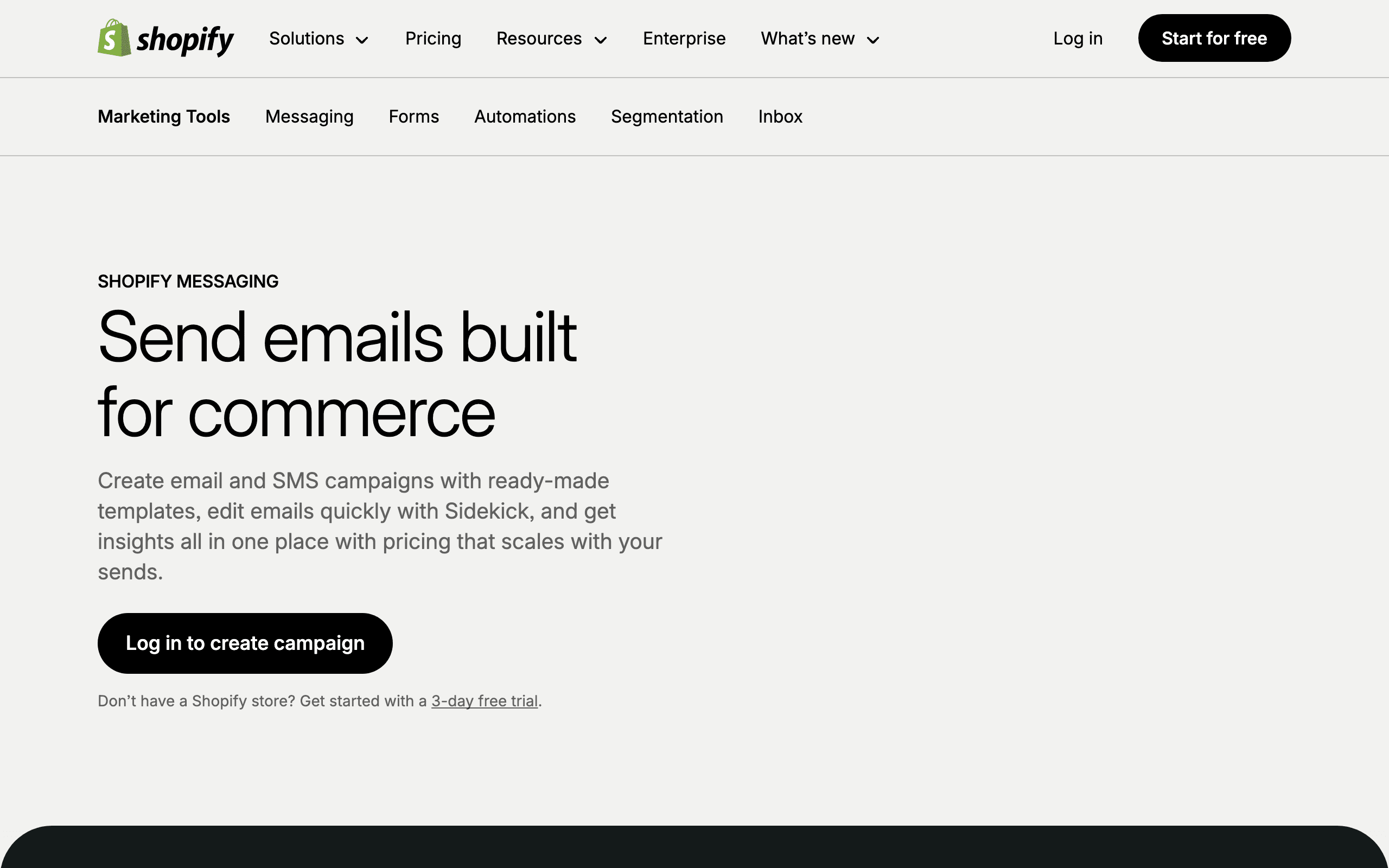
Best for: New stores validating whether either channel works.
Pricing: Shopify Email includes the first 10,000 marketing emails each month on eligible plans. Shopify Messaging is $2.15/month per approved toll-free number for US and Canada marketing SMS, plus per-message charges that vary by country.
This is the cheapest genuine email-plus-SMS setup on Shopify, and it is a legitimate starting point. No integrations, no scopes, no theme extensions, native access to catalog and customer data, and a combined fixed cost of a couple of dollars a month.
Both products read Shopify's own customer and consent data, so the two-database problem does not arise in the same way.
What you give up is everything that makes this article necessary: no cross-channel conditional logic, basic segmentation, narrow automation, and no meaningful attribution. Shopify's abandoned-checkout message is one message, not a recovery flow.
- Pros: Almost no fixed cost, native data with no integration, no scopes or theme extensions, both channels from one admin.
- Cons: No cross-channel logic, minimal segmentation and automation, thin attribution, Shopify only.
Verdict: The right place to start, and a clear signal to move once either channel earns its keep.
12. Yotpo
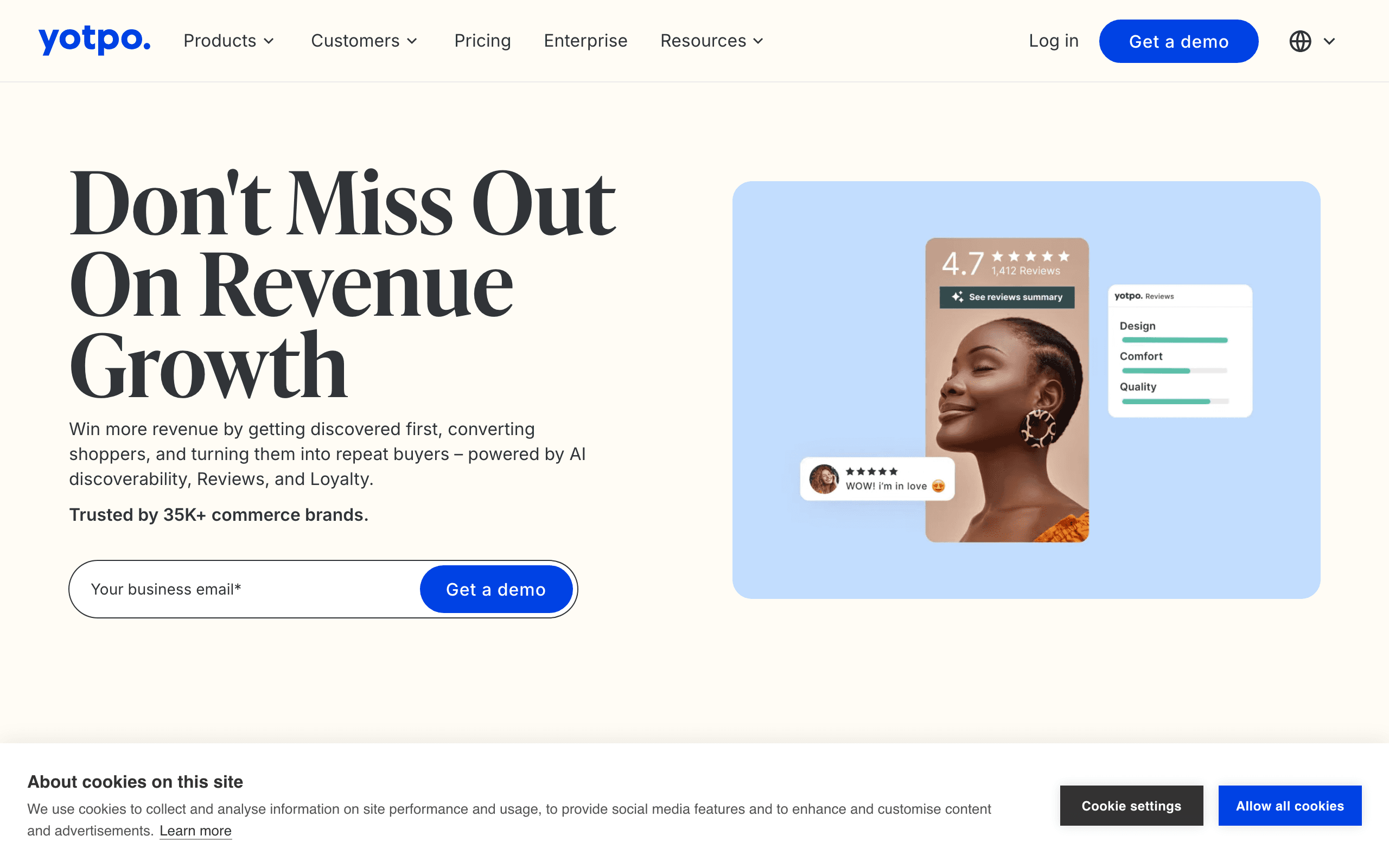
Best for: Stores using Yotpo reviews and loyalty as a data source, not a messaging vendor.
Pricing: Demo-led, with package pricing across the retention suite.
Yotpo appears on most Shopify email-and-SMS lists out of habit, and the situation has changed. It retired its native Email and SMS products at the end of 2025, so brands wanting Yotpo-connected messaging now need a separate messaging platform alongside the reviews and loyalty products.
That does not make Yotpo irrelevant. Review submissions, loyalty tier changes, and reward events are genuinely useful triggers, and feeding them into Klaviyo, Omnisend, or another platform is a reasonable architecture.
It does mean you should not plan around Yotpo as the app that sends your emails or texts. Verify the current product state directly before building anything on it.
- Pros: Strong reviews and loyalty data, useful retention triggers, established in mid-market retail.
- Cons: Native email and SMS retired at the end of 2025, demo-led pricing, requires a separate messaging platform.
Verdict: A retention data source that feeds your messaging app, not the messaging app itself.
What the stacked bill actually looks like
Compare one-app and two-app setups honestly. Both scenarios assume 10,000 contacts, 60,000 emails, and 20,000 US texts a month.
| Setup | Email cost | SMS cost | Carrier fees | Approximate total |
|---|---|---|---|---|
| Klaviyo, one app | About $150 | About $180 in credits | Typically included in the credit rate | Around $330 |
| Omnisend Pro, one app | About $115 to $132 | About $180 | Typically included | Around $300 to $315 |
| Sendlane, one app | $100 for 50k sends, likely a higher tier at 60k | About $180 | Confirm treatment | Around $300 |
| Sequenzy, one app | Send-based plan | SMS add-on plus credits | Cost-weighted credits | Depends on tier |
| Klaviyo email plus Postscript Growth | About $150 | $100 plan plus about $160 | About $84 billed separately | Around $494 |
| Shopify Email plus Messaging | Free under 10k emails, per-email above | About $180 in messages | Included in message rate | Around $185 plus email overage |
Two observations that matter more than the exact numbers:
A two-app setup costs roughly 50 percent more in this scenario, before counting the operational overhead of maintaining the sync. That premium is worth paying when SMS specialization drives real incremental revenue and is wasteful when it does not.
Carrier fee treatment changes the comparison. Postscript publishes about $0.00418 per SMS in average US carrier fees on top of its platform rate. Vendors that quote inclusive rates look more expensive per message and are often cheaper in total. Ask every vendor directly.
Which message goes on which channel
The value of a combined setup is deciding, not sending both.
| Moment | Channel | Reasoning |
|---|---|---|
| Welcome | Email, plus one SMS confirmation | Detail belongs in email; the text confirms cadence and opt-out. |
| Abandoned checkout | Email first, SMS to non-converters | Highest-intent audience, but only text the people the email missed. |
| Back in stock | SMS | Time-sensitive and genuinely wanted. See back-in-stock patterns. |
| Price drop | SMS | Short window, clear value. See price-drop alerts. |
| Shipping and delivery | SMS, transactional | Highest open rate, reduces support tickets, separate consent basis. |
| Post-purchase education | Long-form, no urgency. | |
| Review request | Nothing lost by arriving tomorrow. | |
| Replenishment | Email, SMS only if the window is tight | Depends on real product cadence. |
| Product drop with limited stock | SMS to a targeted segment | The clearest promotional case for a text. |
| Weekly newsletter | Never a text. |
The rule underneath: if a customer could read it tomorrow without losing anything, it is an email.
Frequently asked questions
What is the best Shopify app for email and SMS together?
Klaviyo, for most stores with meaningful data. Email and SMS share one profile, one segment definition, and one flow, which is what makes it possible to text only the people the email did not convert. Omnisend is the better value under roughly 10,000 contacts and adds push. Attentive is stronger at scale when messaging has a dedicated owner and budget.
Should I use one app for both channels or two?
One app if coordination matters more than SMS depth, because shared suppression, a single frequency cap, and one attribution model are hard to reproduce across two systems. Two apps if SMS needs specialist capabilities like real reply management, two-tap capture, or RCS. If you split, name which system owns identity, consent, suppression, and the frequency cap before you launch.
Does Shopify sync SMS consent between apps?
Shopify stores an SMS marketing consent state on the customer record, and well-behaved apps read and write it. That is not the same as a shared suppression list: an unsubscribe recorded in one app's own database may never reach the other. Test it directly by opting out in one app and checking whether the other still considers the customer messageable.
How much does running email and SMS on Shopify cost?
Budget the email plan, the SMS credits or per-message rate, carrier fees where billed separately, and any plan tier required to unlock SMS. A store with 10,000 contacts sending 60,000 emails and 20,000 texts a month commonly lands between $250 and $500 all in, and a two-app setup adds a second platform fee on top of that.
Can I use Shopify Email and Shopify Messaging instead of an app?
Yes, and it is the cheapest real option. Shopify Email includes the first 10,000 marketing emails a month on eligible plans and Shopify Messaging charges $2.15 a month per approved toll-free number plus per-message costs. What you give up is cross-channel logic, segmentation depth, and multi-step recovery flows, so treat it as a starting point rather than a program.
What happened to Yotpo Email and SMS?
Yotpo retired its native Email and SMS products at the end of 2025, so brands wanting Yotpo-connected messaging now need a separate messaging platform alongside Yotpo's reviews and loyalty. If you are planning around Yotpo as a messaging vendor, verify the current product state directly before committing.
Will two apps double-message my customers?
They will unless you prevent it. Two apps have two schedules, two segment definitions, and no shared frequency cap, so a promotion sent from both lands as an email and a text within the same hour. Fix it with a written calendar rule, a single owner for campaign scheduling, and a suppression sync that someone is responsible for maintaining.
Which app has the best SMS on Shopify?
Postscript for self-serve: Shopify-native flows that branch on product, order frequency, and lifetime value, genuine reply management, and published rates. Attentive is stronger overall, with the best capture units and RCS, but it is sales-led with reported minimums around $2,000 to $3,000 per quarter. Klaviyo's SMS is good and better architecturally, but not as specialized as either.
Final recommendation
- Most stores: one app. Klaviyo if data depth matters, Omnisend if value and speed matter more.
- Under 10,000 contacts: Omnisend. Three channels, one canvas, one bill.
- Large dormant database: Sendlane. Unlimited contacts fixes the cost problem while keeping both channels together.
- Lifecycle-led or hybrid revenue: Sequenzy, so store and subscription customers share one profile and one sequence.
- SMS is the bigger channel: Postscript plus an ESP, with suppression and frequency capping solved before launch.
- No internal SMS owner: Recart, and buy the strategist.
- Conversation drives conversion: Emotive.
- Only cart recovery works: audit first, then TxtCart.
- Messaging is a department: Attentive.
- Brand new store: Shopify Email plus Shopify Messaging, and spend the difference on traffic and capture.
- Small SMS list: Privy, before anything else.
The stores that do well with both channels are not the ones with the best apps. They are the ones that decided, in writing, which system owns the customer and when a text is allowed to interrupt.
Related resources
- Best Shopify email marketing apps - the email-only comparison
- Best SMS marketing tools for Shopify - the SMS-only comparison
- Best email and SMS marketing platforms - beyond Shopify
- Best SMS marketing platforms with Shopify integration - integration depth specifically
- SMS and MMS in Sequenzy - how the add-on works