
Overview
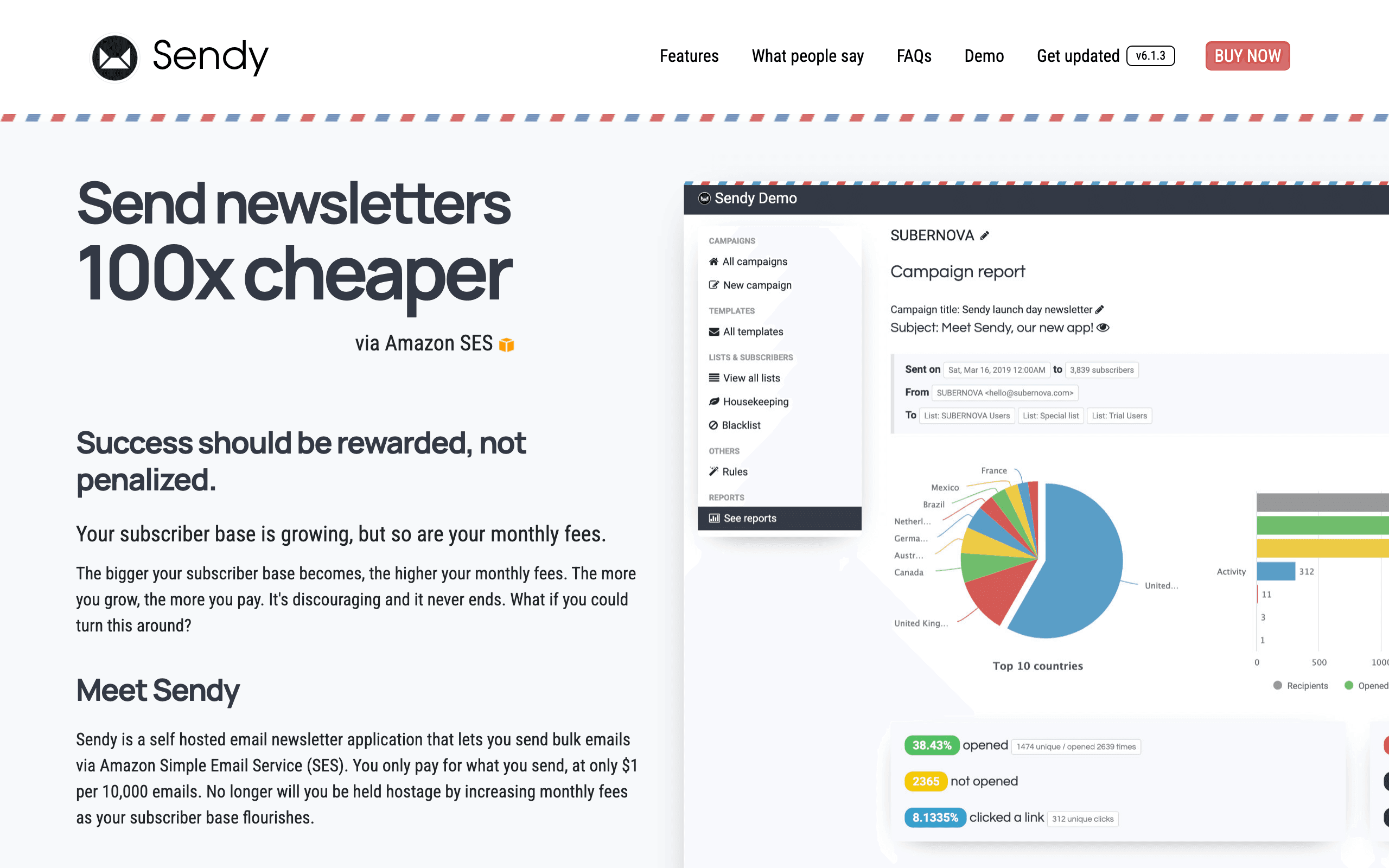
Sendy and Mautic are both self-hosted email solutions with very different purposes. Sendy is a lightweight $69 application for email campaigns via Amazon SES. Mautic is free, open-source marketing automation competing with platforms like HubSpot.
The Complexity Trade-off
This comparison comes down to one question: how much marketing automation do you need? Sendy is simple and limited. Mautic is powerful and complex.
Sendy: Simplicity and Savings
Sendy does one thing well: sending emails at rock-bottom costs. At 100,000 emails/month, you pay roughly $10 in Amazon SES fees. Setup takes 2-4 hours. Maintenance is minimal. If newsletters are all you need, Sendy's simplicity is a feature.
Mautic: Full Marketing Automation
Mautic is a complete marketing platform. Visual campaign builder, lead scoring, landing pages, forms, CRM features, website tracking, and multi-channel support. It competes with enterprise tools, not simple email senders.
Setup and Maintenance
Sendy runs on a basic $5/month VPS. Mautic often needs $20-50/month hosting. Sendy updates are occasional. Mautic updates are more complex with potential breaking changes.
For SaaS Companies
Neither platform is ideal for SaaS. Sendy lacks modern automation. Mautic lacks native payment integrations. For subscription businesses wanting Stripe integration without self-hosting, consider Sequenzy.
Making the Choice
Choose Sendy for simple, cheap email campaigns. Choose Mautic for full marketing automation. Both require technical skills, but Mautic demands significantly more time and expertise.
The Self-Hosted Spectrum: Simplicity vs Capability
Sendy and Mautic occupy opposite ends of the self-hosted email spectrum. Sendy is deliberately simple -- email campaigns, basic autoresponders, subscriber lists. Mautic is deliberately comprehensive -- marketing automation, CRM, landing pages, lead scoring, multi-channel messaging. The choice depends on where your needs fall on this spectrum.
Most businesses start closer to Sendy's end. They need to send email campaigns to subscriber lists. As marketing sophistication grows, they move toward Mautic's end: wanting automation, lead scoring, and multi-channel coordination. Understanding where you are today and where you will be in twelve months guides the right choice.
The risk of choosing Sendy is outgrowing it and facing a migration. The risk of choosing Mautic is investing significant setup time in capabilities you may not need for years. Neither risk is catastrophic, but honest assessment of your current and near-term needs prevents wasted effort in either direction.
The Operational Burden Comparison
Both platforms require self-hosting, but the operational burden differs substantially. Sendy runs on a basic LAMP stack (Linux, Apache, MySQL, PHP) and needs minimal resources. A $5/month VPS with 1GB RAM handles tens of thousands of subscribers comfortably. Updates are infrequent and rarely break functionality. Once configured, Sendy approaches set-and-forget territory.
Mautic demands more from its operators. The application needs $20-50/month hosting for adequate performance. Cron jobs must be configured for campaign processing, email sending, and segment rebuilding. Updates are more frequent and sometimes introduce breaking changes. Performance optimization -- database indexing, cache configuration, queue management -- is ongoing work.
For agencies and teams with dedicated DevOps resources, Mautic's operational requirements are manageable. For solo founders or small teams where email is one of many responsibilities, Sendy's lower maintenance burden means less time diverted from core business activities. The hidden cost of operational complexity is real and should factor into platform decisions.
Marketing Automation: When You Need the Complexity
Mautic's automation capabilities approach those of commercial platforms costing hundreds per month. Visual campaign builders with conditional branching, point-based lead scoring, progressive profiling through forms, and multi-channel campaign coordination. For organizations that would otherwise pay for HubSpot or Marketo, Mautic delivers comparable capabilities for free (plus hosting).
The key question is whether your marketing strategy actually requires these capabilities. Lead scoring matters for B2B companies with sales teams who need to prioritize outreach. Landing pages matter for businesses running paid campaigns that need conversion optimization. Multi-channel automation matters for organizations coordinating email, SMS, and push notifications.
If your marketing consists of sending regular email campaigns to a subscriber list, Mautic's complexity is overhead without benefit. The visual campaign builder, lead scoring, and CRM features sit unused while you navigate an interface designed for sophisticated marketing operations. Sendy's focused simplicity serves this use case better despite fewer features.
The Agency Use Case: Where Mautic Excels
Mautic's multi-tenant capabilities make it the strongest self-hosted option for agencies managing multiple client accounts. One Mautic installation can support multiple brands with separate contact databases, campaigns, and reporting. Sendy would require separate installations for each client, multiplying setup and maintenance effort.
For agencies, Mautic's free licensing means zero per-client software cost. The only expenses are hosting and the time spent on management. This enables agencies to offer marketing automation services to clients at margins that commercial platforms make impossible. A well-configured Mautic installation can replace commercial tools that cost clients hundreds per month.
This is perhaps Mautic's strongest use case: organizations that need sophisticated marketing automation for multiple brands or clients without the per-seat and per-contact costs of commercial platforms. For single-brand businesses with simpler needs, the complexity premium of Mautic is harder to justify.
For SaaS companies that want modern email automation without the operational burden of either self-hosted option, Sequenzy provides Stripe integration, event-based sequences, and transactional email at $49/month with zero infrastructure management.
Use-case matchups
| Situation | Best first look | Why |
|---|---|---|
| Team wants the lowest visible email sending cost and can self-host | Sendy | Sendy is the baseline here for teams comfortable operating their own app layer on top of a sending service. |
| Technical team wants open-source automation control | Mautic | Mautic is broader than Sendy when self-hosted marketing automation matters, not just newsletters. |
| SaaS or subscription team wants lifecycle and transactional email | Sequenzy | Sequenzy is stronger when Stripe events, transactional messages, and campaigns need a hosted lifecycle workflow. |
| Technical team already owns servers and AWS email operations | Sendy | Sendy can make sense when maintenance, updates, deliverability setup, and backup ownership are acceptable. |
| Team needs the specialist capability | Mautic | Mautic deserves the first demo when the main requirement is open-source marketing automation. |
| Team wants hosted workflows without self-hosting | Sequenzy | Sequenzy removes Sendy-style app maintenance while staying focused on email automation and transactional messages. |
Pricing reality
The pricing signals on this page list Sendy at ~$1-5/month or equivalent operating cost, Mautic at $0/month, and Sequenzy at $49/month. Sendy's number should never be read as the whole cost.
Sendy usually shifts cost from the vendor invoice to operations: hosting, updates, backups, SES or SMTP setup, bounce handling, deliverability monitoring, and internal troubleshooting. Mautic's real cost depends on whether the team needs open-source marketing automation.
Review signals
For Sendy, validate reviews around setup, updates, SES integration, bounce handling, deliverability, and the amount of technical maintenance required. For Mautic, focus review research on whether users praise the reason you would choose it: open-source marketing automation.
Best Fit by Newsletter Simplicity and Automation Depth
Best low-cost self-hosted newsletter tool for Amazon SES
Sendy is the better fit when the team wants simple campaigns, autoresponders, and cheap SES-backed sending without operating a full marketing automation system. It is strongest when the scope is newsletters rather than multi-step lead nurturing.
Best open-source marketing automation platform for complex journeys
Mautic is the better fit when the organization needs self-hosted forms, assets, lead scoring, segments, campaigns, and broader automation control. It suits teams with enough technical capacity to maintain a more complex open-source marketing stack.
Best hosted SaaS email platform without self-hosting
Sequenzy fits teams that want lifecycle campaigns, transactional email, and Stripe-triggered automation without running Sendy or Mautic. It is relevant when subscription or product events should drive emails in a managed workflow.
Migration checklist
| Workstream | Moving toward Sendy | Moving toward Mautic | Simplifying to Sequenzy |
|---|---|---|---|
| Hosting and ownership | Provision hosting, backups, updates, SSL, cron jobs, sending service credentials, and admin access. | Map contacts, segments, campaigns, forms, assets, emails, tracking, cron jobs, and suppressions. | Import subscribers, attributes, tags, suppressions, and lifecycle events into a hosted workflow. |
| Sending setup | Configure SES or SMTP, SPF, DKIM, DMARC, bounce processing, complaint handling, and suppression logic. | Confirm sender authentication, deliverability tooling, and plan limits. | Configure sending domains and transactional paths without self-hosting. |
| Contacts and consent | Import lists, custom fields, segments, unsubscribes, bounces, and suppression records. | Import the data model Mautic needs for open-source marketing automation. | Import subscriber data and lifecycle attributes. |
| Automations | Rebuild simple autoresponders and campaigns; custom lifecycle logic may need outside code. | Rebuild the workflows that prove Mautic's advantage. | Rebuild campaign, lifecycle, and transactional email flows. |
| Reporting | Decide which analytics are built in and which require outside tooling. | Validate reporting for open-source marketing automation before committing. | Validate campaign, automation, transactional, and subscription lifecycle reporting. |
Decision checklist
- Is the team honestly willing to own Sendy's hosting, updates, backups, and deliverability operations?
- Does Mautic's strength in open-source marketing automation matter more than Sendy's low visible cost?
- Who owns bounce handling, complaint processing, and suppression hygiene after migration?
- Are the listed prices still realistic after adding hosting, support, and engineering time?
- Would hosted lifecycle and transactional email be more useful than a self-hosted newsletter layer?
- Mautic requires serious operational ownership despite zero license price.









