Updated 2026-06-05
Rejoiner
HubSpot

Rejoiner vs HubSpot

managed ecommerce retention versus email marketing and automation

11
Features Compared
3
Key Differences
2
User Reviews
5
FAQs Answered
TL;DR

Rejoiner is the better fit when you need managed ecommerce retention. HubSpot is the better fit when your team prefers its approach to email marketing and automation. Choose Rejoiner when lifecycle strategy and abandoned cart recovery matter most. Choose HubSpot when its workflow, ecosystem, or pricing fits your team better. Choose Sequenzy if you mainly need affordable Shopify/WooCommerce email automation without a heavier ecommerce suite.

Platform Overview

See how each platform looks

Rejoiner

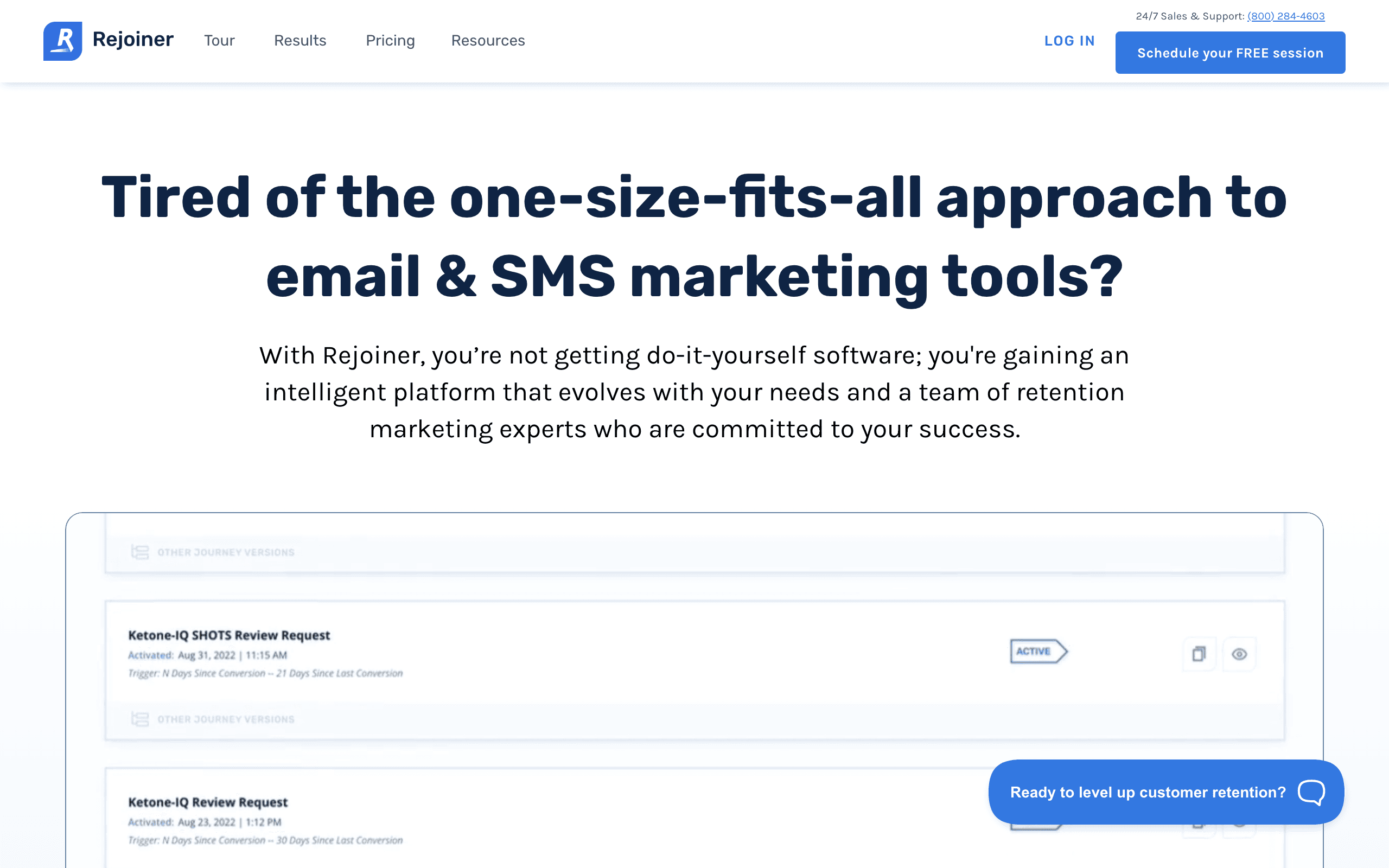
Rejoiner dashboard screenshot

E-commerce retention marketing platform for lifecycle email, SMS, abandoned cart recovery, and managed email strategy.

HubSpot

HubSpot dashboard screenshot

Enterprise all-in-one CRM, marketing, sales, and service platform.

Key Differences

The main things that set these tools apart

Rejoiner is stronger when lifecycle strategy matters
Rejoiner wins

Rejoiner is easier to justify when the buying reason is managed ecommerce retention, especially if your team will use lifecycle strategy, abandoned cart recovery, email and SMS retention.

HubSpot may be easier for a different operating model
HubSpot wins

HubSpot can be the better fit when your team already knows the product, prefers its ecosystem, or needs a different balance of channels and marketing features.

Sequenzy is the simpler email path
Tie

If the real need is Shopify or WooCommerce email automation, Sequenzy avoids the extra complexity of SMS, enterprise personalization, and large-suite implementation.

Pricing Comparison

Comparable ecommerce scale

Rejoiner
Custom/month

Pricing depends on retention program scope, channels, and services

Visit Rejoiner
HubSpot
Varies/month

Pricing depends on plan, contacts, usage, and selected features

Visit HubSpot
Best for SaaS
Sequenzy
$29/month

60,000 emails, unlimited subscribers, Shopify + WooCommerce + Stripe. No SMS or product recommendations.

Start Free Trial

Feature Comparison

11 features compared side-by-side

Feature
Rejoiner
HubSpot
Sequenzy
Ecommerce Fit
Shopify support
Native integration
WooCommerce support
Varies by setup
Varies by setup
Native integration
Abandoned cart
Strong fit
Available
Email recovery
Product recommendations
Varies by plan
Varies by plan
Channels and Automation
Marketing email
SMS
Strong fit
Varies by plan
Segmentation
Strong fit
Available
Basic
Transactional email
Limited
Limited
Team Fit
Enterprise fit
Good fit
Varies by team size
Limited
Simple setup
Can require planning
Depends on implementation
Strong fit
Best for email-only teams
less self-serve than platform-first tools
Depends on plan
Strong fit

Pros & Cons

Honest strengths and weaknesses of each platform

Rejoiner

Pros
  • Strong lifecycle strategy
  • Strong abandoned cart recovery
  • Strong email and SMS retention
  • Strong hands-on support
Cons
  • less self-serve than platform-first tools
  • Pricing can be hard to compare from public pages
  • May require more setup than simple email tools

HubSpot

Pros
  • Useful alternative workflow for ecommerce teams
  • Familiar campaign and automation patterns
  • Can fit teams already invested in its ecosystem
  • Worth comparing on pricing and support
Cons
  • Feature depth depends on plan and implementation
  • May not match Rejoiner's strongest ecommerce use case
  • Can become expensive as contacts or channels grow

What Users Say

Real reviews from Rejoiner and HubSpot users

Rejoiner Reviews

Public review themes from G2, Capterra, Shopify App Store, and vendor case studies

Review themes for Rejoiner often mention strong lifecycle strategy, useful reporting, and good fit for teams that know exactly what they want from ecommerce retention. The common caution is setup effort and pricing clarity.

Ecommerce marketing team2026-06-05

HubSpot Reviews

Public review themes from G2, Capterra, Shopify App Store, and vendor case studies

Review themes for HubSpot usually focus on ease of campaign work, integrations, and day-to-day usability. The common caution is that pricing and advanced features need to be checked against real usage.

Lifecycle marketing team2026-06-05

Best For

When to choose each tool

Choose Rejoiner if you...
  • Teams that need managed ecommerce retention
  • Stores that care most about lifecycle strategy
  • Brands that want abandoned cart recovery
  • Marketers with enough volume to justify a specialized tool
Choose HubSpot if you...
  • Teams already using the HubSpot ecosystem
  • Stores that prefer HubSpot's workflow or pricing model
  • Marketers comparing multiple ecommerce marketing platforms
  • Businesses that want a familiar alternative to Rejoiner
Choose Sequenzy if you...
  • Shopify or WooCommerce stores that mainly need email
  • Teams that do not need SMS or product recommendations
  • Businesses that want transactional and marketing email together
  • Subscription teams that need Stripe-aware lifecycle email
Start Free Trial

When Sequenzy Is the Better Alternative

You only need email automation

If SMS, retail intelligence, reviews, loyalty, or enterprise personalization are not part of the plan, Sequenzy keeps the stack lighter.

You want Shopify and WooCommerce support

Sequenzy focuses on practical ecommerce email flows for both Shopify and WooCommerce, including welcome, cart recovery, and post-purchase messages.

You also send transactional email

Sequenzy combines marketing and transactional email, which is helpful when product, billing, and lifecycle messages should live together.

Compare retention specialization against an all-in-one CRM suite

Rejoiner is a specialist choice for ecommerce lifecycle marketing: cart recovery, retention strategy, email/SMS campaigns, and optimization support. HubSpot is a broader CRM platform that can include marketing, sales, service, CMS, forms, landing pages, and automation in one ecosystem.

That makes this comparison mostly about operating model. If ecommerce retention is the main job, Rejoiner is more focused. If the business wants marketing tied tightly to CRM, sales, service, and content workflows, HubSpot may be the more useful system.

Use-case table

Use case Better starting point What to verify
Store wants guided ecommerce lifecycle strategy Rejoiner Check how onboarding, copy, design, testing, and performance reviews are delivered.
Company wants CRM, sales, service, and marketing in one suite HubSpot Confirm which hubs and tiers are needed for the workflows you actually plan to run.
Cart recovery and repeat purchase are the revenue problem Rejoiner Prioritize ecommerce events, purchase segmentation, and retention reporting.
Lead nurturing, forms, landing pages, and sales handoff matter HubSpot HubSpot is more relevant when ecommerce is only one part of the customer relationship.
Email automation without CRM suite complexity Sequenzy Use a focused email platform when you need storefront and subscription messaging, not a full CRM.

Where Rejoiner is stronger

Rejoiner is stronger when the problem is store revenue after a visitor becomes a shopper: abandoned cart, first purchase, repeat purchase, winback, and lifecycle testing. It is also a better fit when the marketing team wants ecommerce-specific guidance and does not want to translate a general CRM automation tool into a retention program.

The tradeoff is that Rejoiner is not trying to be the company-wide CRM. If sales and service teams need shared records and workflows, another system may still be needed.

Where HubSpot is stronger

HubSpot is stronger when the business wants one customer platform across marketing, sales, service, and content. It can be easier to justify if lifecycle email is part of a larger CRM rollout, especially for B2B, services, or hybrid businesses where ecommerce order data is not the whole customer story.

Before choosing HubSpot for ecommerce retention, verify product-level segmentation, purchase event depth, SMS needs, and whether the required automation features live in the tier being quoted.

Pricing reality

Rejoiner is listed as custom pricing based on retention program scope, channels, and services. HubSpot is listed as variable pricing based on plan, contacts, usage, and selected features. Sequenzy is listed at $29/month for the cited email-first scope.

Rejoiner pricing should be evaluated as ecommerce retention strategy plus support. HubSpot pricing should be modeled around hubs, seats, marketing contacts, CRM adoption, automation scope, and reporting needs.

Review signals

The cited Rejoiner review themes should be read for lifecycle strategy, cart recovery, email/SMS retention, hands-on support, setup effort, and pricing clarity. HubSpot review themes should be read for CRM adoption, reporting, sales and marketing alignment, broad usability, and total suite cost. The review split is managed ecommerce retention versus shared CRM operations.

Migration checklist

  • Separate ecommerce journeys from CRM/sales journeys before deciding where each belongs.
  • Export Rejoiner segments, unsubscribes, suppression lists, purchase attributes, and performance baselines.
  • Confirm how Shopify or WooCommerce order data maps into HubSpot properties and lists.
  • Rebuild high-revenue ecommerce flows before moving newsletter or CRM nurture campaigns.
  • Decide whether HubSpot becomes the source of truth or only another marketing destination.

Buying questions to ask

  • Is the business buying a retention partner or a CRM suite?
  • Which HubSpot hubs and tiers are required for the planned automations?
  • How much ecommerce purchase and product data is available to marketers?
  • Does the team need sales pipeline and service workflows connected to marketing?
  • Who owns lifecycle optimization after the platform is live?

Where Sequenzy fits

Sequenzy is the simpler email-first route when you do not need a full CRM suite or a managed retention program. It fits Shopify, WooCommerce, and subscription teams that need newsletters, transactional email, cart recovery, and Stripe-aware lifecycle messages.

Use-case matchups

Need Better fit Why
Managed ecommerce retention strategy Rejoiner Rejoiner is stronger when the team wants service-backed retention programs, lifecycle planning, and hands-on optimization.
CRM-centered marketing operations HubSpot HubSpot is stronger when the team wants to own CRM-centered marketing operations directly in-platform.
Email-first store or subscription lifecycle Sequenzy Sequenzy fits when the team wants Shopify, WooCommerce, Stripe, newsletters, and transactional email without SMS or managed-service scope.

Best Fit by CRM vs Retention Need

Best managed retention partner for ecommerce email growth

Rejoiner is the better fit when ecommerce retention strategy is the main gap and the team wants a partner involved in planning and optimization.

Best CRM platform for sales and marketing operations

HubSpot fits companies that need contacts, pipeline, sales handoff, forms, automation, and reporting across a broader CRM-centered go-to-market motion.

Best email platform for commerce lifecycle without CRM complexity

Sequenzy fits stores and subscription businesses that need lifecycle email and transactionals without adopting a full CRM suite.

Decision checklist

  • Choose Rejoiner if managed ecommerce retention strategy is the main need.
  • Choose HubSpot if CRM-centered marketing operations is the main need and the team can operate it directly.
  • Avoid Rejoiner if the team only wants self-serve software and no service layer.
  • Avoid HubSpot if the missing piece is retention strategy, not tool access.
  • Consider Sequenzy if the practical need is email automation, transactional email, and store or Stripe lifecycle messages.


Frequently Asked Questions

5 questions answered about Rejoiner vs HubSpot

Testimonials

Sequenzy Testimonials

Not sure which to pick?

If you're a SaaS founder who needs Stripe integration and unified email, try Sequenzy free. No credit card required.

Related Comparisons

Sequenzy pricing reference

Sequenzy - Complete Pricing Guide

Pricing Model

Sequenzy uses email-volume-based pricing. You only pay for emails you send. Unlimited contacts on all plans — storing subscribers is always free.

All Pricing Tiers

  • 2.5k emails/month: Free (Free annually)
  • 15k emails/month: $19/month ($205/year annually)
  • 60k emails/month: $29/month ($313/year annually)
  • 120k emails/month: $49/month ($529/year annually)
  • 210k emails/month: $99/month ($1069/year annually)
  • 300k emails/month: $149/month ($1609/year annually)
  • 600k emails/month: $299/month ($3229/year annually)
  • 900k emails/month: $399/month ($4309/year annually)
  • 1.2M emails/month: $499/month ($5389/year annually)
  • Unlimited emails/month: Custom pricing (Custom annually)

Yearly billing: All plans offer a 10% discount when billed annually.

Free Plan Features (2,500 emails/month)

  • Visual automation builder
  • Transactional email API
  • Reply tracking & team inbox
  • Landing pages
  • Unlimited team members
  • Goal tracking & revenue attribution
  • Dynamic segments
  • Payment integrations
  • API, MCP, and CLI access
  • Custom sending domain
  • Send time optimization
  • A/B testing

Paid Plan Features (15k - 1.2M emails/month)

  • Visual automation builder
  • Transactional email API
  • Reply tracking & team inbox
  • Landing pages (Create hosted signup pages and attach a custom domain.)
  • Unlimited team members
  • Goal tracking & revenue attribution
  • Dynamic segments
  • Payment integrations (Stripe, Paddle, Lemon Squeezy)
  • API, MCP, and CLI access
  • Custom sending domain
  • Send time optimization
  • A/B testing

Enterprise Plan Features (Unlimited emails)

  • Visual automation builder
  • Transactional email API
  • Reply tracking & team inbox
  • Landing pages
  • Unlimited team members
  • Goal tracking & revenue attribution
  • Dynamic segments
  • Payment integrations
  • API, MCP, and CLI access
  • Custom sending domain
  • Send time optimization
  • A/B testing

Important Pricing Notes

  • You only pay for emails you send — unlimited contacts on all plans
  • No hidden fees - all features included in the price
  • No credit card required for free tier

Contact

  • Pricing Page: https://sequenzy.com/pricing
  • Sales: hello@sequenzy.com