
Start with the workflow
Campaigner and HubSpot can both look good on a comparison chart. The real question is which one matches the way your team works. If email marketing with advanced testing is central to your retention strategy, Campaigner deserves a closer look. If your team already prefers HubSpot's editor, reporting, or ecosystem, that may matter more than a marginal feature difference.
Where Campaigner wins
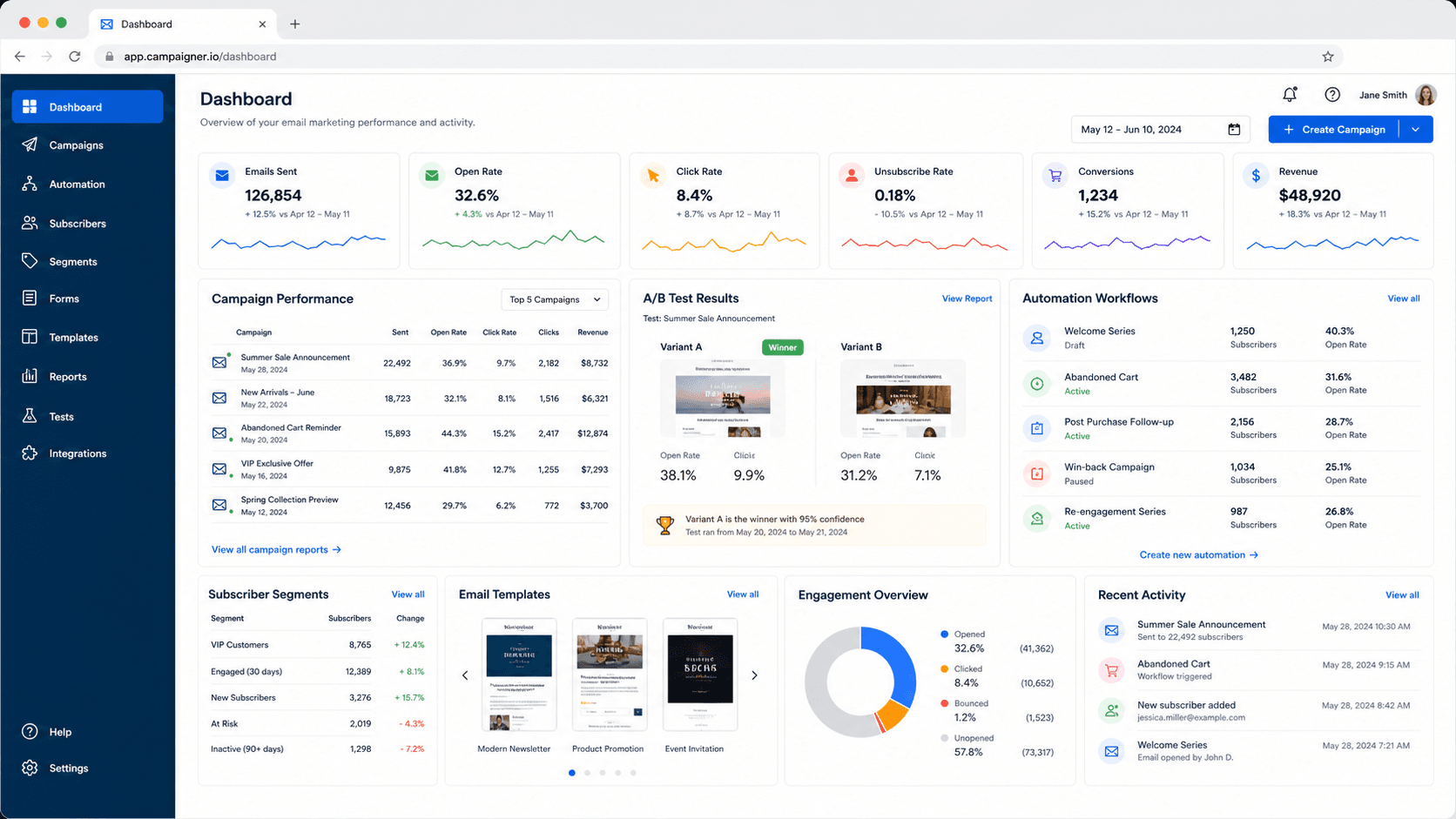
Campaigner wins when you will actually use multivariate testing, email campaigns, automation workflows. It is easiest to justify when those features are tied directly to revenue recovery or repeat purchase campaigns.
Where HubSpot wins
HubSpot wins when it is easier for the team to operate. A tool with slightly less specialized depth can still be the better choice if campaigns ship faster and reporting is easier to understand.
Use-case matchups
| Use case | Better fit | What to verify |
|---|---|---|
| Email optimization and testing | Campaigner | Confirm multivariate testing depth, template workflow, reporting, SMS add-ons, and current plan limits. |
| CRM-led sales and marketing | HubSpot | Verify CRM, Marketing Hub tier, automation limits, contact pricing, and sales/service handoffs. |
| Ecommerce retention campaigns | Campaigner | Check Shopify or WooCommerce integration depth, product data access, segmentation, and abandoned-cart workflow support. |
| All-in-one business operations | HubSpot | HubSpot is stronger when CRM, landing pages, forms, sales, service, and reporting need one shared system. |
| Simpler commerce email plus transactional | Sequenzy | Compare if the team mostly needs Shopify/WooCommerce email, Stripe lifecycle triggers, and transactional email together. |
Best Fit by CRM Dependency
Best email marketing tool for testing-heavy campaign teams
Campaigner fits marketers focused on multivariate testing, template workflow, reporting, ecommerce triggers, and campaign-level optimization. It is the stronger shortlist option when the team already has CRM coverage elsewhere and wants to improve promotions, newsletters, and triggered campaigns without moving sales operations.
Best CRM platform for sales, service, and marketing alignment
HubSpot is the better fit when CRM, forms, landing pages, pipeline, sales handoff, service workflows, and reporting need one shared system. Choose it when email performance is only one part of a larger revenue-operations rollout across marketing, sales, and support.
Best email platform for commerce lifecycle and transactionals
Sequenzy fits when Shopify, WooCommerce, Stripe lifecycle triggers, and transactional email matter more than CRM-led operations. It makes the most sense for teams that want abandoned-cart, payment, subscription, and receipt-style messages in the same lightweight email stack.
Pricing reality
Both tools need quote or plan-context checks for this comparison. The current page pricing data marks Campaigner and HubSpot as variable, with cost depending on contacts, plan, usage, SMS add-ons, and selected features. Do not compare them on a single sticker price without modeling your actual database size and required modules.
Sequenzy is listed here at $49/month for 60,000 emails, unlimited subscribers, Shopify, WooCommerce, and Stripe, with no SMS or AI/predictive product recommendations (catalog-driven recommendation blocks are available).
Review signals
Do not stop at star ratings. Read reviews from teams with similar list sizes and ecommerce platforms. Look for comments about onboarding, deliverability, support, editor speed, segmentation, and billing surprises.
The review summaries on this page point to a practical split: Campaigner is commonly evaluated for multivariate testing, ecommerce workflows, and reporting, while HubSpot is commonly evaluated for campaign workflow, integrations, and day-to-day usability. For both, the review risk is pricing and feature fit at your real usage level.
Migration checklist
| Step | What to confirm |
|---|---|
| Contacts and lifecycle data | Export contacts, lists, segments, custom fields, unsubscribes, bounces, consent, and ecommerce identifiers. |
| CRM ownership | If moving out of HubSpot, decide where deals, companies, sales activity, forms, landing pages, and service data will live. |
| Campaign assets | Rebuild templates, saved modules, forms, landing pages, preference pages, and brand settings. |
| Automations | Map welcome, nurture, abandoned-cart, post-purchase, reactivation, sales handoff, and suppression workflows before cutover. |
| Integrations | Reconnect Shopify, WooCommerce, payment tools, analytics, CRM, ads, and support tools. |
| Reporting continuity | Preserve campaign, revenue, source attribution, test results, and contact-history exports for future comparison. |
Decision checklist
| Question | Why it matters |
|---|---|
| Are you buying email optimization or CRM-led operations? | Campaigner is easier to justify for testing-heavy email work; HubSpot is easier to justify when CRM, sales, service, forms, and reporting need one system. |
| Which modules are included in the real quote? | HubSpot and Campaigner costs can change materially once contacts, hubs, SMS, support, and advanced features are included. |
| Will ecommerce data be first-class? | Confirm Shopify, WooCommerce, product, order, and abandoned-cart depth before committing either platform. |
| What replaces missing systems after migration? | Leaving HubSpot may require replacement CRM, landing page, form, reporting, and sales handoff workflows. |
| Is Sequenzy enough? | If the job is simpler Shopify/WooCommerce email plus Stripe and transactional messages, compare Sequenzy before buying a broader suite. |
Where Sequenzy fits
Sequenzy is the simpler route when ecommerce email is the job. It is built for Shopify, WooCommerce, Stripe lifecycle email, newsletters, and transactional messages without adding SMS, loyalty, or enterprise personalization you may not use.









