
10 Best Postscript Alternatives in 2026

Postscript is a good product, and most people searching for alternatives are not unhappy with the software. They are unhappy with a number: a minimum spend they are not using, a bill that grew faster than the program, or the realization that they are paying two platforms to store the same customers.
Those are different problems with different answers, and one of them is not a migration at all. Postscript's own tier structure changes the per-message rate substantially, so a brand paying $0.009 on Starter and complaining about cost may simply be on the wrong plan.
This comparison starts with the diagnosis, then covers the ten alternatives worth considering. I have been specific about carrier fees throughout, because SMS pricing comparisons are usually wrong by 30 to 50 percent when they ignore them.
For the broader category, see the best SMS marketing tools for Shopify. If Attentive is the platform you are leaving instead, see Attentive alternatives.
Quick comparison table
| Alternative | Type | Entry cost | Published US SMS rate | Replaces Postscript for |
|---|---|---|---|---|
| Klaviyo | Bundled email plus SMS | Email plus SMS from about $35/mo | Credit bundles by plan | Brands that want one profile across channels |
| Omnisend | Bundled multichannel | Standard from about $16/mo | $0.007 to $0.009 on Pro | Smaller brands paying two platform fees |
| Attentive | Enterprise specialist | Custom, roughly $2,000 to $3,000 per quarter minimum | Around $0.01 with commitments | Brands that outgrew self-serve tooling |
| Sendlane | Bundled, send-based | Professional from $100/mo | From about $0.009 per credit | Brands tired of contact-based email billing |
| Recart | Managed Shopify SMS | From about $299/mo | Bundled into tiers | Brands with no internal SMS owner |
| Emotive | Conversational SMS | Starter around $100/mo plus usage | Per message on top | Considered-purchase categories |
| TxtCart | Cart-recovery specialist | Growth around $79/mo | About $0.008/SMS | Brands where only cart recovery works |
| Sequenzy | Lifecycle platform with SMS add-on | Add-on from $16/mo with 1,000 credits | 1 credit per US/Canada segment | Teams that want SMS steps in email sequences |
| Shopify Messaging | Native Shopify | $2.15/mo per toll-free number | Per message by country | Brands scaling the program back |
| Privy | Capture-first | Email from about $30/mo | Credits sold separately | Brands whose real gap is list growth |
Rates and minimums change often. Confirm current pricing, carrier fee treatment, and eligible destinations before committing.
Diagnose before you migrate
"The $49 minimum is wasted"
Postscript Starter has no monthly fee but a $49 minimum monthly spend. At about $0.009 per message, that is roughly 5,000 texts. If you send 1,200, you are paying nearly four times the effective rate.
The fix is not a cheaper SMS platform. It is folding SMS into a platform you already pay for. Omnisend, Klaviyo, and Sequenzy all charge per message with no SMS-specific minimum, so a low-volume program costs what it costs.
"The bill is too high at volume"
Check your tier first. Starter is about $0.009 per SMS, Growth at $100 per month is about $0.008, and Professional at $500 per month is about $0.007.
At 250,000 messages a month, moving from Starter to Professional saves about $500 in message costs and costs $500 in subscription: break-even. At 500,000 it saves $1,000 against a $500 fee. Many "Postscript is expensive" complaints are tier complaints.
"We are paying two platforms for the same customers"
This is the most legitimate reason on the list. Running Postscript plus an ESP means two subscriber databases, two suppression lists, two attribution models, and someone maintaining the sync.
The fix is consolidation, into Klaviyo if you want depth, Omnisend if you want value, or Sequenzy if your program is lifecycle sequences. You will lose SMS specialization; whether that matters depends on whether SMS or email is your larger channel.
"We outgrew the tooling"
If your capture rate has plateaued, you want RCS, or your reply volume needs real conversational infrastructure, Postscript is genuinely the smaller platform.
The fix is Attentive, and it is an upgrade in cost as well as capability. Do not expect a saving.
"Nobody is running it"
An unmanaged seat on a great platform underperforms a managed program on an adequate one.
The fix is Recart or Emotive, or hiring, not a different self-serve tool.
How I evaluated these alternatives
- Built the same three programs on each: welcome, abandoned checkout, and a segmented promotional campaign.
- Exported a Postscript subscriber list and checked which platforms preserved consent source, timestamp, disclosure, and country on import.
- Asked each vendor whether a toll-free number could be ported, and what the process was.
- Modeled total monthly cost at 25,000, 100,000, and 400,000 messages including carrier fees.
- Tested reply handling: whether a genuine customer question routed somewhere a human would see it.
- Compared reported SMS revenue with store orders over the same window to gauge attribution aggressiveness.
- Checked whether an SMS opt-out propagated to email suppression and vice versa.
The 10 best Postscript alternatives
1. Klaviyo
Best for: Brands consolidating SMS into the platform that already runs their email.
Pricing: Email and SMS plans from about $35/month for 251 to 500 active profiles with 1,250 SMS or MMS credits included. Email alone runs from about $20/month to roughly $150/month at 10,000 profiles.
For a brand running Postscript alongside Klaviyo, consolidation into Klaviyo is the single most common and most defensible move. You remove a platform fee, a subscriber database, and the sync that nobody wants to own.
What you gain architecturally is significant: email and SMS operate from one profile, one segment definition, and one flow, so a flow can send an email, wait, and text only the people the email did not convert. That is not possible across two platforms without engineering.
What you lose is specialization. Klaviyo's SMS capture units are good rather than exceptional, and reply handling is functional rather than a workflow. If SMS is your largest revenue channel, that gap is real.
- Pros: Removes the second platform, genuine cross-channel suppression, deepest commerce data, flow-level attribution.
- Cons: Capture and reply handling trail Postscript, active-profile billing, SMS credits stack on the email plan.
Verdict: The right move when email is your larger channel and coordination matters more than SMS depth.
2. Omnisend
Best for: Smaller brands where Postscript's minimum spend exceeds the program.
Pricing: Standard from about $16/month. On current Pro plans, US and Canada SMS runs about $0.009 per message at low spend down to about $0.007 at high volume, with bundles from around $10/month and credits rolling over for 60 days.
Omnisend is the best answer to the wasted-minimum problem. SMS bundles start around $10 per month, credits roll over for 60 days, and there is no SMS-specific minimum spend, so a program sending 1,500 texts a month pays for 1,500 texts.
You also get email and push on the same canvas, which usually replaces another line item rather than adding one.
The trade-offs are real: SMS sits behind the Pro plan on current pricing, reply handling is thin, and the Shopify flow depth does not match Postscript's product- and lifetime-value-based branching.
- Pros: No SMS minimum, credits roll over, three channels on one canvas, low total cost for small programs.
- Cons: SMS gated to Pro, weak reply handling, shallower Shopify branching, contact-based billing.
Verdict: The most economical exit for a low-volume SMS program.
3. Attentive
Best for: Brands that outgrew self-serve SMS entirely.
Pricing: Custom and consumption-based, shaped by volume, subscribers, channels, and AI products. Reported minimums commonly sit around $2,000 to $3,000 per quarter, with roughly $0.01 per SMS and commitments often starting near 50,000 messages a month.
Attentive is the upward exit from Postscript and the only alternative here that is unambiguously more capable at messaging. The signup units and two-tap mobile capture are the best available and often lift subscriber growth enough to justify the move on their own.
Beyond capture, you get RCS, genuine conversational commerce at scale, cross-channel journeys, and strategic support substantive enough to offset internal headcount.
It is more expensive in every dimension, sales-led with no published rate card, and contract-based. If cost was your reason for leaving Postscript, this is the wrong direction.
- Pros: Best-in-class capture, RCS and conversational commerce, cross-channel journeys, strategic support.
- Cons: Enterprise minimums and commitments, no published pricing, contract complexity, never cheaper.
Verdict: The right exit when capability, not cost, drove you to look.
4. Sendlane
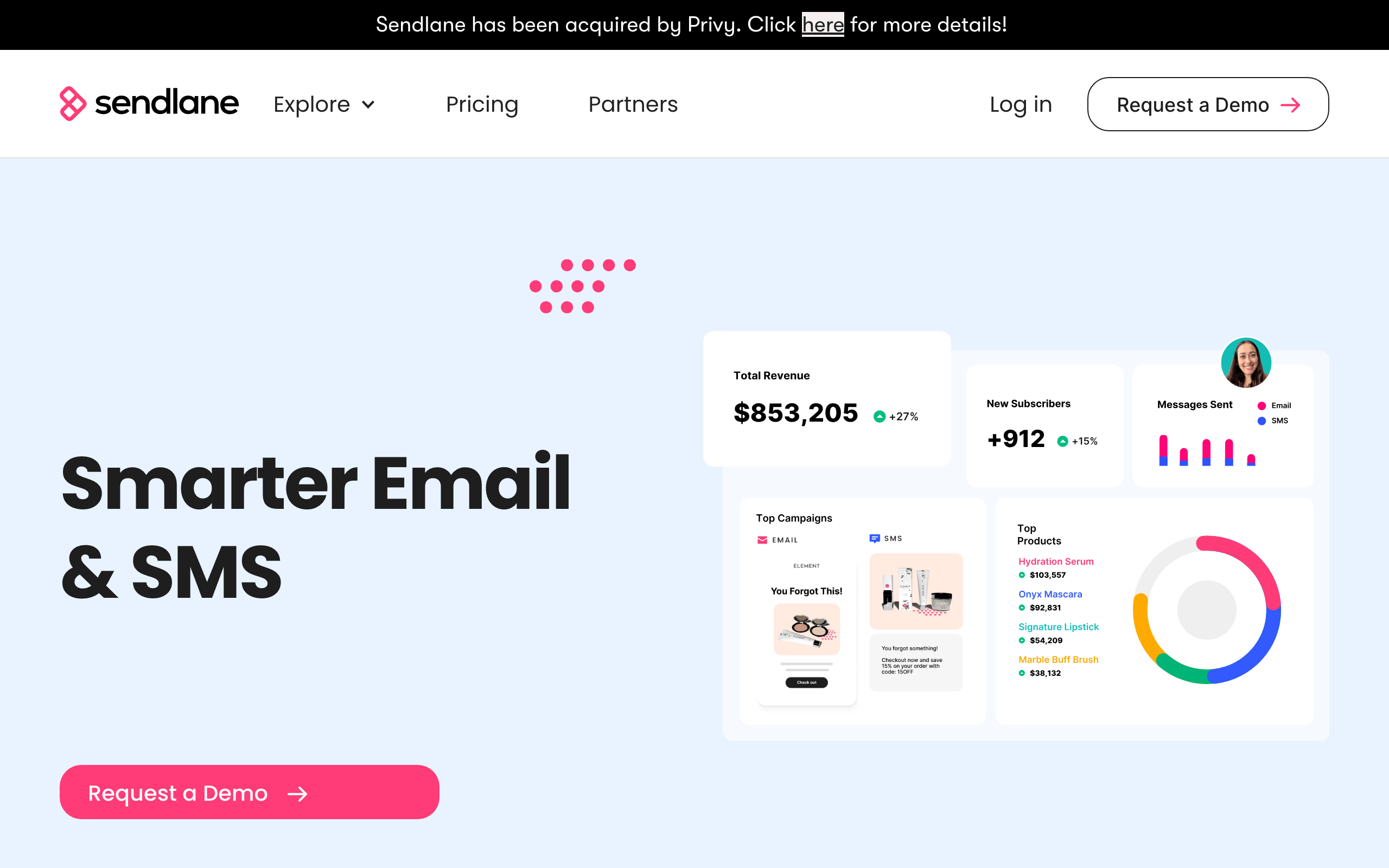
Best for: Brands consolidating both channels while escaping contact-based email billing.
Pricing: Professional from $100/month for 50,000 email sends with unlimited contacts. SMS from about $0.009 per credit, subject to destination rates.
Sendlane is the consolidation option for a brand that wants to leave Postscript and is also unhappy with profile-based email pricing. Unlimited contacts on send-based billing means a large historical database costs nothing to hold.
Commerce depth is genuinely competitive, and email and SMS share profiles and segments properly, so the cross-channel suppression argument applies here too.
The $100 floor is higher than an entry plan elsewhere, and the smaller ecosystem means fewer agencies know it. SMS economics for non-US destinations need verification.
- Pros: Unlimited contacts on send-based pricing, real commerce depth, email and SMS integrated, good for multi-store.
- Cons: $100/month floor, smaller ecosystem, regional SMS needs verification, less brand recognition.
Verdict: The consolidation option that also fixes an email billing problem.
5. Recart
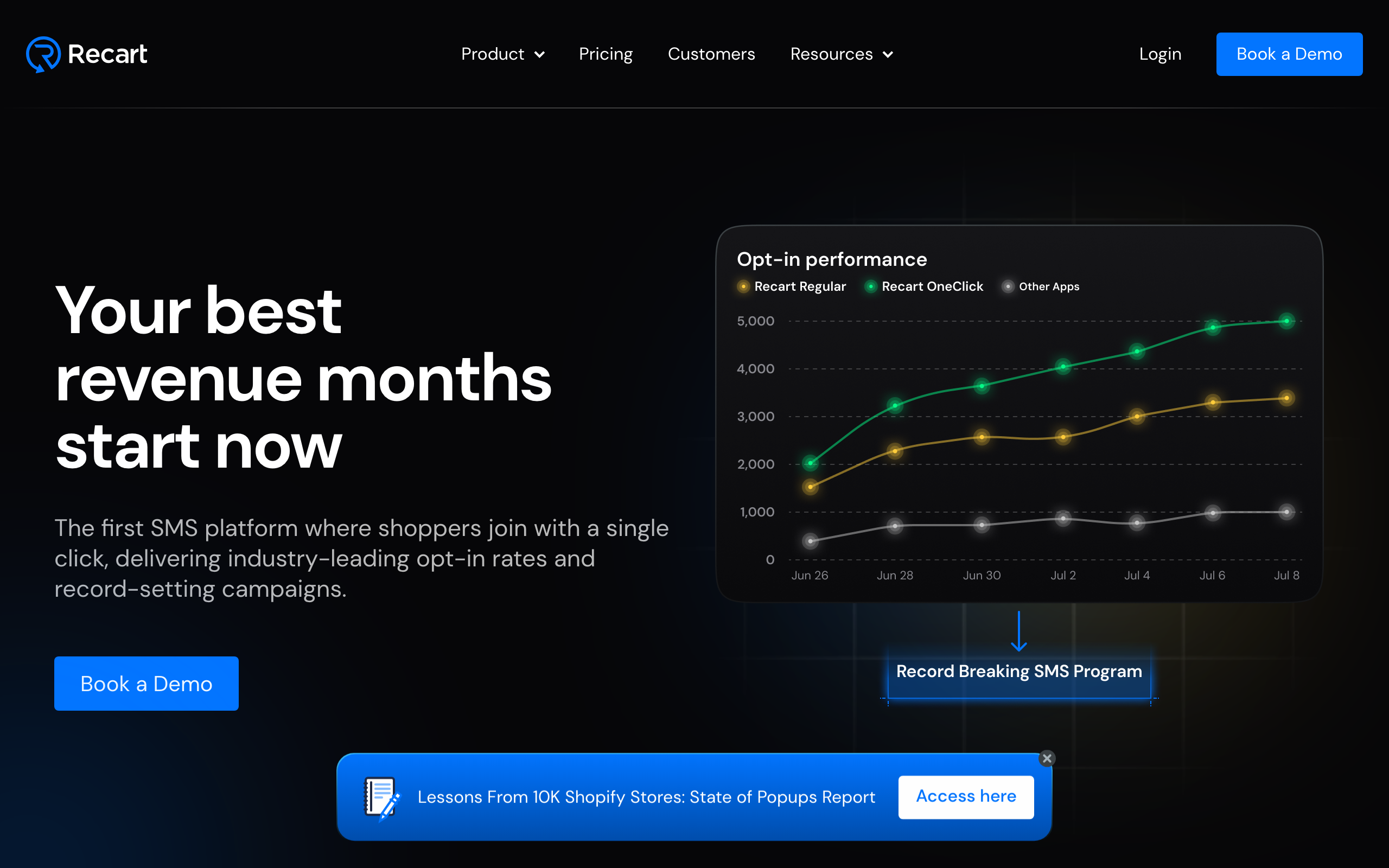
Best for: Brands whose real problem is that nobody is running the program.
Pricing: Plans from about $299/month with unlimited subscribers, a dedicated strategist, and a toll-free number included. Higher tiers around $999/month bundle substantial message volume.
Recart is not cheaper than Postscript and does not pretend to be. What it sells is a managed program: a customer success manager who handles strategy, copy, scheduling, testing, and weekly reporting.
If your Postscript account is underperforming because nobody has touched it in two months, that is worth more than a better self-serve interface.
Attribution differs by tier, with click-only attribution on the entry plan, which matters when you compare its reported revenue with Postscript's. Evaluate it against what the strategist replaces, not against a feature list.
- Pros: Managed program at every tier, unlimited subscribers, number included, strong Shopify capture and recovery.
- Cons: Higher monthly floor than Postscript Starter, less self-serve control, attribution model varies by tier.
Verdict: Buy the strategist. The software is secondary.
6. Emotive
Best for: Categories where customers ask questions before buying.
Pricing: Published tiers around $100/month for Starter, $200/month for Pro, and $300/month for Advanced, plus per-message costs, with enterprise pricing on request.
Emotive competes with Postscript on the one dimension where Postscript is already strong: conversation. Its model centers on two-way messaging with human-assisted responses rather than broadcast plus reply handling.
For high-consideration, high-AOV products where a sizing, compatibility, or timing question stands between a customer and a purchase, that mechanic converts better than another discount.
It is narrower than the bundled platforms, per-message costs sit on top of the plan, and the commerce automation depth does not match Postscript's Shopify branching. Verify the current plan structure before assuming the entry price covers your volume.
- Pros: Genuine conversational model, human-assisted responses, transparent tiers, strong for considered purchases.
- Cons: Usage costs on top of plans, narrower automation, not an email platform, less Shopify branching depth.
Verdict: A lateral move that trades flow depth for conversation quality.
7. TxtCart
Best for: Brands where abandoned-cart recovery is the only SMS program that works.
Pricing: Recent published pricing shows a Growth plan around $79/month at about $0.008/SMS and $0.030/MMS, with a trial period and starting credits. Older plans charged a percentage of attributed sales, so confirm which model you are quoted.
TxtCart is deliberately narrow. If you audit your Postscript account and find that cart recovery produces almost all of the revenue while campaigns produce opt-outs, a focused tool at a lower monthly floor is a rational simplification.
The AI-assisted conversational recovery handles common objections, which is more than a static reminder does.
Because it is narrow, you should measure it the same way: hold out a portion of eligible carts and compare. And be clear that this is one automation with a bill attached, not an SMS program.
- Pros: Focused on the highest-intent use case, lower monthly floor, conversational recovery, transparent current rates.
- Cons: Single use case, no broader program, pricing model has changed, not a platform replacement.
Verdict: A simplification, not an alternative. Only correct if the audit supports it.
8. Sequenzy
Best for: Teams that want SMS as a step inside lifecycle sequences rather than a standalone program.
Pricing: SMS is a paid add-on from $16/month including 1,000 credits, on paid plans. One US or Canada SMS segment uses one credit, and international credits are cost-weighted by destination.
Disclosure: I build Sequenzy. The honest framing against Postscript is that this is a step down in SMS specialization and a step up in consolidation. There is no in-app two-way inbox, no RCS, and no capture units that compete with a specialist's.
What it does replace is the second-platform problem. A Send SMS step drops into any sequence alongside email steps, using the same subscribers, segments, and attribution. SMS consent is a separate field from email status and never inferred from a phone number, so consolidation does not quietly widen your consent surface. Sequenzy provisions a dedicated toll-free number, guides carrier verification, handles STOP, START, and HELP per number, and defers sends outside local quiet hours.
The pricing shape suits low and moderate volume: no SMS minimum spend, credits included in the add-on, and cost-weighted international credits. SMS is also fully exposed through the API, CLI, and MCP server for teams that script campaign operations.
- Pros: No SMS minimum spend, SMS inside existing email sequences, consent separate by design, managed number and verification, quiet hours enforced, full API, CLI, and MCP coverage.
- Cons: No two-way inbox yet, MMS US and Canada only, basic capture units, not an SMS specialist.
Verdict: Right when consolidation matters more than SMS depth. Wrong if SMS is your primary channel.
9. Shopify Messaging
Best for: Brands scaling the SMS program back rather than replacing it.
Pricing: $2.15/month per approved toll-free number for US and Canada marketing SMS, plus per-message charges that vary by country.
This is the honest option for a brand that concluded SMS is not the channel they hoped it was. Rather than migrating to a different specialist, you keep a minimal capability with essentially no platform cost.
There is no integration to maintain, no subscription, and no minimum. You send order-related and occasional promotional messages from the Shopify admin and stop paying for infrastructure you were not using.
What you give up is everything that makes SMS a growth channel. Treat it as a deliberate downgrade, not a lateral move.
- Pros: Almost no fixed cost, native Shopify context, zero integration overhead, no minimum spend.
- Cons: Minimal automation and segmentation, Shopify only, no real capture tooling, international rates vary sharply.
Verdict: A dignified way to scale back rather than migrate sideways.
10. Privy
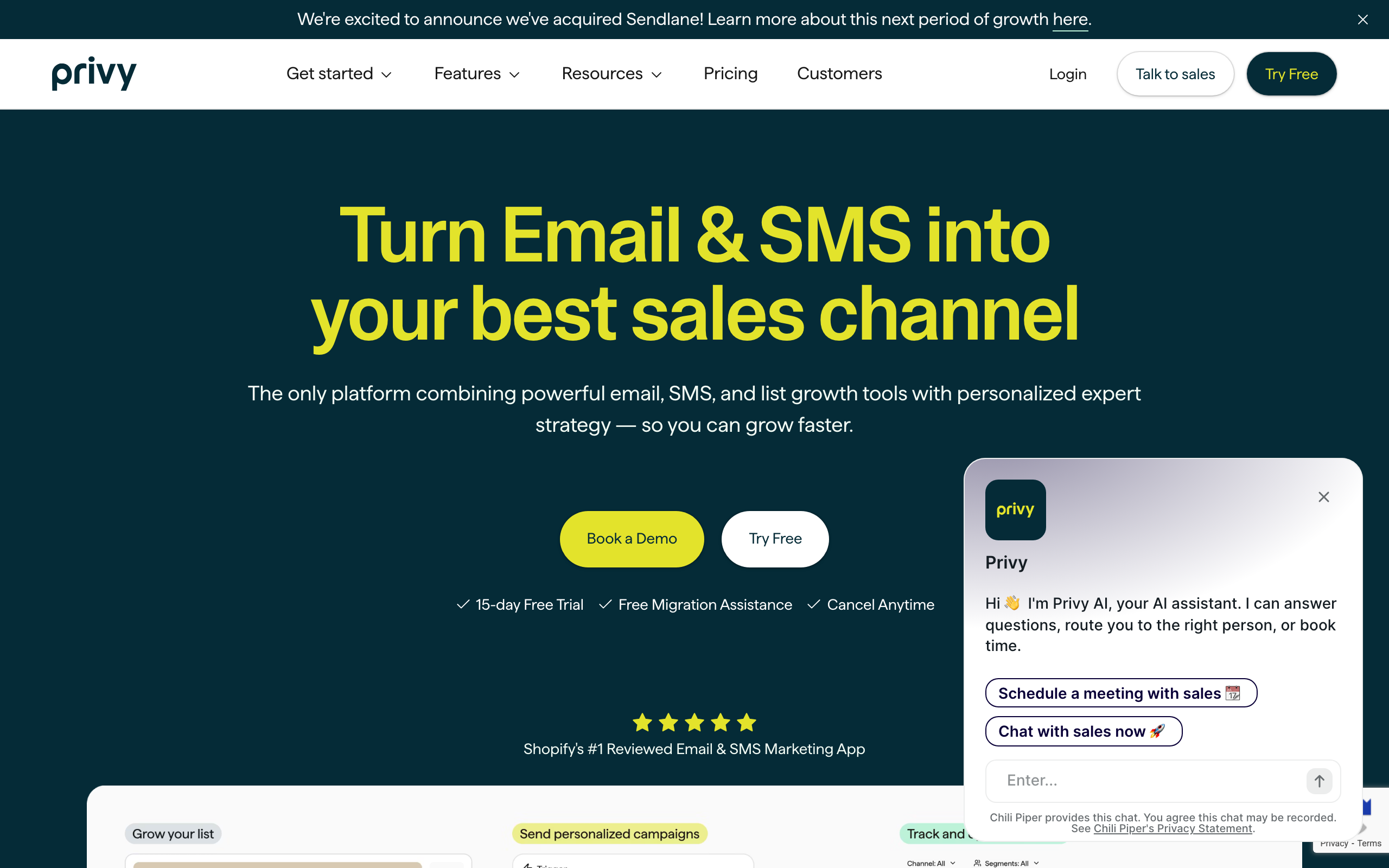
Best for: Brands whose Postscript performance problem is subscriber count.
Pricing: Around $24/month for pop-ups and displays only, or about $30/month with email included. SMS credits are sold separately.
Privy is here as a diagnostic rather than a replacement. If your SMS list is small relative to your traffic, changing platforms will not improve revenue; capture will.
Exit intent, spin-to-win, cart savers, and targeted mobile units are what Privy does well, and it is cheap relative to the revenue a better capture rate produces.
Its messaging layer is not a Postscript replacement, and most brands run it alongside a primary platform. That is a legitimate architecture provided one system clearly owns consent.
- Pros: Strong on-site capture, cheap relative to impact, fast to deploy, good Shopify fit.
- Cons: Not a messaging platform replacement, SMS credits separate, adds a tool rather than removing one.
Verdict: Fix capture before you blame the platform.
The carrier fee problem in every SMS comparison
Postscript publishes its carrier fees, which is unusually transparent and also makes it look more expensive than vendors that bury them. Compare honestly.
| Cost component | Postscript Starter | Postscript Professional | Bundled platform (typical) |
|---|---|---|---|
| Platform subscription | $0, with $49 minimum spend | $500/mo | Included in your email plan |
| Per SMS | About $0.009 | About $0.007 | About $0.007 to $0.009 |
| Average US carrier fee | About $0.00418, billed separately | About $0.00418, billed separately | Often bundled into the quoted rate |
| Effective per SMS | About $0.013 | About $0.011 | Compare only after asking |
| Per MMS | About $0.045 plus about $0.00841 | About $0.024 plus about $0.00841 | Varies |
The question to ask every vendor: "Is your quoted rate inclusive of carrier passthrough fees, and can I see an invoice with the line item?" A vendor quoting $0.008 inclusive is cheaper than one quoting $0.007 plus fees.
Worked example at 100,000 messages a month:
- Postscript Starter: about $900 in messages plus about $418 in carrier fees, so roughly $1,318.
- Postscript Growth: $100 plus about $800 plus about $418, so roughly $1,318. Identical, which is why tier choice matters at this volume.
- Postscript Professional: $500 plus about $700 plus about $418, so roughly $1,618. Worse at this volume, better above roughly 200,000.
At 400,000 messages: Starter is roughly $5,272, Growth roughly $4,872, Professional roughly $4,472. The tier decision is worth more than most platform decisions.
Migrating an SMS list without burning it
SMS migration is riskier than email migration for one reason: the number changes.
1. Export everything, not just numbers. You need opt-in source, timestamp, disclosure text shown at signup, country, and current opt-out state per subscriber. A list of phone numbers without consent records is a liability.
2. Export the suppression list separately. Everyone who ever opted out. This is the file that matters most.
3. Ask about porting. Some providers can port a toll-free number, most will not or cannot do it quickly. Ask early, because the answer changes your plan.
4. Register the new number first. Toll-free verification or 10DLC registration takes one to five business days for toll-free and longer for 10DLC brand vetting. Do this before you cancel anything.
5. Import suppressions before subscribers. Always. This is the single most common and most damaging migration error.
6. Tell subscribers the number is changing. Send one message from the old number announcing the change, then a first message from the new number that reintroduces you. Recognition is most of what keeps opt-out rates low.
7. Expect a temporary dip. Unfamiliar numbers get lower engagement and higher opt-outs for the first few sends. Budget for it rather than reacting to it.
8. Keep the old platform for one billing cycle. You will discover something you forgot to export.
What you give up by leaving a specialist
Be honest with yourself about these before consolidating.
Reply management as a workflow. Postscript treats replies as a first-class object: routed, assignable, and convertible. Most bundled platforms forward them to an inbox and hope.
SMS-native capture. Signup units designed for a mobile keyboard, tap-to-join, and two-step flows perform meaningfully better than an email form with a phone field added.
Shopify branching on commerce attributes. Segmenting an SMS audience by product purchased, order frequency, and lifetime value with minimal setup is genuinely faster in a specialist.
Published, comparable rates. Postscript publishes its rates and its carrier fees. Several alternatives do not, which makes the comparison work harder.
Focus. A platform that does one thing tends to keep improving that thing. A bundled platform allocates roadmap across channels.
Frequently asked questions
What is the best Postscript alternative?
It depends on why you are leaving. If you are under-using the $49 minimum spend, folding SMS into Omnisend, Klaviyo, or Sequenzy removes a second platform entirely. If you have outgrown Postscript's capture and conversational tooling, Attentive is the upward move. If nobody internally owns the channel, Recart sells a managed program instead of software. There is no single replacement because Postscript solves a narrow job well.
Is Postscript expensive?
Its published rates are competitive, but the effective cost is higher than the headline. Starter is $0 per month with a $49 minimum spend at about $0.009 per SMS, and average US carrier fees of roughly $0.00418 per SMS are billed on top, so the all-in cost is closer to $0.013. Higher tiers cut the rate: Professional at $500 per month drops it to about $0.007, which pays for itself above roughly 250,000 messages a month.
Can I move my SMS subscribers to another platform?
Yes, but export more than phone numbers. You need the opt-in source, timestamp, disclosure text, country, and opt-out state for every subscriber, plus the full suppression list. Import suppressions into the new platform before importing subscribers so nobody who opted out receives a message from the new number.
Will I lose my phone number if I switch?
Usually yes. Most SMS platforms provision a number on your behalf and porting a toll-free number between providers is possible but slow and not always offered. Assume a new number, tell subscribers before the first send from it, and expect a temporary dip in engagement while recognition rebuilds.
Is Klaviyo SMS good enough to replace Postscript?
For most mid-market brands, yes on capability and better on architecture. Klaviyo's SMS shares one profile and one flow with email, which makes genuine cross-channel suppression possible. What you give up is specialization: Postscript's capture units and reply management are stronger. If SMS is your largest channel, that gap matters; if it supports email, it usually does not.
What does Postscript do that bundled platforms do not?
Three things. Reply management is a real workflow rather than a forwarded inbox. Subscriber capture is purpose-built for SMS rather than adapted from an email form. And its Shopify flows can branch on product, order frequency, and lifetime value with less setup than a general platform requires. Those are worth paying for when SMS is the primary channel.
Should I run both Postscript and an email platform?
Many brands do, and it works if you decide explicitly which system owns identity, suppression, and the frequency cap. The failure mode is a customer who unsubscribes in one system and keeps getting messages from the other, or who receives an email and a text about the same promotion within an hour. Assign an owner to the sync before you rely on it.
How do I compare SMS costs between platforms fairly?
Build one number: platform subscription, plus per-message rate, plus carrier fees where billed separately, multiplied by your real message volume, weighted by the countries you send to, with MMS and multi-segment messages counted at their true cost. Compare that total, not the rate on the pricing page.
Final recommendation
- Wasting the $49 minimum: Omnisend or Sequenzy. Pay for the messages you actually send.
- Paying two platforms: consolidate into Klaviyo if email leads, Sendlane if you also want to escape profile billing.
- Outgrew the tooling: Attentive, and accept that it costs more.
- Nobody running it: Recart, and buy the strategist rather than the software.
- Only cart recovery works: audit first, then TxtCart if the audit holds up.
- Small SMS list: Privy. Fix capture before changing platforms.
- Channel did not work: Shopify Messaging, and stop paying for infrastructure you are not using.
- Cost complaint at high volume: check your Postscript tier before doing anything else. The rate difference between Starter and Professional is often larger than any platform saving.
Postscript is rarely the wrong tool. It is frequently the wrong tier, the wrong volume, or the second tool in a stack that should be one.
Related resources
- Best SMS marketing tools for Shopify - the broader Shopify comparison
- Best Attentive alternatives - if you are leaving the enterprise option instead
- Postscript pricing explained - how the bill is built
- Postscript alternatives - the wider alternatives page
- Best abandoned cart SMS tools - the highest-intent use case