
10 Best Attentive Alternatives in 2026

Attentive is not a platform people leave because the software disappoints. It is a platform people leave because of the contract.
The typical story is consistent: a brand signs an annual agreement with a quarterly minimum during a growth phase, message volume flattens or seasonality bites, and eighteen months later they are paying for committed capacity they cannot use. The product is still excellent. The commitment no longer fits.
That distinction shapes this entire comparison. If you are leaving for cost, your alternatives are self-serve platforms with published rates and no minimums, and you should plan carefully for the capabilities you will lose. If you are leaving because the program stalled, a different platform may not fix it. And if you are leaving because you never used the strategic support, that is worth knowing before you pay for a managed alternative.
I have been specific about what disappears when you leave, because the list-growth tooling in particular is the thing brands most reliably underestimate.
For the specialist-to-specialist version of this decision, see Postscript alternatives. For the general category, see the best SMS marketing tools for DTC brands.
Quick comparison table
| Alternative | Commitment | Entry cost | Published US SMS rate | Closest to Attentive on |
|---|---|---|---|---|
| Postscript | None, self-serve | Starter $0/mo with $49 minimum spend | $0.009 Starter, $0.008 Growth, $0.007 Professional | Shopify flows, reply management |
| Klaviyo | None, self-serve | Email plus SMS from about $35/mo | Credit bundles by plan | Cross-channel journeys, data depth |
| Omnisend | None, self-serve | Standard from about $16/mo | $0.007 to $0.009 on Pro | Multichannel breadth at low cost |
| Sendlane | None, self-serve | Professional from $100/mo | From about $0.009 per credit | Bundled email and SMS depth |
| Recart | Monthly | From about $299/mo | Bundled into tiers | The strategic support model |
| Emotive | Monthly | Starter around $100/mo plus usage | Per message on top | Conversational messaging |
| Sequenzy | None, self-serve | SMS add-on from $16/mo with 1,000 credits | 1 credit per US/Canada segment | Lifecycle orchestration, not SMS depth |
| TxtCart | Monthly | Growth around $79/mo | About $0.008/SMS | Nothing; single use case |
| Bloomreach | Enterprise contract | Custom | Custom | Enterprise orchestration, different shape |
| Shopify Messaging | None | $2.15/mo per toll-free number | Per message by country | Nothing; a deliberate scale-back |
Pricing and commercial terms change often. Confirm current rates, carrier fee treatment, and contract terms with each vendor.
Work out what you are actually leaving
Before shortlisting, be precise about which part of Attentive you are giving up. Brands consistently misjudge this.
If you are leaving for cost
Check the shape of the spend first. Attentive's minimums are commonly reported around $2,000 to $3,000 per quarter, which is roughly $667 or more per month before message costs, with volume commitments often starting near 50,000 messages a month.
If you are sending well above that commitment, self-serve rates may not save much: at 400,000 messages a month, per-message economics dominate and the gap narrows considerably. The saving is largest for brands sending well below their commitment, which is exactly the situation that makes people look.
If you are leaving because the program stalled
A stalled SMS program is usually a capture problem or an ownership problem, not a platform problem. Attentive's signup units are the best available, so if subscriber growth stalled on Attentive, it will not improve on a platform with weaker capture.
Diagnose before you migrate. Check your SMS-to-email subscriber ratio and your opt-out rate per campaign. If capture is healthy and opt-outs are high, you are over-messaging, and no platform fixes that.
If you never used the strategic support
Attentive bundles onboarding, deliverability help, and a support team into the price. If your team ran the program independently, you were paying for something you did not consume, and a self-serve platform is straightforwardly cheaper.
If the support was the whole value
Then a self-serve tool is a downgrade regardless of the rate card. Recart or an agency retainer replaces the function; a cheaper seat does not.
If you need RCS or conversational scale
Very few alternatives match this. Be realistic: if branded rich messaging or high-volume two-way conversation is central to your program, your options are narrow and mostly expensive.
How I evaluated these alternatives
- Rebuilt the same welcome, abandoned-checkout, and segmented-campaign programs on each platform.
- Compared signup unit capability directly: two-step capture, mobile tap-to-join, and post-purchase collection.
- Exported an SMS list and checked which platforms preserved consent source, timestamp, disclosure, and country.
- Asked each vendor about toll-free number porting and registration lead time.
- Modeled total monthly cost at 40,000, 150,000, and 400,000 messages including carrier fees.
- Tested reply routing with a genuine customer question rather than a keyword.
- Checked whether SMS opt-out propagated to email suppression where both channels existed.
The 10 best Attentive alternatives
1. Postscript
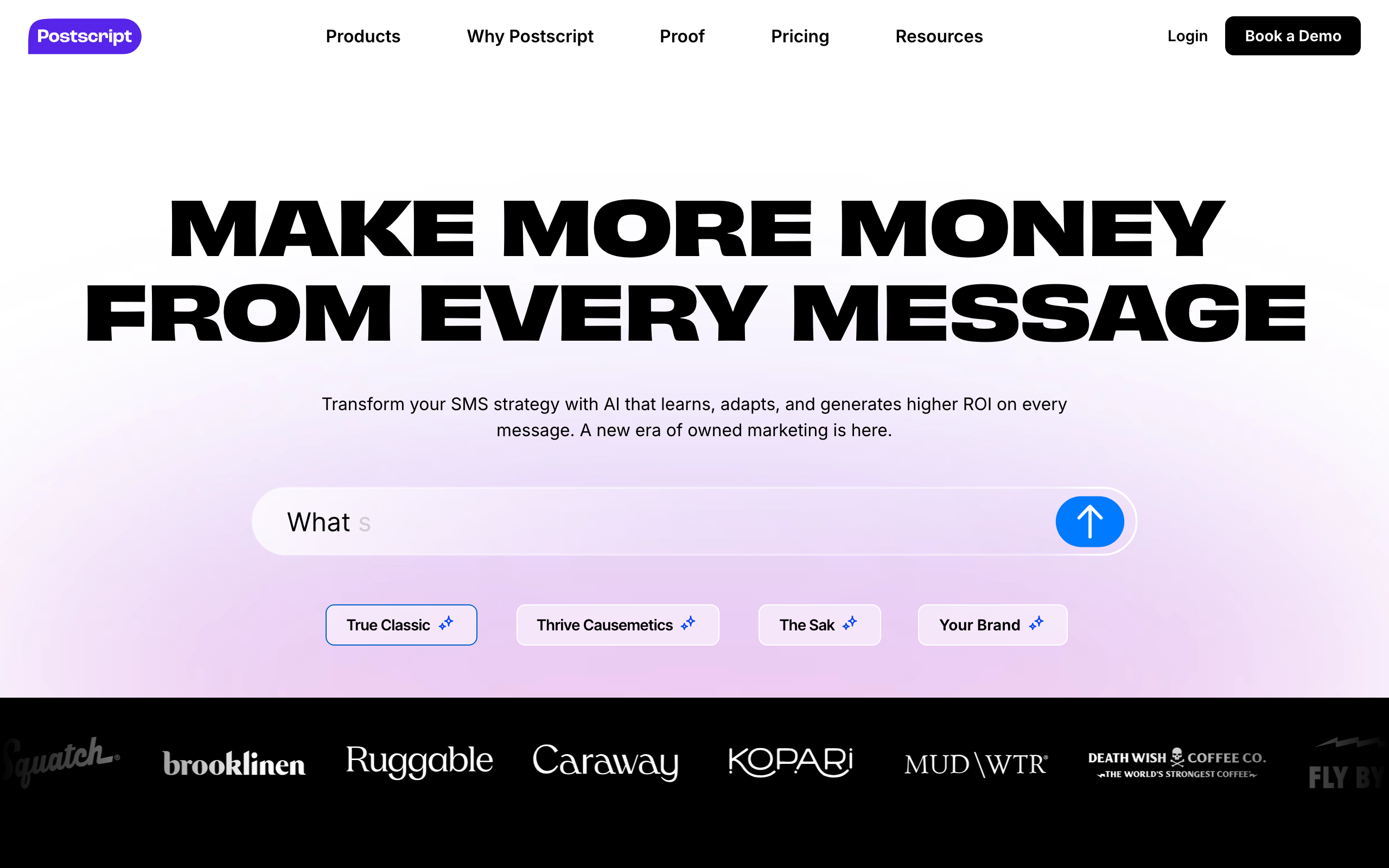
Best for: Shopify brands that want specialist SMS without an annual commitment.
Pricing: Starter $0/month with a $49 minimum monthly spend at about $0.009/SMS and $0.045/MMS. Growth $100/month at about $0.008/SMS and $0.03/MMS. Professional $500/month at about $0.007/SMS and $0.024/MMS. Average US carrier fees of about $0.00418/SMS and $0.00841/MMS are billed separately.
Postscript is the closest thing to Attentive that you can buy with a credit card. Shopify-native flows branch on product, order frequency, and lifetime value; reply management is a real workflow rather than a forwarded inbox; and the published rate card removes the quote-comparison work entirely.
For a mid-market brand, this covers most of what Attentive was actually being used for. Flows, segmentation, campaigns, and conversation all hold up.
What is missing matters though. The capture units are good but not two-tap-good, there is no RCS, and there is no strategist. If your Attentive growth came from the signup experience, budget time and possibly a separate capture tool to replace it.
- Pros: No commitment, published transparent rates including carrier fees, deep Shopify flows, genuine reply management, self-serve at every tier.
- Cons: Capture units trail Attentive, no RCS, no strategic support, needs a separate ESP, Shopify-centric.
Verdict: The default Attentive replacement for a self-serve Shopify brand.
2. Klaviyo
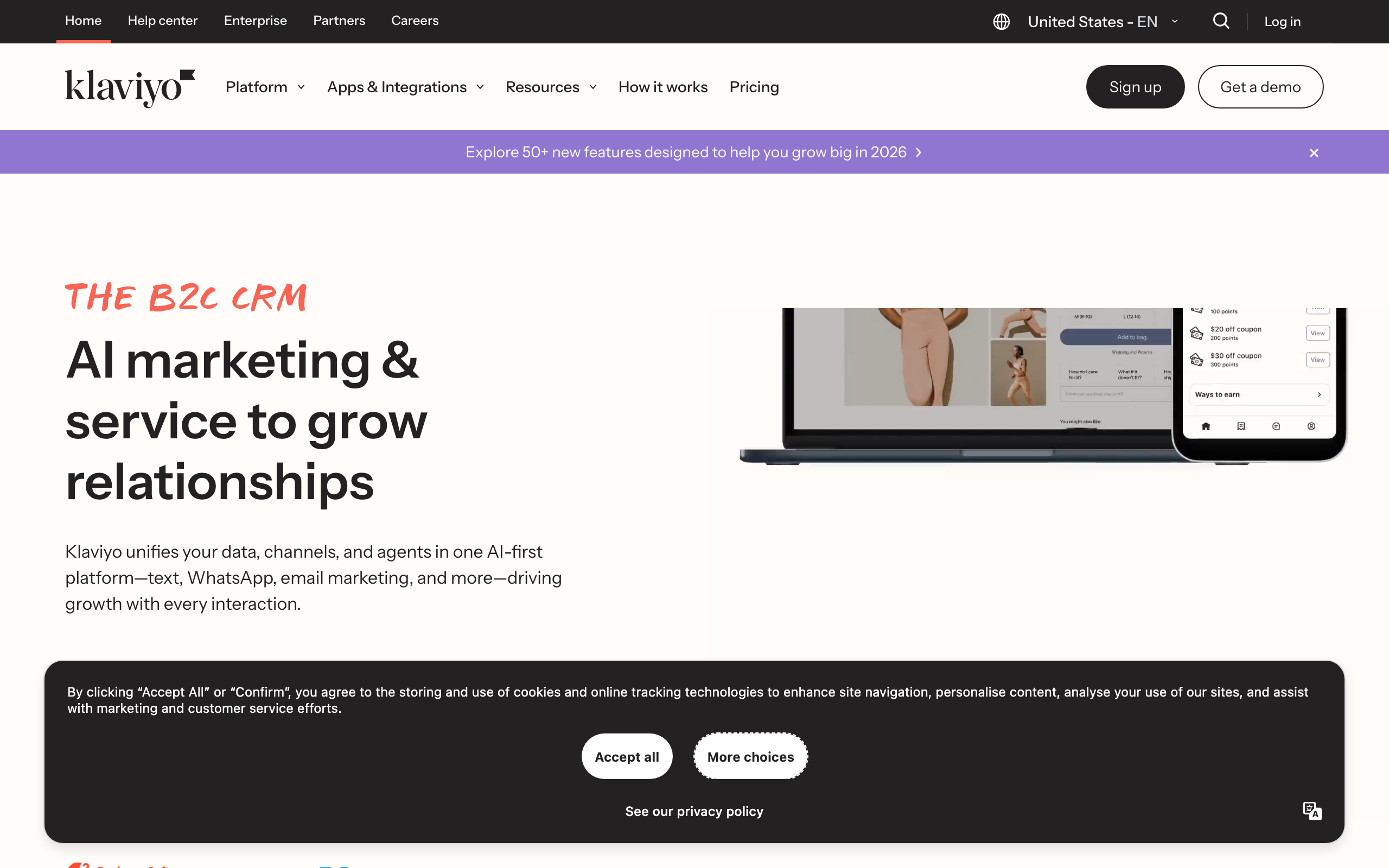
Best for: Brands consolidating messaging into the platform that runs their email.
Pricing: Email and SMS from about $35/month for 251 to 500 active profiles including 1,250 credits. Email alone runs from about $20/month to roughly $150/month at 10,000 profiles, with SMS credits on top.
If you ran Attentive alongside Klaviyo, consolidating into Klaviyo removes a contract, a platform fee, a second subscriber database, and the sync between them.
Architecturally it is a genuine improvement over two platforms: email and SMS share one profile, one segment definition, and one flow, so a journey can send an email, wait, and text only the non-converters. Attentive can do cross-channel journeys too, but not across your existing ESP.
The trade-off is SMS specialization. Klaviyo's capture is adequate rather than exceptional, reply handling is functional, and there is no RCS. Active-profile billing also means a large dormant list costs money.
- Pros: Removes the contract and the second platform, true cross-channel suppression, deepest commerce data, flow-level attribution, self-serve.
- Cons: Weaker capture and reply handling, no RCS, active-profile billing, SMS credits stack on the email plan.
Verdict: The right move when email is your larger channel and consolidation is the goal.
3. Omnisend
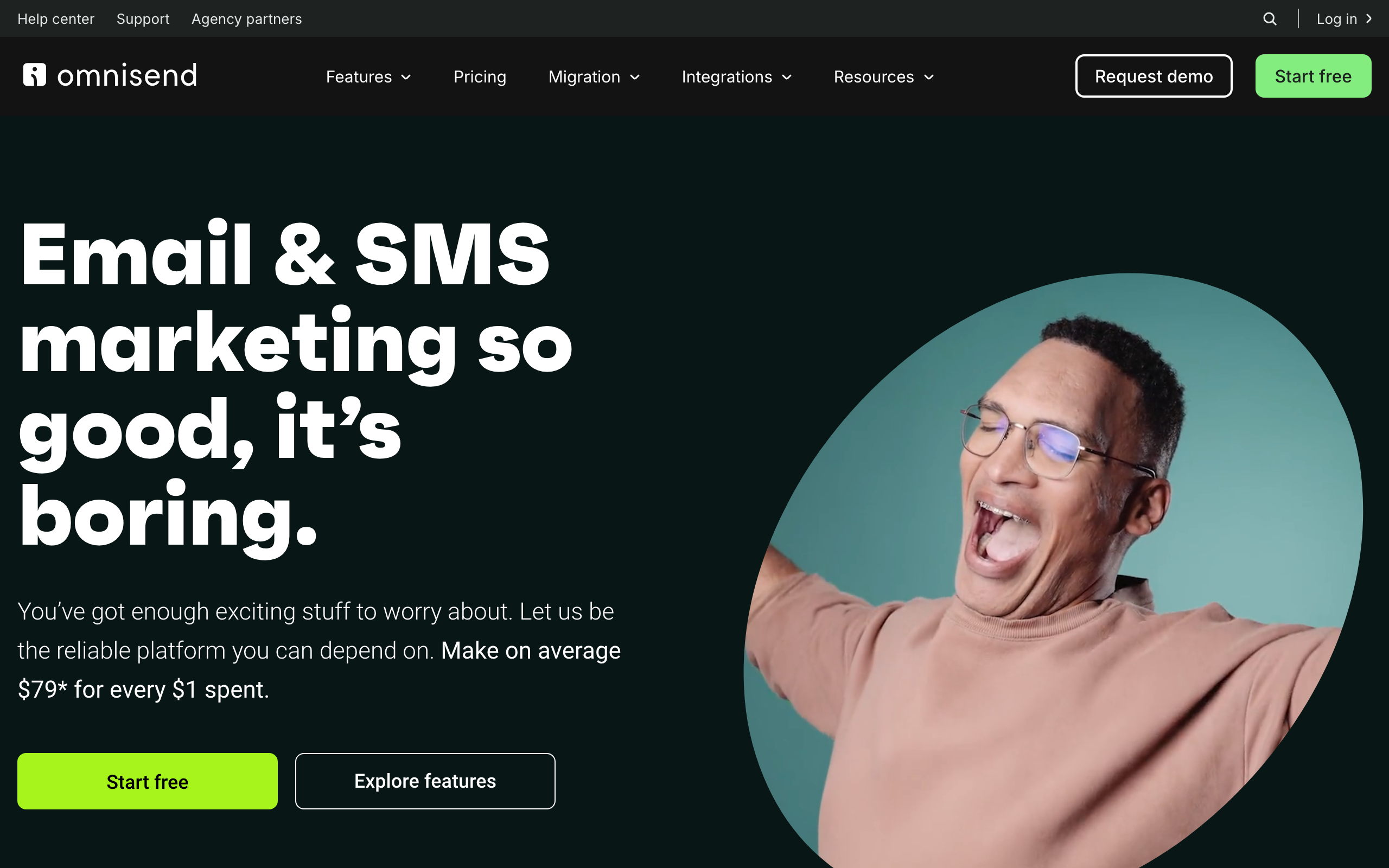
Best for: Brands scaling the program down to fit its actual size.
Pricing: Standard from about $16/month. On current Pro plans, US and Canada SMS runs about $0.009 per message at low spend down to about $0.007 at high volume, with bundles from around $10/month and credits rolling over for 60 days.
Omnisend produces the largest cost reduction on this list for a brand whose real message volume is modest. There is no minimum spend, credits roll over, and email and push come in the same subscription rather than as separate line items.
For a brand sending 20,000 texts a month, the difference against an Attentive commitment is often an order of magnitude, and the prebuilt commerce automations cover the standard journeys quickly.
You are giving up a lot of capability, and you should be honest about that. Segmentation is shallower, capture is basic, reply handling is thin, and SMS sits behind the Pro plan.
- Pros: No minimum spend, biggest cost reduction, three channels in one subscription, credits roll over, quick to launch.
- Cons: Significant capability drop from Attentive, SMS gated to Pro, weak capture and replies, shallower segmentation.
Verdict: The right landing place if the honest answer is that the program was smaller than the contract.
4. Sendlane
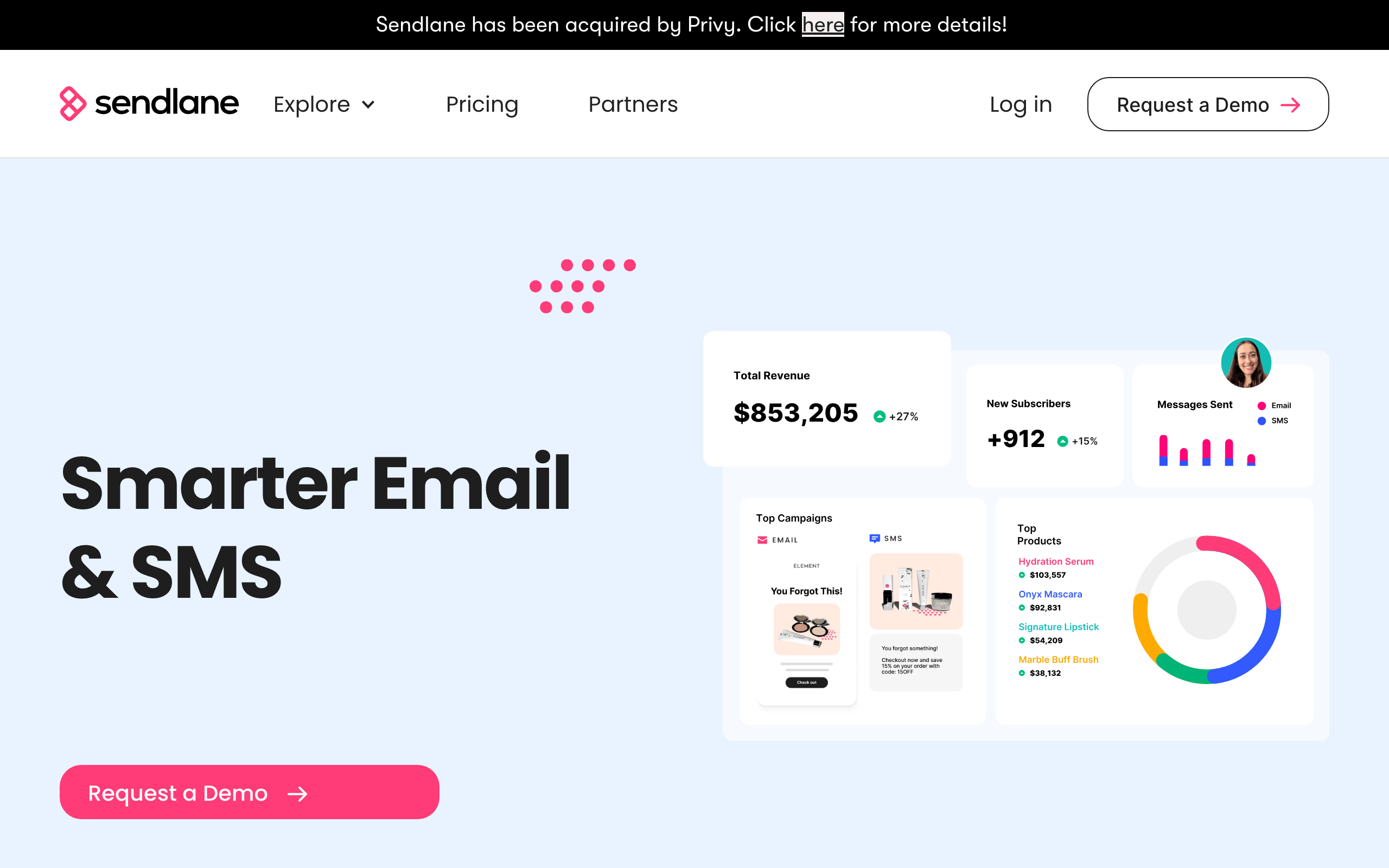
Best for: Brands consolidating both channels while escaping contact-based email billing.
Pricing: Professional from $100/month for 50,000 email sends with unlimited contacts. SMS from about $0.009 per credit, subject to destination rates.
Sendlane is the consolidation option for a brand that wants to leave Attentive and would also like to stop paying for stored email profiles. Unlimited contacts on send-based billing changes the math for any brand with a large historical database.
The commerce depth is competitive, email and SMS share profiles and segments properly, and multi-store operations are handled well.
There is no commitment, but the $100 floor is real, the ecosystem is smaller, and international SMS economics need verification against your actual destination mix.
- Pros: No commitment, unlimited contacts on send-based pricing, genuine commerce depth, email and SMS integrated.
- Cons: $100/month floor, smaller ecosystem, capture and RCS well behind Attentive, regional SMS needs checking.
Verdict: A strong consolidation move that also fixes an email billing problem.
5. Recart
Best for: Brands where the strategic support was the real product.
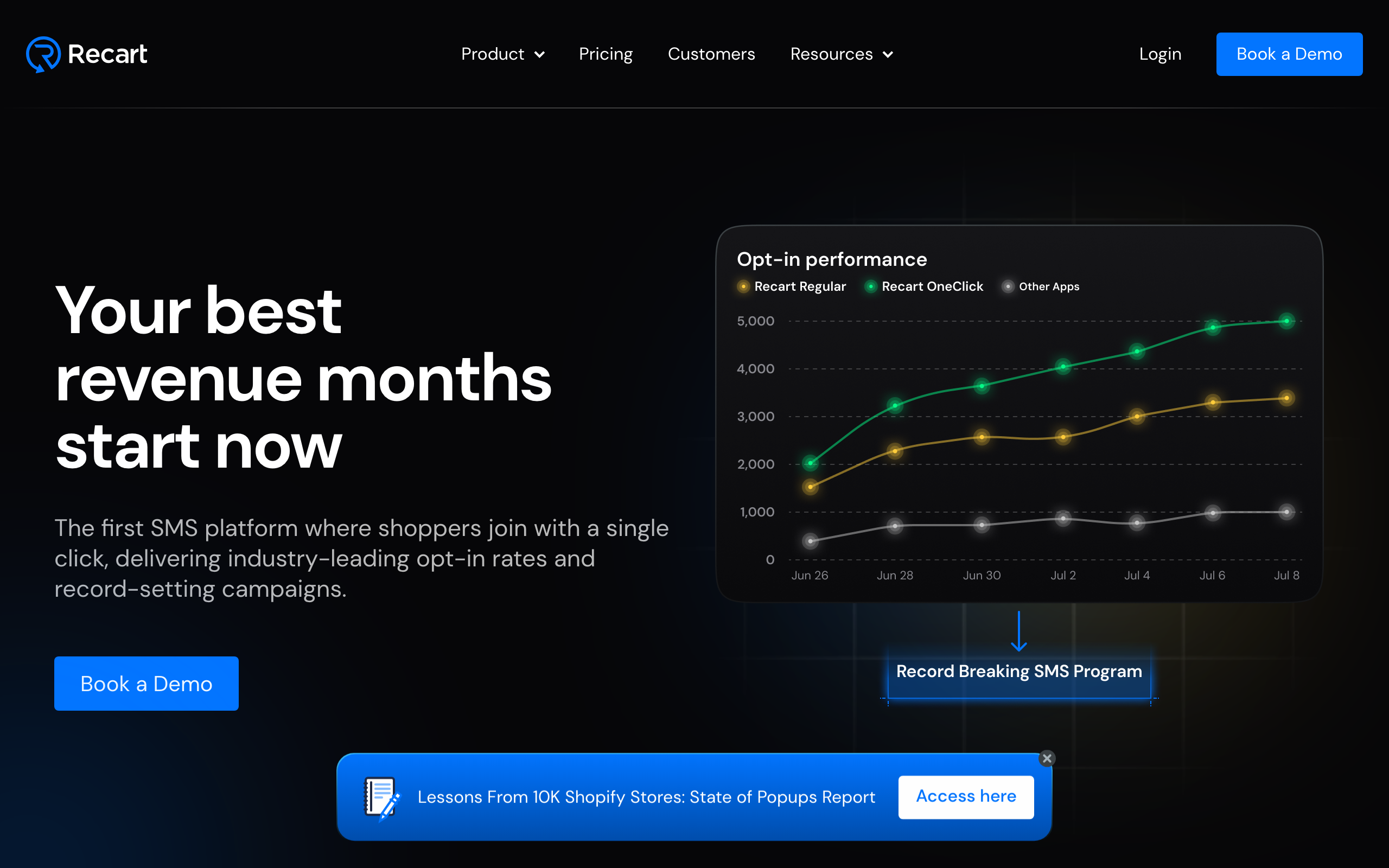
Pricing: Plans from about $299/month with unlimited subscribers, a dedicated strategist, and a toll-free number included. Higher tiers around $999/month bundle substantial message volume.
If what you valued about Attentive was that someone else planned the calendar, wrote the copy, ran the tests, and sent the weekly report, Recart is the closest replacement at a fraction of the commitment.
Every account gets a customer success manager doing that work, and the Shopify capture and recovery tooling is solid. Monthly rather than annual terms are a meaningful difference for a brand burned by a commitment.
It is not Attentive on capability: no RCS, less conversational depth, and click-only attribution on the entry tier. Evaluate the strategist, because that is what you are buying.
- Pros: Managed program included, monthly terms, unlimited subscribers, number included, much lower floor than Attentive.
- Cons: Less capable platform, no RCS, attribution model varies by tier, quality depends on the assigned strategist.
Verdict: The right replacement when the service, not the software, was the value.
6. Emotive
Best for: Brands whose Attentive program was mostly conversational.
Pricing: Published tiers around $100/month for Starter, $200/month for Pro, and $300/month for Advanced, plus per-message costs, with enterprise pricing on request.
Emotive is the closest alternative on the conversational dimension specifically. Its model is two-way messaging with human-assisted responses rather than broadcast with reply handling attached.
For considered purchases and high-AOV categories, that mechanic is where a meaningful share of Attentive-style revenue actually comes from, and Emotive reproduces it at a much lower floor.
It is a narrower platform overall: less flow depth, no email, and per-message costs on top of the plan. Verify the current tier structure and usage rates before assuming the entry price covers your volume.
- Pros: Genuine conversational model at a low floor, human-assisted responses, transparent tiers, monthly terms.
- Cons: Narrower automation, no email, usage on top of plans, no RCS or enterprise capture.
Verdict: A focused replacement for the conversational half of an Attentive program.
7. Sequenzy
Best for: Teams deliberately stepping back to SMS as a lifecycle step rather than a channel.
Pricing: SMS is a paid add-on from $16/month including 1,000 credits, on paid plans. One US or Canada SMS segment uses one credit, and international credits are cost-weighted by destination.
Disclosure: I build Sequenzy, and I want to be blunt about the gap: this is not an Attentive replacement in capability terms. There is no RCS, no two-tap signup unit, no conversational commerce suite, and no in-app two-way inbox. A brand that needs those should stay with a specialist.
Where it fits an Attentive exit is a brand concluding that SMS should be a supporting step in a lifecycle program rather than a standalone department. A Send SMS step drops into any sequence using the same subscribers, segments, and attribution as email, so a text becomes one decision inside a journey rather than a separate calendar.
The operational side is fully managed: a dedicated toll-free number is provisioned, carrier verification is guided, SMS consent stays separate from email status and is never inferred from a phone number, STOP, START, and HELP are handled per number, and quiet hours defer out-of-window sends. There is no minimum spend, and SMS is fully available through the API, CLI, and MCP server.
- Pros: No minimum spend, SMS inside existing email sequences, managed number and verification, consent separate by design, quiet hours enforced, full API, CLI, and MCP coverage.
- Cons: No RCS, no two-way inbox, no enterprise capture units, MMS US and Canada only, not an SMS specialist.
Verdict: Right for a deliberate step back. Wrong if you still need what Attentive did.
8. TxtCart
Best for: Brands whose Attentive revenue was concentrated in cart recovery.
Pricing: Recent published pricing shows a Growth plan around $79/month at about $0.008/SMS and $0.030/MMS, with a trial and starting credits. Older plans charged a percentage of attributed sales, so confirm the model you are quoted.
Run the audit before you dismiss this. A surprising number of brands find that after removing promotional sends that mostly generated opt-outs, cart and checkout recovery accounted for most of the genuinely incremental revenue.
If that is your situation, replacing an enterprise contract with a single-purpose tool at a low monthly floor is a rational simplification rather than a downgrade.
Measure it with a holdout, and be clear that this is one automation, not a program.
- Pros: Very low floor, focused on the highest-intent use case, conversational recovery, monthly terms.
- Cons: Single use case, no broader program, pricing model has changed, no email.
Verdict: A legitimate simplification if the revenue audit supports it.
9. Bloomreach Engagement
Best for: Retailers whose real need is a customer data platform, not a messaging vendor.
Pricing: Enterprise quote based on customers, catalog size, and event volume.
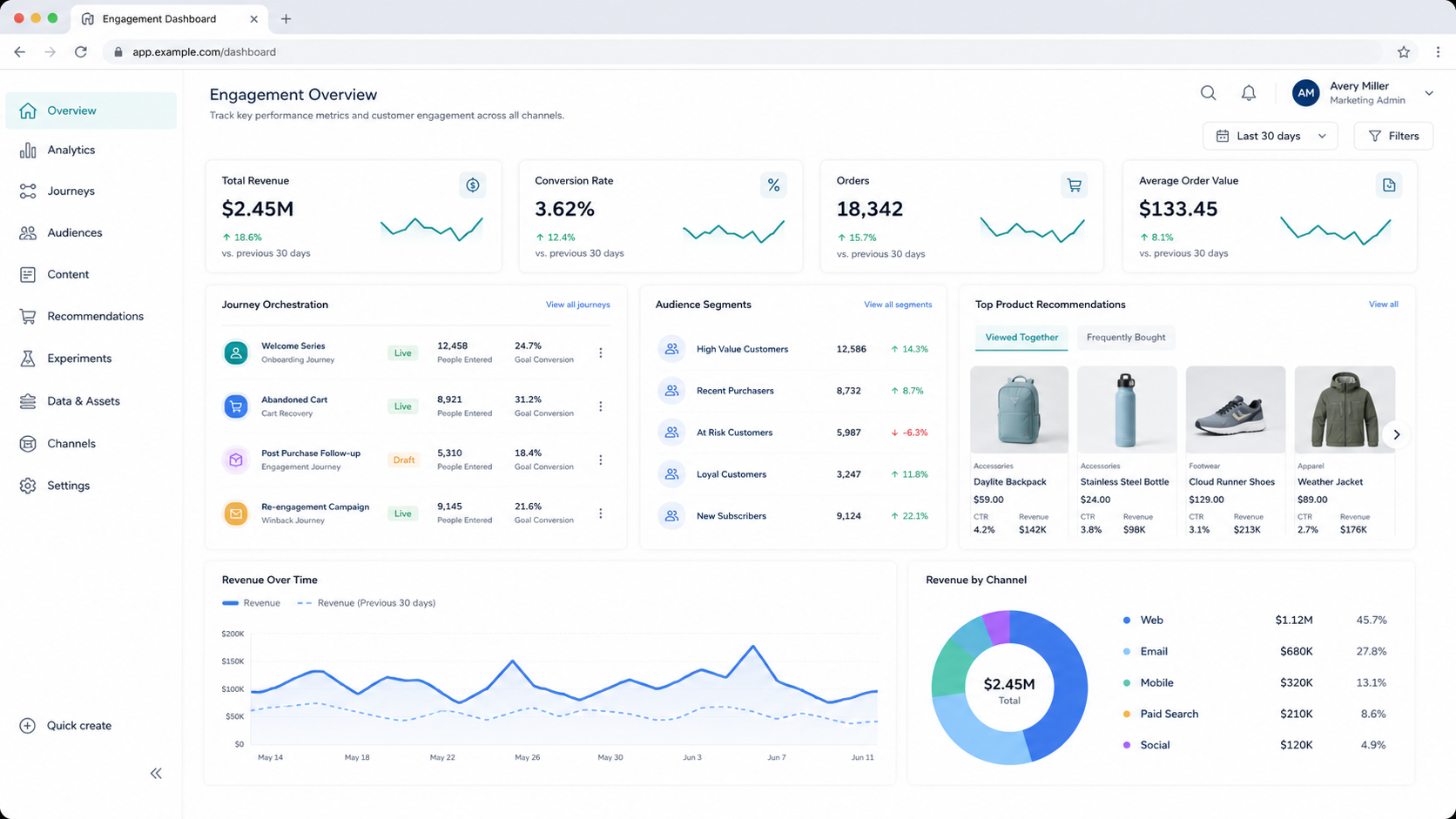
Some brands leave Attentive sideways rather than downward. If the constraint is that messaging sits outside your customer data and web personalization, a full CDP with orchestration solves a different and larger problem.
Bloomreach covers commerce search, merchandising, personalization, and messaging from one data layer. That is a bigger implementation with a bigger budget and usually a dedicated team.
If you are here to reduce spend, this is not your answer. If you are here because Attentive was solving one channel in isolation, it belongs on the list.
- Pros: Full CDP, web and commerce personalization, enterprise orchestration, one data layer across channels.
- Cons: Enterprise cost and implementation, needs a dedicated team, not a cost reduction, long time to value.
Verdict: The sideways enterprise exit, relevant only for a specific kind of retailer.
10. Shopify Messaging
Best for: Brands concluding that SMS is not their channel.
Pricing: $2.15/month per approved toll-free number for US and Canada marketing SMS, plus per-message charges that vary by country.
This is the honest option nobody puts on an alternatives list. If your Attentive program never produced incremental revenue that justified its cost, the correct move may be to stop running an SMS program rather than to run it more cheaply.
Native Shopify messaging keeps a minimal capability for order-related and occasional promotional messages with essentially no fixed cost, no integration, and no minimum.
Treat it as a deliberate wind-down with an option to restart, not as a competitive alternative.
- Pros: Almost no fixed cost, native Shopify context, no integration or minimum, easy to maintain.
- Cons: Minimal automation and segmentation, Shopify only, no capture tooling, international rates vary sharply.
Verdict: The right answer if the honest conclusion is that the channel did not work.
What leaving Attentive actually costs you
Four capabilities disappear, and only one of them is easy to replace.
Two-tap and two-step signup units. This is the big one. Attentive's mobile capture experience is materially better than what most alternatives offer, and for many brands it was the primary engine of subscriber growth. After migration, expect growth to slow unless you deliberately rebuild capture, potentially with a separate tool such as Privy or a dedicated on-site conversion product.
RCS. Branded, richer messaging on supported devices is not broadly available in self-serve platforms. If it was part of your program, there is currently no cheap substitute.
Conversational commerce at scale. Handling large volumes of genuine two-way conversation with routing, automation, and human handoff is a real infrastructure capability. Postscript and Emotive are the closest; most bundled platforms are not close at all.
The strategist. Onboarding, deliverability guidance, calendar planning, and a named contact are bundled into Attentive's price. Recart replaces the function; an agency retainer replaces it differently; a self-serve platform does not replace it at all.
The one thing that is easy to replace: campaign sending and basic flows. Every platform here does that adequately.
The cost comparison, done honestly
Attentive does not publish rates, so this uses commonly reported figures. Verify against your own contract.
| Monthly volume | Attentive (reported) | Postscript Starter | Postscript Professional | Omnisend Pro |
|---|---|---|---|---|
| 40,000 messages | Commonly $667+ minimum, often above commitment floor | About $360 in messages plus about $167 carrier, roughly $527 | $500 plus about $280 plus about $167, roughly $947 | Plan plus roughly $340 in messages |
| 150,000 messages | Commonly $1,500 to $2,000+ | About $1,350 plus about $627, roughly $1,977 | $500 plus about $1,050 plus about $627, roughly $2,177 | Plan plus roughly $1,050 in messages |
| 400,000 messages | Commonly $4,000+ | About $3,600 plus about $1,672, roughly $5,272 | $500 plus about $2,800 plus about $1,672, roughly $4,972 | Plan plus roughly $2,800 in messages |
Three conclusions worth acting on:
Below your commitment, self-serve wins decisively. A brand committed at 50,000 messages but sending 20,000 is the clearest possible case for leaving.
At high volume, the gap narrows. At 400,000 messages a month, per-message economics dominate and Attentive's negotiated rates can be competitive. Leaving for cost at that scale requires a real quote comparison, not an assumption.
Bundled platforms look cheapest because they hide the plan. Omnisend's message costs are low, but the Pro plan, the contact tier, and the email you were already paying for all belong in the comparison.
A contract-aware exit plan
The migration is the easy part. The contract is where money is lost.
1. Find the renewal date and the notice window. Most enterprise messaging agreements auto-renew with a notice period, often 30 to 90 days before term end. Missing it costs you a year.
2. Read the minimum commitment clause. Committed spend generally survives a volume drop. Understand whether unused commitment rolls, expires, or is simply billed.
3. Plan the migration to land after renewal, not before. Running a parallel program for a month is cheaper than paying out a term.
4. Export before you give notice. Subscribers with consent source, timestamp, disclosure, country, and opt-out state. The full suppression list. Campaign and flow performance history, because reporting does not migrate.
5. Register the new number early. Toll-free verification takes one to five business days; 10DLC brand vetting can take longer. Do this while still on Attentive.
6. Rebuild capture first, not last. This is where brands lose the most after migration. Have the new signup units live before the old ones come down.
7. Announce the number change. One message from the old number, one reintroduction from the new one. Recognition is most of what keeps opt-out rates low.
8. Run both for two weeks. New number, small segment, compare opt-out and click rates against your Attentive baseline before moving everything.
Frequently asked questions
What is the best Attentive alternative?
Postscript is the closest self-serve replacement for a Shopify brand: it publishes its rates, requires no sales process, and offers real reply management and Shopify-native flows. Klaviyo is the better move if you also want to consolidate email onto the same profile. Omnisend is the largest cost reduction for a smaller program. Recart is the answer if the strategic support, not the software, was what you valued.
Why do brands leave Attentive?
Almost always the commercial structure rather than the product. Reported minimums commonly sit around $2,000 to $3,000 per quarter with volume commitments and annual contracts, so a brand whose volume falls, whose season ends, or whose program stalls keeps paying for capacity it is not using. Feature dissatisfaction is a much rarer reason.
What do I lose by leaving Attentive?
The signup units and two-tap mobile capture, which are the best in the category and often the single largest driver of program growth. Also RCS, conversational commerce at scale, cross-channel journeys across SMS, email, RCS and push, and the strategic support team. Expect subscriber growth to slow after migration unless you rebuild capture deliberately.
How much cheaper is a self-serve alternative?
Substantially, if your volume is modest. Postscript Starter has no monthly fee and a $49 minimum spend at about $0.009 per SMS plus roughly $0.00418 in average US carrier fees. A brand sending 40,000 messages a month pays roughly $530 all in, against an Attentive commitment that commonly starts near $667 a month before message costs. At 400,000 messages a month the gap narrows considerably.
Can I get out of an Attentive contract early?
Read the agreement rather than assuming. Most enterprise messaging contracts are annual with auto-renewal, a notice window before renewal, and minimum commitments that survive a volume drop. Identify your renewal date and notice deadline first, then plan the migration to land after it rather than paying out a term.
Will my SMS subscribers transfer?
The subscriber records transfer if you export them properly, with opt-in source, timestamp, disclosure text, country, and opt-out state. The sending number usually does not. Assume a new number, register it before you migrate, announce the change from the old number, and expect a temporary dip in engagement.
Is Postscript as good as Attentive?
On Shopify flows, reply management, and pricing transparency, it is competitive. On list-growth units, RCS, conversational scale, and strategic support, Attentive is clearly ahead. The honest framing is that Postscript does about 80 percent of what a mid-market brand actually uses, at a fraction of the commitment.
Should I replace Attentive with a bundled email and SMS platform?
Yes if email is your larger channel and coordination matters more than SMS depth, because a single platform gives you shared suppression, shared frequency caps, and one attribution model. No if SMS is the primary revenue channel, because bundled platforms do not match a specialist on capture or reply handling.
Final recommendation
- Self-serve Shopify brand leaving for cost: Postscript. Closest capability, published rates, no commitment.
- Already running Klaviyo alongside: consolidate into Klaviyo and delete a contract, a database, and a sync.
- Program smaller than the contract: Omnisend. Pay for what you send.
- Large dormant email database too: Sendlane. Fix both billing problems at once.
- The strategist was the value: Recart, or an agency retainer.
- The program was mostly conversation: Emotive.
- SMS should support email, not lead: Sequenzy, as a deliberate step back.
- Only cart recovery was incremental: audit, then TxtCart.
- Channel never worked: Shopify Messaging, and reinvest the budget in capture or email.
Before signing anything, do the boring work: find your renewal date, model your real volume against published rates, and check whether your subscriber growth came from the platform's capture units. That last one decides whether leaving costs you more than it saves.
Related resources
- Best Postscript alternatives - the specialist-to-specialist decision
- Best SMS marketing tools for DTC brands - the wider DTC comparison
- Attentive pricing explained - how the quote is built
- Attentive alternatives - the wider alternatives page
- Best email and SMS marketing platforms - if consolidation is the goal