
Retail data platform or custom event messaging
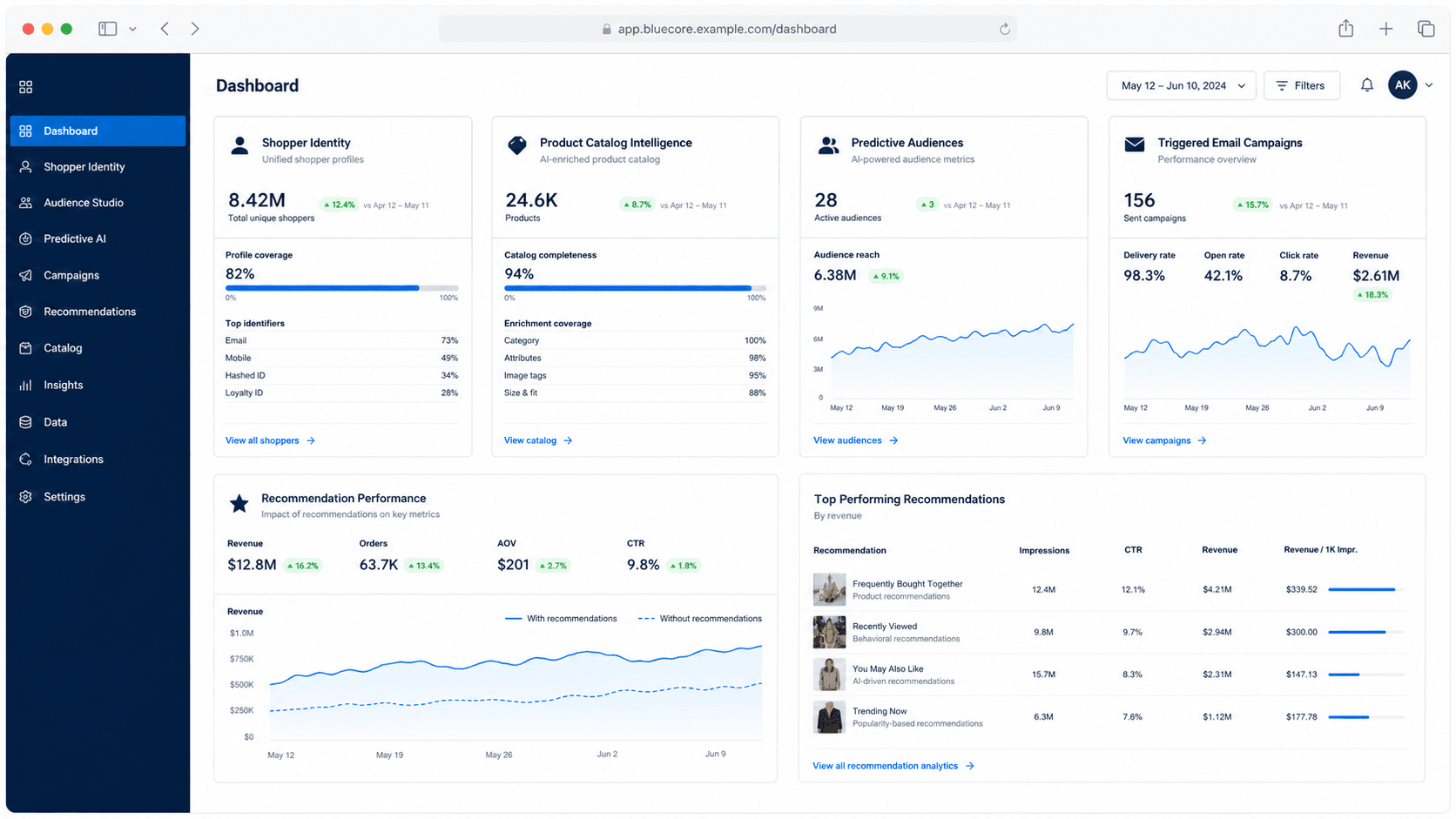
Bluecore is purpose-built for retail teams that want to use product catalog data, shopper identity, and predictive audiences in ecommerce campaigns. Customer.io is built for teams that want flexible lifecycle messaging from custom events, attributes, APIs, and product states.
The best fit depends on the source of truth for personalization. If product catalog and shopper behavior are the primary signals, Bluecore is closer. If the signals come from a custom product or subscription lifecycle, Customer.io may be easier to shape around the business.
Use-case matchups
| Need | Better fit | Why |
|---|---|---|
| Retail catalog behavior and shopper identity | Bluecore | Bluecore is built around product intelligence and retail audiences. |
| Custom event and attribute-driven messaging | Customer.io | Customer.io is stronger when teams define their own lifecycle event model. |
| Price drop, back-in-stock, and product affinity | Bluecore | Those are specialized retail signals. |
| Product/app lifecycle events and APIs | Customer.io | It is more natural for arbitrary product states and technical messaging models. |
| Supported Shopify/WooCommerce/Stripe email flows | Sequenzy | It is simpler when custom events and retail intelligence are unnecessary. |
Best Fit by Retail Signals and Custom Event Models
Best retail personalization platform for price-drop and back-in-stock campaigns
Bluecore is the better fit when the team needs shopper identity, catalog behavior, product affinity, predictive audiences, and retail triggers such as price drop or back-in-stock. It is strongest when product intelligence is the main differentiator.
Best lifecycle messaging platform for custom product events
Customer.io is the better fit when teams define their own event model around product states, account attributes, APIs, webhooks, subscriptions, and arbitrary lifecycle data. It works best when engineering can instrument and maintain the messaging data layer.
Best email tool for supported store and Stripe workflows
Sequenzy is the better fit when the required workflows are Shopify, WooCommerce, Stripe lifecycle email, newsletters, and transactional messages without custom event infrastructure or retail recommendation modeling.
Pricing reality
The existing pricing data is directional: Bluecore is custom-priced around retail data, channels, modules, and contract scope, while Customer.io varies by plan, contacts, usage, and selected features. Bluecore pricing should be scoped around retail feeds, identity, personalization modules, product intelligence, and services. Customer.io pricing should be evaluated around profile volume, message volume, data integrations, technical setup, and whether event instrumentation already exists.
Review signals
Existing review themes for Bluecore mention shopper identity, reporting, ecommerce retention fit, setup effort, and pricing clarity. Existing Customer.io review themes focus on campaign work, integrations, usability, pricing, and advanced features. Read reviews from teams with similar technical ownership, event volume, API setup, lifecycle complexity, and deliverability requirements.
Why Bluecore can be the better fit
Bluecore is strongest when retail signals are the hard part: product views, price drops, back-in-stock logic, category interest, shopper identity, and predictive audiences. It can give retail marketers a more specialized way to activate those signals.
It is less appropriate when the business needs arbitrary event-triggered messaging across non-retail states and product usage behavior.
Why Customer.io can be the better fit
Customer.io is stronger when engineering and lifecycle teams can define the event model and use that model to trigger messages. It works well for subscription commerce, SaaS-commerce hybrids, marketplaces, and products with important account lifecycle states.
The tradeoff is setup responsibility. Customer.io needs clean identifiers, event taxonomy, attributes, and suppression logic; it does not package retail product intelligence the way Bluecore does.
Where Sequenzy fits
Sequenzy fits when supported Shopify, WooCommerce, and Stripe events are enough. It is less flexible than Customer.io for arbitrary events and less sophisticated than Bluecore for retail intelligence, but simpler for email-first lifecycle work.
Event-driven fit table
| Decision point | Bluecore | Customer.io | Sequenzy |
|---|---|---|---|
| Product catalog intelligence and retail audiences are central | Stronger fit | Not the center | No. |
| Product/app events should trigger lifecycle messages | Partial | Stronger fit | Strong for supported store/billing events. |
| Technical team wants API-driven messaging control | Heavier retail path | Stronger fit | Simpler path. |
| Ecommerce recommendations and shopper identity matter most | Stronger fit | Limited compared with retail tools | No recommendations. |
| SaaS or product-led lifecycle messaging is in scope | Weak | Stronger fit | Strong for Stripe-aware email. |
| Marketers need a no-code retail personalization layer | Stronger fit | More technical | Email-focused. |
When Customer.io is the real choice
Customer.io is strongest when messaging is driven by events from a product, app, or custom data model. Teams that already think in event names, attributes, API calls, and lifecycle states may find it more natural than a retail-specific platform.
Bluecore is stronger when the business is specifically retail and wants product catalog intelligence, shopper identity, predictive audiences, and product-led campaign activation.
Sequenzy fits when the event model is simpler: Shopify, WooCommerce, Stripe, campaigns, and transactional messages. It is less flexible than Customer.io for arbitrary product events, but simpler when those integrations cover the job.
Migration checklist
| Area | Moving toward Bluecore | Moving toward Customer.io | Moving toward Sequenzy |
|---|---|---|---|
| Data model | Prepare catalog, shopper identity, behavior events, and audience strategy. | Define event taxonomy, person attributes, identifiers, segments, and API sources. | Map subscribers, consent, tags, attributes, ecommerce events, and Stripe events. |
| Technical setup | Plan enterprise feeds, identity matching, and catalog activation. | Instrument events, test webhooks/API calls, and document source-of-truth rules. | Connect supported integrations and import subscriber context. |
| Automation | Build product-led personalization and predictive audiences. | Build event-triggered journeys from product and lifecycle states. | Build email flows, campaigns, and transactional messages. |
| Team ownership | Align ecommerce, merchandising, data, and retention teams. | Align lifecycle, product, engineering, and data teams. | Assign email lifecycle and deliverability owners. |
| Success metrics | Measure audience lift, recommendation impact, and retail campaign revenue. | Measure event-to-message conversion, lifecycle activation, retention, and message revenue. | Measure flow revenue, campaign performance, deliverability, and transactional reliability. |
Decision checklist
| Choose | When |
|---|---|
| Bluecore | You need shopper identity, catalog behavior, predictive audiences, and product-led retail personalization. |
| Customer.io | You need flexible event-triggered messaging from custom product, subscription, API, and lifecycle data. |
| Sequenzy | You need Shopify/WooCommerce lifecycle email, newsletters, Stripe triggers, and transactional email. |
| Re-check pricing | Retail feeds, profiles, message volume, event volume, data integrations, technical setup, and support can change the real cost materially. |









