
Overview
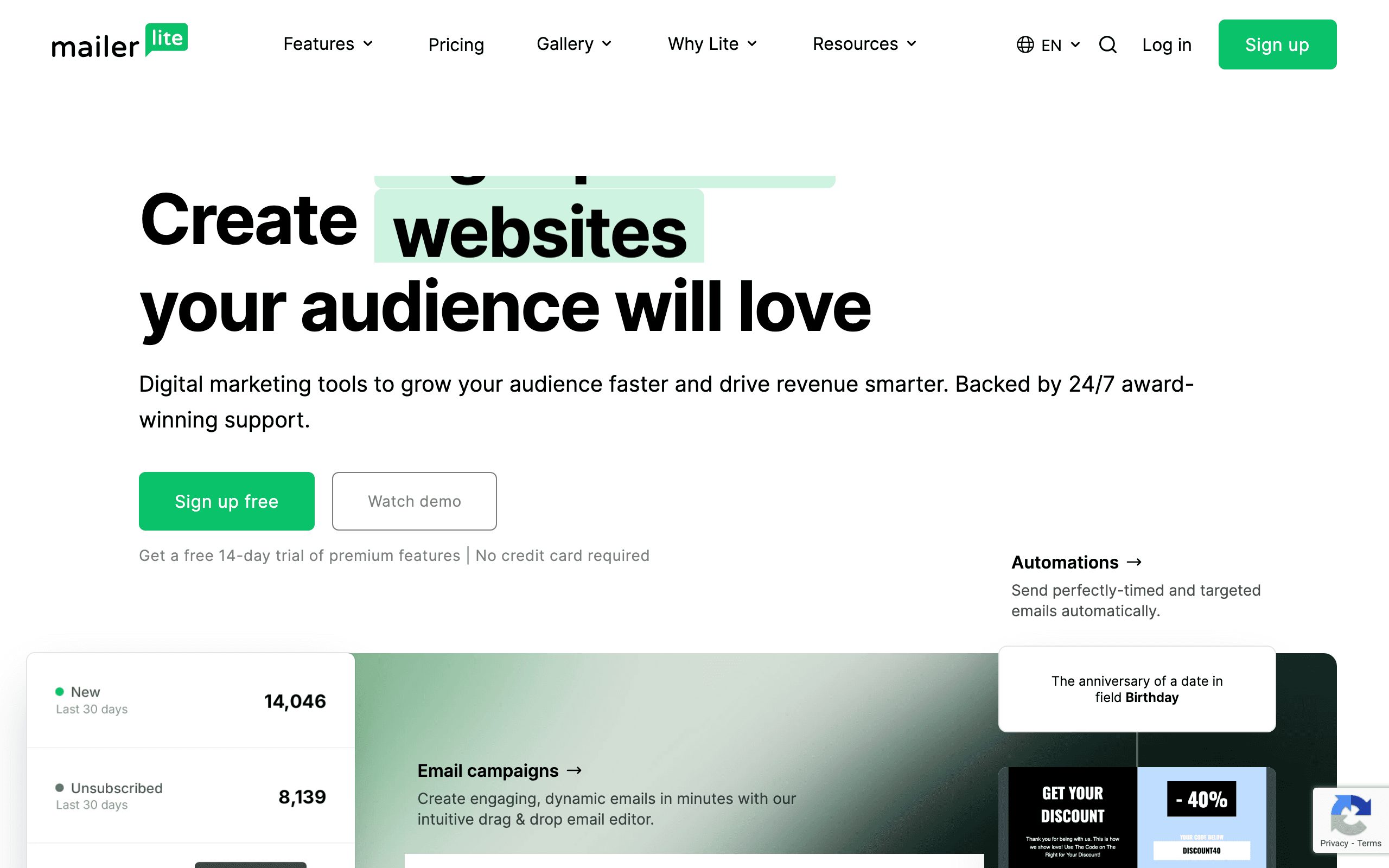
BirdSend and MailerLite both serve email marketers but with different priorities. BirdSend is a lightweight email marketing platform built for content creators. MailerLite is a user-friendly email marketing platform with website and landing-page features.
BirdSend's Niche
BirdSend narrows in on subscriber revenue: LTV tracking per subscriber and unique-contact billing so you are not charged twice for someone on two lists, plus a built-in resend to people who never opened the first send. MailerLite skips revenue tracking but adds landing pages, a website builder, and forms alongside its own resend-to-unopens option, at $73 a month for 10,000 subscribers against BirdSend's $9 for 1,000. Pick BirdSend for revenue visibility, MailerLite for a fuller creator toolkit.
MailerLite offers a polished user experience, landing pages, forms, website features, and creator monetization tools, while BirdSend focuses on revenue tracking and creator email.
Pricing reality
Compare current pricing against real usage. For BirdSend, check subscriber limits, send limits, unique-contact billing, revenue tracking, and automation depth. For MailerLite, check subscribers, sends, landing pages, forms, website features, paid newsletters, digital product sales, and plan-level feature access.
Making the Choice
Choose BirdSend for creator email with revenue tracking. Choose MailerLite for interface polish, landing pages, forms, website features, and creator monetization. For SaaS email with Stripe, consider Sequenzy.
The User Experience Gap
MailerLite consistently earns praise for its clean, intuitive interface. Every interaction - from creating a campaign to setting up automation - feels thoughtfully designed. The drag-and-drop editor, the visual workflow builder, and the overall navigation are polished in a way that makes email marketing feel accessible rather than technical.
BirdSend's interface is functional but unrefined. It gets the job done without the design polish that MailerLite provides. For users who spend significant time in their email platform, interface quality directly affects productivity and satisfaction. For users who log in weekly to send a newsletter, the experience difference matters less.
This UX gap extends to onboarding. MailerLite guides new users through setup with contextual help and clear next steps. BirdSend expects users to figure things out with less hand-holding. For non-technical creators, MailerLite's guidance reduces the time to first email significantly.
The Website Builder Question
MailerLite includes a full website builder on paid plans, making it possible to run your entire online presence - website, blog, email, and landing pages - through a single platform. For creators who do not yet have a website, this eliminates the need for WordPress, Squarespace, or other website tools.
BirdSend has no website or landing page capabilities. You need a separate tool for any web presence beyond email. For creators already running a WordPress site or Shopify store, this is irrelevant. For those starting from scratch who want the simplest possible tech stack, MailerLite's consolidation provides real value.
The trade-off is that MailerLite's website builder, while functional, is simpler than dedicated website platforms. You get basic pages and blogs but not the customization depth of WordPress or the design flexibility of Webflow. For most creator websites, the basic functionality is sufficient.
Revenue Data vs Revenue Features
BirdSend tracks revenue per subscriber but offers no features to help generate that revenue beyond basic email. MailerLite takes the opposite approach: it does not track per-subscriber revenue but offers features designed to generate it - paid newsletters, digital product sales, and landing pages with conversion optimization.
This difference matters for how you think about your email as a business tool. BirdSend helps you analyze your existing revenue patterns and understand subscriber value. MailerLite helps you create new revenue streams through built-in commerce features. Both approaches have merit, but they serve different stages of a creator's business evolution.
For creators who already sell products through external platforms and want to understand per-subscriber economics, BirdSend's tracking is more immediately useful. For creators looking to launch their first digital product or paid newsletter, MailerLite's built-in commerce tools lower the barrier to monetization.
Use-case matchups
| Use case | Better fit | Why |
|---|---|---|
| Creator email with LTV per subscriber | BirdSend | Revenue tracking and unique-contact billing are core strengths. |
| Polished email marketing with pages and forms | MailerLite | It has stronger UX, website builder, landing pages, and forms. |
| Existing audience that needs revenue analysis | BirdSend | It helps understand subscriber value. |
| Creator starting a website, paid newsletter, or digital product | MailerLite | It has more built-in monetization and hosted-page tools. |
| SaaS billing-triggered lifecycle email | Sequenzy | Stripe events are outside both tools' core focus. |
Review signals
The BirdSend reviews on this page praise low pricing, LTV tracking, and budget fit, while acknowledging that the interface and broader platform polish lag MailerLite. That makes BirdSend a focused creator email tool rather than a complete marketing toolkit.
The MailerLite reviews praise interface quality, website builder, landing pages, paid newsletters, and digital product sales, while noting that per-subscriber revenue analytics are missing. That makes MailerLite stronger for creators building an all-around email and page stack.
Best Fit by Creator Simplicity Need
Best email tool for creators tracking subscriber revenue
BirdSend fits creators who want lean newsletters, simple sequences, and revenue visibility around courses, memberships, or affiliate offers. It is strongest when subscriber value tracking matters more than polished design tools.
Best email platform for polished creator and small-business campaigns
MailerLite is the better fit when the team wants a clean editor, landing pages, website builder, forms, automations, and approachable templates. It works best when ease of use and presentation matter more than narrow revenue analytics.
Best lifecycle email platform for subscription products
Sequenzy fits teams whose emails should react to signups, trials, upgrades, invoices, failed payments, and product behavior. It is more relevant when subscribers are product users or paying accounts, not only creator audience members.
Migration checklist
Before moving between BirdSend and MailerLite, export subscribers, suppression data, tags, custom fields, revenue tracking fields, forms, landing pages, templates, campaign history, sequences, automations, website pages, paid newsletter data, product sales data, and domain authentication records. If moving to MailerLite, rebuild landing pages, forms, website pages, and monetization workflows. If moving to BirdSend, preserve revenue fields where possible and replace MailerLite website, landing page, commerce, and paid newsletter features with separate systems.
Decision checklist
- Choose BirdSend if subscriber revenue tracking and low-cost creator email matter most.
- Choose MailerLite if ease of use, landing pages, website builder, paid newsletters, and digital product tools matter more.
- Avoid BirdSend if hosted pages, forms, and a polished all-in-one workflow are required.
- Avoid MailerLite if LTV-per-subscriber analytics are central to the workflow.
- Consider Sequenzy if SaaS lifecycle, transactional email, and Stripe-triggered automation are the real requirements.









