
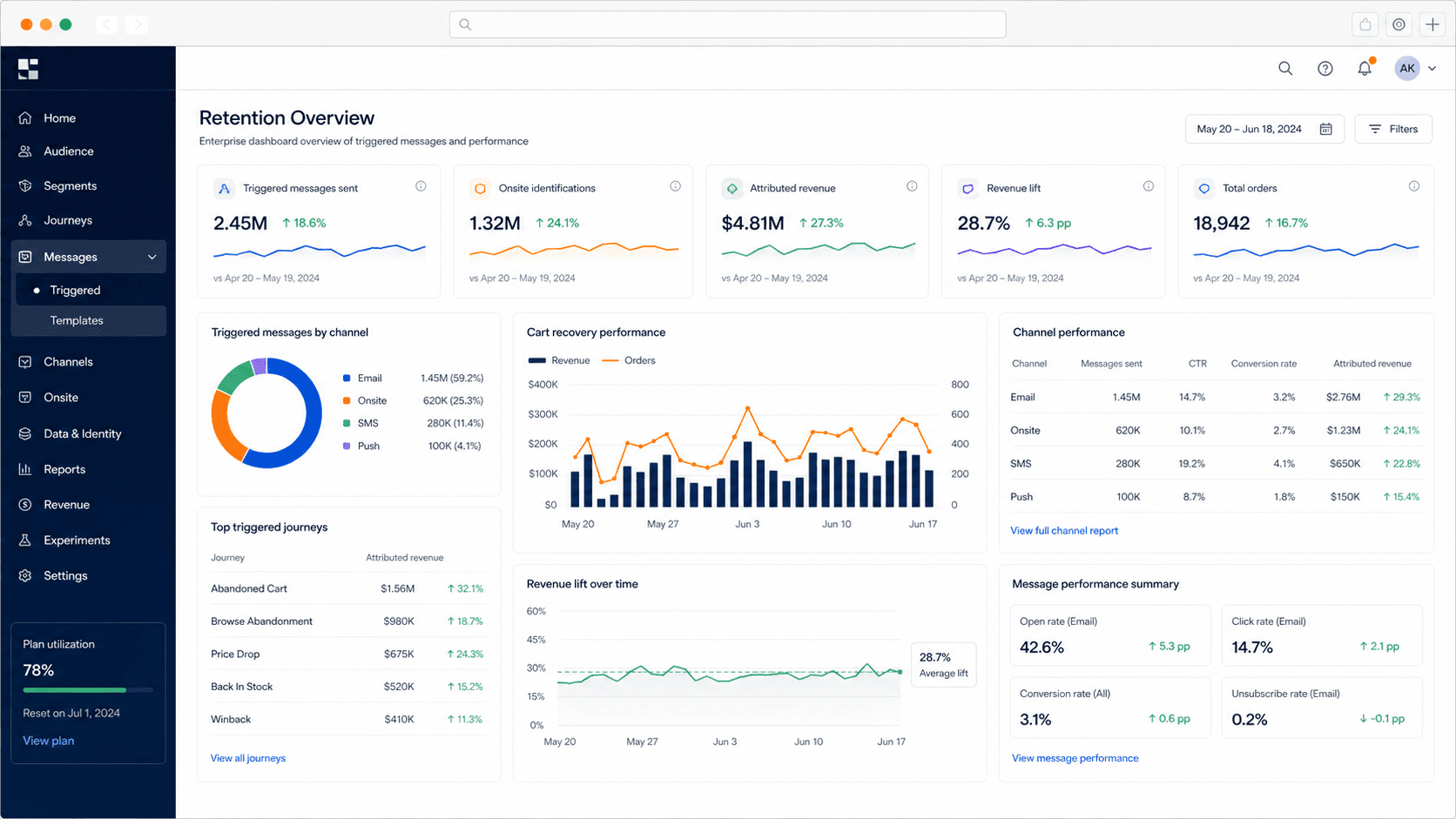
Compare identity-led performance against enterprise engagement orchestration
Wunderkind is usually considered when ecommerce brands want to identify more site visitors and trigger revenue recovery messages from onsite behavior. Braze is considered when lifecycle teams need a broader engagement platform across email, push, in-app, SMS, web, app events, and audience orchestration.
The decision is whether the missing layer is performance recovery from site traffic or a central lifecycle platform across channels.
Use-case table
| Use case | Better starting point | What to verify |
|---|---|---|
| Recover revenue from unidentified site visitors | Wunderkind | Ask for identity methodology, consent handling, triggered message rules, and incrementality proof. |
| Coordinate lifecycle messaging across app, web, push, email, and SMS | Braze | Confirm SDKs, data ingestion, channel modules, permissions, and lifecycle operations ownership. |
| Performance team wants managed triggered messaging | Wunderkind | Wunderkind is stronger when the goal is measurable onsite recovery, not general campaign management. |
| Enterprise team wants one cross-channel journey platform | Braze | Braze fits when data and channel orchestration are the core requirements. |
| Email-first storefront lifecycle | Sequenzy | Sequenzy fits when the team does not need identity recovery or enterprise orchestration. |
Where Wunderkind is stronger
Wunderkind is stronger when site traffic is large enough for identification and triggered recovery to move revenue. It should be judged on reach, consent, trigger quality, incrementality, and whether the vendor-managed program produces lift beyond normal lifecycle messaging.
It is less useful if the main need is to let lifecycle teams build complex app and push journeys themselves.
Where Braze is stronger
Braze is stronger when the company needs a cross-channel engagement platform. It makes more sense for teams with mature lifecycle operations, app or product events, push/in-app requirements, and a need for shared audience governance.
Before choosing Braze as a Wunderkind alternative, confirm whether the team can reproduce the identity-led recovery value or whether Braze would only replace ordinary campaign workflows.
Migration checklist
- Separate Wunderkind-triggered identity messages from standard lifecycle campaigns.
- Map web events, app events, identifiers, consent states, and channel permissions.
- Export suppressions, templates, custom fields, revenue baselines, and holdout-test results if available.
- Rebuild ordinary lifecycle journeys before replacing identity-led triggers.
- Compare incrementality with a controlled test, not only attributed revenue.
Buying questions to ask
- Is the business buying incremental site recovery or cross-channel orchestration?
- Who owns SDKs, event quality, and channel QA?
- Can Braze reproduce the same triggered onsite moments?
- How is consent handled across identity, email, SMS, push, and app channels?
- What proof shows lift beyond revenue that would have happened anyway?
Where Sequenzy fits
Sequenzy is the focused email option when the team needs Shopify/WooCommerce automations, newsletters, transactional email, and Stripe lifecycle messages without identity recovery or a broad engagement platform.
Pricing reality
Both Wunderkind and Braze should be priced from real quotes. Compare included channels, event volume, implementation work, and contract terms before deciding one is cheaper.
Review signals
The cited Wunderkind review themes mention onsite identification, reporting, ecommerce retention fit, setup effort, and pricing clarity. The cited Braze review themes mention campaign work, integrations, day-to-day usability, and the need to check pricing and advanced features against real usage.
Use-case matchups
| Situation | Best first look | Why |
|---|---|---|
| Enterprise ecommerce brand wants identity capture and triggered revenue programs | Wunderkind | Wunderkind is the baseline here when anonymous visitor identification, onsite capture, triggered email, and managed ecommerce revenue programs are central. |
| Team wants enterprise cross-channel engagement | Braze | Braze deserves the first demo when that specialist capability matters more than Wunderkind's identity-led ecommerce model. |
| Store or SaaS team wants simpler lifecycle and transactional email | Sequenzy | Sequenzy is more relevant when email automation and transactional messages matter more than enterprise identity resolution. |
| Team needs a managed service motion | Wunderkind | Wunderkind should be evaluated when services, strategy, and performance programs are part of the buying case. |
| Team wants software-first control | Braze | Braze is usually the better first look if the team wants to own configuration and day-to-day execution internally. |
Best Fit by Engagement Architecture
Best identity-led revenue partner for enterprise ecommerce sites
Wunderkind fits ecommerce brands that want onsite identity capture, triggered messages, and managed performance programs rather than a general engagement platform.
Best engagement platform for cross-channel product journeys
Braze is the better fit when push, in-app, SMS, email, web messaging, and real-time event orchestration are central to the customer journey.
Best email platform for ecommerce and SaaS lifecycle messages
Sequenzy fits when email automation and transactionals are the real need, and enterprise engagement infrastructure would add unnecessary complexity.
Decision checklist
- Does your team want a managed, identity-led ecommerce program from Wunderkind, or a configurable cross-channel platform like Braze?
- Does Braze's strength in enterprise cross-channel engagement matter more than Wunderkind's onsite identity and triggered revenue model?
- Which of the two can show incremental lift from your own ecommerce data, rather than attributed revenue alone?
- Before signing with Wunderkind or Braze, have you pinned down custom pricing, the services included, and which side owns implementation?
- Could a simpler email product like Sequenzy cover your lifecycle and transactional needs without the enterprise identity tooling behind Wunderkind's onsite identification?








