
Overview
SendFox and Moosend both compete in the budget email marketing space but with vastly different capabilities. SendFox is a minimal newsletter tool for bloggers. Moosend is a proper marketing platform with automation, e-commerce features, and unlimited sending. For SaaS businesses, Sequenzy offers purpose-built features that neither provides.
The Automation Gap
Moosend's visual automation builder is its strongest advantage over SendFox. You can create multi-step workflows with conditional branches, time delays, action triggers, and behavioral conditions. Welcome sequences, abandoned cart flows, re-engagement campaigns, and birthday emails all run automatically with visual logic.
SendFox's automation is limited to basic drip sequences. Send email A, wait X days, send email B. No conditional branching, no behavioral triggers, no event-based logic. For anyone who needs automation beyond simple time-based sequences, SendFox is not equipped.
The automation gap becomes critical as your email marketing matures. Early-stage newsletters can survive with simple sequences. But once you want to segment behavior, trigger emails based on actions, or build multi-path journeys, Moosend's capabilities become essential while SendFox hits a wall.
Unlimited Emails vs Lifetime Pricing
Moosend includes unlimited emails on all paid plans. You can send as many campaigns, automations, and broadcasts as your list needs without worrying about email volume limits. For businesses that send frequently, such as daily deal sites, news publishers, or active e-commerce stores, unlimited sending removes a significant cost variable.
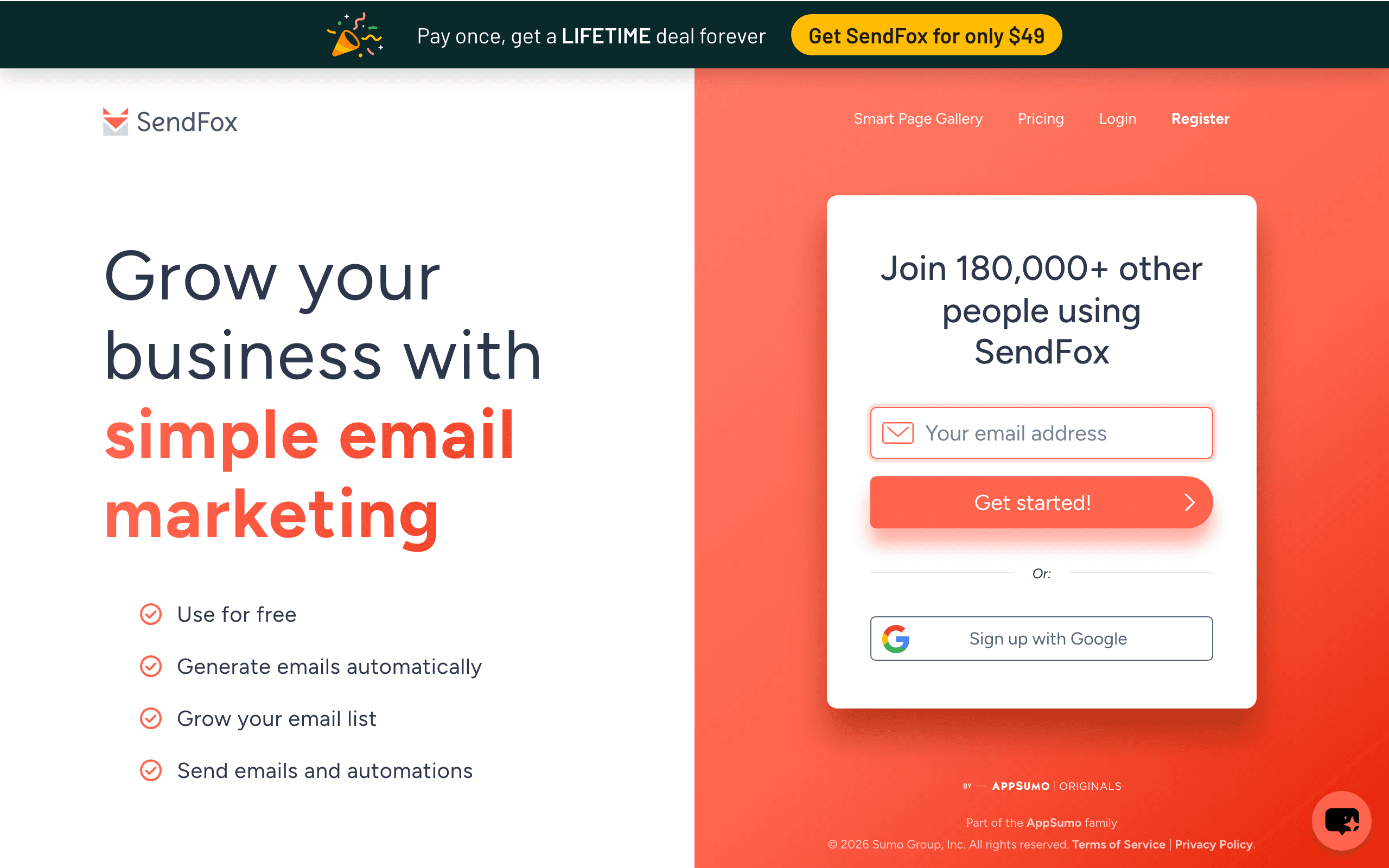
SendFox's lifetime deal eliminates monthly costs entirely but comes with sending limits. The $49 one-time payment covers basic newsletter sending, but heavy senders may find the limits restrictive. The monthly plan at $18/month is still cheaper than Moosend but with far fewer features.
The value calculation depends on sending volume. Low-volume monthly newsletters favor SendFox's lifetime deal. High-frequency senders benefit from Moosend's unlimited approach despite the higher monthly cost.
The Sitecore Factor
Moosend was acquired by Sitecore, a major enterprise content management company. This acquisition brings financial stability and enterprise resources but raises questions about the product's future direction. Enterprise acquirers sometimes shift pricing models, reduce focus on small business features, or integrate the product into a larger enterprise suite.
SendFox remains part of the AppSumo ecosystem, which keeps it focused on budget-conscious creators. The small team means slower development but also less risk of dramatic product changes. Neither ownership model is inherently better, but both carry different risks.
For businesses planning long-term email marketing strategy, ownership stability matters. Consider whether each platform's parent company aligns with your needs and whether migration would be necessary if either product changes direction significantly.
E-commerce Capabilities
Moosend offers e-commerce features that SendFox entirely lacks: AI-powered product recommendations, cart abandonment tracking, purchase-based segmentation, and product catalog integration. For online stores, these features drive measurable revenue that justifies Moosend's higher price.
SendFox has no e-commerce features. No product recommendations, no cart recovery, no purchase tracking. It sends newsletters and that is the extent of its capability. Online stores should not consider SendFox as a serious option.
For SaaS companies specifically, neither platform offers subscription billing integration. Sequenzy provides native Stripe integration with AI-powered sequences and transactional email purpose-built for software businesses. Use our email validator to maintain list quality on either platform and check our email warmup calculator when planning migration.
Use-case matchups
| Need | Better fit | Why |
|---|---|---|
| Low-cost creator newsletter sending | SendFox | SendFox is stronger when the buyer wants a simple, low-cost newsletter tool and can accept fewer advanced features. |
| Affordable email automation | Moosend | Moosend is stronger when affordable email automation are the main requirements. |
| SaaS lifecycle and transactional email | Sequenzy | Sequenzy fits when the team needs Stripe-aware lifecycle campaigns, newsletters, and transactional email in one product. |
Best Fit by Automation Ambition
Best creator newsletter tool for low-cost broadcast sending
SendFox fits creators who need simple email broadcasts and occasional automations without paying for a more capable marketing automation tool.
Best affordable email automation platform for ecommerce-lite journeys
Moosend is the better fit when the buyer wants stronger automation, product-style recommendations, and more advanced campaigns while staying below premium ecommerce platforms.
Best SaaS email platform for triggered lifecycle and transactional messages
Sequenzy fits SaaS teams that need lifecycle and transactional email tied to product or billing events rather than general budget automation.
Pricing reality
The page data lists SendFox at "$49 lifetime", Moosend at "$88"/month, and Sequenzy at "$49"/month for the cited comparison tier. SendFox's lifetime-style pricing can be attractive, but it should not be compared as if it includes every workflow in more mature platforms.
Review signals
For SendFox, pay attention to simplicity, lifetime pricing appeal, and feature limits. For Moosend, pay attention to affordable email automation, onboarding effort, pricing, and support quality.
Migration checklist
| Workstream | What to verify |
|---|---|
| Subscriber data | Export subscribers, tags, custom fields, segments, consent, unsubscribes, bounces, and suppressions. |
| Content archive | Preserve broadcasts, newsletters, subject lines, templates, and performance history. |
| Automations | Rebuild welcome, nurture, newsletter, promotion, reactivation, and lifecycle workflows manually. |
| Forms and pages | Recreate signup forms, landing pages, embeds, incentives, and confirmation flows. |
| Integrations | Reconnect website forms, ecommerce, CRM, payment, analytics, and Zapier-style handoffs. |
| Sender setup | Recheck SPF, DKIM, DMARC, branded links, sender identities, and warmup. |
Decision checklist
- Choose SendFox if low-cost newsletter sending is the main requirement.
- Choose Moosend if affordable email automation matter more than lifetime-price simplicity.
- Avoid SendFox if advanced automation, ecommerce, CRM, or transactional email are required.
- Avoid Moosend if the buyer only needs a simple newsletter sender.
- Consider Sequenzy if SaaS lifecycle, transactional email, and Stripe-triggered messages are the core jobs.









