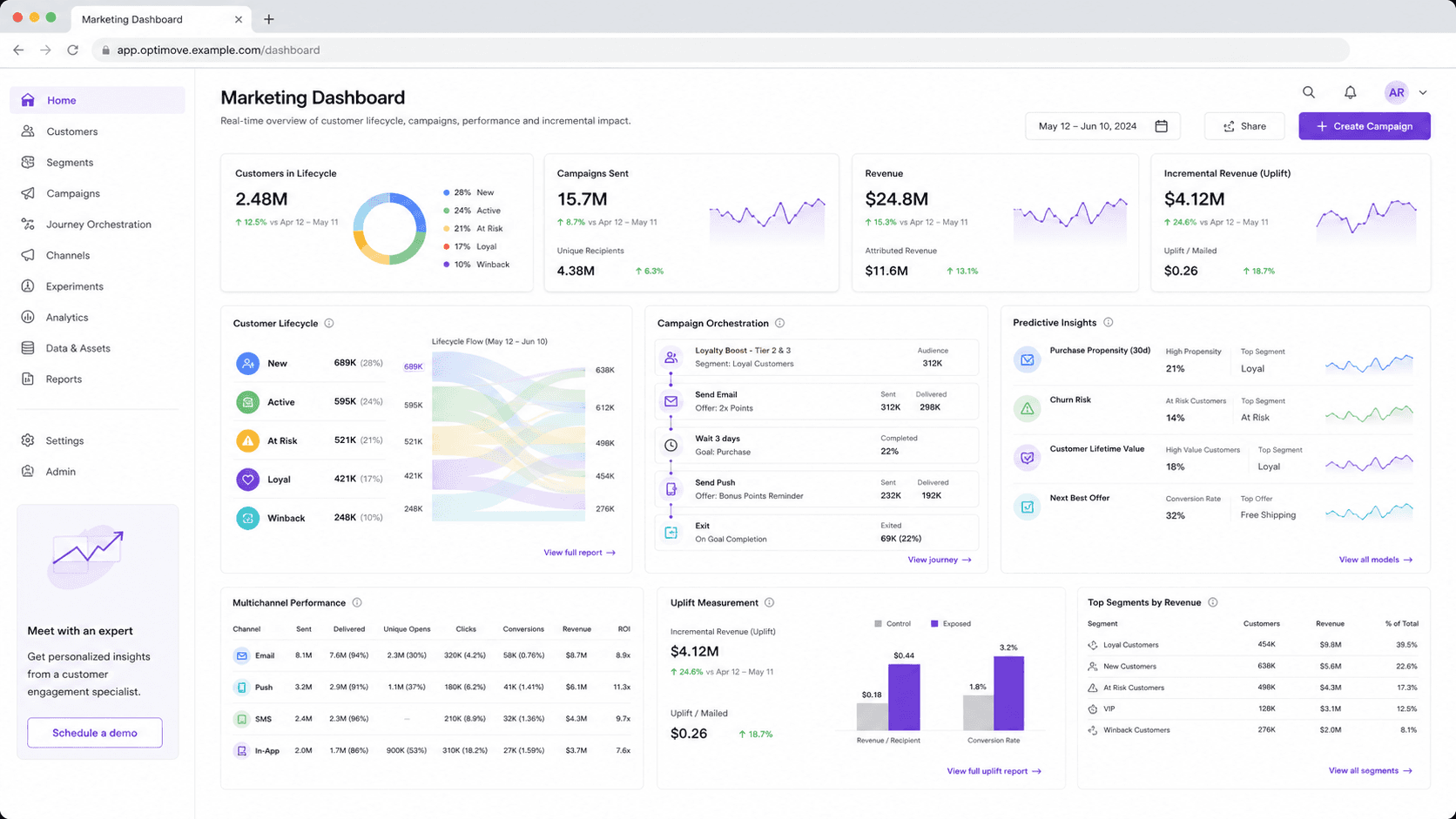

Compare customer-led strategy against lifecycle execution scale
Optimove and Iterable both serve mature lifecycle teams, but they emphasize different parts of the operating model. Optimove is centered on customer analytics, predictive segmentation, and deciding the next best campaign. Iterable is centered on building and operating cross-channel journeys across email, SMS, push, in-app, and events.
The best fit depends on whether the team needs a retention decision layer or a flexible lifecycle execution platform.
Use-case table
| Use case | Better starting point | Why |
|---|---|---|
| Predictive customer segmentation and campaign prioritization | Optimove | Optimove is stronger when deciding who gets what is the hard part. |
| Cross-channel journey building and lifecycle operations | Iterable | Iterable is stronger when execution across channels and events is the hard part. |
| Retention team manages customer states, value, and risk | Optimove | Optimove is more customer-strategy oriented. |
| Lifecycle team manages campaigns across email, SMS, push, and app | Iterable | Iterable is more natural for campaign operations and journey control. |
| Email-first ecommerce lifecycle | Sequenzy | Sequenzy fits when a smaller focused email stack is enough. |
Where Optimove is stronger
Optimove is stronger when customer intelligence is central to the program. It helps teams prioritize customers, offers, and campaigns based on value, behavior, lifecycle stage, and expected impact.
It can be more than needed if the team already has segmentation strategy and mostly needs journey execution.
Where Iterable is stronger
Iterable is stronger when lifecycle operations need a flexible builder for cross-channel journeys. It fits teams that want to control campaigns, templates, experiments, audiences, and event-triggered messages in one platform.
Before replacing Optimove, decide how customer-state logic and campaign priority rules will be recreated or simplified.
Pricing reality
Optimove is listed as custom enterprise pricing based on customer data, channels, modules, and contract scope. Iterable is listed as variable pricing based on plan, contacts, usage, and selected features. Sequenzy is listed at $49/month for the cited email-first scope.
Optimove pricing should be justified by customer intelligence and predictive campaign prioritization. Iterable pricing should be modeled around profiles, events, channels, journeys, experiments, data integrations, and lifecycle-team ownership.
Review signals
The cited Optimove review themes point to predictive segmentation, journey orchestration, customer analytics, multichannel campaigns, setup effort, and pricing clarity. The cited Iterable review themes should be read for journey building, cross-channel orchestration, experimentation, event setup, and send-time optimization. The review split is predictive customer decisioning versus flexible journey execution.
Migration checklist
- Inventory predictive segments, campaign priority rules, lifecycle states, and suppression logic.
- Map event streams, attributes, identifiers, and channels needed by Iterable.
- Export templates, journeys, campaign baselines, and segment definitions.
- Rebuild journey execution first, then test whether customer prioritization still works.
- Compare retention outcomes by lifecycle state after migration.
Buying questions to ask
- Is the primary gap strategy or execution?
- Which customer models must survive migration?
- Who owns journey QA, templates, and channel governance?
- Can Iterable handle campaign conflicts and audience priority?
- What reporting proves retention lift by segment?
Use-case matchups
| Need | Better fit | Why |
|---|---|---|
| Customer-led retention strategy | Optimove | Optimove is stronger when marketers need help deciding campaign priority by customer state. |
| Enterprise journey execution across channels | Iterable | Iterable is stronger when the main job is flexible cross-channel campaign execution. |
| Focused ecommerce or SaaS email | Sequenzy | Sequenzy fits when neither enterprise platform's scale is necessary. |
Best Fit by Enterprise Journey Need
Best CRM marketing platform for customer-led retention strategy
Optimove fits teams that need analytics and campaign priority to decide how to treat customers across lifecycle states.
Best journey platform for flexible cross-channel execution
Iterable is the better fit when the main job is building and testing enterprise journeys across channels, audiences, and customer states.
Best email platform for focused ecommerce or SaaS lifecycle
Sequenzy fits when neither enterprise platform's scale is necessary and the team only needs email-first lifecycle and transactional workflows.
Decision checklist
- Choose Optimove if strategy, customer scoring, and retention decisioning are central.
- Choose Iterable if journey execution and channel operations are central.
- Avoid Optimove if the team already owns strategy and only needs execution tooling.
- Avoid Iterable if it cannot handle the required campaign priority and customer model.
- Consider Sequenzy if lightweight email, transactionals, and Stripe/store triggers are enough.
Where Sequenzy fits
Sequenzy is the lightweight email-first option for Shopify/WooCommerce automations, newsletters, transactionals, and Stripe lifecycle messages when neither Optimove nor Iterable-level scale is needed.
How to make the Optimove vs Iterable decision
Optimove is the better fit when you need CRM marketing orchestration. Iterable is the better fit when your team prefers its approach to email marketing and automation.
The decision should start with the workflow, not the brand. In a enterprise stack, the right platform is the one that makes your next important campaign easier to launch and easier to improve. If the team needs deep platform capability but has no owner for setup, reporting, and iteration, the larger product will underperform. If the team needs only a narrow workflow and buys a broad suite, the extra features become drag.
Look hardest at these differences: Optimove is stronger when predictive segmentation matters; Iterable may be easier for a different operating model; Sequenzy is the simpler email path. Those are the areas most likely to affect daily work after the demo is over.
| Decision area | Pick Optimove when... | Pick Iterable when... |
|---|---|---|
| Primary workflow | Its core strength matches the campaign you need next. | Its core strength matches the campaign you need next. |
| Data model | Your customer data already fits its segments and triggers. | Your customer data already fits its segments and triggers. |
| Team ownership | Someone can own setup, testing, and reporting inside the tool. | Someone can own setup, testing, and reporting inside the tool. |
| Budget | The price is justified by workflows you will use now. | The price is justified by workflows you will use now. |
My read: Choose Optimove if CRM marketing orchestration is the main reason you are buying. Choose Iterable if its ecosystem, workflow, or pricing better matches how your team runs campaigns. Choose Sequenzy if you want a simpler email-first setup for Shopify, WooCommerce, or subscription lifecycle messages.
Before committing, rebuild one live use case in the preferred tool. Use a real audience, real copy, a real trigger, and a real success metric. If that test feels clear, the platform is probably a good fit. If it requires workarounds before the first campaign is live, keep evaluating.