Retail retention or company-wide CRM
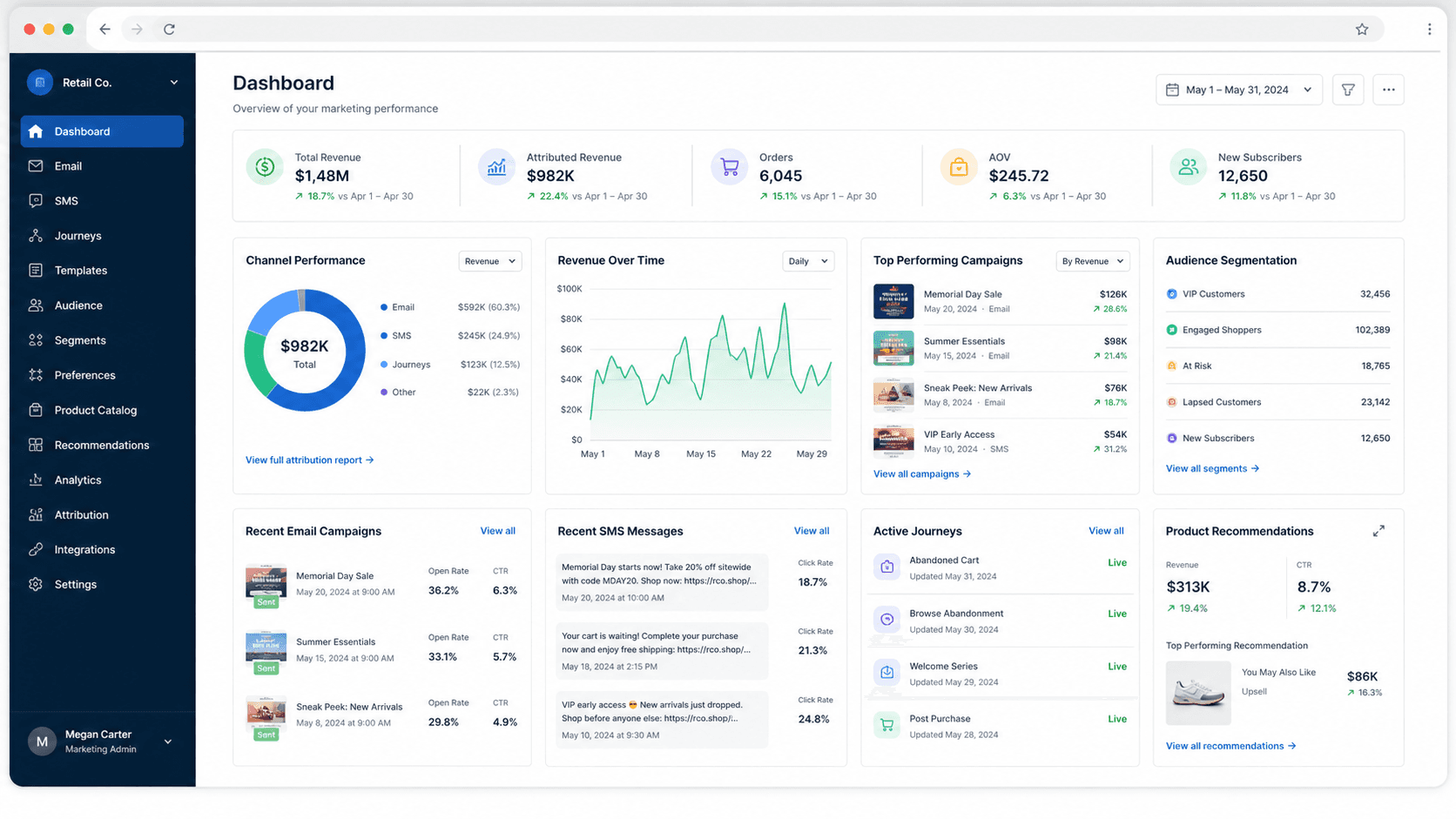
Listrak is built for ecommerce retention teams that need campaigns, SMS, cart recovery, product recommendations, and retail services. HubSpot is built as a CRM suite spanning marketing, sales, service, forms, landing pages, contacts, and reporting. This is less a feature-by-feature email comparison and more a question of where the customer record should live.
If the buyer is a retail marketing team optimizing store revenue, Listrak is more direct. If multiple teams need the same CRM record for marketing, sales, and service, HubSpot may be the better organizational fit.
Why Listrak can be the better fit
Listrak is stronger when ecommerce behavior should drive retention campaigns: browsing, carts, product affinity, purchases, recommendations, and SMS consent. It can be easier to evaluate when the success metric is retail revenue from campaigns and flows.
It is not designed to be a complete CRM suite for sales pipelines, service tickets, and RevOps workflows.
Why HubSpot can be the better fit
HubSpot is stronger when marketing needs CRM context from leads, deals, forms, sales activity, service history, and lifecycle stages. It can make sense for stores that also run wholesale, B2B sales, partner programs, or content-led acquisition.
The tradeoff is ecommerce depth. HubSpot can support ecommerce marketing, but product recommendations and retail-services depth are not the core reason to buy it.
Where Sequenzy fits
Sequenzy is the narrower email system when the store does not need retail services or a CRM suite. It covers Shopify, WooCommerce, newsletters, transactional email, and Stripe-aware lifecycle flows.
Use-case matchups
| Decision point | Listrak | HubSpot | Sequenzy |
|---|---|---|---|
| Retail email, SMS, recommendations, and services are central | Stronger fit | Partial | No SMS/recommendations. |
| CRM, sales, service, and marketing need one shared record | Not the center | Stronger fit | No CRM suite. |
| Ecommerce lifecycle campaigns need vendor support | Stronger fit | Depends on setup | Email-only support. |
| Sales handoff and lifecycle stages matter | Weak | Stronger fit | Partial email only. |
| Product recommendations are a retention lever | Stronger fit | Limited | No. |
| Core need is store-triggered email and transactional messages | Too heavy | Often more suite than needed | Stronger fit. |
Best Fit by Retail vs CRM Ownership
Best retail retention suite for ecommerce campaign support
Listrak fits brands that need retail email, SMS, recommendations, and vendor support around ecommerce lifecycle campaigns.
Best CRM suite for sales, service, and marketing teams
HubSpot is the better fit when the company needs CRM records, pipeline, service, sales handoff, forms, and marketing automation in one shared system.
Best email platform for store-triggered and transactional messages
Sequenzy fits when the real need is storefront lifecycle email and transactionals, not a retail services suite or company-wide CRM platform.
When HubSpot is the better organizational fit
HubSpot is the better organizational fit when ecommerce marketing is only one part of the customer system. If sales, service, CRM records, forms, tickets, and lifecycle stages need to share the same source of truth, HubSpot's suite model can matter more than retail-specific marketing depth.
Listrak is the better fit when the buyer is a retail retention team focused on campaigns, SMS, recommendations, cart recovery, and vendor-supported execution.
Sequenzy is the better fit when the company does not need CRM-suite alignment or retail services, and the job is focused lifecycle and transactional email.
Pricing reality
Listrak pricing should be scoped around ecommerce channels, SMS, recommendation modules, services, integrations, and reporting ownership.
HubSpot pricing should be modeled around hubs, seats, marketing contacts, automation requirements, reporting, and whether sales/service teams will use the same CRM data.
Sequenzy should be evaluated as an email system only. It does not replace HubSpot's CRM, Sales Hub, Service Hub, or Listrak's retail services.
Review signals
The cited Listrak review themes point to retail marketing workflows, reporting, ecommerce retention fit, setup effort, and pricing clarity. The cited HubSpot review themes should be read for CRM adoption, reporting, sales and marketing alignment, and the cost of hubs, seats, and contacts. The review split is organizational: Listrak feedback is about retail retention execution, while HubSpot feedback is about running more of the customer system in one CRM suite.
Migration checklist
| Area | Moving toward Listrak | Moving toward HubSpot | Moving toward Sequenzy |
|---|---|---|---|
| Data readiness | Prepare customer, order, product, recommendation, email consent, and SMS consent data. | Prepare CRM properties, lifecycle stages, marketing contacts, deals, tickets, forms, and ecommerce events. | Map subscribers, consent, tags, attributes, ecommerce events, and billing triggers. |
| Ownership | Assign retention marketing and vendor-service owners. | Align marketing, sales, service, RevOps, ecommerce, and CRM admins. | Assign email lifecycle and deliverability owners. |
| Automation | Rebuild retail campaigns, SMS, cart recovery, recommendations, and reporting. | Rebuild CRM-triggered nurture, ecommerce follow-up, sales handoff, and service-aware messaging. | Rebuild welcome, cart, post-purchase, winback, campaigns, and transactional messages. |
| Reporting | Measure campaign revenue, SMS lift, recommendation impact, and services contribution. | Measure lifecycle stage movement, campaign contribution, sales/service context, and ecommerce revenue. | Measure flow revenue, campaign performance, deliverability, and transactional reliability. |
| Rollout risk | Plan services-led onboarding and channel migration. | Plan CRM cleanup, permissions, hub configuration, and automation governance. | Keep scope narrow and launch email first. |
Decision checklist
- Is the buying reason retail retention depth or company-wide CRM alignment?
- Do sales and service teams need the same customer record as marketing?
- Are SMS and product recommendations phase-one requirements?
- Is HubSpot already the customer source of truth?
- Would a focused email tool solve the problem without CRM-suite migration?