Overview
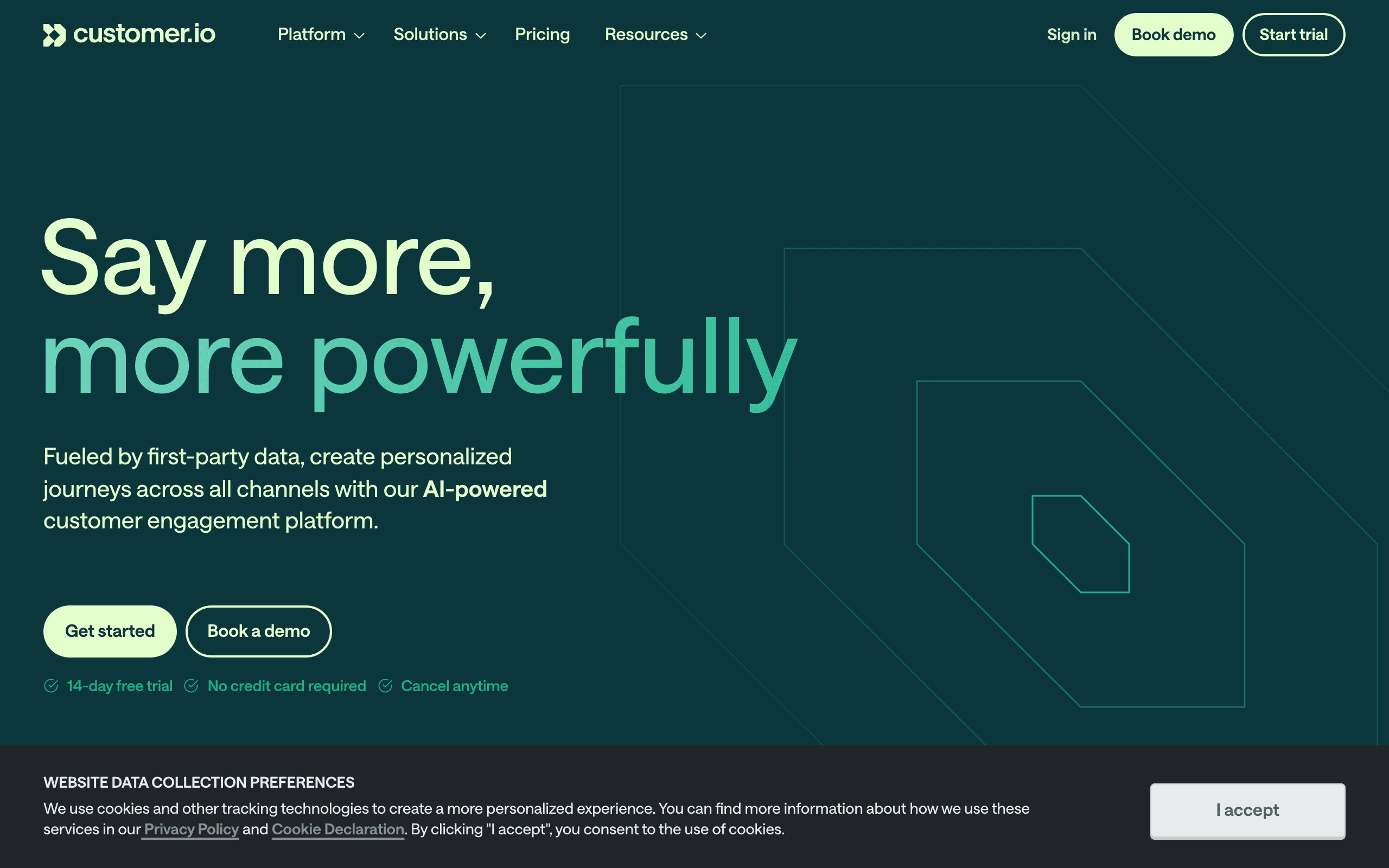
Customer.io and Resend serve different parts of the email stack. Customer.io is a behavioral marketing platform - it excels at triggered campaigns, lifecycle automation, and multi-channel engagement. Resend is a transactional email API - it excels at reliable delivery with clean developer experience. See our Customer.io comparison and Resend comparison.
Different Problems
Customer.io answers "how do I send the right marketing message when a user takes action X?" Resend answers "how do I reliably send this password reset email with minimal code?" These are complementary needs. Many companies use both tools together.
Marketing Power
Customer.io's strength is behavioral automation. Trigger emails based on any user event, build complex multi-branch workflows, segment users dynamically, reach them across email, push, SMS, and in-app. Resend has none of this - Audiences is in beta and limited to broadcasts.
Developer Experience
Resend wins on developer experience. Modern API design, excellent documentation, React Email integration for building templates as React components. If you're a developer sending transactional emails, Resend is cleaner to work with than Customer.io's more complex marketing-oriented API.
Use-case matchups
| Use case | Better fit | Why |
|---|---|---|
| Behavioral lifecycle marketing | Customer.io | Customer.io has event triggers, journeys, segmentation, and multi-channel campaigns that Resend does not provide. |
| Developer-owned transactional email | Resend | Resend is cleaner for password resets, receipts, invites, and system notifications built from code. |
| React Email templates | Resend | Resend's React Email workflow fits teams that want email templates maintained like application components. |
| Growth-stage onboarding and retention | Customer.io | Customer.io is stronger when messages depend on user behavior, activation milestones, and lifecycle state. |
| Simple low-cost email delivery | Resend | Resend is cheaper and quicker when the need is reliable transactional delivery rather than marketing automation. |
| Unified SaaS email with Stripe | Sequenzy | Sequenzy is the better fit when marketing and transactional emails should share one subscriber profile and Stripe triggers. |
Best Fit by Lifecycle Automation and Developer Email APIs
Best lifecycle messaging platform for behavioral onboarding
Customer.io is the better fit when onboarding, activation, retention, and expansion emails depend on product events, behavioral segments, user attributes, and multi-step journeys.
Best transactional email API for React Email teams
Resend is the better fit when developers want clean APIs, React Email templates, password resets, invites, receipts, and system notifications managed close to application code.
Best email tool for unified Stripe-aware SaaS email
Sequenzy is the better fit when marketing campaigns, transactional messages, Stripe triggers, lifecycle sequences, and subscriber profiles should live in one workspace.
Pricing reality
Resend is significantly cheaper. Free tier with 3,000 emails, then $20/month for 50k emails. Customer.io starts at $100/month with no free tier. If budget matters and you only need transactional, Resend is the clear choice.
Review signals
The sourced Customer.io reviews frame it as the marketing automation layer, while also criticizing the cost of transactional email access and the need to add Resend anyway.
The sourced Resend reviews praise developer experience, React Email, and transactional delivery. They also note that Audiences is too basic for serious marketing automation today.
Use those reviews to avoid the wrong substitution: Resend can replace a transactional API, but it does not replace Customer.io's behavioral journeys.
Using Both Together
The common pattern: Customer.io for marketing campaigns, onboarding sequences, and behavioral triggers. Resend for transactional emails like password resets, receipts, and system notifications. Two tools, two bills, but each doing what it does best.
The Unified Alternative
Sequenzy offers marketing campaigns and transactional email in one platform with native Stripe integration. Instead of managing Customer.io + Resend separately, one tool handles both with unified analytics.
Making the Choice
Choose Customer.io for behavioral marketing automation at growth-stage companies. Choose Resend for clean transactional email delivery. Use both for complete coverage. Or choose Sequenzy for unified SaaS email in one platform.
The React Email Factor
Resend's integration with React Email represents a paradigm shift in how developers build email templates. Instead of fighting with HTML tables and inline CSS, you write email templates as React components with TypeScript type safety. For teams already building products in React and Next.js, this means email templates use the same language, the same patterns, and the same tooling as the rest of the codebase.
Customer.io has no equivalent. Their template system uses a drag-and-drop editor or custom HTML - fine for marketing teams, but a step backward for developers accustomed to component-based development. The disconnect is jarring: you build your app in React, then switch to a WYSIWYG editor for emails.
This matters less than you might think for marketing automation, where templates change frequently and marketers need direct control. But for transactional emails - receipts, notifications, system alerts - that developers own and maintain, React Email through Resend is a genuinely better developer experience.
The Audiences Bet
Resend's Audiences feature, still in beta, signals their ambition to move beyond pure transactional delivery into marketing territory. The question is whether they can close the gap with platforms like Customer.io that have spent years building behavioral automation.
Today, Audiences supports basic contact management and broadcast sending. There are no behavioral triggers, no multi-step workflows, no event-based segmentation, and no A/B testing. For teams that need only simple broadcasts alongside transactional email, Audiences might eventually be sufficient. But for anything resembling product-led growth automation, Customer.io remains years ahead.
The strategic risk of betting on Audiences is clear: you might outgrow it before it matures. Starting with Resend for everything and planning to add Customer.io later means a migration. Starting with both from day one means managing two tools from the start. Neither path is ideal for growing SaaS companies.
The Unified Stack Argument
The Customer.io + Resend combination is a popular SaaS email stack, but it comes with real costs beyond the subscription fees. Two sets of API integrations to maintain. Two webhook configurations to monitor. Two dashboards where subscriber data lives in parallel. When a user unsubscribes in Customer.io, that status doesn't automatically propagate to Resend - you need custom logic to keep them in sync.
Sequenzy eliminates this synchronization problem by handling both marketing campaigns and transactional emails in one platform. A single subscriber profile captures both marketing engagement and transactional history. Native Stripe integration adds billing awareness that neither Customer.io nor Resend offers natively. At $49/month versus the $170+ combined cost of Customer.io and Resend Pro, the financial and operational case for unification is compelling for SaaS teams that don't need Customer.io's full multi-channel capabilities.
User Behavior Tracking
SaaS email marketing depends on understanding how users interact with your product. Customer.io and Resend track user events differently. The depth of behavioral data determines how targeted your email automation can be.
Event tracking, feature usage monitoring, and activity scoring help you identify which users need onboarding help, which are ready to upgrade, and which are at risk of churning. Compare how each platform ingests and acts on this behavioral data.
Trial and Onboarding Optimization
Converting trial users to paid customers is critical for SaaS growth. Customer.io and Resend handle onboarding email sequences differently. The ability to trigger emails based on specific product milestones creates more relevant communication.
Effective onboarding emails guide users to their activation moment. Compare how each platform lets you define milestones, segment by trial progress, and personalize onboarding content based on user behavior and plan type. For deeper billing integration, see Sequenzy's Stripe features.
Company-Level vs User-Level Communication
SaaS products often have multiple users within a single account. Customer.io and Resend handle company-level targeting differently. Being able to group users by organization and trigger emails based on account-level events is essential for B2B SaaS.
Consider how each platform manages company attributes, aggregate usage data, and role-based communication. The ability to send different onboarding emails to admins vs team members, or trigger expansion revenue emails based on company-level metrics, matters for B2B growth.
Migration checklist
- Decide whether marketing automation and transactional email should stay separate or move into one platform.
- Export contacts, profiles, events, attributes, segments, journeys, templates, suppressions, transactional templates, webhooks, and delivery reports.
- If moving to Customer.io, define lifecycle events, user attributes, company attributes, campaign logic, and transactional message ownership before importing users.
- If moving to Resend, convert Customer.io templates into React Email or HTML and identify which campaigns will be lost or rebuilt elsewhere.
- Rebuild critical transactional and lifecycle flows first: verification, password reset, receipt, invite, onboarding, activation, re-engagement, and billing notices.
- Reconnect SDKs, APIs, webhooks, unsubscribe handling, analytics, and any background jobs that send email.
- Authenticate domains and test both transactional and marketing unsubscribe behavior with a small cohort before full cutover.
- Preserve historical delivery and campaign reports so the team can compare the two-tool stack against a unified setup.
Decision checklist
| Choose | When this is true |
|---|---|
| Customer.io | You need behavioral journeys, lifecycle marketing, segments, A/B tests, and multi-channel product engagement. |
| Resend | Developers need a clean transactional API, React Email templates, webhooks, and affordable delivery. |
| Sequenzy | You want marketing and transactional email together with Stripe-triggered SaaS lifecycle automation. |
| Verify before buying | Check transactional tier limits, Audiences maturity, unsubscribe syncing, and whether two tools are acceptable. |