
This is a scale mismatch unless the store has outgrown basics
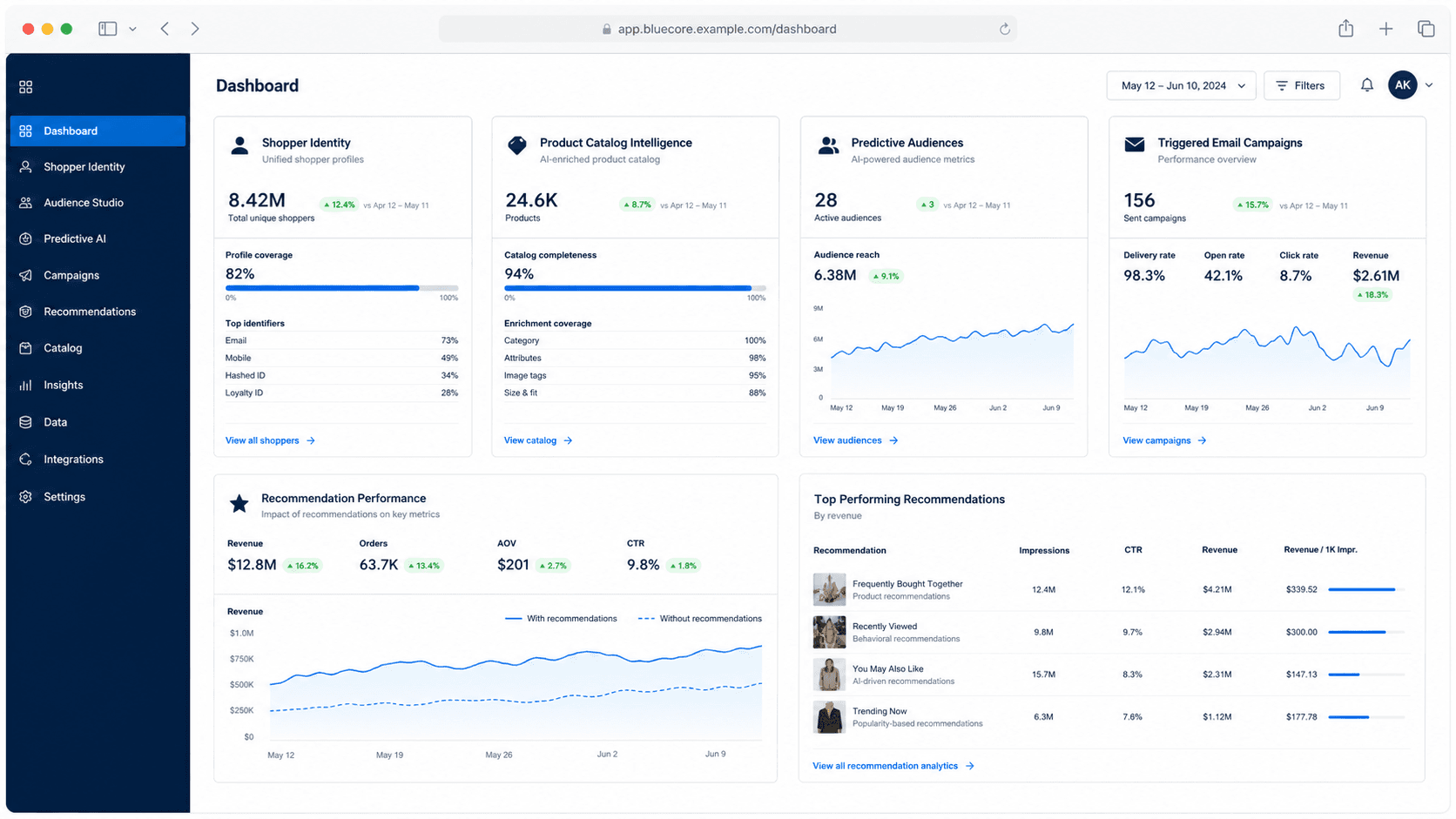
Bluecore and Shopify Email sit at opposite ends of the ecommerce email spectrum. Bluecore is an enterprise retail intelligence platform for product catalog data, shopper identity, predictive audiences, and personalization. Shopify Email is the native, simple campaign tool inside Shopify.
That means the comparison is useful mostly as a maturity check. If the store only needs product newsletters and simple campaigns from Shopify admin, Shopify Email is the honest answer. If the business needs enterprise personalization from shopper and catalog data, Shopify Email is not in the same category.
Use-case matchups
| Need | Better fit | Why |
|---|---|---|
| Enterprise retail personalization | Bluecore | Bluecore is built around shopper identity, catalog intelligence, and predictive audiences. |
| Native Shopify campaign sending | Shopify Email | It is the simplest option when Shopify admin is enough. |
| Product recommendations and shopper-identity audiences | Bluecore | Shopify Email is not a retail intelligence platform. |
| Occasional product newsletters | Shopify Email | A native convenience layer is more honest than an enterprise rollout. |
| Lifecycle and transactional email beyond Shopify Email | Sequenzy | It sits between native simplicity and enterprise retail intelligence. |
Best Fit by Shopify Simplicity and Retail Scale
Best retail personalization platform for enterprise stores
Bluecore is the better fit when the team needs shopper identity, catalog intelligence, predictive audiences, product recommendations, and enterprise retail personalization. It is appropriate when Shopify-native campaigns are far too basic.
Best email tool for simple Shopify-native campaigns
Shopify Email is the better fit when the store wants occasional product newsletters, promo sends, and basic campaign creation inside Shopify admin. It is the honest choice when simplicity matters more than automation depth.
Best email tool for lifecycle and transactional email beyond Shopify Email
Sequenzy is the better fit when the team has outgrown simple native sends and needs Shopify or WooCommerce lifecycle flows, newsletters, Stripe triggers, and transactional messages without going all the way to an enterprise retail platform.
Pricing reality
The existing pricing data is directional: Bluecore is custom-priced around retail data, channels, modules, and contract scope, while Shopify Email varies by Shopify's current send allowance, paid usage, and plan details. Bluecore should be scoped as an enterprise project with feeds, identity, catalog intelligence, predictive audiences, channels, services, and implementation. Shopify Email should be evaluated as a native Shopify convenience layer, not a full retention platform.
Review signals
Existing review themes for Bluecore mention shopper identity, reporting, ecommerce retention fit, setup effort, and pricing clarity. Existing Shopify Email review themes on this page are generic, so treat them as prompts rather than hard proof. Check current Shopify ecosystem feedback for native sending limits, editor workflow, automation depth, deliverability, and whether Shopify Email is enough before comparing it to an enterprise retail platform.
Why Bluecore can be the better fit
Bluecore is the better fit when a retailer has enough catalog complexity, traffic, and data maturity to justify product-led personalization. It should have named use cases such as back-in-stock audiences, price-drop campaigns, predictive product recommendations, and shopper-identity segments.
It is not the right answer for a small store trying to send occasional emails.
Why Shopify Email can be the better fit
Shopify Email is useful when staying inside the Shopify admin is more important than advanced automation. It keeps the workflow simple and avoids vendor onboarding, data feeds, and enterprise contracts.
The limitation is lifecycle depth. Once the store needs richer automations, transactional context, or non-Shopify coverage, Shopify Email can become too shallow.
Where Sequenzy fits
Sequenzy sits between the two: more lifecycle depth than Shopify Email for email automation and transactional messages, but without Bluecore's enterprise retail intelligence, SMS, or AI/predictive product recommendations (catalog-driven recommendation blocks are available).
Scale mismatch table
| Decision point | Bluecore | Shopify Email | Sequenzy |
|---|---|---|---|
| Enterprise retail personalization is the project | Stronger fit | No | No. |
| Native Shopify campaign sending is enough | Too heavy | Stronger fit | Stronger only if automation depth is needed. |
| Product catalog intelligence and predictive audiences matter | Stronger fit | No | No AI/predictive recommendations. |
| Store owner wants the simplest admin workflow | No | Stronger fit | Separate email workspace. |
| Lifecycle flows are outgrowing Shopify Email | Possible but too heavy | Weak | Stronger fit. |
| Transactional and marketing email should share context | No | Shopify system emails only | Stronger fit. |
When Shopify Email is the honest answer
Shopify Email is the honest answer when the store only needs simple campaigns from inside Shopify. A small team can create product-led newsletters without buying a marketing platform or managing data integrations.
Bluecore is the opposite end of the spectrum. It makes sense only when the business has enough catalog complexity, shopper behavior, and data maturity to justify enterprise retail intelligence.
Sequenzy sits between them when Shopify Email becomes too shallow but Bluecore is not remotely justified. That is usually the case when the store needs better lifecycle email, transactional messages, or WooCommerce/Stripe coverage without SMS or AI/predictive product recommendations (catalog-driven recommendation blocks are available).
Migration checklist
| Area | Moving toward Bluecore | Staying with Shopify Email | Moving toward Sequenzy |
|---|---|---|---|
| Data readiness | Prepare catalog feeds, shopper identity, events, and predictive audience definitions. | Keep Shopify customer and product data clean enough for simple campaigns. | Map subscribers, consent, tags, attributes, ecommerce events, and transactional triggers. |
| Campaign workflow | Plan data-led personalization and recommendation campaigns. | Keep sends inside Shopify admin with simple product blocks. | Rebuild welcome, cart, post-purchase, winback, campaign, and transactional templates. |
| Team ownership | Align ecommerce, merchandising, data, and retention teams. | Assign a Shopify admin owner for occasional campaigns. | Assign email lifecycle and deliverability ownership. |
| Automation | Build product-led triggered campaigns and audience tests. | Use basic Shopify capabilities where sufficient. | Build lifecycle flows from store and billing events. |
| Metrics | Measure audience lift, recommendation impact, and campaign revenue. | Measure basic campaign engagement and sales in Shopify. | Measure flow revenue, campaign performance, deliverability, and transactional reliability. |
Decision checklist
| Choose | When |
|---|---|
| Bluecore | You need shopper identity, product catalog intelligence, predictive audiences, and enterprise retail personalization. |
| Shopify Email | You need simple native Shopify campaign sending and occasional product newsletters. |
| Sequenzy | You need deeper Shopify/WooCommerce lifecycle email, newsletters, Stripe triggers, and transactional email. |
| Re-check pricing | Enterprise modules, Shopify send allowance, paid usage, automation needs, implementation, and support can change the real cost materially. |









