Overview
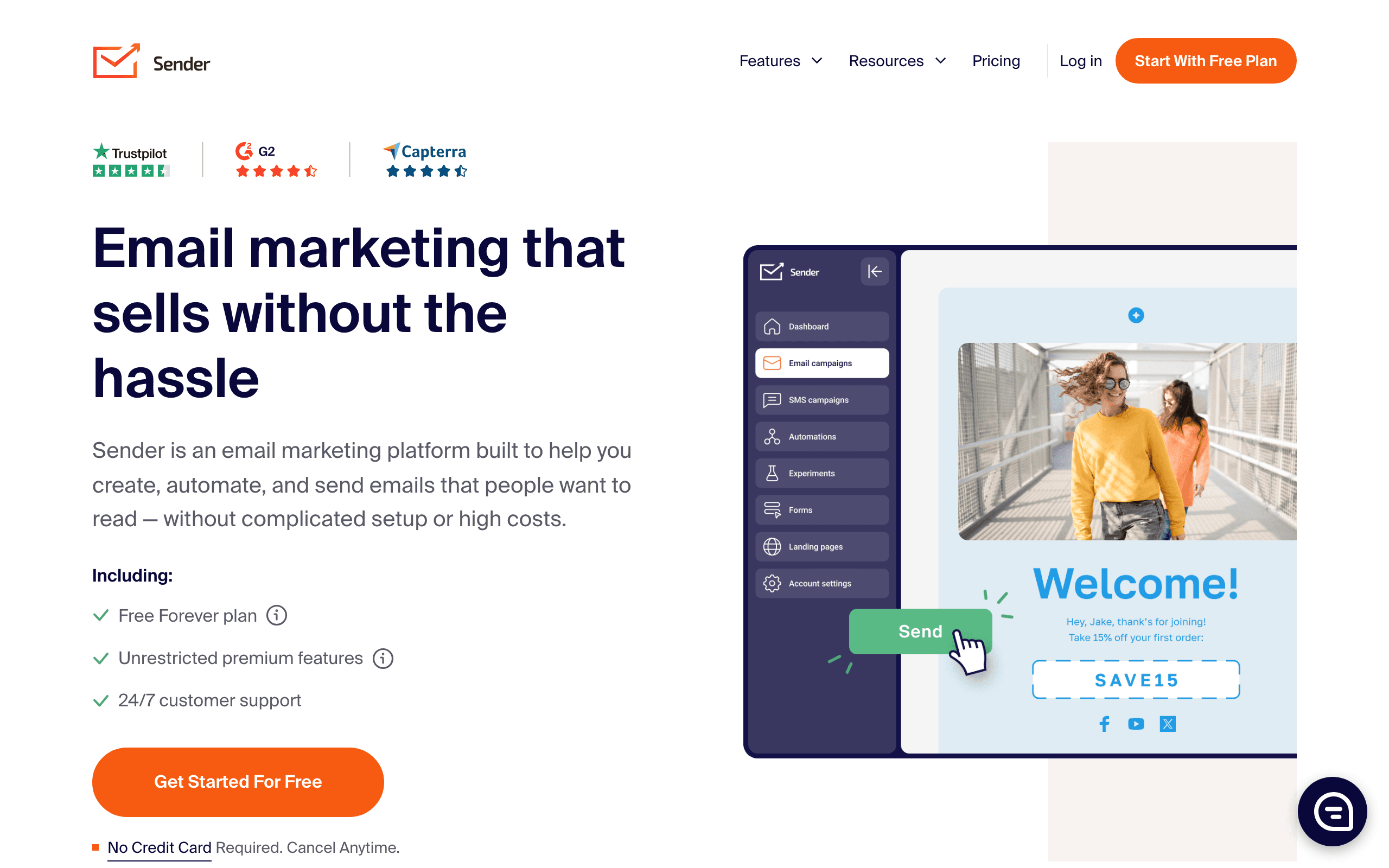
BirdSend and Sender both serve email marketers but with different priorities. BirdSend is a lightweight email marketing platform built for content creators. Sender is a budget email and SMS marketing platform.
BirdSend's Niche
BirdSend was designed for creators who care about revenue per subscriber more than list size. It tracks LTV per subscriber, bills by unique contact instead of by list, and adds a built-in resend to people who did not open the first email. Sender skips those metrics but pairs email with SMS, ecommerce integrations for Shopify and WooCommerce, and a popup and form builder. Pick BirdSend when subscriber revenue is what you check first; pick Sender when you want email and SMS bundled into one affordable plan.
Sender offers email plus SMS, forms, templates, and automation, while BirdSend focuses on revenue tracking and creator email.
Pricing reality
Compare current pricing against real usage. For BirdSend, check subscriber limits, send limits, unique-contact billing, revenue tracking, and automation depth. For Sender, check subscribers, email volume, SMS usage, forms, templates, automations, branding, and plan-level feature access.
Making the Choice
Choose BirdSend for creator email with revenue tracking. Choose Sender for budget email plus SMS, forms, templates, and ecommerce-oriented basics. For SaaS email with Stripe, consider Sequenzy.
Entry Path And Channel Fit
Both platforms may offer entry-level paths, but verify current limits before choosing. Subscriber caps, email limits, branding, automation access, and SMS availability can materially change the value of the entry plan.
The quality of an entry path matters for early-stage businesses and solo creators testing the platform. Sender is more attractive when email plus SMS and forms are part of the evaluation. BirdSend is more attractive when the core question is whether subscriber revenue tracking is useful.
For creators starting from zero, compare the actual features you can test before paying. A larger subscriber limit is less useful if the features you need are gated; a smaller limit can be enough if it lets you validate the workflow.
SMS as a Competitive Advantage
Sender's inclusion of SMS marketing alongside email can be meaningful in this segment. Having both channels in one budget platform gives small businesses multi-channel capability without immediately buying a heavier marketing suite.
BirdSend is email-only with no SMS capability. For businesses whose customers respond to text message marketing - local services, retail, restaurants, and appointment-based businesses - the absence of SMS is a genuine limitation. For content creators whose audience engages primarily through email and social media, SMS matters less.
The value of SMS depends heavily on your business type and audience preferences. Not every business benefits from text message marketing, and adding SMS can create compliance requirements (opt-in management, quiet hours, carrier regulations) that small businesses may not be prepared to handle.
The Budget Email Landscape
BirdSend and Sender both compete in the most crowded segment of email marketing - budget tools for small businesses. This market includes EmailOctopus, MailerLite, Moosend, and many others, each offering slight variations on affordable email with basic features.
The differentiators in this segment tend to be narrow: BirdSend has LTV tracking, Sender has SMS, EmailOctopus has Amazon SES integration, MailerLite has a website builder. No budget platform excels at everything. Choosing between them requires prioritizing which specific feature matters most to your business.
For SaaS companies evaluating budget tools, none of these platforms are purpose-built for subscription businesses. Stripe integration, behavioral event tracking, and subscription lifecycle automation require platforms designed for SaaS, like Sequenzy, which starts at a higher price point but provides capabilities that no budget email tool offers.
Use-case matchups
| Use case | Better fit | Why |
|---|---|---|
| Creator email with revenue visibility | BirdSend | BirdSend is more relevant when LTV per subscriber drives decisions. |
| Budget email plus SMS | Sender | Sender is stronger when text messaging is required. |
| Forms and ecommerce basics | Sender | Sender is broader than BirdSend for small-business marketing. |
| Simple creator broadcasts | BirdSend | BirdSend keeps the workflow focused when SMS is unnecessary. |
| SaaS lifecycle email | Sequenzy | Sequenzy is more focused when billing events drive SaaS messaging. |
Best Fit by Budget Channel Mix
Best creator email tool for revenue-focused broadcasts
BirdSend is the better fit when a creator wants email to stay focused on subscribers, offers, and revenue visibility. Choose it for plain broadcasts, simple drips, resend-to-unopens, and list monetization decisions where SMS, ecommerce forms, and broad SMB features would add clutter. It works best when the sender already has a sales funnel and wants email metrics tied closer to buyer value.
Best budget email tool for SMS and small-business basics
Sender is stronger for small businesses that want affordable email plus SMS, forms, automation basics, and ecommerce-friendly features in one entry-level package. It is a better first look for local businesses, small stores, and budget teams that need multiple channels and practical growth tools. The tradeoff is that SMS introduces consent, compliance, and deliverability work that pure email creators may not need.
Best SaaS email platform when behavior and billing matter
Sequenzy is the better fit when the business is a subscription product and email needs to respond to user behavior. SaaS teams should prioritize Stripe integration, onboarding, activation triggers, transactional email, cancellation flows, renewal reminders, and customer lifecycle segmentation. Those jobs are outside the core budget-email strengths of both BirdSend and Sender.
Review signals
The reviews show BirdSend's positive signal around LTV tracking and creator simplicity, with criticism that Sender offers broader value for many users. Sender's positive signal is generous entry-level usage, SMS, and small-business value; the caution is that automation remains basic and SMS adds compliance work.
Migration checklist
Before moving between BirdSend and Sender, export subscribers, suppression data, tags, custom fields, revenue tracking fields, forms, templates, campaign history, sequences, automations, SMS consent records, ecommerce settings, and domain authentication records. If moving to Sender, map SMS consent, ecommerce integrations, forms, and automation triggers. If moving to BirdSend, preserve revenue fields where possible and replace SMS, forms, and ecommerce workflows with separate systems.
Decision checklist
| Question | Why it matters |
|---|---|
| Is SMS part of the marketing plan? | Sender is stronger when text messaging is required. |
| Is subscriber revenue tracking central? | BirdSend is more relevant when LTV per subscriber drives decisions. |
| Do you need forms or ecommerce basics? | Sender is broader than BirdSend for budget small-business marketing. |
| Can you handle SMS compliance? | SMS adds opt-in, consent, and sending-rule responsibilities. |
| Is Stripe lifecycle email central? | Sequenzy is more focused when billing events drive SaaS messaging. |