Overview
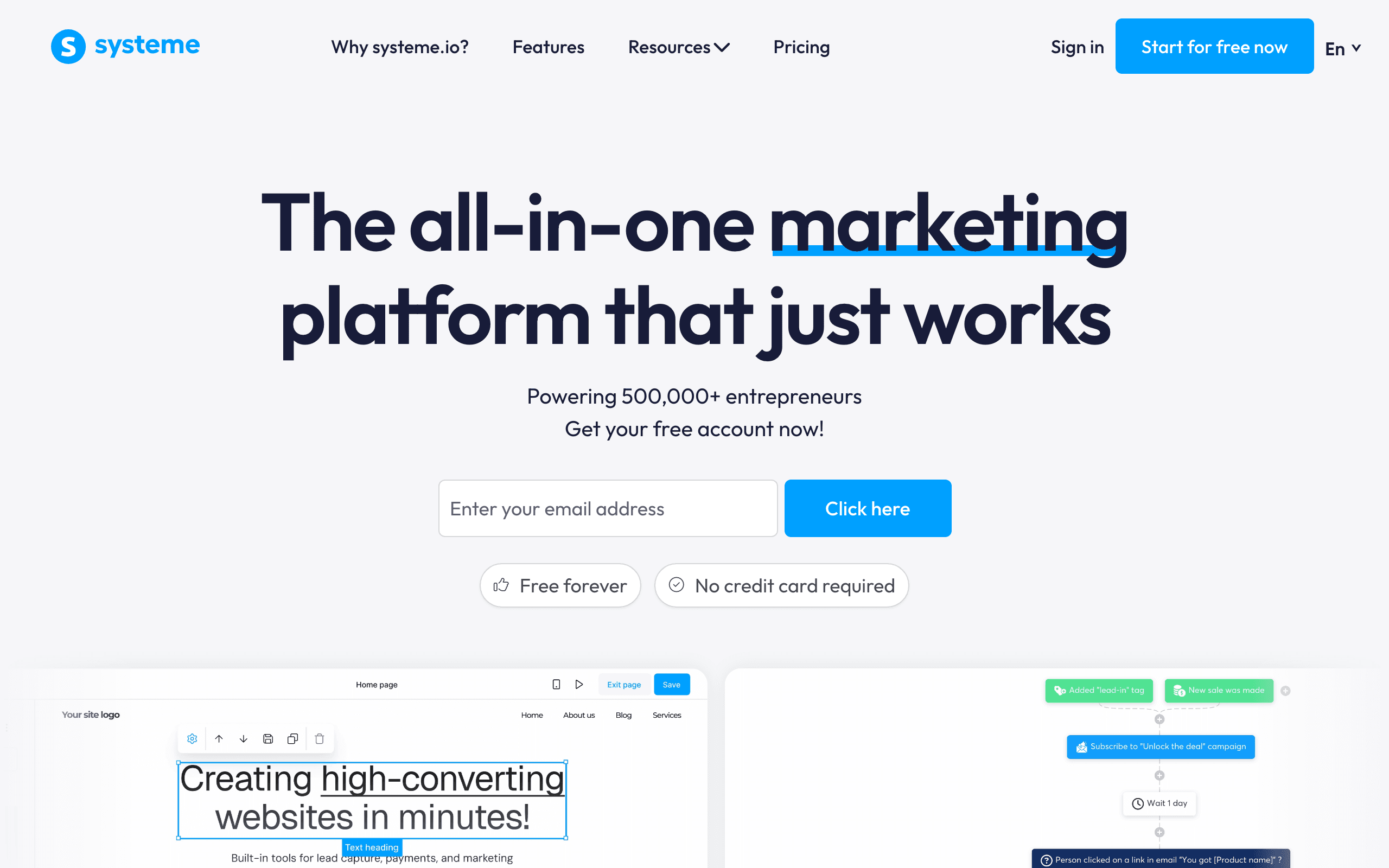
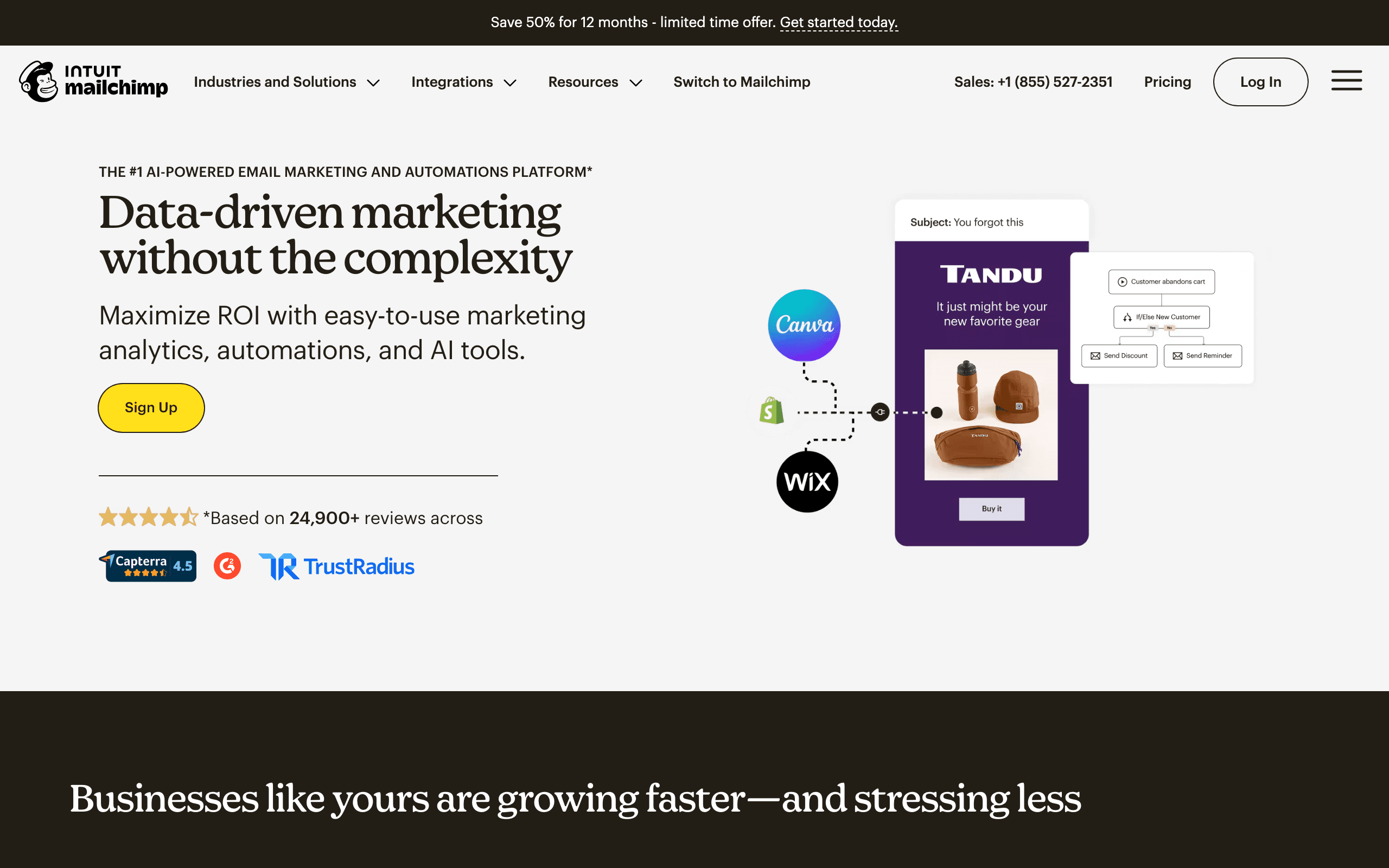
Systeme.io and Mailchimp serve different needs. Systeme.io is a all-in-one marketing platform with funnels, courses, and email. Mailchimp is a the most popular email marketing platform.
The All-in-One Proposition
Systeme.io folds email marketing together with sales funnels, courses, membership sites, and a blog into one platform, free for up to 2,000 contacts with unlimited sends. Mailchimp keeps its focus narrower on email and landing pages but backs it with the largest integration ecosystem of the two, at roughly $100 a month for a comparable contact count. Solopreneurs building a full offer stack may prefer Systeme.io's bundle; teams that just need email plus broad third-party integrations may prefer Mailchimp's.
Mailchimp is the email marketing standard with a massive ecosystem, but it only handles email and landing pages. To match Systeme.io's feature set, you'd need Mailchimp plus a funnel builder plus a course platform plus a membership tool. That adds up fast.
The Trade-off: Breadth vs Depth
Systeme.io's email marketing features are functional but basic compared to dedicated email platforms. If you need advanced automation, beautiful templates, or sophisticated segmentation, Mailchimp will likely do a better job at biggest ecosystem.
Pricing
Systeme.io offers a genuinely generous free plan: 2,000 contacts with unlimited emails. Paid plans start at $27/month. Mailchimp costs $100/month. For pure email marketing, Mailchimp may offer better value. For an all-in-one platform, Systeme.io is hard to beat on price.
For SaaS Founders
Sequenzy does not include funnels, courses, or membership sites, so it does not replace Systeme.io's bundle. What it adds is billing-aware automation through Stripe integration, AI sequences, and unified transactional + marketing email at $49/month, found on Sequenzy.
Integration Ecosystem Comparison
Mailchimp integrates with nearly every business tool available. CRMs, e-commerce platforms, accounting software, social media tools, and hundreds of other services connect directly. Systeme.io has limited integrations, primarily through Zapier rather than native connections.
For businesses that rely on multi-tool workflows where data flows between platforms, Mailchimp's integration depth is a genuine operational advantage. Systeme.io's all-in-one approach reduces the need for integrations by bundling features, but when you do need external tool connections, the options are limited.
Analytics Depth
Mailchimp provides detailed analytics including audience insights, engagement patterns, purchase behavior attribution, and comparative reporting across campaigns. The data helps optimize future campaigns based on what actually works.
Systeme.io analytics cover basic metrics like open rates and click rates but lack the depth that data-driven marketers need. For businesses that make decisions based on email performance data, Mailchimp provides significantly more insight.
Brand Trust and Professionalism
Mailchimp's brand recognition means your contacts are more likely to recognize the sending infrastructure if they check email headers. The platform's professionalism extends to deliverability, where Mailchimp's reputation and infrastructure help ensure emails reach inboxes. For businesses where email professionalism matters to their audience, Mailchimp's maturity provides confidence.
The $73/Month Gap and What It Actually Buys
At 10,000 contacts, Mailchimp costs roughly $100/month while Systeme.io costs $27/month. That $73/month difference ($876/year) buys you Mailchimp's 300+ native integrations, sophisticated analytics with purchase attribution, AI content suggestions, and a massive template library. For businesses where email is the primary revenue driver and data-driven optimization matters, Mailchimp's analytics alone can generate enough incremental revenue to justify the premium.
But if email is just one part of your funnel and you also need a course platform ($39-99/month), funnel builder ($97-297/month), and membership site ($29-79/month), Systeme.io's bundled approach saves $150-400/month compared to assembling a Mailchimp-centered stack. The math depends entirely on whether you need those additional tools or whether you are primarily doing email marketing.
Mailchimp's Reputation as a Trust Signal
There is an underappreciated benefit to using Mailchimp: brand trust. When prospects check the technical headers of your emails and see Mailchimp's infrastructure, it signals professionalism. When you mention your email platform to potential partners or clients, Mailchimp is universally recognized. Systeme.io is largely unknown outside the digital product creator community.
This matters more for B2B businesses, agencies, and professional services than for solopreneurs selling courses. If your email recipients include corporate decision-makers who might scrutinize your sending infrastructure, Mailchimp's brand provides implicit credibility that Systeme.io cannot match. For course creators selling directly to consumers, this brand trust difference is largely irrelevant.
The Scalability Ceiling Both Platforms Share
Neither Systeme.io nor Mailchimp was designed for the SaaS subscription model. As your business grows past simple email marketing into territory where email automation needs to respond to billing events, both platforms hit their ceiling. Mailchimp's sophisticated automation can handle complex conditional logic but has no concept of subscription status, MRR, or payment failure. Systeme.io's automation is too basic for anything beyond simple drip campaigns.
SaaS companies outgrow both platforms when they need trial-to-paid conversion sequences triggered by Stripe data, dunning emails for failed payments, and expansion revenue campaigns based on usage metrics. Sequenzy's native Stripe integration addresses this specific scalability gap, treating billing lifecycle as the core automation trigger rather than trying to approximate it through generic tagging and manual middleware.
Use-case matchups
| Situation | Best first look | Why |
|---|---|---|
| Creator or small business wants funnels, courses, pages, and email together | Systeme.io | Systeme.io is the baseline when all-in-one funnel and course tooling matters more than specialized email depth. |
| Team wants a familiar general email platform | Mailchimp | Mailchimp is stronger when brand familiarity and general campaigns matter more than funnel tooling. |
| SaaS or commerce team wants lifecycle and transactional email | Sequenzy | Sequenzy is stronger when Stripe, store, transactional, and lifecycle email events are the center of the workflow. |
| Team wants to avoid stitching course, checkout, page, and email tools | Systeme.io | Systeme.io is useful when one lower-cost suite is more important than best-in-class email features. |
| Team needs the specialist capability | Mailchimp | Mailchimp deserves the first demo when the main requirement is broad all-purpose email marketing. |
| Team wants email automation without funnel-suite overhead | Sequenzy | Sequenzy is narrower and should be evaluated when email lifecycle workflows matter more than course or page building. |
Best Fit by General Marketing Needs
Best all-in-one platform for creators who need funnels and courses
Systeme.io fits creator businesses that want email bundled with funnels, checkout, memberships, course hosting, and affiliate tools.
Best general email marketing platform for broad campaigns
Mailchimp is the better fit when the team wants familiar templates, integrations, segmentation, landing pages, and general small-business campaign tools.
Best SaaS email platform for lifecycle and transactional email
Sequenzy fits software teams that need lifecycle triggers and transactionals tied to subscriber and billing behavior rather than broad campaign tooling.
Pricing reality
The pricing signals on this page list Systeme.io at $27/month, Mailchimp at $100/month, and Sequenzy at $49/month. Compare the cost against the job each product is doing.
Systeme.io can look inexpensive because it bundles funnels, pages, courses, checkout, and email. Mailchimp's real cost depends on whether the team needs broad all-purpose email marketing.
Review signals
For Systeme.io, validate review themes around funnel builder quality, course features, email deliverability, support, and where users hit limits. For Mailchimp, focus review research on whether users praise the reason you would choose it: broad all-purpose email marketing.
Migration checklist
| Workstream | Moving toward Systeme.io | Moving toward Mailchimp | Simplifying to Sequenzy |
|---|---|---|---|
| Assets and funnels | Move landing pages, funnels, forms, courses, checkout steps, domains, and email assets. | Map audiences, tags, groups, journeys, templates, forms, ecommerce sync, and suppressions. | Move subscribers, tags, attributes, suppressions, and lifecycle events. |
| Contacts and consent | Import contacts, tags, custom fields, purchases, consent, unsubscribes, and suppressions. | Import the data model Mailchimp needs for broad all-purpose email marketing. | Import subscriber data and lifecycle attributes. |
| Automations | Rebuild nurture, sales funnel, course onboarding, checkout follow-up, and newsletter automations. | Rebuild the workflows that prove Mailchimp's advantage. | Rebuild lifecycle and transactional email flows. |
| Payments and products | Validate course access, checkout, offers, coupons, and payment events. | Keep products and payments elsewhere unless Mailchimp supports them. | Use Stripe or store events for lifecycle email. |
| Reporting | Validate funnel conversion, email engagement, sales, exports, and course metrics. | Validate reporting for broad all-purpose email marketing before committing. | Validate campaign, automation, transactional, and subscription lifecycle reporting. |
Decision checklist
- Does the buyer need only email and landing pages, or also the funnels, courses, and checkout that Systeme.io bundles in?
- Does Mailchimp's strength in broad all-purpose email marketing matter more than Systeme.io's all-in-one bundle?
- When you move contacts over, which platform keeps consent, unsubscribes, and suppressions intact with the least manual cleanup?
- Do the listed prices still hold once you add the funnel, course, or membership tools that Mailchimp lacks?
- Would a focused platform like Sequenzy be simpler to run than an all-in-one suite like Systeme.io?
- Mailchimp can become expensive if broader features are not used.