

Overview
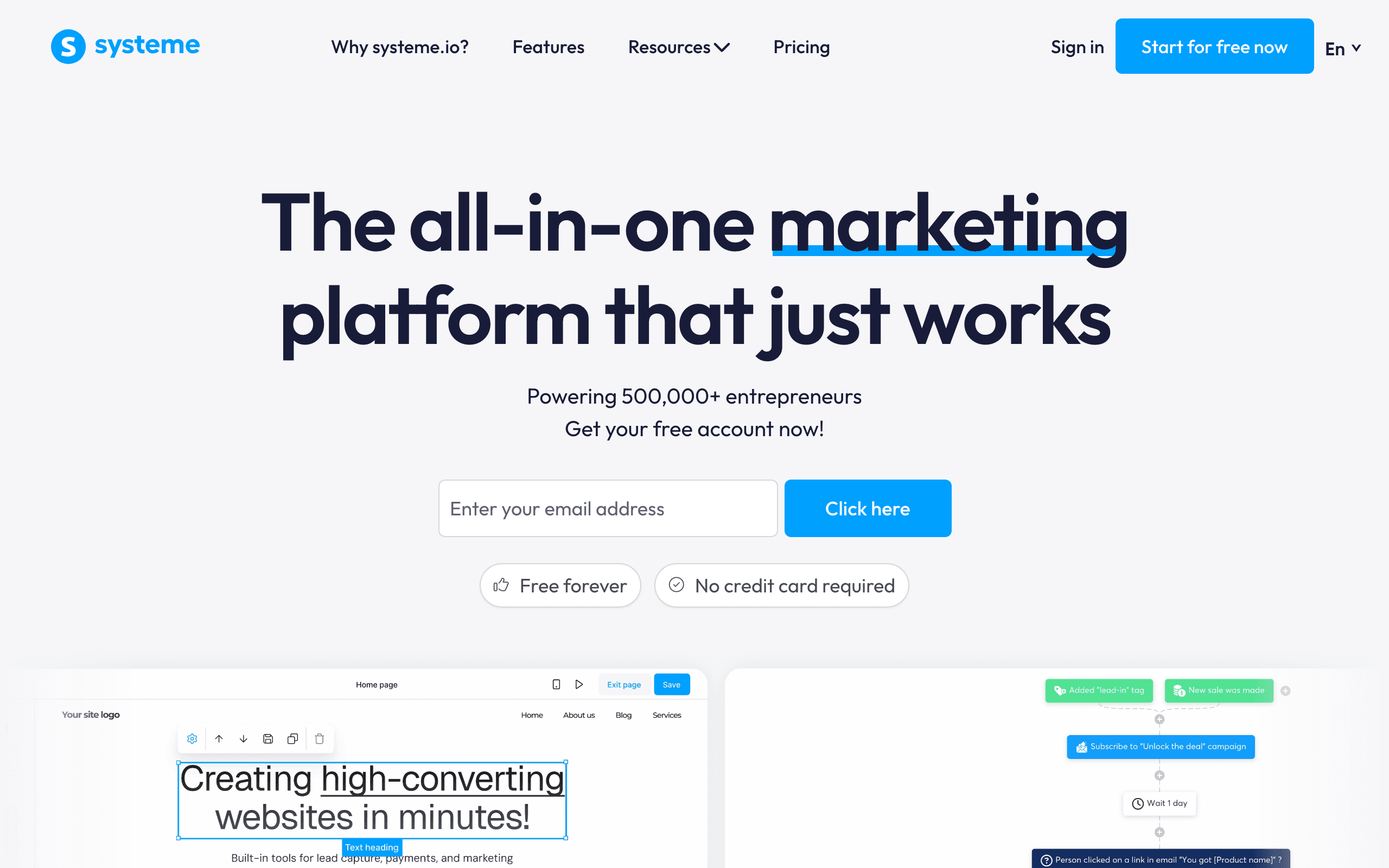
Systeme.io and ConvertKit serve different needs. Systeme.io is a all-in-one marketing platform with funnels, courses, and email. ConvertKit is a creator-focused email marketing with visual automation.
The All-in-One Proposition
Systeme.io bundles email marketing with sales funnels, online courses, membership sites, and a blog builder, all inside a free tier that covers 2,000 contacts and unlimited emails before you pay anything. ConvertKit skips the funnels and course hosting entirely and instead focuses on visual automation, landing pages, and a cleaner design philosophy built for writers and creators, with its own free tier stretching to 10,000 subscribers. Pick Systeme.io if you want one platform for the whole business; pick ConvertKit if email and audience growth are the whole job.
ConvertKit focuses on creator-focused and visual automation. While ConvertKit does email well, Systeme.io bundles more tools under one roof.
The Trade-off: Breadth vs Depth
Systeme.io's email marketing features are functional but basic compared to dedicated email platforms. If you need advanced automation, beautiful templates, or sophisticated segmentation, ConvertKit will likely do a better job at creator-focused.
Pricing
Systeme.io offers a genuinely generous free plan: 2,000 contacts with unlimited emails. Paid plans start at $27/month. ConvertKit costs $25/month. For pure email marketing, ConvertKit may offer better value. For an all-in-one platform, Systeme.io is hard to beat on price.
For SaaS Founders
Neither platform is built for SaaS subscription businesses. If you need Stripe integration for billing-aware automation, Sequenzy handles that with AI sequences and unified transactional + marketing email at $49/month.
Creator-First Design Philosophy
ConvertKit was designed specifically for creators, writers, and bloggers. The platform reflects this in its minimalist email design approach, powerful tagging system, and focus on building relationships through text-based content rather than flashy HTML emails. This creator-first philosophy attracts users who value substance over design.
Systeme.io was designed for digital product sellers and course creators. Its creator support comes through funnels and course hosting rather than email sophistication. The philosophies overlap but prioritize different aspects of the creator business.
Deliverability Track Record
ConvertKit's deliverability reputation is among the best in the industry. The platform is strict about who can join and actively monitors sending practices. This results in consistently high inbox placement rates that matter for creators whose business depends on reaching their audience.
Systeme.io's deliverability is adequate but less consistently praised. For creators where email is the primary revenue channel, ConvertKit's deliverability advantage can directly impact income.
Subscriber Tagging and Segmentation
ConvertKit's tagging system is elegantly simple yet powerful. You can tag subscribers based on behavior, purchases, form submissions, and link clicks, then build automated sequences that respond to these tags. The system scales well from small newsletters to complex multi-product businesses.
Systeme.io has basic tagging but lacks the same depth of behavioral triggers and tag-based automation. For businesses that rely on sophisticated segmentation, ConvertKit provides more precision.
The Paid Newsletter Revenue Model ConvertKit Owns
ConvertKit has built paid newsletter infrastructure that Systeme.io cannot match. Creators can charge subscribers monthly for premium content, sell digital products directly through email, and accept tips from fans. The Creator Network enables cross-promotion between newsletter writers, driving organic subscriber growth. These features make ConvertKit the default platform for professional writers and podcasters who monetize their audience through recurring content subscriptions.
Systeme.io's monetization model is different. It excels at one-time product sales through funnels, not recurring content subscriptions. A course creator who sells a $497 course and needs a funnel to drive sales is better served by Systeme.io. A newsletter writer who charges $10/month for premium content is better served by ConvertKit. The monetization model determines the platform choice more than any feature comparison.
ConvertKit's Deliverability Advantage Is Real and Measurable
ConvertKit consistently ranks among the top platforms for email deliverability, and the reason is their strict account policies. They reject applications that look like spam operations, monitor engagement rates aggressively, and maintain clean shared IP pools. For creators whose income depends on emails reaching the inbox, this deliverability premium is not theoretical. It directly affects open rates, click rates, and ultimately revenue.
Systeme.io's deliverability is adequate but not at ConvertKit's level. When you bundle email with funnels, courses, and membership sites, the platform attracts a wider range of senders including some who engage in aggressive marketing practices. This can dilute the quality of shared sending infrastructure. Creators who have experienced deliverability problems on all-in-one platforms often migrate to ConvertKit specifically for this reason.
The SaaS Subscription Gap Both Platforms Share
Course creators and newsletter writers are not the only online businesses. SaaS companies need email automation triggered by subscription billing events: trial ending, payment failed, plan upgraded, customer churning. Neither Systeme.io nor ConvertKit has any concept of these triggers. Both platforms understand "subscriber opened email" and "subscriber clicked link" but not "customer's trial expires in 48 hours" or "payment attempt failed for the third time."
Building SaaS email workflows on either platform means duct-taping Stripe through Zapier, manually tagging subscribers by plan tier, and maintaining fragile automations that break when APIs change. For software companies where email automation directly impacts MRR, this middleware approach is expensive in both engineering time and ongoing maintenance. Sequenzy treats the Stripe subscription lifecycle as a first-class automation trigger, connecting billing events directly to email sequences without middleware.
Use-case matchups
| Situation | Best first look | Why |
|---|---|---|
| Creator or small business wants funnels, courses, pages, and email together | Systeme.io | Systeme.io is the baseline when all-in-one funnel and course tooling matters more than specialized email depth. |
| Creator wants audience-first email workflows | ConvertKit | ConvertKit is stronger when creator sequences, forms, and products matter more than all-in-one funnels. |
| SaaS or commerce team wants lifecycle and transactional email | Sequenzy | Sequenzy is stronger when Stripe, store, transactional, and lifecycle email events are the center of the workflow. |
| Team wants to avoid stitching course, checkout, page, and email tools | Systeme.io | Systeme.io is useful when one lower-cost suite is more important than best-in-class email features. |
| Team needs the specialist capability | ConvertKit | ConvertKit deserves the first demo when the main requirement is creator email, products, and audience monetization. |
| Team wants email automation without funnel-suite overhead | Sequenzy | Sequenzy is narrower and should be evaluated when email lifecycle workflows matter more than course or page building. |
Best Fit by Creator Monetization Model
Best all-in-one platform for creators who need funnels courses and checkout
Systeme.io fits creators who want one lower-cost platform for pages, funnels, course hosting, memberships, affiliates, checkout, and email.
Best creator email platform for audience-first monetization
Kit is the better fit when subscriber relationships, forms, sequences, digital products, paid newsletters, and creator audience segmentation matter more than funnel hosting.
Best SaaS email platform for onboarding and billing automation
Sequenzy fits software teams that need lifecycle and transactional email around product and subscription events rather than creator product sales.
Pricing reality
The pricing signals on this page list Systeme.io at $27/month, ConvertKit at $25/month, and Sequenzy at $49/month. Compare the cost against the job each product is doing.
Systeme.io can look inexpensive because it bundles funnels, pages, courses, checkout, and email. ConvertKit's real cost depends on whether the team needs creator email, products, and audience monetization.
Review signals
For Systeme.io, validate review themes around funnel builder quality, course features, email deliverability, support, and where users hit limits. For ConvertKit, focus review research on whether users praise the reason you would choose it: creator email, products, and audience monetization.
Migration checklist
| Workstream | Moving toward Systeme.io | Moving toward ConvertKit | Simplifying to Sequenzy |
|---|---|---|---|
| Assets and funnels | Move landing pages, funnels, forms, courses, checkout steps, domains, and email assets. | Map subscribers, tags, segments, forms, landing pages, broadcasts, sequences, and products. | Move subscribers, tags, attributes, suppressions, and lifecycle events. |
| Contacts and consent | Import contacts, tags, custom fields, purchases, consent, unsubscribes, and suppressions. | Import the data model ConvertKit needs for creator email, products, and audience monetization. | Import subscriber data and lifecycle attributes. |
| Automations | Rebuild nurture, sales funnel, course onboarding, checkout follow-up, and newsletter automations. | Rebuild the workflows that prove ConvertKit's advantage. | Rebuild lifecycle and transactional email flows. |
| Payments and products | Validate course access, checkout, offers, coupons, and payment events. | Keep products and payments elsewhere unless ConvertKit supports them. | Use Stripe or store events for lifecycle email. |
| Reporting | Validate funnel conversion, email engagement, sales, exports, and course metrics. | Validate reporting for creator email, products, and audience monetization before committing. | Validate campaign, automation, transactional, and subscription lifecycle reporting. |
Decision checklist
- Is the buyer replacing only email, or also funnels, pages, courses, checkout, and automations?
- Does ConvertKit's strength in creator email, products, and audience monetization matter more than Systeme.io's all-in-one bundle?
- Which platform handles consent, suppressions, and deliverability with the least manual cleanup?
- Are the listed prices still realistic after adding any missing funnel, course, checkout, or email tools?
- Would a focused lifecycle email platform be easier to operate than an all-in-one suite?
- ConvertKit should win only if creator email is more important than all-in-one funnel tooling.









