
Two different ideas of what a newsletter is
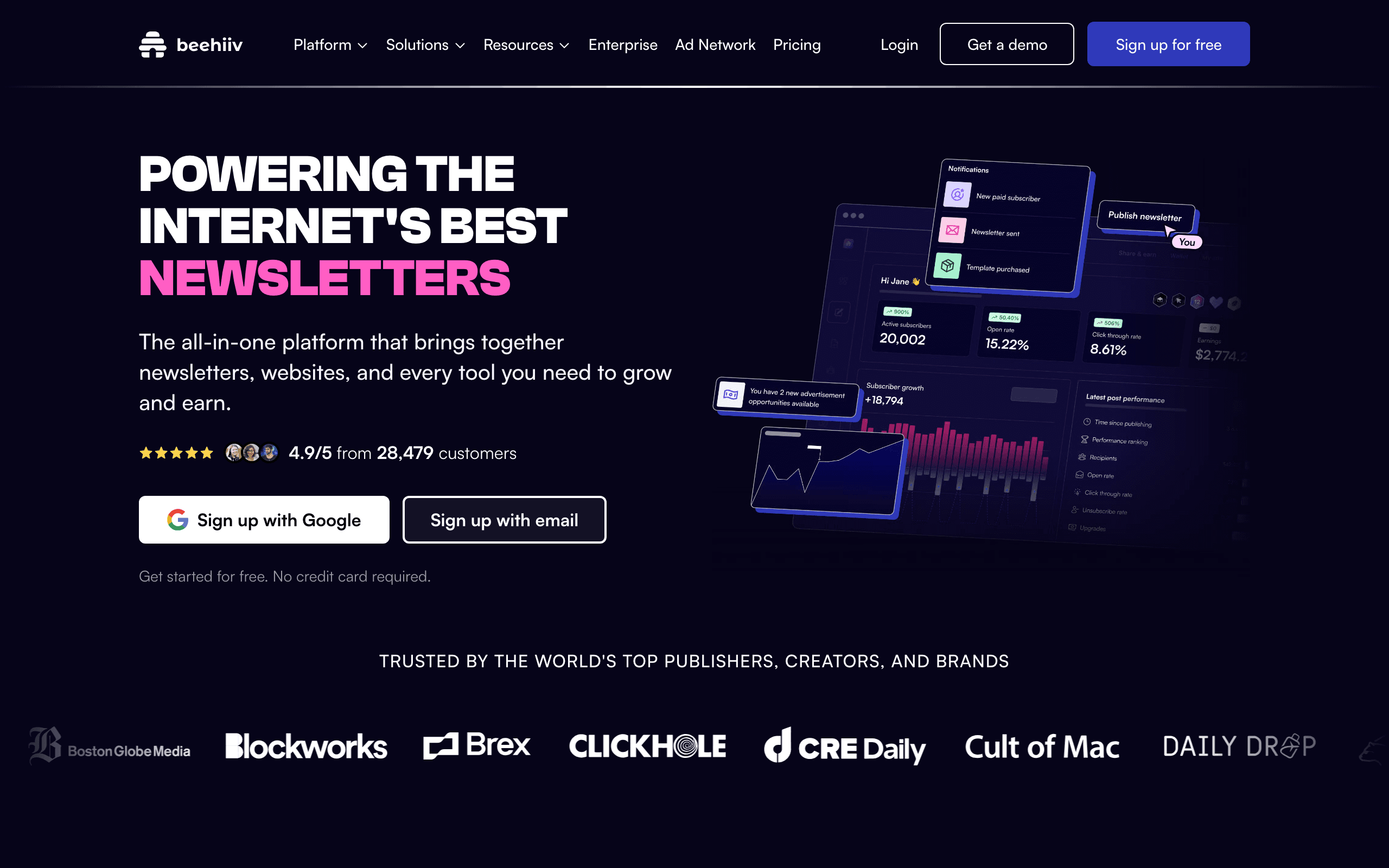
Beehiiv was built by people who worked on newsletter growth, and it shows. The dashboard is organized around subscriber acquisition, engagement and revenue. You write a post, send it, and then look at referral progress, Boost earnings and ad placements. The website exists mainly to capture signups and host the archive.
Ghost started as a blogging platform and grew into a publishing and membership system. You write a post, choose whether it goes to the web, to email or both, and decide which member tier can read it. The website is the center of gravity, and email is one of several ways a post reaches people.
That difference drives almost every tradeoff on this page. If your success metric is list size and revenue per subscriber, beehiiv is organized around that metric. If your success metric is a durable publication with paying members and search traffic, Ghost is organized around that.
Where beehiiv pulls ahead
Monetization you do not have to sell yourself. Beehiiv's Ad Network matches your newsletter with advertisers, Boosts pay you for recommending other newsletters, and Max adds a sponsorship storefront. For a newsletter without a sales team, these can cover the plan cost. Ghost has none of these, so sponsorship revenue on Ghost means selling and placing ads yourself.
Growth loops. The referral program rewards readers for bringing in subscribers, and the recommendation network exposes you to readers of other beehiiv newsletters. Ghost supports recommendations between Ghost sites, but a referral program needs a third-party tool and extra setup.
Automations. On Scale and above, beehiiv supports automations such as welcome series. Ghost is primarily a post-sending system, and many Ghost publishers bolt on another tool when they want onboarding sequences.
Where Ghost pulls ahead
Ownership. Ghost is MIT-licensed open source. You can run it on your own server, move between hosts, and export members and content at any time. Beehiiv exports your subscribers and posts, but you cannot run the platform yourself.
A real website. Ghost themes control the full site: homepage, tag pages, author pages, custom templates and SEO metadata. Publications that get meaningful search traffic or want a distinct brand usually find Ghost more flexible than beehiiv's website builder.
Memberships as the core model. Ghost lets you create free and paid tiers, gate individual posts by tier, and bill members through your own Stripe account with no Ghost transaction fee. Beehiiv also charges 0% on paid subscriptions from Scale upward, so the fee gap is small, but Ghost's content gating and tier structure are deeper.
The pricing math at 10,000 subscribers
| Cost item | Beehiiv | Ghost |
|---|---|---|
| Free option | Launch, up to 2,500 subscribers | Self-host (you pay for server and Mailgun) |
| Paid entry | Scale from $43/month billed annually | Starter from $18/month billed annually (1,000 members, no paid tiers) |
| At 10,000 subscribers | About $109/month on Scale, billed monthly | About $85/month on Publisher |
| Platform fee on paid subscriptions | 0% on Scale and Max | 0% on paid-member plans |
| Extra revenue lines | Ad Network, Boosts, sponsorship storefront | None built in |
Both prices climb with audience size. Beehiiv's plan cost can be offset by Boost and ad income; Ghost's cost can be reduced by self-hosting if you have someone to maintain it. Check current tiers on each pricing page before committing, since both adjust prices by list size and billing period.
What moves when you switch
Moving between these two is more involved than moving between two email tools, because each one also hosts your website.
- Subscribers and members. Both export CSV. Map Ghost's free and paid status and labels to beehiiv segments, or map beehiiv's free and premium subscribers to Ghost tiers.
- Paid subscriptions. Both bill through Stripe. Connecting the same Stripe account on the new platform is what keeps existing paying members billing without asking them to re-subscribe. Test this with a few accounts before announcing the move.
- Posts and archive. Ghost exports JSON; beehiiv has importers for common platforms. Formatting, embeds and custom cards often need cleanup after import.
- URLs. Post URLs will change. Set up redirects from old paths or you will lose search traffic, which matters most when moving away from Ghost.
- What does not move. Beehiiv referral progress, Boost relationships and ad network history stay behind. Ghost themes and custom templates do not have a beehiiv equivalent.
The self-hosting question
Ghost's open-source license is its most distinctive feature and the one most often misunderstood. Self-hosting means installing Ghost on a server you control, usually with a MySQL database and a reverse proxy, then keeping it updated. Bulk newsletters on self-hosted Ghost are sent through Mailgun, so you also need a Mailgun account, a sending domain with SPF, DKIM and DMARC, and someone who watches bounces and complaints.
That matters more since Gmail and Yahoo tightened their bulk sender rules in 2024: senders of large volumes need authenticated domains, one-click unsubscribe and low spam complaint rates. Ghost(Pro) and beehiiv handle most of this for you. A self-hosted setup puts it on your plate.
Self-hosting makes sense for teams with an engineer who already runs servers, publications that need custom integrations, or organizations that require data to stay on their own infrastructure. For a solo writer, the hosted plan usually costs less than the time spent maintaining it.
Who stands behind each platform
The companies are built differently, and that affects long-term risk. Ghost is developed by the Ghost Foundation, a non-profit organization funded by Ghost(Pro) subscriptions, and the software is open source. If the company changed direction, the code would still exist and could be hosted elsewhere.
Beehiiv is a venture-funded company founded in 2021 by people who worked on newsletter growth at Morning Brew. It ships features quickly, especially around monetization, and its business depends on growing newsletters that earn money through its ad network and paid plans. That alignment is useful for operators, but the platform is proprietary, so your exit path is an export rather than a self-hosted copy.
What each one lets you measure
Beehiiv's analytics are built around growth: subscriber sources, referral performance, Boost earnings, ad revenue, open and click trends, and cohort-style views of engagement. If you make decisions based on which acquisition channel or which sponsor performs, beehiiv shows you more without extra tools.
Ghost reports on posts, members and newsletters: who signed up from which post, how free members convert to paid, and how each newsletter performs. Recent Ghost releases have expanded built-in web analytics, but for deep acquisition analysis many Ghost publishers still add a separate analytics tool.
Use-case matchups
| Situation | Better fit | Why |
|---|---|---|
| Sponsor-funded daily newsletter | Beehiiv | Ad Network, sponsorship storefront and growth analytics are built in |
| Investigative outlet with paid tiers | Ghost | Tiered memberships, gated posts and a full website |
| Several niche newsletters from one team | Beehiiv | Max supports up to 10 publications in one account |
| Organization that must host its own data | Ghost | Open source and self-hostable |
| Writer testing an idea on a budget | Beehiiv | Launch is free up to 2,500 subscribers |
| Blog with years of posts and search traffic | Ghost | Themes, tags and SEO control keep the archive working |
| SaaS company newsletter plus onboarding email | Sequenzy | Product events, billing triggers and transactional email |
Where Sequenzy fits, and where it does not
Sequenzy is not a publishing platform. It has no website CMS, no paid membership billing for readers, no ad network, and no referral program, so it cannot replace either tool for a media business.
It becomes relevant when the newsletter belongs to a software company. In that case the audience is mostly product users, and the emails that matter most are onboarding, trial conversion, failed payment and product update messages. Sequenzy connects to Stripe, Paddle and Polar, sends transactional and marketing email from one account, and bills by emails sent with unlimited contacts. A SaaS team can still publish a monthly newsletter from Sequenzy, while the blog stays on Ghost or another CMS.
Choosing between them
Choose beehiiv if the list is the business and you want growth and ad revenue tools included. Choose Ghost if the publication is the business and you want to own the site, the member relationship and the code. If you are unsure, list your revenue sources for the next year: ads and sponsors point to beehiiv, member tiers and site traffic point to Ghost.
Decision checklist
- Pick beehiiv if ads, sponsorships, Boosts or referrals will be a meaningful part of revenue.
- Pick Ghost if paid memberships and gated content are the core business.
- Pick Ghost if open source, self-hosting or full theme control is a requirement.
- Pick beehiiv if you want to run several publications from one account.
- Budget for Mailgun and maintenance before choosing self-hosted Ghost to save money.
- Check where your readers come from today; a site with strong search traffic favors Ghost.
- Consider Sequenzy if your subscribers are product users and billing events drive your email.