Loops's pricing page
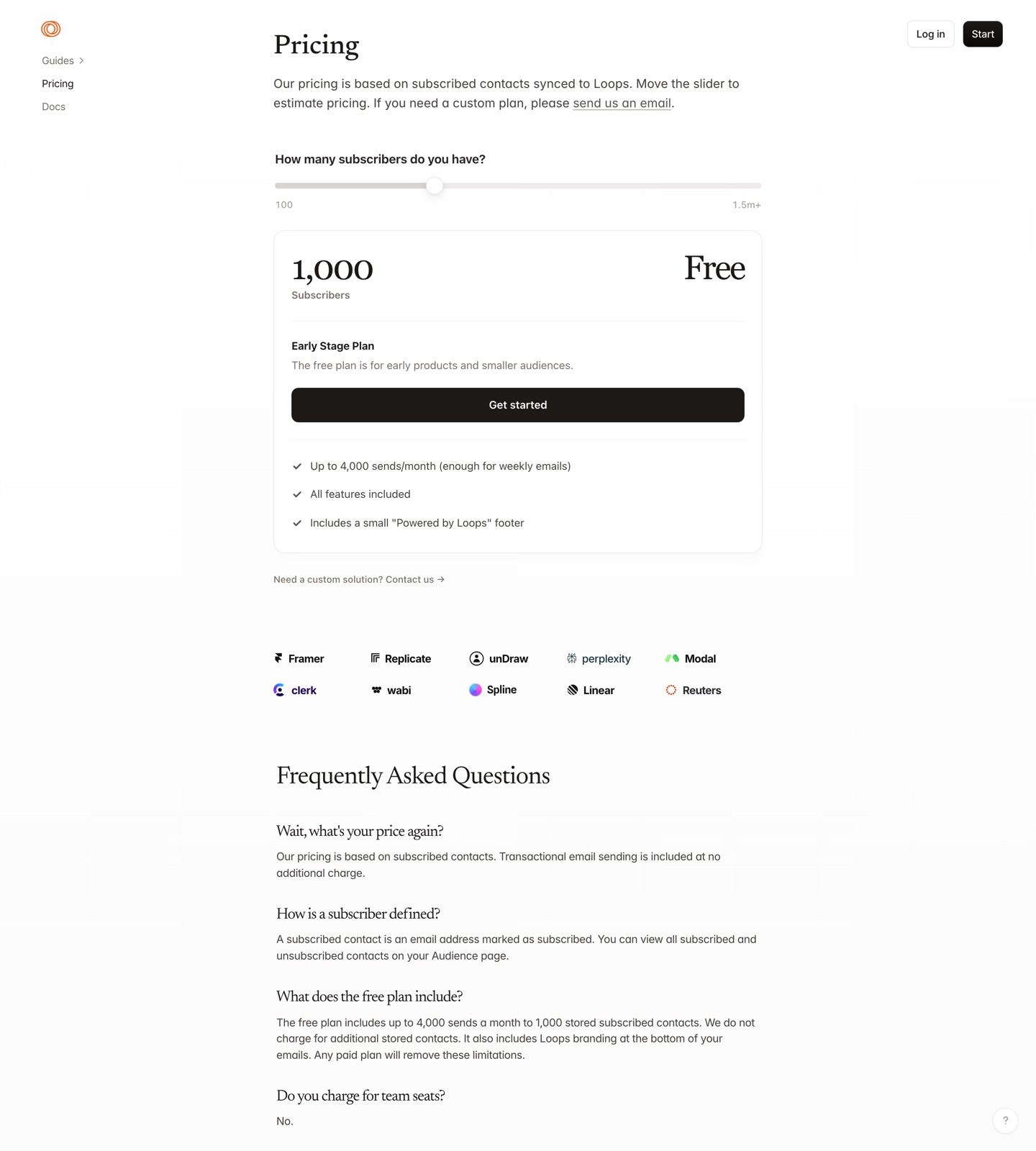
Captured from loops.so. Pricing changes often, so confirm the current numbers on the live page.
Buying shortcut
Which Loops plan should you choose?
Start here
Free
Early SaaS teams testing product email. It is the first tier to check when you only need the core Loops workflow. Watch for: Powered by Loops footer
Public price
$0/mo
Up to 1,000 subscribed contacts and 4,000 sends/month.
Main upgrade
1K-5K
Early paid SaaS teams. Inspect this tier when the lower tier starts blocking reporting, automation, collaboration, or support needs. Watch for: Subscriber bracket jump after 5,000
Public price
$49/mo
1,000 to 5,000 subscribed contacts.
High-volume or advanced
Enterprise
Very high-volume SaaS teams. Treat this as the serious-operations tier, especially if the first two plans leave key limits or add-ons unresolved. Watch for: Sales-led pricing
Public price
Custom
Custom for 1,000,000+ subscribers.
Cost scenarios
Pricing pages show the entry point. These scenarios show what the plan means in real buying situations.
Early SaaS with fewer than 1,000 subscribers
Loops: Free if 4,000 sends/month is enough.. Sequenzy: Compare based on sequence generation and campaign scope.. Loops is a strong early SaaS option.
SaaS with 3,000 subscribers and frequent sends
Loops: $49/month with unlimited sends.. Sequenzy: Email-volume model may be better or worse depending on send frequency.. Loops is attractive when sends are frequent and contacts stay clean.
SaaS with many inactive subscribers
Loops: Subscriber brackets still count subscribed contacts.. Sequenzy: May fit better if cost should track sends more directly.. Keep the subscribed audience clean before judging total cost.
What to watch for
Pricing jumps by subscriber bracket.
Free includes a Powered by Loops footer.
Paid plans are attractive for high send frequency, less so for large dormant lists.
Loops pricing is simple for SaaS teams
Loops prices by subscribed contacts and keeps paid feature access broad. That makes the math clean: keep your audience clean, choose the subscriber bracket, and send without worrying about per-email overages on paid plans.
The main risk is paying for subscribers that are not engaged. If your SaaS has lots of old trials or inactive leads, list hygiene becomes part of pricing strategy.
Loops is one of the most direct comparisons because it is SaaS-oriented rather than newsletter-first or ecommerce-first. The paid plans are easiest to justify when your subscriber list is clean and you send often. In that case, unlimited sends can be valuable and the monthly bracket is predictable. The math is less attractive when the list includes many old trials, dormant users, or leads that rarely receive email.
The comparison should also include workflow style. Loops gives SaaS teams a modern product email tool, while Sequenzy emphasizes lifecycle strategy and generated sequences. Use the Loops alternatives guide and the Loops comparison if you are deciding whether subscriber brackets or email-volume economics better match your product.
Loops vs Sequenzy
Loops and Sequenzy compete directly for SaaS email workflows. Loops is strongest on simple subscriber brackets and unlimited sends. Sequenzy is positioned around lifecycle content, SaaS-specific sequence generation, and email-volume economics.
Choose Loops when you like contact brackets, broad paid access, and a clean SaaS email workflow. Choose Sequenzy when the harder part is deciding what lifecycle messages to run and connecting them to product and billing context.
Loops vs Sequenzy
How Loops compares with Sequenzy, which bills on emails sent rather than contact count.
How Sequenzy prices the same volume
Sequenzy price per 1k emails
$0.82 / 1k at $49/mo for 60k emails
Verdict
Loops is one of the closest competitors to Sequenzy because it is explicitly SaaS-oriented. Loops is compelling for clean subscriber lists and frequent sends; Sequenzy should win when teams want more AI-assisted lifecycle strategy and pricing tied around email volume.
FAQ
Sources checked · Jun 16, 2026