Overview
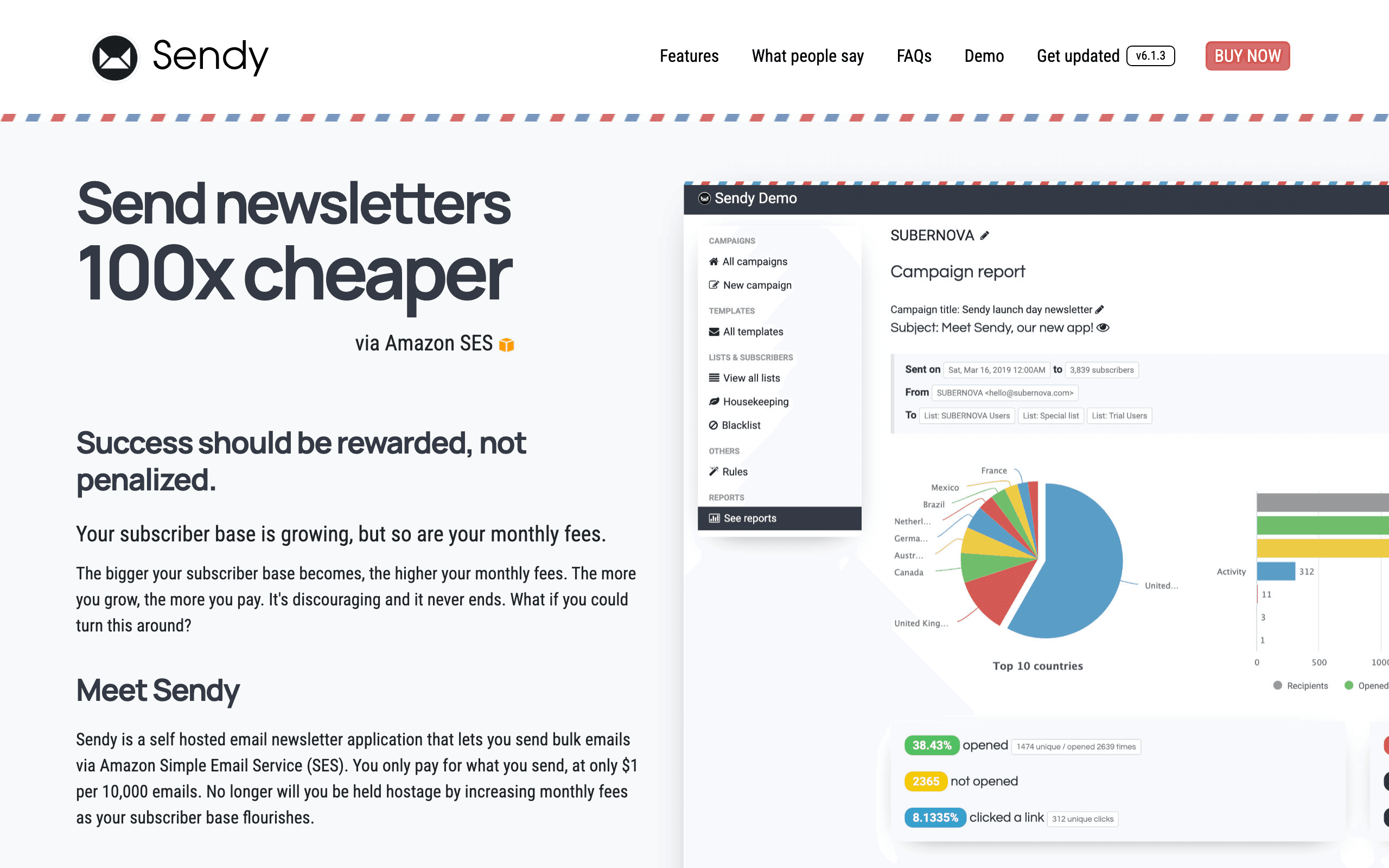
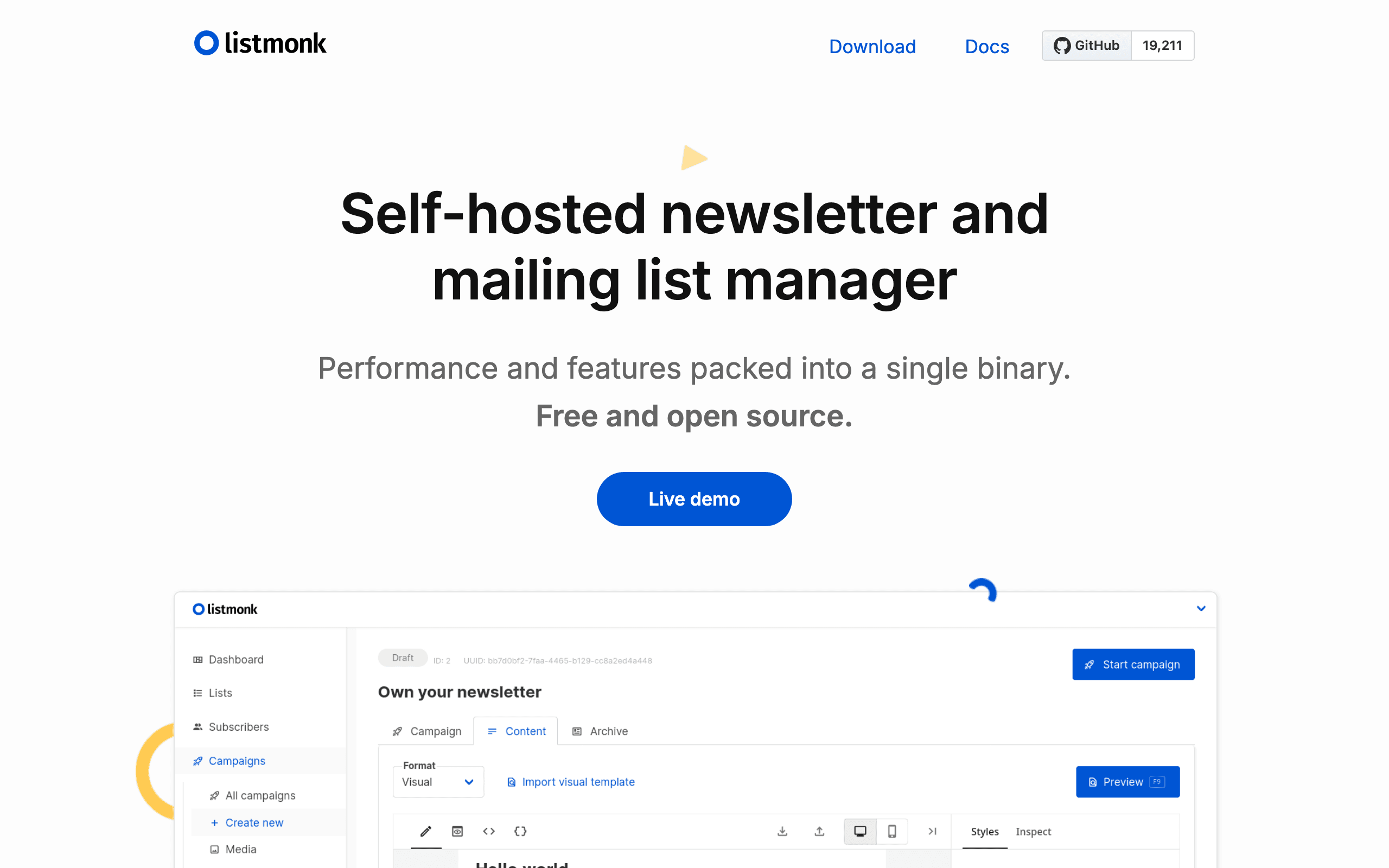
Sendy and Listmonk are both self-hosted email marketing solutions. Sendy is proprietary ($69) and optimized for Amazon SES. Listmonk is open source (free) and works with any SMTP provider. Both require technical skills to set up and maintain.
The Open Source Question
Listmonk's biggest advantage is being completely free. No license fees, ever. Sendy costs $69 upfront and major version upgrades may cost more. If you're maximizing savings and comfortable with open source support models, Listmonk is compelling.
Provider Flexibility
Sendy is locked to Amazon SES. This is fine since SES is excellent and cheap. Listmonk works with any SMTP provider: SES, Mailgun, Postmark, your own mail server. If you want flexibility to switch providers, Listmonk wins.
Technical Stack
Sendy is PHP/MySQL, a stack many find dated but widely supported. Listmonk is Go/PostgreSQL, modern and performant. For developers, Listmonk's codebase is cleaner and more pleasant to work with. Performance-wise, Go is significantly faster.
Established vs Modern
Sendy has been around since 2013. More tutorials, community knowledge, and proven deployments exist. Listmonk is newer with an active community but less historical knowledge. Some prefer proven reliability over cutting-edge tech.
Neither is a Complete Solution
Both Sendy and Listmonk focus on basic campaigns and list management. Neither has sophisticated automation, landing pages, or advanced segmentation. For anything beyond newsletters, you'll hit limitations.
For SaaS Companies
Self-hosting makes sense for cost optimization, but building SaaS-specific features on top of either would require significant custom development. For subscription businesses wanting Stripe integration and event-based automation, consider Sequenzy.
Making the Choice
Choose Sendy if you want an established solution with Amazon SES. Choose Listmonk if you want free open source with provider flexibility. Both are solid self-hosted options for technical users with basic email needs.
Two Philosophies of Self-Hosted Software
Sendy and Listmonk represent different philosophies within the self-hosted software movement. Sendy is proprietary software sold at a one-time price -- the developer maintains and improves the codebase, and users pay for access. Listmonk is open source under the AGPL license -- anyone can use, modify, and distribute the software, with development driven by community contributions.
The proprietary model gives Sendy a clear point of accountability. One developer maintains the product, answers support requests, and makes roadmap decisions. The open source model gives Listmonk a broader development community, faster feature evolution, and the security of community code review. Neither model is inherently superior -- they offer different guarantees.
For organizations that require vendor accountability for compliance or procurement processes, Sendy's commercial license may be easier to justify. For organizations that value transparency, auditability, and the freedom to modify software, Listmonk's open source license is more aligned. The technical choice often follows organizational values as much as feature comparisons.
Performance and Architecture Comparison
Listmonk's Go-based architecture delivers measurably better performance than Sendy's PHP. Go compiles to native binaries that handle concurrent operations efficiently, making Listmonk faster at processing large subscriber lists, rendering templates, and handling API requests. PHP's interpreted execution model is slower, particularly under high concurrent load.
In practical terms, Listmonk handles 100,000+ subscriber campaigns more efficiently and with lower server resource requirements per unit of work. A $5/month VPS that runs Sendy adequately for 10,000 subscribers might handle 50,000+ on Listmonk. At scale, this efficiency translates to lower hosting costs or better performance on equivalent hardware.
The architectural difference also affects development velocity. Listmonk's codebase is cleaner and more maintainable, attracting contributors who improve the software. Sendy's PHP codebase, while functional, does not attract the same level of community engagement. Over time, this development velocity gap means Listmonk evolves faster.
Provider Lock-in: SES-Only vs Any SMTP
Sendy's exclusive dependency on Amazon SES is both a feature and a limitation. The tight integration simplifies setup -- SES credentials are all you need. But if Amazon changes SES pricing, restricts your account, or you have reasons to avoid AWS, there is no alternative without switching platforms entirely.
Listmonk works with any SMTP provider. Configure SES for cheap bulk sending. Switch to Mailgun for better deliverability analytics. Use Postmark for transactional speed. Use your own mail server for complete independence. This flexibility protects against vendor lock-in and enables provider optimization based on evolving needs.
The flexibility extends to multi-provider setups. Listmonk can route different types of email through different providers -- marketing through SES for cost, transactional through Postmark for speed. This architectural flexibility is impossible with Sendy's SES-only design.
The Case for Neither: When to Choose Managed Platforms
Both Sendy and Listmonk require ongoing server administration. Security patches, database maintenance, backup management, SSL certificate renewals, and performance monitoring are your responsibility. For teams without dedicated DevOps resources, this operational burden is a recurring cost that nominal pricing comparisons miss.
Managed email platforms eliminate this overhead entirely. Sequenzy provides advanced automation, transactional email, and Stripe integration at $49/month with zero infrastructure management. The total cost of ownership -- including time spent on maintenance -- often favors managed platforms over self-hosted alternatives for teams without existing server management competency.
The self-hosted vs managed decision should account for your team's actual capabilities, not aspirational ones. If your team already manages production servers, adding Sendy or Listmonk is marginal effort. If email would be your first self-hosted service, the learning curve and ongoing commitment may not justify the cost savings.
Use-case matchups
| Situation | Best first look | Why |
|---|---|---|
| Team wants the lowest visible email sending cost and can self-host | Sendy | Sendy is the baseline here for teams comfortable operating their own app layer on top of a sending service. |
| Technical team wants open-source self-hosted control | Listmonk | Listmonk is the more open self-hosted option when the team wants control without Sendy's commercial license model. |
| SaaS or subscription team wants lifecycle and transactional email | Sequenzy | Sequenzy is stronger when Stripe events, transactional messages, and campaigns need a hosted lifecycle workflow. |
| Technical team already owns servers and AWS email operations | Sendy | Sendy can make sense when maintenance, updates, deliverability setup, and backup ownership are acceptable. |
| Team needs the specialist capability | Listmonk | Listmonk deserves the first demo when the main requirement is open-source self-hosted newsletters and campaigns. |
| Team wants hosted workflows without self-hosting | Sequenzy | Sequenzy removes Sendy-style app maintenance while staying focused on email automation and transactional messages. |
Pricing reality
The pricing signals on this page list Sendy at ~$10 + $69/month or equivalent operating cost, Listmonk at ~$5-20/month, and Sequenzy at $99/month. Sendy's number should never be read as the whole cost.
Sendy usually shifts cost from the vendor invoice to operations: hosting, updates, backups, SES or SMTP setup, bounce handling, deliverability monitoring, and internal troubleshooting. Listmonk's real cost depends on whether the team needs open-source self-hosted newsletters and campaigns.
Sequenzy is a hosted product, so compare it against Sendy by including maintenance time and lifecycle needs, not just license or sending cost.
Review signals
This page has existing review data from G2, Capterra, Trustpilot. Keep those review sources in the decision because self-hosted tools and SaaS tools fail in different ways: operations burden, support, deliverability, ease of use, pricing, and feature depth.
For Sendy, validate reviews around setup, updates, SES integration, bounce handling, deliverability, and the amount of technical maintenance required. For Listmonk, focus review research on whether users praise the reason you would choose it: open-source self-hosted newsletters and campaigns.
Use reviews to build implementation questions. Ask what breaks during domain setup, imports, suppressions, template migration, and incident handling before choosing the cheaper-looking option.
Best Fit by Open-Source Architecture and SES Lock-In
Best self-hosted newsletter tool for Amazon SES economics
Sendy is the better fit when Amazon SES is already the intended delivery layer and the team wants a lightweight newsletter app with low visible cost. It suits operators comfortable with PHP hosting, cron, MySQL, SES bounces, complaints, and backups.
Best open-source newsletter platform for modern infrastructure teams
Listmonk is the better fit when the team wants a free open-source app, Docker-friendly deployment, PostgreSQL, and SMTP provider flexibility. It is especially relevant for teams that already run Go or containerized services and want to avoid SES lock-in.
Best hosted email platform for lifecycle and transactionals
Sequenzy fits teams that want to avoid self-hosting decisions entirely. It is relevant when campaigns, transactional email, Stripe events, and subscriber lifecycle workflows should be managed together in a hosted product.
Migration checklist
| Workstream | Moving toward Sendy | Moving toward Listmonk | Simplifying to Sequenzy |
|---|---|---|---|
| Hosting and ownership | Provision hosting, backups, updates, SSL, cron jobs, sending service credentials, and admin access. | Map lists, subscribers, attributes, campaigns, templates, bounce processing, SMTP settings, and permissions. | Import subscribers, attributes, tags, suppressions, and lifecycle events into a hosted workflow. |
| Sending setup | Configure SES or SMTP, SPF, DKIM, DMARC, bounce processing, complaint handling, and suppression logic. | Confirm sender authentication, deliverability tooling, and plan limits. | Configure sending domains and transactional paths without self-hosting. |
| Contacts and consent | Import lists, custom fields, segments, unsubscribes, bounces, and suppression records. | Import the data model Listmonk needs for open-source self-hosted newsletters and campaigns. | Import subscriber data and lifecycle attributes. |
| Automations | Rebuild simple autoresponders and campaigns; custom lifecycle logic may need outside code. | Rebuild the workflows that prove Listmonk's advantage. | Rebuild campaign, lifecycle, and transactional email flows. |
| Reporting | Decide which analytics are built in and which require outside tooling. | Validate reporting for open-source self-hosted newsletters and campaigns before committing. | Validate campaign, automation, transactional, and subscription lifecycle reporting. |
Decision checklist
- Is the team honestly willing to own Sendy's hosting, updates, backups, and deliverability operations?
- Does Listmonk's strength in open-source self-hosted newsletters and campaigns matter more than Sendy's low visible cost?
- Who owns bounce handling, complaint processing, and suppression hygiene after migration?
- Are the listed prices still realistic after adding hosting, support, and engineering time?
- Would hosted lifecycle and transactional email be more useful than a self-hosted newsletter layer?
- Listmonk still requires operational ownership even if software cost is low.