
Overview
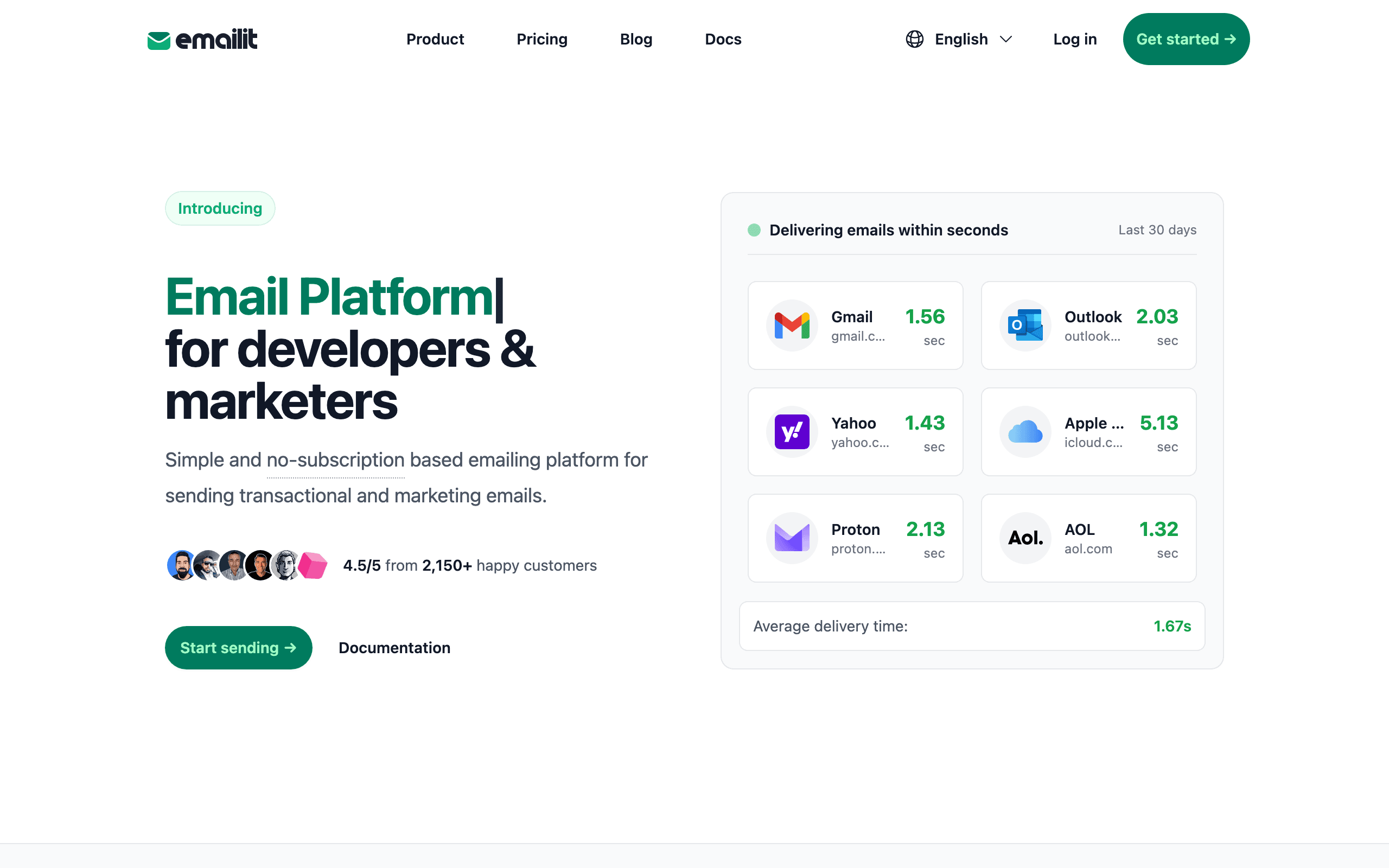
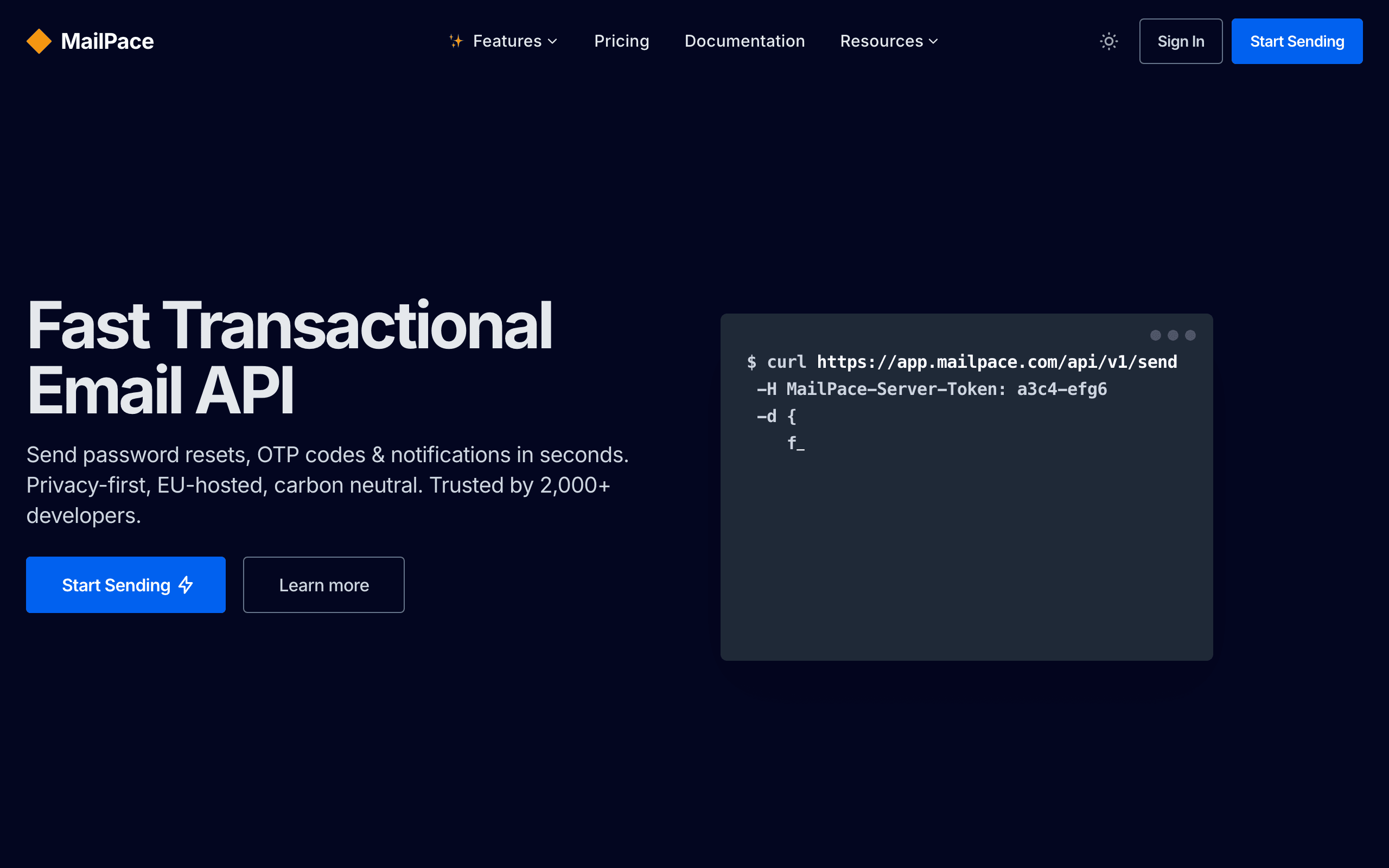
EmailIt and MailPace serve different needs in the email space. EmailIt is a budget pay-per-email delivery service. MailPace is a privacy-first EU-hosted transactional email API.
The choice depends on what you need: cheapest per-email pricing (EmailIt) or eu-only hosting (MailPace). For SaaS businesses specifically, Sequenzy offers purpose-built features that neither tool provides.
Pricing reality
- EmailIt: ~$1-2/10k emails - Pay-per-email, no subscription. SMTP and API.
- MailPace: $10/month - Transactional only. EU-hosted. Privacy-first.
- Sequenzy: $99/month for 120,000 emails, with yearly billing 10% off and a free tier of 2,500 emails to start. See pricing.
Review signals
The EmailIt reviews on this page support the lowest-cost path when privacy controls are not a buying requirement. One reviewer says password resets and notifications do not justify MailPace's privacy premium for their use case.
The negative EmailIt review shows the compliance limit: the team switched to MailPace when EU customers required data-residency guarantees that EmailIt could not confirm.
MailPace's reviews reinforce the privacy-first positioning. Reviewers cite EU hosting, no tracking by default, GDPR posture, and idempotent sending as practical advantages, while also acknowledging the small-team risk.
Where EmailIt Wins
Cheapest per-email pricing
EmailIt offers cheapest per-email pricing, which is a genuine advantage for teams that need it.
No monthly subscription
EmailIt offers no monthly subscription, which is a genuine advantage for teams that need it.
Simple SMTP/API
EmailIt offers simple smtp/api, which is a genuine advantage for teams that need it.
Fast delivery
EmailIt offers fast delivery, which is a genuine advantage for teams that need it.
Where MailPace Wins
EU-only hosting
MailPace offers eu-only hosting, which matters for teams that prioritize this.
Privacy-first design
MailPace offers privacy-first design, which matters for teams that prioritize this.
Idempotent sending
MailPace offers idempotent sending, which matters for teams that prioritize this.
Inbound email
MailPace offers inbound email, which matters for teams that prioritize this.
Delivery Speed and Reliability
EmailIt and MailPace both position themselves as straightforward transactional senders for receipts, password resets, and verification codes. EmailIt keeps things simple with pay-per-email pricing and no monthly subscription, while MailPace builds its whole approach around EU-only hosting and privacy-first defaults, including idempotent sending that guards against accidental duplicate messages during retries.
API Design and Developer Experience
MailPace ships clean, well-written developer documentation and a genuinely GDPR-compliant setup by design, not as an afterthought. EmailIt's documentation is thinner and its SDK support more limited, reflecting its focus on being the cheapest per-email option rather than the most polished developer experience. If documentation quality matters more than price, MailPace is the safer bet.
Scaling and Cost at Volume
EmailIt charges roughly $1 to $2 per 10,000 emails with no monthly subscription, which rewards bursty or low-volume senders who do not want a recurring bill. MailPace charges a flat $10 a month for its transactional plan regardless of exact volume. As your sending grows steadily each month, MailPace's flat fee becomes easier to predict, while EmailIt stays cheaper if your volume is irregular.
The Privacy-First Philosophy
MailPace takes a fundamentally different approach to email by defaulting to no tracking. Most email platforms automatically insert tracking pixels into every email to measure opens and click-through rates. MailPace does not track by default, respecting recipient privacy and simplifying your GDPR compliance posture.
For SaaS businesses serving privacy-conscious customers -- particularly in healthcare, finance, legal, or European markets -- this default matters. EmailIt does not offer configurable tracking controls because it sends whatever HTML you provide without modification. If you embed tracking pixels yourself, EmailIt sends them. If you do not, it does not. The difference is that MailPace has made privacy a core architectural decision rather than leaving it to the developer.
The idempotent sending feature is also noteworthy. MailPace's API prevents duplicate sends by recognizing repeated requests with the same idempotency key. This protects against the common scenario where a queue processor retries a failed job and accidentally sends the same email twice. EmailIt has no such protection -- duplicate prevention must be built into your application logic.
Two Small Companies Compared
Both EmailIt and MailPace are small, independent companies. This has advantages and risks. On the positive side, small teams are responsive, iterate quickly, and build focused products without corporate bloat. On the negative side, small teams have limited redundancy, and either company could face challenges that affect service continuity.
When evaluating small email providers, consider what happens if the service experiences downtime or the team faces capacity constraints. Larger platforms like SendGrid or Postmark have engineering teams that can respond to incidents around the clock. With EmailIt and MailPace, the response capacity is more limited.
For mission-critical transactional email -- password resets, two-factor authentication codes, payment confirmations -- the organizational risk of small providers is worth weighing against their cost and privacy advantages. For less time-sensitive communications like notifications and updates, the risk is more acceptable.
The SaaS Email Layer Neither Provides
Both EmailIt and MailPace solve the sending problem without addressing the automation layer that SaaS businesses need. Neither platform knows about your users' subscription status, trial period, payment history, or engagement patterns. Building lifecycle email automation requires custom code regardless of which sender you choose.
Sequenzy provides this lifecycle layer with native Stripe integration for billing-aware automation, AI sequences that generate onboarding and retention emails, and unified transactional plus marketing email at $49/month. For SaaS businesses, the automation layer matters more than the raw sending cost. See pricing for details.
Use-case matchups
| Use case | Better fit | Why |
|---|---|---|
| Lowest-cost simple transactional email | EmailIt | EmailIt is better when the team only needs basic API/SMTP sending and wants to minimize recurring cost. |
| EU-hosted privacy-first transactional email | MailPace | MailPace is stronger when EU data residency, no tracking by default, and GDPR posture are central requirements. |
| Duplicate-send protection | MailPace | MailPace's idempotent API is useful when queues retry failed jobs and duplicate transactional emails would be harmful. |
| Stack-agnostic SMTP relay | EmailIt | EmailIt is straightforward when existing applications already send through SMTP and privacy tooling is not the key need. |
| SaaS lifecycle automation | Sequenzy | Sequenzy is better when Stripe events, transactional email, and lifecycle campaigns need one SaaS-focused workspace. |
| Inbound email handling | MailPace | MailPace is the better first look when inbound processing is part of the transactional workflow. |
Best Fit by Cost, Privacy, and Duplicate-Send Risk
Best cheapest transactional email API for simple apps
Choose EmailIt when the app only needs simple SMTP/API sending and the buying constraint is raw cost. It is the better fit for password resets, receipts, alerts, and notifications where EU-only hosting, no-tracking defaults, inbound processing, and idempotency are not explicit requirements.
Best privacy-first transactional email service for EU customers
Choose MailPace when customers, contracts, or internal policy require EU hosting, minimal retention, privacy defaults, or stronger duplicate-send protection. It is a better fit for healthcare, finance, legal, and European SaaS workflows where compliance posture matters more than shaving a few dollars from sending costs.
Best SaaS email platform for lifecycle automation
Choose Sequenzy when the business needs more than raw transactional delivery. SaaS teams often need Stripe-triggered onboarding, lifecycle campaigns, product-event email, and subscriber segmentation together, which neither EmailIt nor MailPace provides as a managed marketing layer.
Migration checklist
- Export domains, sender identities, API keys, SMTP credentials, templates, suppressions, webhooks, bounce handling, and delivery logs before switching.
- If moving to MailPace, confirm EU data residency, retention, no-tracking defaults, idempotency keys, inbound routing, and any legal documentation required by customers.
- If moving to EmailIt, replace MailPace-specific idempotency, inbound handling, and privacy assumptions in application code or policy documents.
- Reconfigure SPF, DKIM, DMARC, return-path, sender addresses, and webhook destinations in the destination provider.
- Test password resets, verification codes, receipts, alerts, inbound flows if used, retry behavior, bounces, and suppression handling before cutover.
- Keep both providers active until latency, failure handling, and compliance evidence are validated.
Decision checklist
Are EU hosting and GDPR data-residency guarantees required by customers or compliance teams?
Does the team need privacy defaults like no tracking pixels by default?
Would duplicate-send protection through idempotency reduce real product risk?
Is EmailIt's lower cost worth more than MailPace's privacy and inbound tooling?
Would SaaS lifecycle automation and billing-aware email make Sequenzy a better fit?
Decide whether the destination should optimize for raw cost, EU privacy controls, or SaaS lifecycle automation.
Export verified domains, sender identities, SMTP/API keys, templates, webhooks, inbound routes, idempotency logic, suppression data, and delivery reports.
If moving to MailPace, define EU data residency requirements, tracking defaults, idempotency keys, inbound processing, and privacy documentation before switching traffic.
If moving to EmailIt, identify which MailPace privacy defaults, idempotency protection, inbound handling, and GDPR-oriented controls need replacement in application code.
Rebuild critical transactional templates first: verification, password reset, invite, receipt, invoice, billing, alert, and notification emails.
Reconnect API/SMTP calls, webhooks, inbound routes, bounce handling, complaint handling, alerts, monitoring, and suppression syncing.
Authenticate SPF, DKIM, and DMARC, then test duplicate-send handling and privacy behavior before moving all production traffic.
Preserve historical delivery, privacy, inbound, retry, bounce, complaint, and cost reports so the team can compare raw cost against privacy assurance.









