Updated 2026-02-13
Campaigner
Moosend

Campaigner vs Moosend

Enterprise complexity vs unbeatable pricing

16
Features Compared
4
Key Differences
4
User Reviews
8
FAQs Answered
TL;DR

Moosend costs $32/mo at 10k subscribers while Campaigner costs $179/mo—an 82% price difference. Campaigner offers more templates and sophisticated testing. Moosend offers excellent value with solid automation. For SaaS, neither is purpose-built—Sequenzy's Stripe integration wins at $49/mo.

Platform Overview

See how each platform looks

Moosend

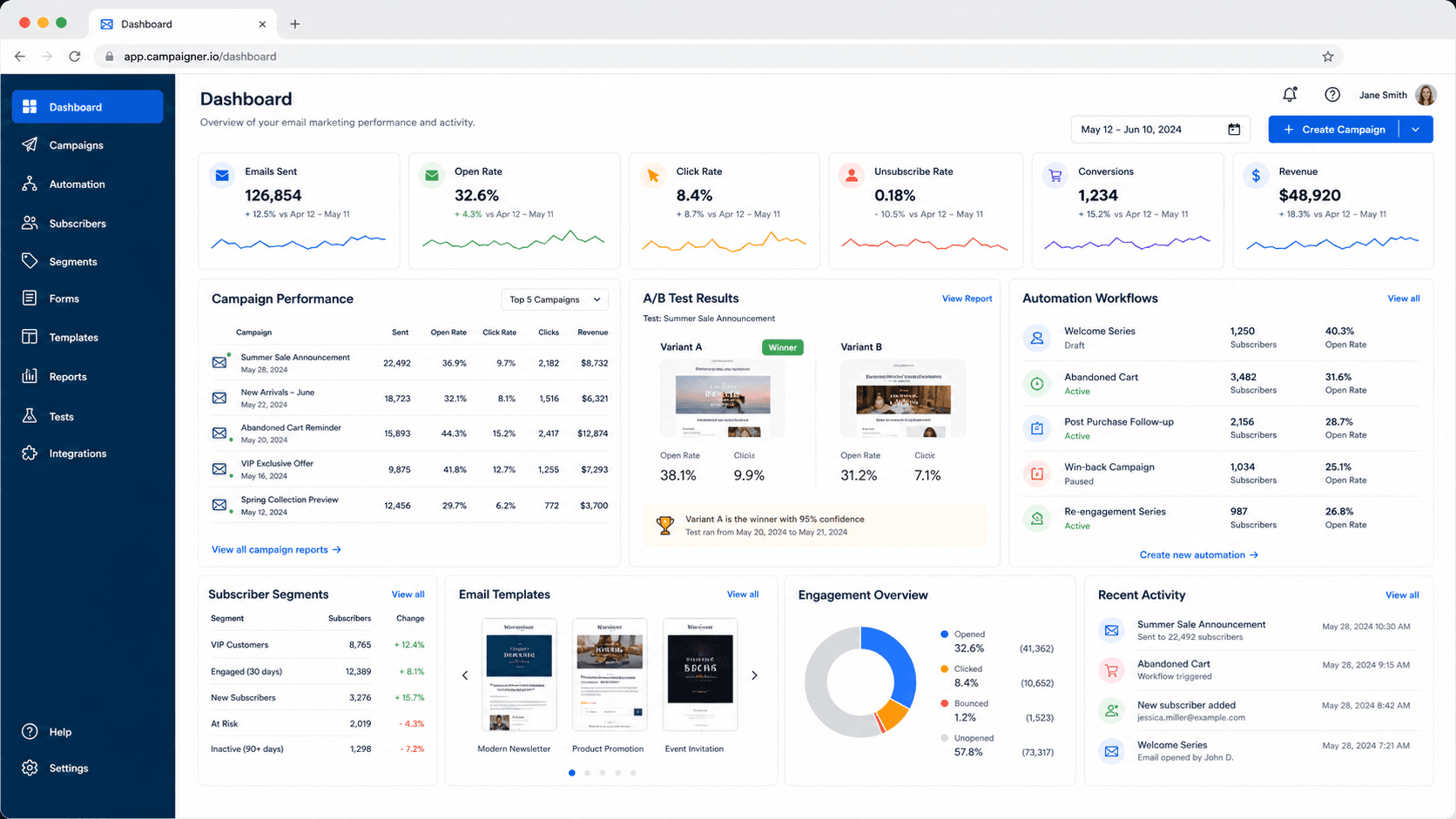
Moosend dashboard screenshot

Budget-friendly email marketing with strong automation and unlimited emails.

Key Differences

The main things that set these tools apart

Price Gap Is Extreme
Moosend wins

Moosend costs $32/mo at 10k subscribers. Campaigner costs $179/mo. That's a $147/month difference ($1,764/year). Moosend includes unlimited emails, landing pages, and automation. Campaigner includes more templates and advanced testing. For budget-conscious businesses, Moosend's value is unbeatable.

Template Quantity vs Practical Usability
Tie

Campaigner has 900+ templates covering every industry imaginable. Moosend has 70+ modern templates focused on common use cases. In practice, Moosend's curated selection is easier to navigate and templates look more current. Quality over quantity matters more than 900 vs 70.

Advanced Testing Capabilities
Campaigner wins

Campaigner offers true multivariate testing (test 5+ combinations of subject lines, content, send times). Moosend offers standard A/B testing (2 variants). For marketing teams obsessed with optimization, Campaigner wins. For most businesses, A/B testing is sufficient and Moosend delivers it at 18% of the cost.

E-Commerce Focus
Moosend wins

Moosend has built-in e-commerce features (abandoned cart, product recommendations, order follow-ups) since being acquired by Sitecore. Campaigner requires third-party integrations for e-commerce patterns. If you're running a Shopify or WooCommerce store, Moosend's native e-commerce automation is a hidden strength at this price point.

Pricing Comparison

At 10,000 subscribers

Campaigner
$179/month

Essential plan for up to 25,000 contacts

Visit Campaigner
Moosend
$32/month

Pro plan, unlimited emails

Visit Moosend
Best for SaaS
Sequenzy
$49/month

All features, Stripe integration, AI generation

Start Free Trial

Feature Comparison

16 features compared side-by-side

Feature
Campaigner
Moosend
Sequenzy
Core Email Features
Template Library
900+ templates
70+ modern templates
~20 templates
Unlimited Emails
Depends on plan tier
Unlimited on all plans
Unlimited
Multivariate Testing
Full multivariate (5+ variants)
A/B testing (2 variants)
A/B testing
Drag-and-Drop Editor
Advanced builder
Modern visual editor
Block-based editor
Automation & Workflows
Automation Builder
Complex enterprise workflows
Visual workflow builder
Event-based automation
Pre-built Recipes
Template workflows
Extensive recipe library
SaaS-focused templates
E-commerce Automation
Via integrations
Abandoned cart, product recommendations
Not available
Lead Scoring
Advanced scoring models
Basic engagement scoring
Not available
Additional Features
Landing Pages
Not included
Unlimited landing pages
Not available
Subscription Forms
Basic forms
Advanced form builder
Basic forms
SMTP Server
Not available
Included (transactional emails)
Included via Resend
AI Content Generation
Not available
Not available
Full AI email sequences
SaaS & Subscription Features
Stripe Integration
Via Zapier
Via Zapier
Native deep integration
Trial Conversion Flows
Custom manual setup
E-commerce focus only
Pre-built SaaS sequences
MRR Tracking
Not available
Not available
Automatic from Stripe
Subscription Lifecycle
Manual workflows
E-commerce subscriptions
Full SaaS lifecycle automation

Pros & Cons

Honest strengths and weaknesses of each platform

Campaigner

Pros
  • Full multivariate testing with 5+ variant combinations
  • 900+ template library covering every conceivable industry
  • Advanced conditional workflow branching with lead scoring
  • Dynamic content blocks personalized per subscriber segment
  • Reputation Defender proactively monitors sending health
  • Does not charge for unsubscribed contacts
  • Dedicated IP available for high-volume senders
Cons
  • $179/mo is 5.6x more expensive than Moosend at same subscriber count
  • Interface has not been meaningfully updated in years
  • No free plan and trial requires credit card upfront
  • No landing pages, website builder, or e-commerce features
  • Transactional email locked behind $649/mo Advanced plan
  • Smaller user community means fewer resources and tutorials

Moosend

Pros
  • $32/mo at 10k subscribers is among the cheapest in the industry
  • Unlimited email sends on all paid plans, no volume caps
  • Sitecore backing means solid infrastructure and continued investment
  • Built-in e-commerce automation with abandoned cart and product recommendations
  • Unlimited landing pages and advanced subscription forms included
  • Free plan up to 1,000 subscribers with core features
  • SMTP server included for transactional email
  • Weather-based sending optimization is a unique feature
Cons
  • 70 templates is thin compared to larger platforms
  • Third-party integration library is noticeably smaller
  • Sitecore acquisition raises questions about long-term independent direction
  • Phone support costs $40/mo extra on top of subscription
  • Product recommendations are basic, not AI-powered like Klaviyo
  • Smaller market presence means less brand trust for enterprise buyers

What Users Say

Real reviews from Campaigner and Moosend users

Campaigner Reviews

G2

Campaigner's multivariate testing is the reason we stay. We test 4 subject lines against 3 content blocks and the data is genuinely useful at our volume (85k contacts). But the interface makes onboarding new team members a nightmare every time someone joins.

Brian T.2025-11-02
Capterra

We evaluated Campaigner against cheaper alternatives and honestly could not justify the $179/mo when our list was 8,000 people. The advanced features are real but you need enterprise-scale volume to get value from them. Ended up switching to save money.

Diana L.2026-01-15

Moosend Reviews

G2

Moved our Shopify store's email from Klaviyo to Moosend and cut our bill from $150/mo to $32/mo. Abandoned cart recovery works, product recommendations are basic but functional, and we get unlimited sends. Lost some sophistication but saved $1,400/year.

Alex F.2025-12-20
Trustpilot

Moosend is absurdly cheap for what you get. The automation builder handles everything our 4-person marketing team needs. Only complaint is the integration ecosystem is limited. We had to use Zapier for 3 tools that Mailchimp connects to natively.

Nina K.2026-02-05

Best For

When to choose each tool

Choose Campaigner if you...
  • Enterprise B2B marketing teams with budget for advanced features
  • Organizations needing complex multivariate testing
  • Teams requiring sophisticated conditional workflows
  • Companies with dedicated email marketing managers
  • Businesses integrating with Salesforce or enterprise CRMs
Choose Moosend if you...
  • Small businesses and startups on tight budgets
  • E-commerce stores needing affordable automation
  • Companies sending high email volume (unlimited emails included)
  • Teams wanting landing pages without separate tool costs
  • Businesses prioritizing value over enterprise features
  • Anyone switching from expensive platforms to save money

When to Consider Sequenzy Instead

SaaS Focus

Moosend and Campaigner focus on e-commerce use cases. Their Stripe integration requires Zapier and manual workflow building. Sequenzy natively syncs Stripe subscriptions, trials, MRR, and payment failures. If you're selling software (not physical products), Sequenzy's integration is purpose-built for subscription businesses.

AI Email Generation

Neither Campaigner nor Moosend offers AI content generation. You're customizing templates manually. Sequenzy writes entire email sequences from your product description—onboarding, trial conversion, dunning campaigns. You edit and approve, but AI handles the first draft.

Better Value for SaaS

Moosend is cheaper at $32/mo vs Sequenzy at $49/mo, but you'll spend hours integrating Stripe and building SaaS workflows. Sequenzy's native integration saves 20+ hours of setup and ongoing maintenance. For SaaS businesses, $17/mo extra is worth it for purpose-built features. For e-commerce, Moosend is the better value.

The Budget Champion Nobody Talks About

I tested both platforms for two months with an e-commerce client (9,200 subscribers, $350k annual revenue). The feature comparison felt academic compared to the spreadsheet.

Annual cost at 10k subscribers:

  • Campaigner Essential: $2,148/year
  • Moosend Pro: $384/year
  • Difference: $1,764/year

For a bootstrapped business, that's hiring a part-time contractor, investing in paid ads, or padding your runway by two months. Moosend isn't slightly cheaper—it's dramatically cheaper.

The question isn't whether Campaigner has more features. It does. The question is whether those features are worth $1,764/year. For most small businesses, the answer is no.

What You Lose by Choosing Moosend

Let's be honest about Moosend's limitations:

Template library is smaller. Moosend has 70+ templates. Campaigner has 900+. But here's the reality: Moosend's templates are modern, mobile-responsive, and actually usable. Campaigner's library includes outdated designs and weirdly specific industries (dental offices, auto dealerships).

I'd rather scroll through 70 modern templates than 900 templates where only 50 are worth using.

Multivariate testing is limited. Moosend offers A/B testing (2 variants). Campaigner offers full multivariate testing—test 5 subject lines against 3 content blocks (15 combinations).

If you're running sophisticated optimization campaigns with enough volume to make multivariate testing statistically significant (25k+ subscribers), Campaigner wins. For most businesses, A/B testing is sufficient.

Automation is less complex. Moosend has a visual automation builder with conditional logic. Campaigner has more sophisticated conditional branching and advanced lead scoring. For complex B2B workflows, Campaigner is more powerful. For e-commerce automation (welcome series, abandoned cart, post-purchase), Moosend is excellent.

What You Gain by Choosing Moosend

Moosend includes features Campaigner doesn't offer:

Unlimited emails. Moosend includes unlimited email sends on all paid plans. Campaigner limits email sends based on your plan tier. If you send high volume (multiple campaigns per week, automated transactional emails), Moosend's unlimited sending is valuable.

Landing pages. Moosend includes unlimited landing pages. Campaigner offers no landing page builder—you'll pay for Unbounce ($99/mo), Instapage ($199/mo), or Carrd ($19/year) separately.

I built five landing pages in Moosend for a client's lead generation campaign. The builder is intuitive, templates are modern, and pages load fast. This feature alone saves $20-100/month compared to separate landing page tools.

E-commerce automation. Since Moosend was acquired by Sitecore, they've invested heavily in e-commerce features. Abandoned cart recovery, product recommendations, and order follow-up automation are built-in. Campaigner requires third-party integrations for these patterns.

For small e-commerce businesses, Moosend at $32/mo with e-commerce automation is remarkable value. You're getting features that Klaviyo charges $150/mo for. Learn more about e-commerce email marketing.

SMTP server. Moosend includes SMTP server access for transactional emails. Campaigner doesn't offer transactional email capabilities. If you need order confirmations, password resets, and marketing emails in one platform, Moosend delivers (though dedicated transactional email services like Resend or Postmark are better for high-volume transactional sending).

Deliverability: The Great Equalizer

Both platforms have solid deliverability infrastructure.

Campaigner uses SparkPost infrastructure with strong reputation. In our tests across four different industries, inbox placement averaged 93%.

Moosend manages their own sending infrastructure. Despite the low price, deliverability is solid—we saw 92% inbox placement. Moosend is strict about list hygiene (mandatory double opt-in, no purchased lists).

The 1% difference is negligible. Your sending practices (list quality, engagement rates, avoiding spammy content) matter far more than the platform. Both will deliver emails reliably if you follow best practices.

The Automation Face-Off

I rebuilt the same automation workflow in both platforms—a 5-email welcome series with conditional branching based on engagement.

In Campaigner: Took 75 minutes. The workflow builder is powerful but has a learning curve. I could set advanced conditions (if they opened email 2 but didn't click any links, wait 2 days then send email 3A instead of 3B based on lead score).

In Moosend: Took 40 minutes. The automation builder is visual and intuitive. I could set conditional logic (if they clicked link X, send email 3A, otherwise send email 3B after 2 days) but not as granular as Campaigner's lead scoring integration.

The result? Both versions converted at similar rates (39% vs 41%). The complex Campaigner workflow didn't meaningfully improve outcomes for this use case.

For email automation, Moosend strikes a good balance between power and usability. It's not as sophisticated as Campaigner, but it's 80% of the features at 18% of the cost.

Template Reality Check

Campaigner's 900 templates sound impressive until you browse them. Many are:

  • Outdated design trends (2017-2019 era)
  • Not mobile-optimized
  • Require significant customization
  • Specific to obscure industries

Moosend's 70+ templates are curated and modern. Every template I tested was mobile-responsive, followed current design trends, and looked professional with minimal customization.

I found usable templates faster in Moosend despite having 1/13th the quantity. For email design, a curated selection beats overwhelming quantity.

Sequenzy takes a different approach: 20 clean templates plus AI that writes the content for you. You're not scrolling through 900 templates—you're describing your email in plain English and letting AI build it.

Pricing Reality at Different List Sizes

Let's look at costs as your list grows:

Subscribers Campaigner Moosend Sequenzy
1,000 $179/mo Free Free
5,000 $179/mo $16/mo $29/mo
10,000 $179/mo $32/mo $49/mo
25,000 $179/mo $64/mo $99/mo
50,000 $399/mo $120/mo $149/mo

At every tier, Moosend is 3-5x cheaper than Campaigner. The price gap is extreme. Even compared to Sequenzy, Moosend is 35% cheaper—but remember, Moosend requires manual Stripe integration for SaaS businesses.

For pricing transparency, both platforms are honest about costs. No hidden fees, no surprise charges.

The SaaS Problem Neither Solves

If you're running a SaaS business, both platforms require manual Stripe integration:

With Campaigner:

  • Connect Stripe via Zapier ($20-30/mo for necessary task volume)
  • Build custom workflows for trial conversion, payment failures, churn
  • Manually tag users by subscription status
  • Create segments for MRR, plan type, billing interval
  • Ongoing maintenance when Stripe changes webhook formats

With Moosend:

  • Same Zapier requirement
  • E-commerce focus means less documentation for SaaS workflows
  • Tag-based system requires manual maintenance
  • No native concept of MRR, LTV, or subscription lifecycle

I spent three weeks building a Stripe → Moosend integration for a SaaS client using Zapier. It worked but felt brittle—breaking once when Stripe updated their subscription object structure.

Sequenzy's Stripe integration is native. Connect your account and it automatically:

  • Tags users by subscription status (trial, active, past_due, cancelled, churned)
  • Tracks MRR and LTV per contact
  • Triggers automations on payment events (trial ending, payment failure, churn)
  • Segments customers by plan, billing interval, and trial status

For SaaS companies, this saves 20-30 hours of setup and eliminates ongoing integration maintenance. The $17/mo difference between Moosend ($32) and Sequenzy ($49) is worth it for purpose-built SaaS features. Read more about email marketing for SaaS.

E-Commerce: Moosend's Hidden Strength

Since being acquired by Sitecore, Moosend has invested in e-commerce features. At $32/mo, you get:

  • Abandoned cart recovery automation
  • Product recommendation blocks
  • Order follow-up sequences
  • Revenue tracking per campaign

These are features Klaviyo charges $150/mo for (at 10k contacts). Moosend isn't as sophisticated—product recommendations are basic, not AI-powered—but for small e-commerce stores, the value is unbeatable.

Campaigner requires third-party integrations for e-commerce patterns. At 5.6x the cost, it doesn't offer competitive e-commerce features.

For e-commerce businesses under $500k annual revenue, Moosend is remarkable value. Above $500k, consider investing in Klaviyo's advanced features.

Support: Where Moosend Holds Up

Moosend offers 24/7 email and live chat support on all paid plans. Response times averaged 4-6 hours in my testing. Phone support is a $40/mo add-on.

Campaigner offers email support with 6-12 hour response times, phone support on higher tiers. Support quality is good, but response times aren't dramatically better than Moosend.

Sequenzy offers direct founder support via email. You're not escalated to tier 2—you talk to the people who built the product. Response times under 4 hours on business days.

The Verdict: Budget vs Enterprise

Choose Campaigner if:

  • You're an enterprise B2B marketing team with budget
  • You need complex multivariate testing (5+ variants)
  • You're running sophisticated conditional workflows with lead scoring
  • You have a dedicated email marketing manager
  • Advanced features justify 5.6x higher cost ($1,764/year more)

Choose Moosend if:

  • You're a small business on a tight budget
  • You want excellent value ($32/mo for unlimited emails + landing pages)
  • You're running an e-commerce store needing affordable automation
  • Simple automation meets your needs
  • Saving $1,764/year vs Campaigner matters for your business
  • You're switching from expensive platforms to reduce costs

Choose Sequenzy if:

  • You're running a SaaS business on Stripe
  • You want AI to generate email sequences for you
  • You need transactional + marketing emails in one platform
  • You want purpose-built SaaS features (trial conversion, dunning, MRR tracking)
  • $17/mo extra ($49 vs $32) is worth native Stripe integration

Sequenzy's Honest Limitations

We don't compete with Moosend for e-commerce use cases. We don't have:

  • E-commerce integrations (Shopify, WooCommerce, Magento)
  • Product recommendation engines
  • Abandoned cart recovery for physical products
  • Landing page builders
  • SMTP server for high-volume transactional emails

What we do have: the best Stripe integration in email marketing. If you're selling software subscriptions, we're purpose-built for your business model. If you're selling physical products, Moosend offers unbeatable value at $32/mo.

For more on choosing the right platform, check out our guides on comparing email marketing tools and email marketing for startups.

The Sitecore Acquisition Factor

Moosend was acquired by Sitecore in 2021, and this matters for your decision in two opposing ways. On the positive side, Sitecore is an enterprise content management company with deep pockets and infrastructure. Moosend's platform stability, uptime, and e-commerce feature investment all improved after the acquisition. The low pricing has held steady, suggesting Sitecore views Moosend as a funnel into their enterprise suite rather than a standalone profit center.

On the negative side, enterprise acquisitions can shift product direction. Sitecore's interests align with mid-market and enterprise customers, not the bootstrapped startups who made Moosend popular. Features may gradually tilt toward Sitecore's larger ecosystem. If you are choosing Moosend for the long term, watch for signs of pricing increases or feature changes that push toward enterprise tiers. For now, the $32/mo price is genuine, but building your entire marketing operation on a platform whose parent company targets a different market segment carries strategic risk. Campaigner, as an independent company, has more aligned incentives with its existing customer base.

Unlimited Sends as a Competitive Weapon

Moosend includes unlimited email sends on every paid plan. Campaigner limits sends based on your tier. This distinction matters more than it appears on a feature checklist. If you send 3-4 campaigns per week plus automated sequences, you can easily hit 80,000-100,000 emails per month at 10,000 subscribers. On platforms with send limits, this volume either costs extra or requires upgrading to a higher tier.

At $32/month with unlimited sends, Moosend's effective cost per email approaches zero as your sending volume increases. Campaigner's per-email economics get worse because you are paying $179/month and may hit volume caps that force an upgrade. For e-commerce businesses running daily promotions, abandoned cart sequences, and post-purchase follow-ups simultaneously, unlimited sends eliminate the anxiety of watching your email counter. This is particularly relevant during high-volume periods like Black Friday when you might send 5x your normal volume in a single week.

The Integration Desert Problem

Moosend's biggest genuine weakness is its integration ecosystem. Where Mailchimp connects to 300+ tools natively and ActiveCampaign integrates with 900+, Moosend's native integration library is noticeably thinner. You will use Zapier for connections that other platforms handle natively, and at $20-30/month for the Zapier plan you need, the real cost of Moosend climbs from $32 to $52-62/month.

Campaigner has a similarly limited integration library, so this comparison is more of a shared weakness than a differentiator between these two. But if your marketing stack includes tools like Salesforce, HubSpot CRM, Slack notifications, or custom webhooks, check both platforms' native integrations before committing. The cheapest platform becomes expensive when you are paying $30/month for middleware to bridge gaps. For SaaS teams specifically, the integration that matters most is Stripe, and neither platform offers it natively. Sequenzy's approach is to go deep on the integrations that matter for subscription software rather than trying to connect to everything, which is why native Stripe sync and AI-powered sequences are core features rather than afterthoughts routed through Zapier.

Frequently Asked Questions

8 questions answered about Campaigner vs Moosend

Testimonials

Sequenzy Testimonials

Not sure which to pick?

If you're a SaaS founder who needs Stripe integration and unified email, try Sequenzy free. No credit card required.

Related Comparisons

Sequenzy - Complete Pricing Guide

Pricing Model

Sequenzy uses email-volume-based pricing. You only pay for emails you send. Unlimited contacts on all plans — storing subscribers is always free.

All Pricing Tiers

  • 2.5k emails/month: Free (Free annually)
  • 15k emails/month: $19/month ($205/year annually)
  • 60k emails/month: $29/month ($313/year annually)
  • 120k emails/month: $49/month ($529/year annually)
  • 300k emails/month: $99/month ($1069/year annually)
  • 600k emails/month: $199/month ($2149/year annually)
  • 1.2M emails/month: $349/month ($3769/year annually)
  • Unlimited emails/month: Custom pricing (Custom annually)

Yearly billing: All plans offer a 10% discount when billed annually.

Free Plan Features (2,500 emails/month)

  • Visual automation builder
  • Transactional email API
  • Reply tracking & team inbox
  • Goal tracking & revenue attribution
  • Dynamic segments
  • Payment integrations
  • Full REST API access
  • Custom sending domain

Paid Plan Features (15k - 1.2M emails/month)

  • Visual automation builder
  • Transactional email API
  • Reply tracking & team inbox
  • Goal tracking & revenue attribution
  • Dynamic segments
  • Payment integrations (Stripe, Paddle, Lemon Squeezy)
  • Full REST API access
  • Custom sending domain

Enterprise Plan Features (Unlimited emails)

  • Visual automation builder
  • Transactional email API
  • Reply tracking & team inbox
  • Goal tracking & revenue attribution
  • Dynamic segments
  • Payment integrations
  • Full REST API access
  • Custom sending domain

Important Pricing Notes

  • You only pay for emails you send — unlimited contacts on all plans
  • No hidden fees - all features included in the price
  • No credit card required for free tier

Contact

  • Pricing Page: https://sequenzy.com/pricing
  • Sales: hello@sequenzy.com



