
21 Best Email Tools With Neon Database Integration (2026)

Neon is the serverless Postgres database that's becoming standard for modern SaaS applications. It branches like Git, scales to zero, and integrates with the frameworks developers already use (Next.js, Vercel, Cloudflare Workers). But like any database, Neon doesn't handle email. You need to connect it to an email platform.
The integration pattern for Neon is straightforward: when data changes in your Neon database (new user, subscription update, usage threshold crossed), trigger an email via your application code or a background job. If you are evaluating email platforms for your SaaS more broadly, our guide on choosing an email platform for SaaS covers the full set of criteria worth considering.
Best Neon Email Tool by Use Case
Best Neon email tool for SaaS lifecycle automation: Sequenzy
Choose Sequenzy when Neon stores product events and your email tool needs to turn those events into onboarding, activation, trial, dunning, or retention sequences. Your app can write to Neon, enqueue a job, and trigger Sequenzy events from the same code path. Pair transactional email, AI sequences, and the automate onboarding guide for a clean SaaS flow.
Best Neon email tool for Next.js transactional email: Resend
Resend is the strongest fit when your Neon app is a Next.js or Vercel project and you mainly need transactional email with a clean TypeScript SDK. It pairs especially well with React Email. If marketing automation is not part of the requirement, read the Resend comparison and React Email support guide.
Best Neon email tool for critical transactional delivery: Postmark
Postmark is the better choice when Neon-backed product flows send password resets, receipts, account invitations, and security notifications where delivery speed is the priority. It will not manage lifecycle marketing for you, but it is excellent at transactional delivery. Compare the Postmark page and transactional email templates if that is your use case.
Best Neon email tool for complex product-event journeys: Customer.io
Customer.io makes sense when Neon-backed events need advanced branching, cohort logic, and product-led messaging at scale. It costs more and needs a cleaner event model, but it is powerful for mature product teams. Use the Customer.io comparison and event-based automation tools list for that decision.
How Neon + Email Works
Neon is a Postgres database, so the integration patterns are the same as any Postgres-backed application:
- Application-level triggers: Your app code calls the email API after database operations
- Background jobs: A job queue (like BullMQ, Inngest, or Trigger.dev) processes database events and sends emails
- Database triggers + listeners: Postgres NOTIFY/LISTEN or logical replication for real-time event streaming
- Serverless functions: API routes or serverless functions (Vercel, Cloudflare Workers) that handle both the database write and the email API call
Most Neon-based apps use the first approach: after writing to the database, call the email tool's API.
Why Neon Integration Is Different From Supabase or Firebase
Unlike Supabase (which offers built-in database webhooks and Edge Functions) or Firebase (which offers Cloud Functions and Extensions), Neon is a pure database. It does not have a built-in serverless function runtime or webhook system. This means email integration always happens at the application level, not the database level.
This is not a disadvantage. Application-level integration gives you full control over when and how email events are triggered. You decide exactly which database operations should generate emails, what data to include, and how to handle errors. There is no abstraction layer between your code and your email tool.
Common Neon Email Integration Patterns
Pattern 1: Inline API Call After Database Write
The simplest pattern. After inserting or updating a row in Neon, call your email tool's API in the same request handler. This works well for low-volume, latency-tolerant use cases.
POST /api/signup -> Insert user into Neon -> Call email API (add subscriber + trigger welcome) -> Return response
The downside is that the email API call adds latency to your response. If the email API is slow or times out, your user's request is affected.
Pattern 2: Background Job Queue
After writing to Neon, enqueue a job that handles the email API call asynchronously. The response returns immediately, and the job processes in the background. This is the recommended pattern for production applications.
Common job queue options for Neon-based apps include BullMQ (Redis-backed), Inngest (serverless-friendly), and Trigger.dev (developer-focused). All of them work well with Neon because the job contains the data needed to call the email API, with no database dependency in the job worker itself.
Pattern 3: Postgres NOTIFY/LISTEN
Neon supports Postgres NOTIFY/LISTEN, which lets you broadcast events from database triggers. A listener process receives the notification and calls the email API. This pattern is more complex to set up but decouples the email trigger from your application code.
The caveat with Neon is that NOTIFY/LISTEN requires a persistent connection, which may not align with Neon's serverless connection model (connection pooling via the Neon proxy). For serverless applications, the background job pattern is more reliable.
Pattern 4: Webhook from Application Framework
If you are using a framework like Next.js with API routes, you can treat your own API routes as webhook endpoints. After a database write, fire an internal webhook to a separate API route that handles the email logic. This keeps your primary request handler clean and separates concerns.
Quick Comparison
| Tool | Best For | Starting Price | Free Tier | Integration Type |
|---|---|---|---|---|
| Sequenzy | SaaS lifecycle email with event tracking | $19/mo | No | Event API from application |
| Resend | Next.js + Neon developers | $20/mo | Yes (100/day) | SDK in application code |
| Loops | Simple event-driven email | $49/mo | Yes (1k contacts) | Event API from application |
| Postmark | Transactional email speed | $15/mo | No | SDK in application code |
| Customer.io | Complex email systems | $100/mo | No | Event API from application |
| Brevo | Budget-conscious Neon projects | $9/mo | Yes (300/day) | SDK in application code |
| SendGrid | High-volume transactional | $20/mo | Yes (100/day) | SDK in application code |
| Mailgun | Flexible transactional API | $15/mo | No | SDK in application code |
| Amazon SES | Cost-sensitive teams on AWS | $0.10/1k | No | SDK in application code |
| Mailchimp | Marketing email layered on Neon | $13/mo | Yes (500 contacts) | API from application code |
| ConvertKit (Kit) | Creator-style SaaS | $29/mo | Yes (10k subs) | API from application code |
| ActiveCampaign | Sales-led SaaS with CRM | $29/mo | No | API from application code |
| MailerLite | Solo founders | $10/mo | Yes (1k subs) | API from application code |
| Beehiiv | Newsletter-led products | $39/mo | Yes (2.5k subs) | API from application code |
| HubSpot | Companies on HubSpot CRM | $20/mo | Yes (CRM) | API from application code |
| Klaviyo | Hybrid e-commerce + Neon | $45/mo | Yes (250 contacts) | API from application code |
| Encharge | Non-technical teams | $79/mo | No | API from application code |
| Userlist | B2B SaaS account-level data | $149/mo | No | API from application code |
| Vero | Event-based messaging | $99/mo | No | Events API from application |
| Bento | Indie SaaS events + email | $30/mo | No | API from application code |
| Iterable | Enterprise SaaS lifecycle | $500+/mo | No | Events via warehouse or API |
The 21 Best Options
1. Sequenzy
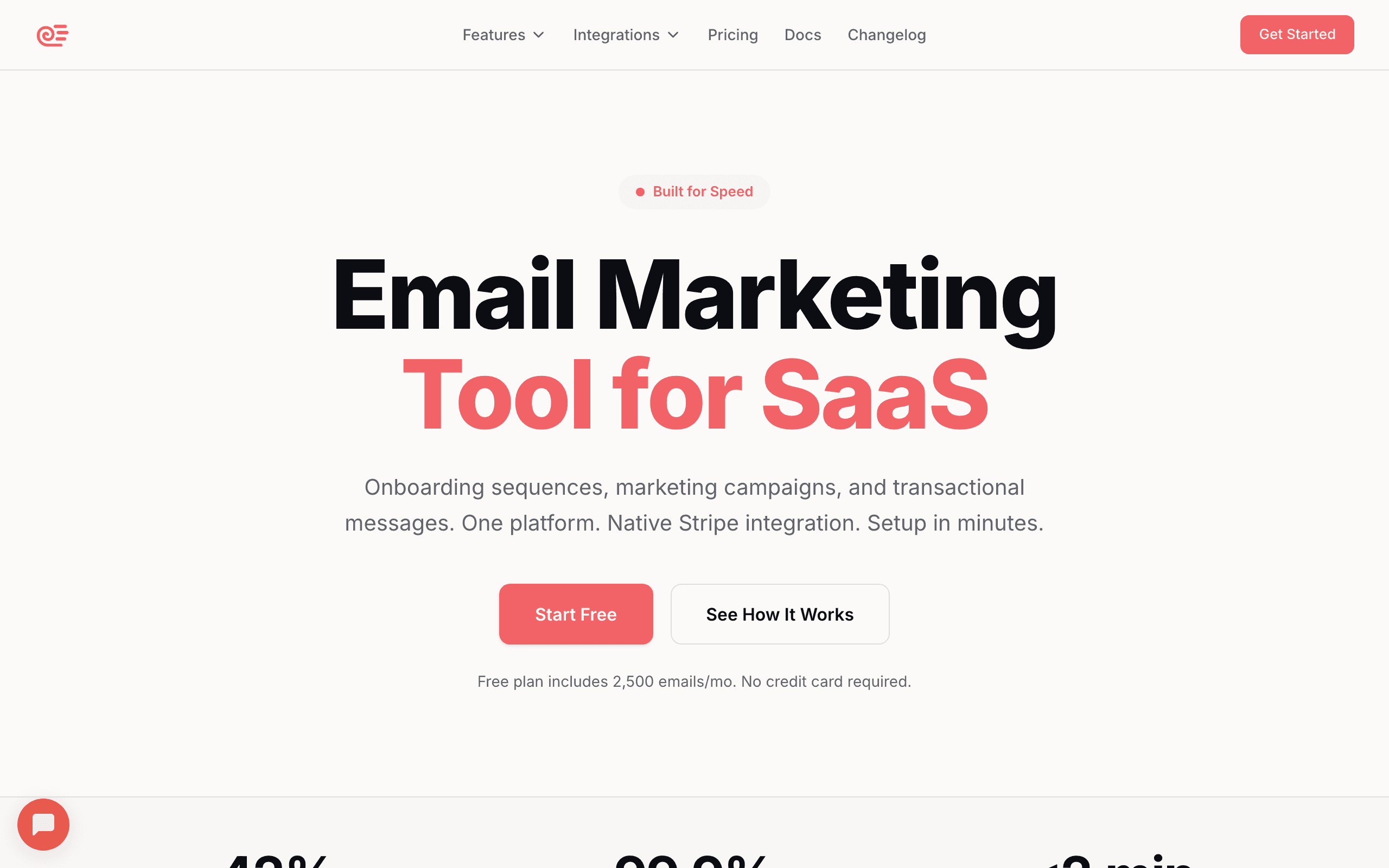
Best for: SaaS on Neon wanting lifecycle email with event tracking
Sequenzy's event API accepts events from your Neon-backed application. When a user signs up, completes a task, or hits a milestone (all stored in Neon), send an event to Sequenzy and trigger automated sequences.
The event-driven model is a natural fit for Neon-based SaaS. Your application already knows when significant events happen (it just wrote them to the database). Forwarding those events to Sequenzy is a single API call that triggers the right automated email sequence based on the event type.
Sequenzy's strength for Neon-based SaaS is the lifecycle focus. Onboarding sequences, trial conversion emails, dunning flows, upgrade nudges, and re-engagement campaigns all map to events that your application generates. The Stripe integration adds payment events (subscription created, payment failed, plan upgraded) alongside your product events from Neon.
For teams using Next.js with Neon (a very common stack), the integration is straightforward. Call Sequenzy's API from your API routes or server actions after writing to Neon. For background processing, enqueue a job that handles the Sequenzy API call asynchronously.
- Key Strength: AI integration
- Pricing: Free up to 2,500 emails/month, paid plans from $19/month
- Integration: Event tracking API from your application
- Pros: Lifecycle automation, AI sequences, transactional + marketing, Stripe integration, SaaS-focused
- Cons: No database-level integration (application code required)
2. Resend
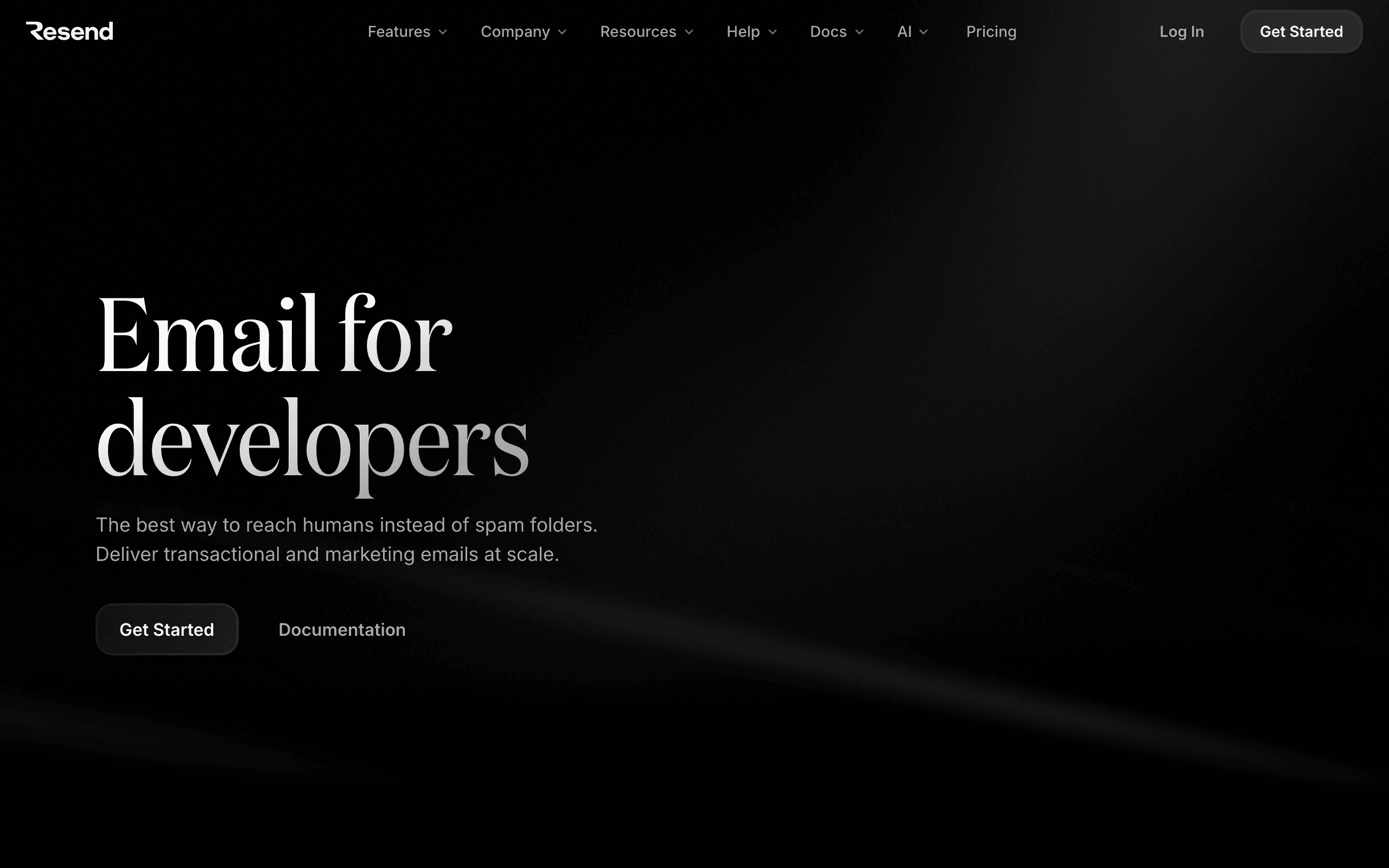
Best for: Next.js + Neon developers wanting the cleanest DX
Resend is the natural email companion for Neon-powered apps. Both target the same modern stack: Next.js, Vercel, TypeScript. The Resend SDK integrates cleanly into API routes or server actions that also write to Neon.
The developer experience is where Resend excels. The SDK is TypeScript-first with excellent types. The API surface is minimal and predictable. React Email lets you build templates as React components in the same codebase as your Next.js app. For teams that value clean code and modern tooling, Resend fits the Neon ecosystem perfectly.
A typical integration looks like this: your Next.js API route validates the request, writes to Neon, renders a React Email template, and sends it through Resend. All in one file, all in TypeScript, all type-safe. The simplicity is the selling point.
The limitation is automation depth. Resend handles sending beautifully but does not offer the lifecycle automation, segmentation, and behavioral triggers that a full marketing platform provides. For transactional emails and simple sequences, Resend is ideal. For complex lifecycle automation, you will want something more full-featured.
- Pricing: Free for 100 emails/day, from $20/month
- Integration: SDK in your application code
- Pros: Best DX for modern stacks, React Email, TypeScript-first, Vercel-friendly
- Cons: Marketing features still maturing, limited automation depth
3. Loops
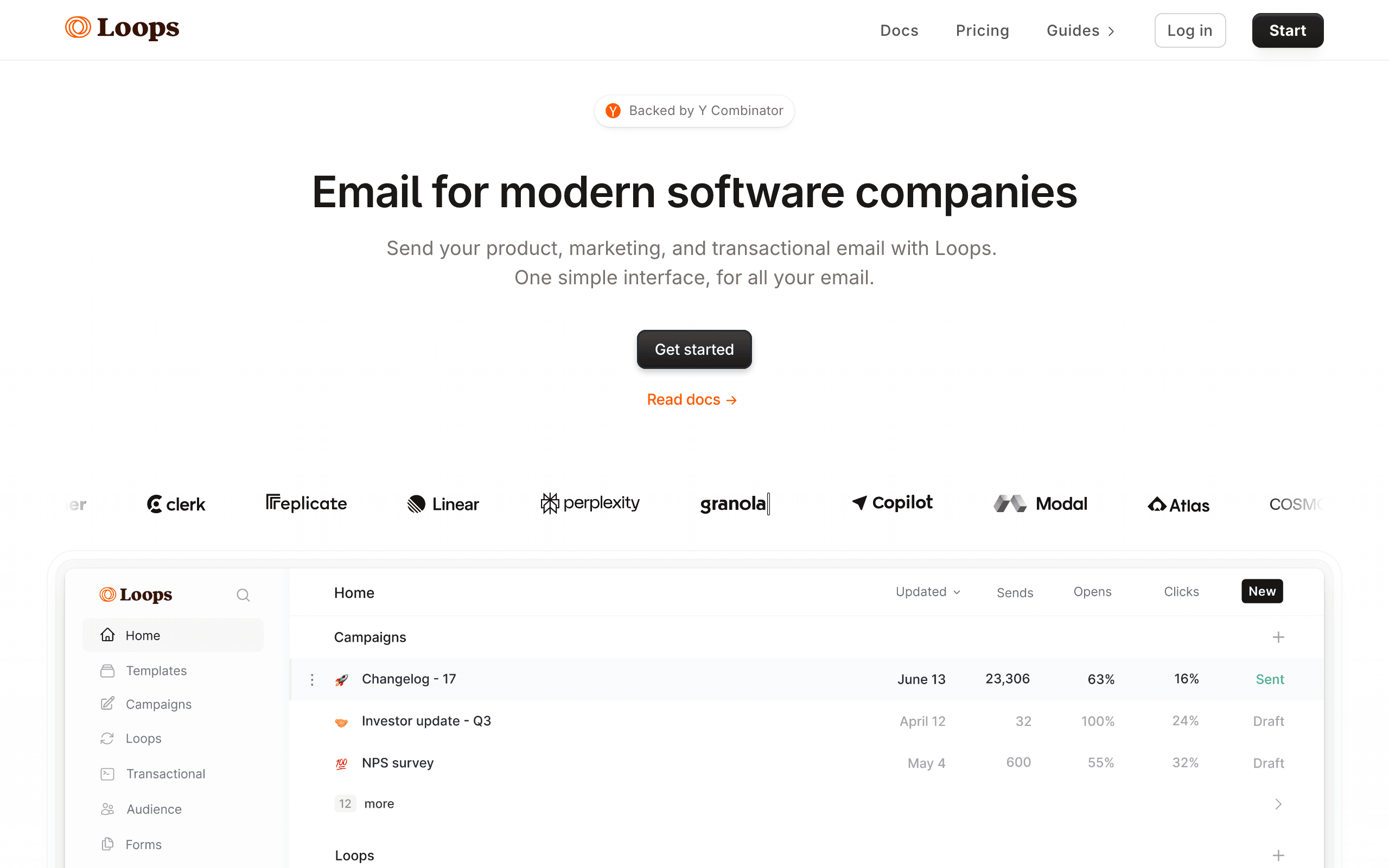
Best for: Early-stage Neon apps wanting simple event-driven email
Loops accepts events via API, making it easy to integrate from any application that uses Neon. Send events from your API routes or server actions, and trigger email sequences.
Loops targets the same audience as Neon: modern SaaS developers who want simple tools that do one thing well. The event API is clean, the dashboard is intuitive, and the email editor is straightforward. For early-stage products that need onboarding emails, product updates, and basic automations without deep configuration, Loops gets you there quickly.
The free tier (1,000 contacts) is generous enough for early-stage products. You can validate your email strategy without committing to a paid plan, which aligns well with Neon's own generous free tier for development and small-scale production.
- Pricing: Free for 1,000 contacts, from $49/month
- Integration: Event API from your application
- Pros: Simple, modern, good free tier, event-driven model, quick setup
- Cons: Limited automation depth, basic features, may outgrow quickly
4. Postmark
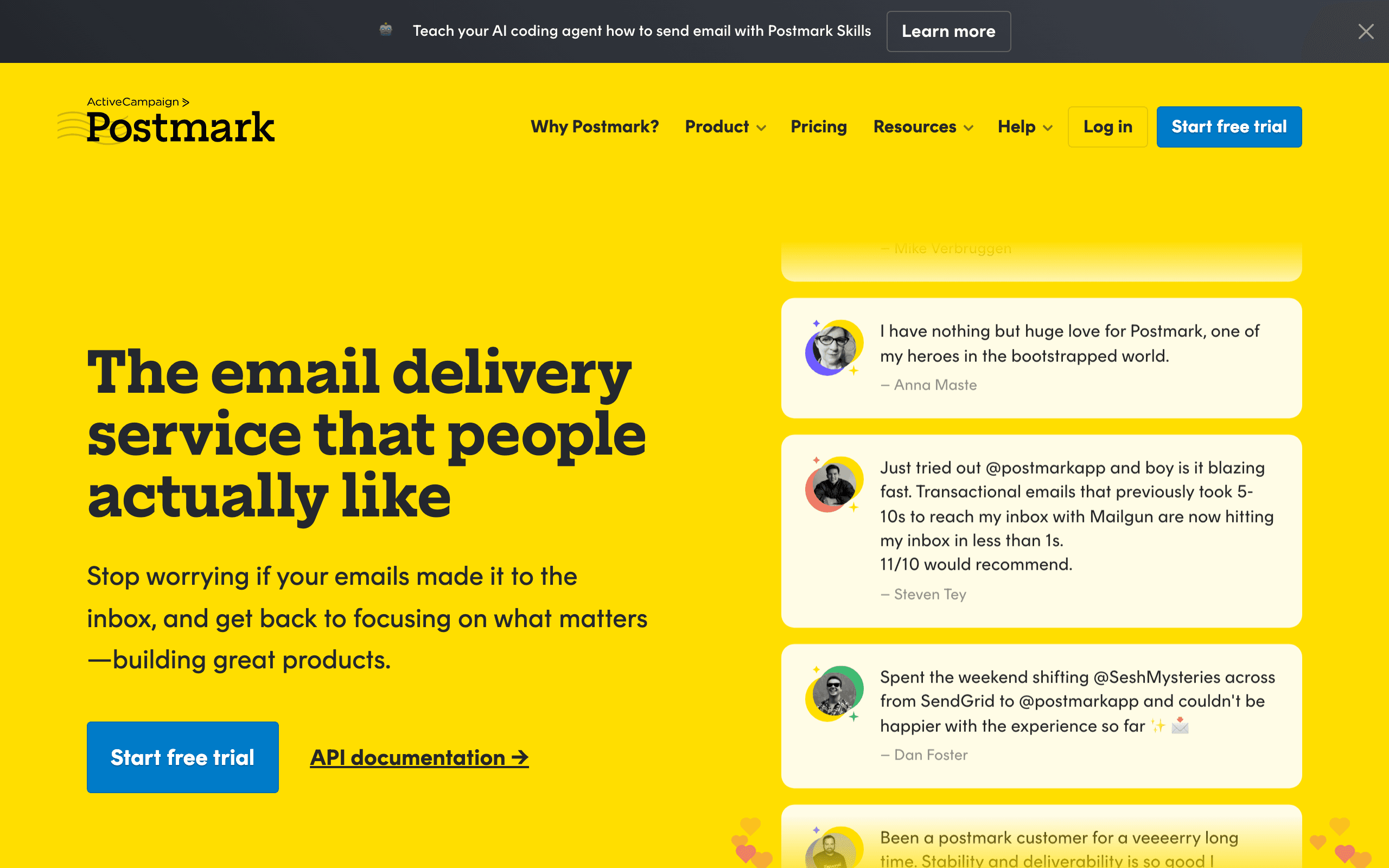
Best for: Neon apps prioritizing transactional email speed
Postmark handles transactional email (password resets, notifications, receipts) with the best deliverability in the industry. Integrate from your Neon-backed application via the Postmark SDK.
For Neon-based apps where email reliability is non-negotiable (B2B SaaS, fintech, healthcare), Postmark ensures that every transactional email reaches the inbox quickly. The average delivery time is under 10 seconds, and Postmark's dedicated transactional infrastructure means your system emails are not competing with marketing email for reputation.
Postmark's server-side templates are also worth mentioning. You can create email templates in the Postmark dashboard and reference them from your application code by alias. Non-developers can update email copy without code changes, which is useful for growing teams where not every email change should require a deployment.
- Pricing: From $15/month
- Integration: SDK in your application code
- Pros: Fastest delivery, best deliverability, excellent for transactional, great docs
- Cons: Basic marketing features, no automation sequences, separate tool needed for lifecycle email
5. Customer.io
Best for: Technical teams building complex email systems on Neon
Customer.io accepts events from any source via API. Forward user actions from your Neon-backed application and build complex multi-step email workflows. Maximum flexibility for teams willing to invest in setup.
The depth of Customer.io's automation engine is unmatched. You can build workflows with conditional branching, time delays, attribute-based filtering, A/B testing, and multi-channel delivery (email, push, SMS). When your Neon database captures rich user behavior data, Customer.io lets you build sophisticated automations that respond to that behavior.
Customer.io also supports real-time attribute updates. As user data changes in your Neon database, your application can update corresponding Customer.io profiles. Your segmentation and automation conditions always reflect the latest data, enabling precise targeting based on user behavior and attributes.
The trade-off is cost and complexity. Starting at $100/month, Customer.io is a significant investment for early-stage products. The setup requires more upfront work than simpler alternatives. For products with complex user journeys and large user bases, the investment pays for itself. For simpler needs, it is overkill.
- Pricing: From $100/month
- Integration: Event API from your application
- Pros: Most powerful automation, flexible event handling, multi-channel, real-time attributes
- Cons: Expensive, complex setup, overkill for many use cases, steep learning curve
6. Brevo
Best for: Budget-conscious Neon projects
Brevo offers both transactional (SMTP/API) and marketing email at an affordable price. Use it from your Neon-backed application for system emails and marketing sequences. The free tier (300 emails/day) works for development and early stages.
For Neon projects that need both transactional and marketing email without paying for two separate tools, Brevo is the most cost-effective option. The transactional API handles system emails, and the marketing side handles campaigns, contacts, and basic automations.
The trade-off is developer experience. Brevo's API and documentation are functional but not as polished as Resend or Postmark. The dashboard is older and less intuitive than newer alternatives. For teams that prioritize price over DX, it works. For teams that value clean developer tools, other options may be more enjoyable to work with.
- Pricing: Free for 300 emails/day, from $9/month
- Integration: SDK in your application code
- Pros: Affordable, both transactional and marketing, generous free tier, all-in-one
- Cons: Dated interface, less developer-focused than alternatives, basic automation
7. SendGrid
Best for: High-volume transactional email from Neon-based apps
SendGrid (Twilio SendGrid) is a long-standing transactional email API that pairs naturally with Neon-based applications. Call the SendGrid API from your application code after writing to Neon for transactional sends triggered by database changes.
The strength is scale. SendGrid is built to handle very high volumes reliably, with mature deliverability tooling, IP warmup support, and dedicated IPs available on higher plans. For Neon products that send millions of transactional emails (notifications, receipts, alerts), the infrastructure has been battle-tested.
Marketing Campaigns is bundled into SendGrid, but it is broadly considered the weakest part of the platform. Most teams treat SendGrid as transactional infrastructure and pair it with a marketing tool for lifecycle email. Documentation is solid and the API is stable, which matters when you are wiring it into application code you would rather not revisit often.
- Pricing: Free up to 100 emails/day, from $20/month
- Integration: SDK in your application code
- Pros: Mature transactional infrastructure, scales to high volume, established deliverability, large ecosystem
- Cons: Marketing Campaigns is weak, support has mixed reputation, no lifecycle automation
8. Mailgun
Best for: Developers wanting a flexible transactional API with Neon
Mailgun is another developer-focused transactional email API. It fits Neon the same way Postmark and SendGrid do: integrate via SDK in your application code for transactional sends, with database operations driving the trigger logic.
Where Mailgun differentiates is on flexibility. The API exposes routing rules, inbound email parsing, and detailed event webhooks that you can pipe back into Neon tables. If you need to receive replies to outbound emails and store them in Postgres, Mailgun's inbound routes make that straightforward.
Deliverability is solid but typically not at Postmark's level for transactional. The pricing model also rewards larger volumes more than tiny ones, so for very small Neon projects it may not be the cheapest option. For mid-volume teams that want a flexible API with both outbound and inbound capabilities, it earns its place.
- Pricing: Free trial, paid plans from $15/month
- Integration: SDK in your application code, inbound routing supported
- Pros: Flexible API, inbound email parsing, detailed event webhooks, EU/US regions
- Cons: Deliverability not best-in-class, pricing favors larger volumes, no marketing automation
9. Amazon SES
Best for: Cost-sensitive teams already running on AWS
Amazon SES is the cheapest reliable way to send email at scale. For Neon teams that already have AWS accounts (or do not mind setting one up), SES costs roughly $0.10 per 1,000 emails, an order of magnitude less than most alternatives.
Call the SES API from your application code after writing to Neon. There are no automation features, no template editor worth mentioning, and no segmentation. SES is plumbing, not a marketing platform.
Deliverability is good once you are out of the SES sandbox and have warmed up your sending reputation, but the operational overhead is real. You manage suppression lists, bounces, complaints, and reputation yourself. For teams that want absolute lowest cost and are comfortable with AWS, SES paired with a marketing tool for lifecycle email is a defensible architecture. For teams that want everything handled, look elsewhere.
- Pricing: Pay-as-you-go, roughly $0.10 per 1,000 emails sent
- Integration: SDK in your application code
- Pros: Lowest cost at scale, reliable AWS infrastructure, generous sending limits
- Cons: No marketing features, operational overhead, sandbox approval required, weak DX
10. Mailchimp
Best for: Teams wanting marketing email layered on a Neon backend
Mailchimp is the most recognizable name in email marketing, and it does have a usable API that you can call from your Neon-backed application. There is no native Neon connector, but the workflow is the standard one: write to Neon, then call Mailchimp API to add or update a subscriber and trigger a journey.
Mailchimp's strength is its template library and the polish of its campaign editor. For teams that send a lot of broadcast newsletter content alongside product email, those tools save real time. The marketing automation is functional, though it has a more list-and-broadcast shape than the event-driven model Neon developers tend to prefer.
The downsides are pricing that scales aggressively with contacts (including unsubscribed ones on some legacy plans), and a developer experience that feels dated next to Resend or Loops. If your team is already on Mailchimp for other reasons, layering it on Neon works. If you are choosing fresh, there are better-fit options on this list.
- Pricing: Free for up to 500 contacts, paid plans from $13/month
- Integration: API from your application code, no native Neon connector
- Pros: Mature template library, recognizable brand, broad ecosystem, polished campaign editor
- Cons: Pricing scales aggressively, dated DX, list-shaped not event-shaped, no native connector
11. ConvertKit (Kit)

Best for: Creator-style SaaS on Neon
ConvertKit (now branded "Kit") is built for creators selling courses, paid newsletters, and digital products. Neon teams shipping that kind of product get a clean fit: call the Kit API from your application code when users sign up, complete onboarding, or take key actions, and Kit handles tagging and automations from there.
The tag-based segmentation model is approachable, and the visual automation builder is easy to learn. For non-technical co-founders managing the email side of a Neon product, Kit reduces the cognitive load compared to event-and-segment models like Customer.io or Vero.
For pure SaaS with deep lifecycle needs (multi-branch dunning, MRR-based segmentation, complex trial flows), Kit is shallower than purpose-built tools. The free tier is generous though, which makes it easy to try alongside an existing Neon project.
- Pricing: Free up to 10,000 subscribers, paid from $29/month
- Integration: API from your application code
- Pros: Strong creator features, generous free tier, clean tagging-based segmentation, approachable automation
- Cons: Creator-shaped not SaaS-shaped, dunning is DIY, reporting is limited, fewer integrations than larger tools
12. ActiveCampaign
Best for: Sales-led SaaS wanting CRM + email on a Neon backend
ActiveCampaign bundles email automation with a built-in CRM, which can be useful for SaaS products that have a sales-assisted motion alongside self-serve. The Neon integration is API-based: your application code calls ActiveCampaign's contact and event APIs when users sign up, hit milestones, or change subscription state.
The automation builder is mature and supports branching, delays, and conditional logic. Combined with the CRM, you can build flows like "if a user from a high-MRR account stops logging in, notify their account manager and start a re-engagement sequence." That kind of cross-system automation is harder to assemble in pure email tools.
The trade-offs are a steeper learning curve, an interface that feels heavier than newer tools, and pricing that escalates as you add contacts and features. For Neon teams without a sales motion, the CRM is wasted weight. For those with one, it is genuinely useful.
- Pricing: From $29/month (Lite plan)
- Integration: API from your application code
- Pros: Built-in CRM, mature automation builder, large ecosystem, good deliverability
- Cons: Steep learning curve, complex interface, pricing scales with contacts and features
13. MailerLite
Best for: Solo founders wanting simple email on top of Neon
MailerLite is one of the most pleasant email tools to use day-to-day. The editor is clean, the dashboard is uncluttered, and the free tier is one of the most generous in the space. From Neon, the integration looks familiar: your application code hits the MailerLite API to add subscribers and trigger automations.
For solo founders or very small teams running a Neon-backed SaaS plus a newsletter, MailerLite is a reasonable single-tool answer. The pricing stays affordable as you grow, and the segmentation is enough for straightforward use cases.
The limits show up when you need event-driven behavioral email or complex multi-step automations. MailerLite is shaped around lists and broadcasts more than events and journeys. If your Neon product needs deep lifecycle email, you will outgrow it.
- Pricing: Free up to 1,000 subscribers and 12,000 emails/month, from $10/month
- Integration: API from your application code
- Pros: Pleasant editor, generous free tier, simple pricing, easy to learn
- Cons: Segmentation is basic, not event-shaped, limited automation depth, fewer integrations
14. Beehiiv
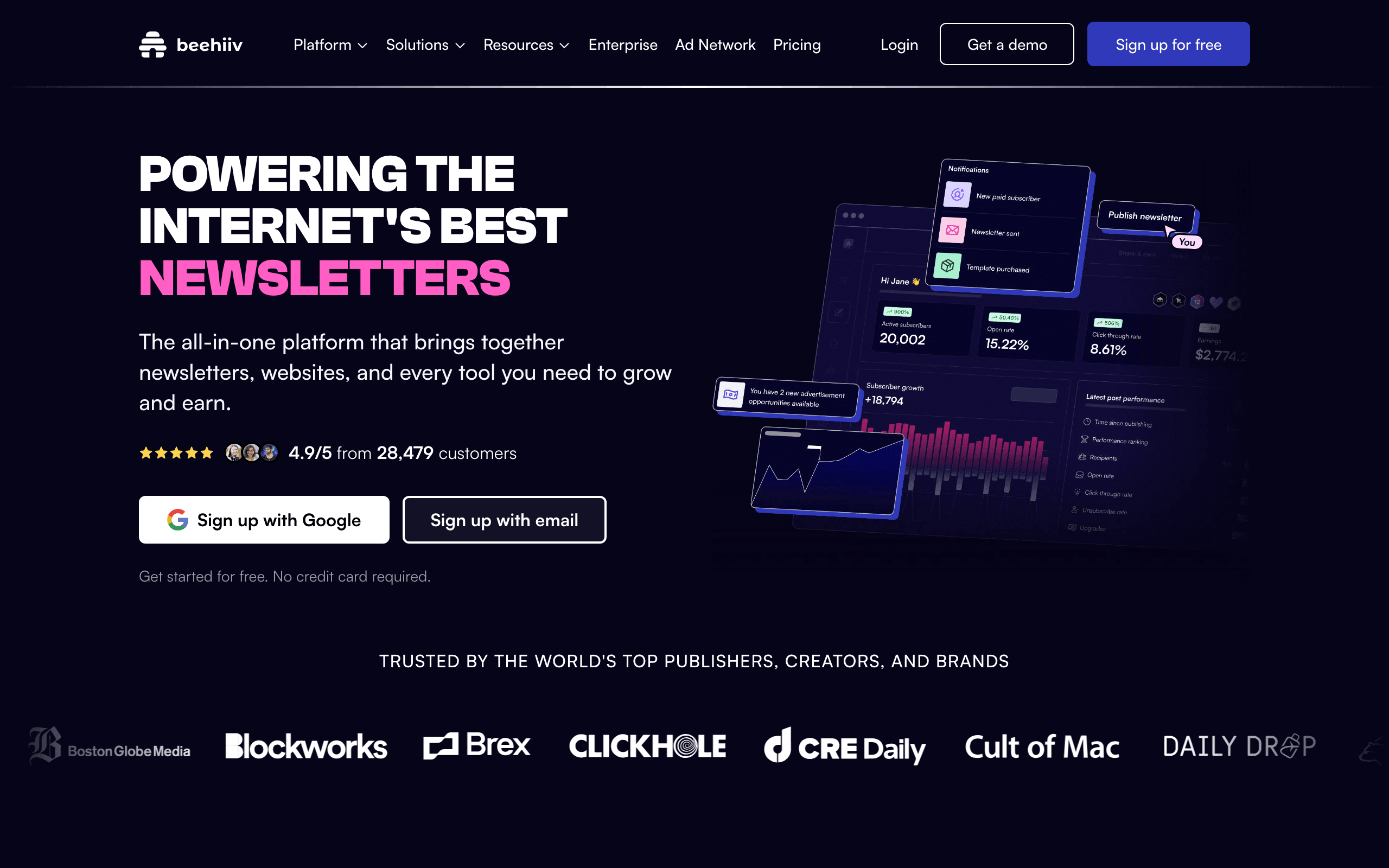
Best for: Newsletter-led products built on Neon
Beehiiv is a newsletter platform with strong audience growth tools (referral programs, recommendations network, ad network). For Neon products that are really content businesses with a paid tier or a community layer, Beehiiv handles the publishing and subscription side better than general-purpose email tools.
The integration with Neon is API-based. When a user signs up or upgrades in your Neon database, your application code calls Beehiiv's API to subscribe them to the right tier. For traditional SaaS use cases (dunning, onboarding sequences for an app), Beehiiv is the wrong tool because it is shaped around newsletters, not behavioral product email.
If your "SaaS" is really a paid media or community product on Neon, Beehiiv is one of the cleanest answers in the space. If it is a real app, look elsewhere.
- Pricing: Free up to 2,500 subscribers, paid plans from $39/month
- Integration: API from your application code
- Pros: Strong audience growth tools, polished editor, native paid newsletter support
- Cons: Newsletter-shaped not SaaS-shaped, limited behavioral automation, weak transactional email
15. HubSpot

Best for: Companies standardized on HubSpot CRM
HubSpot is a full marketing and sales platform with a free CRM and paid Marketing Hub tiers. From Neon, you call the HubSpot API from your application code to sync contacts, log events, and trigger workflows. There is no native Neon connector, but the API is comprehensive.
The reason to use HubSpot with Neon is usually that the rest of the company is already on HubSpot. Sales pipeline, support tickets, marketing campaigns, and customer data all live in one place, and adding Neon product events into that picture means your sales and CS teams see the full customer story.
The honest caveats: HubSpot's automation pricing scales hard, the CRM-shaped data model means you do some translation between Neon events and HubSpot's contact/company/deal model, and the platform can feel heavy for teams that just want product email automation.
- Pricing: Free CRM, Marketing Hub from $20/month, automation features gated by tier
- Integration: API from your application code
- Pros: Unified with CRM, deals, and pipelines, strong reporting, large ecosystem, good support
- Cons: Pricing escalates rapidly, CRM-shaped data model, complex permissions, heavy for product-focused teams
16. Klaviyo
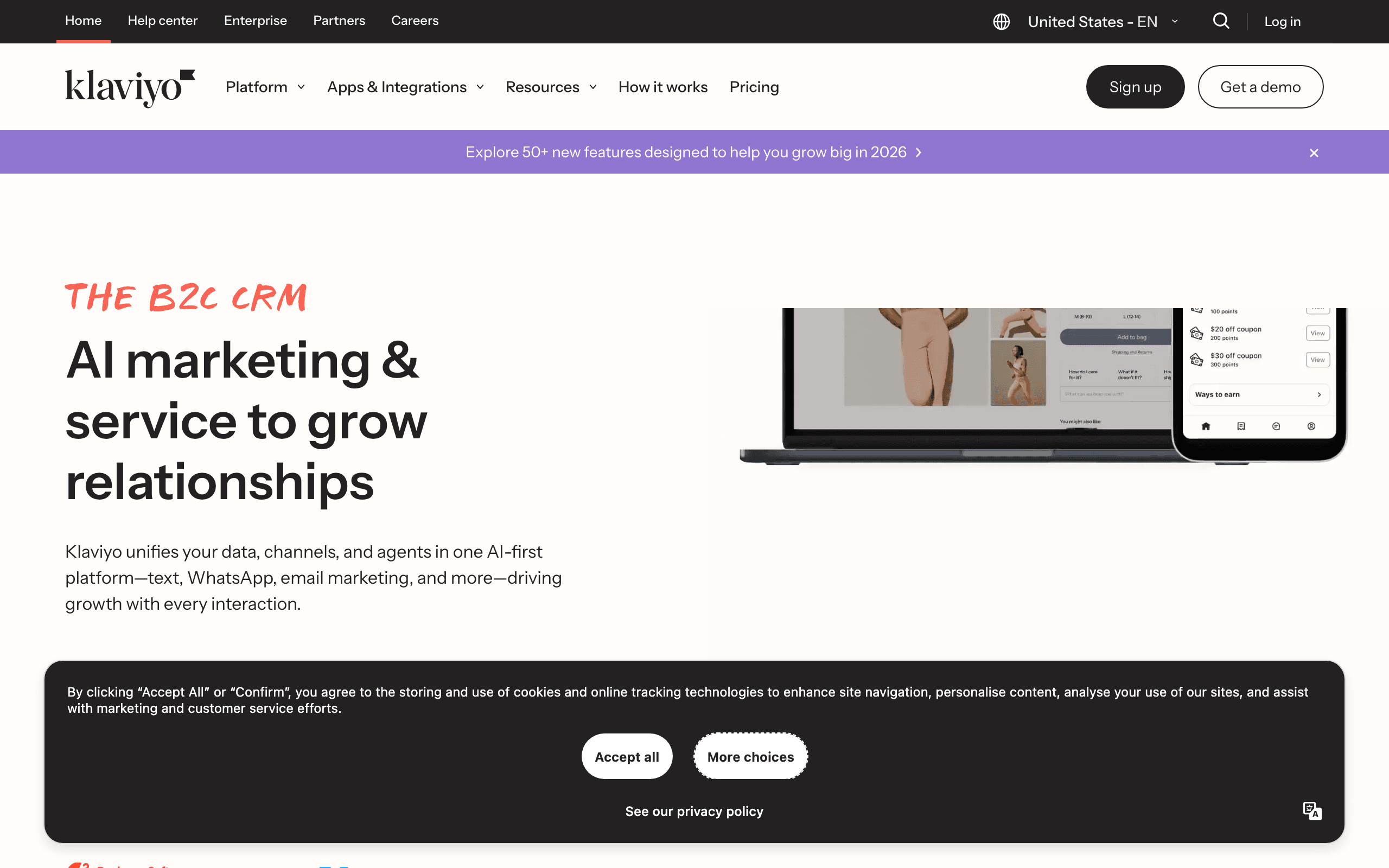
Best for: Hybrid e-commerce + Neon products
Klaviyo's core market is Shopify-style e-commerce, but the platform itself supports any data source you can pipe in via API. From your Neon-backed application, you can call Klaviyo's events API to sync product behavior into customer profiles and trigger flows.
The segmentation engine is genuinely best-in-class. If your Neon product has both transactional purchases and a SaaS-style subscription layer, Klaviyo can blend that data in a single profile better than most tools. Few platforms reason cleanly across e-commerce events and product events.
The mental model is e-commerce throughout, though. Flows, templates, terminology, and dashboards all assume order-based behavior. You can absolutely run SaaS lifecycle email on Klaviyo, but you will be translating concepts the whole way. Pricing also scales aggressively with contacts.
- Pricing: Free up to 250 contacts, from $45/month
- Integration: API from your application code
- Pros: Best-in-class segmentation, blends e-commerce + SaaS data, strong analytics, many templates
- Cons: Mental model is e-commerce, pricing scales aggressively, dunning is DIY, can feel heavy
17. Encharge
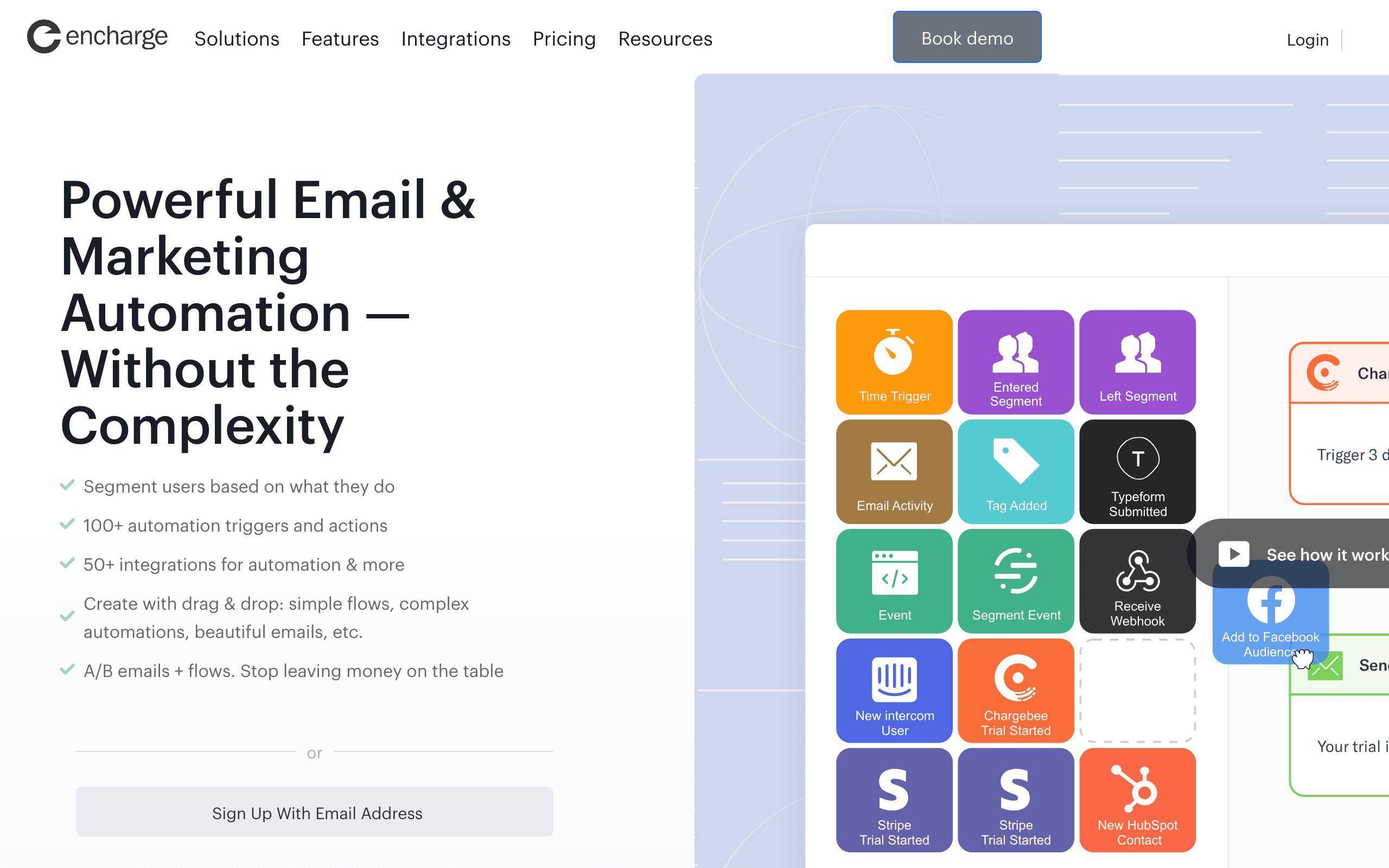
Best for: Non-technical teams wanting visual flows on Neon data
Encharge offers a visual flow builder that accepts events from external systems via its API. From Neon, your application code pushes events into Encharge, and from there you build automations visually.
The visual builder is useful for non-technical co-founders who want to understand what is happening in their email program. Branching logic ("if user did X but not Y in 7 days, send this") is easier to read in a flow diagram than in code or in a list of segment rules. For teams where the founder wants to own email but does not want to write SQL, Encharge fits.
The downsides are mid-range pricing, a smaller user base than the major platforms, and an email editor that is functional but not the prettiest. For visual-first teams on Neon, it covers the basics well.
- Pricing: From $79/month
- Integration: API from your application code
- Pros: Visual flow builder, approachable for non-technical users, supports common SaaS patterns
- Cons: Mid-range pricing, smaller user base, basic email editor, can get complex for sophisticated flows
18. Userlist
Best for: B2B SaaS on Neon needing account-level data
Userlist is built for B2B SaaS and supports both user-level and company-level (account) entities. Most email tools think only in terms of individual contacts, which makes B2B segmentation messy when multiple users belong to one paying account.
The Neon integration is API-based. Your application code syncs users, companies, and events into Userlist. From there, you can build automations that target the right person on the account: "when a company's plan upgrades, email the admin AND the power users with different messages." That kind of role-aware automation is hard to build cleanly elsewhere.
The trade-offs are a higher starting price ($149/month), a smaller community, and a smaller template library than larger tools. For B2B SaaS founders running on Neon, the account-level model often justifies the price.
- Pricing: From $149/month
- Integration: API from your application code
- Pros: Built specifically for B2B SaaS, clean account + user data model, role-aware automation
- Cons: Higher starting price, smaller community, fewer resources, limited template options
19. Vero
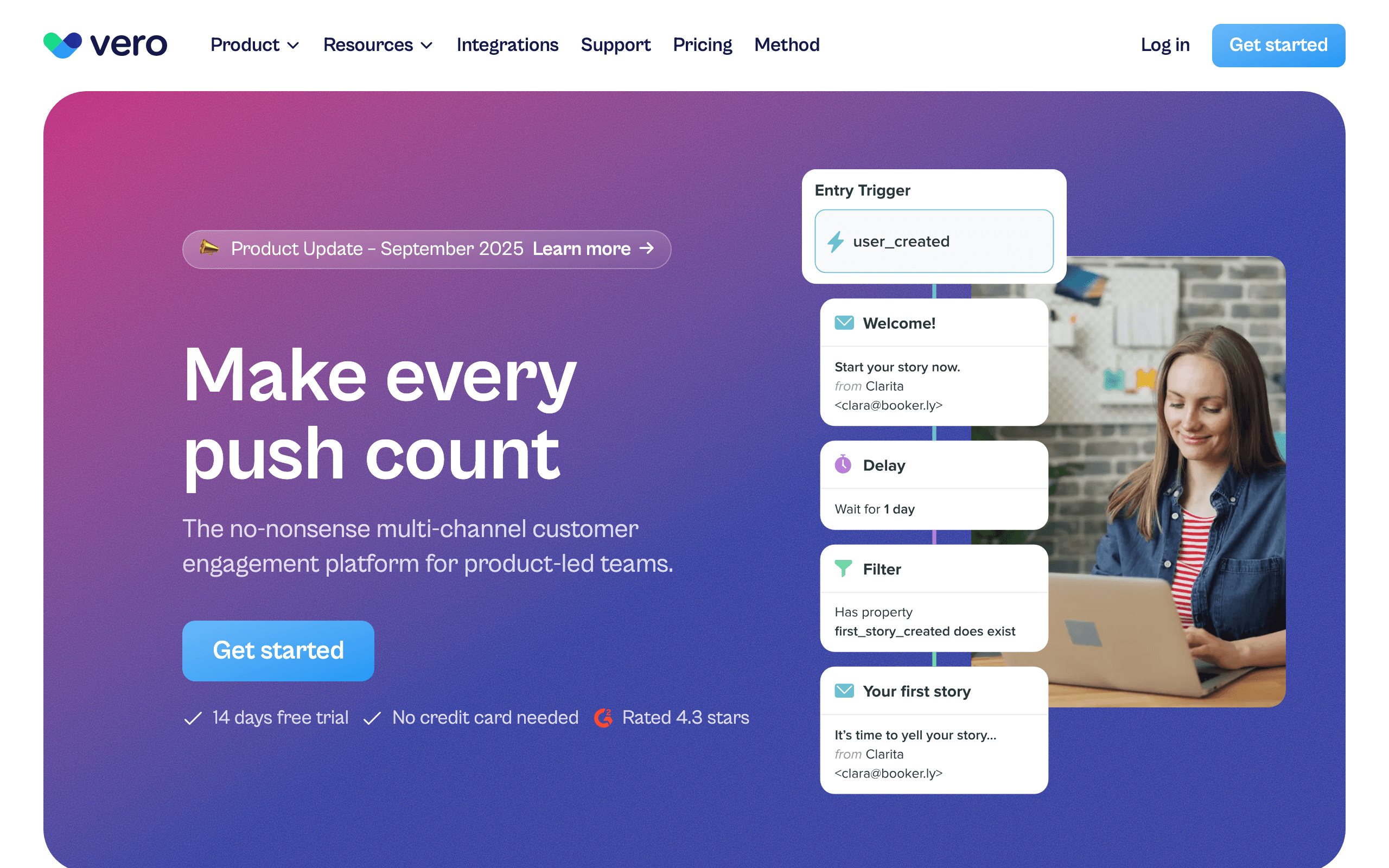
Best for: Product teams wanting event-based messaging with Neon data
Vero is one of the older event-based messaging platforms in the category. There is no native Neon connector, but Vero's events API and Segment integration make Neon data straightforward to ingest. Forward events from your application code, and every product action becomes something you can trigger workflows on.
The strength of Vero is its workflow engine. You can express "if event X happened, wait 24 hours, check condition, send email, branch on engagement" cleanly. The same workflow can drive email and push notifications, which matters for SaaS that ships mobile apps too.
It is not the trendiest tool in the category anymore, but for teams who want Customer.io-style flexibility at a slightly lower price point, Vero is worth a look.
- Pricing: From $99/month
- Integration: Events API from your application code or Segment
- Pros: Mature workflow engine, multi-channel (email + push), strong segmentation, predictable pricing
- Cons: No native Neon connector, smaller ecosystem than Customer.io, dated UI in places
20. Bento
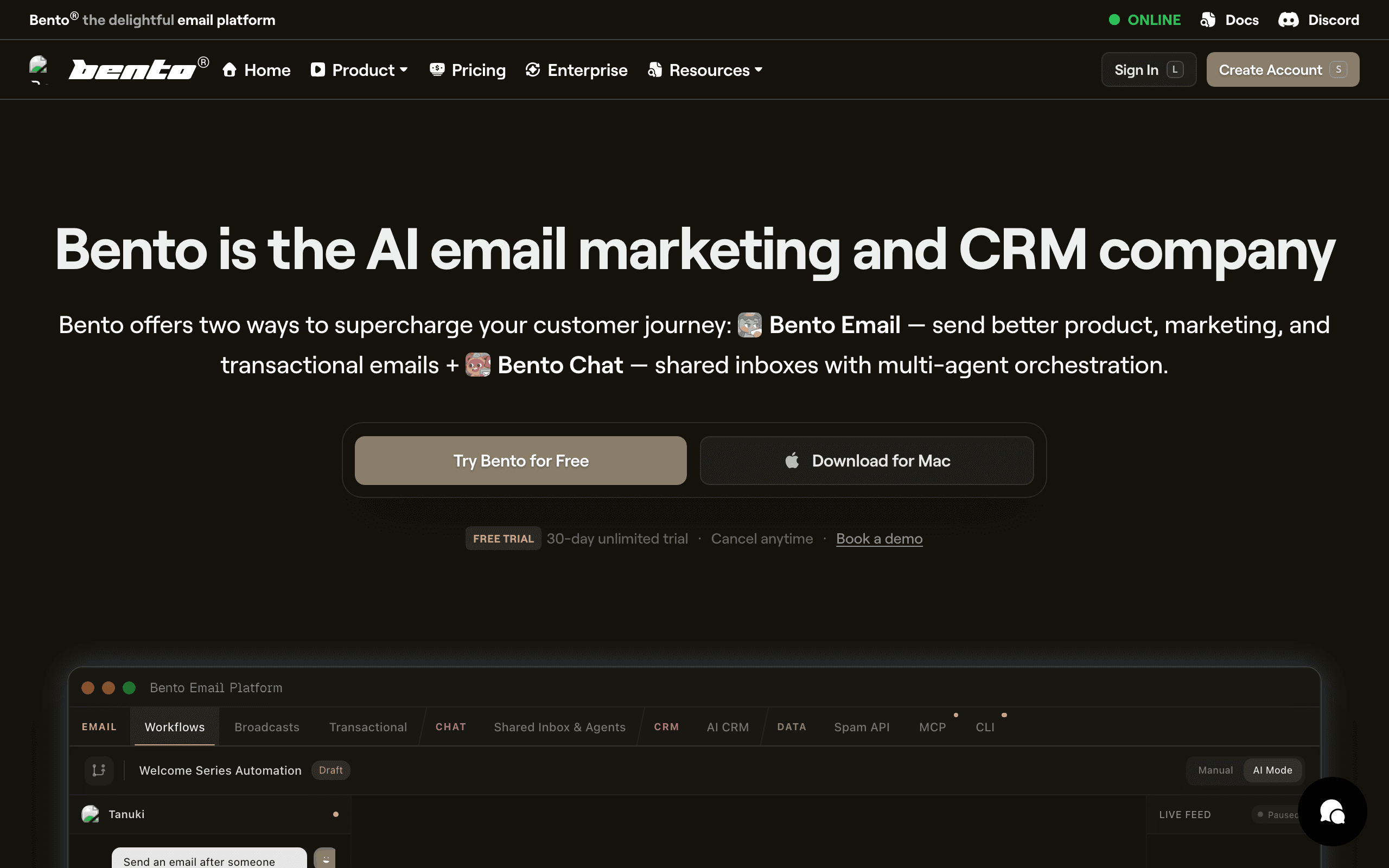
Best for: Indie SaaS wanting events + email + Neon together
Bento markets itself to indie hackers and small SaaS teams as a behavior-driven email platform. The Neon integration is the standard pattern: your application code pushes events to Bento's API, and Bento handles the automation, segmentation, and sending.
The platform leans heavily on events. Every product action becomes a Bento event you can use to trigger flows or build segments. This is closer to the Customer.io model than the Mailchimp model, but at indie pricing. For Neon teams who want event-driven email without the Customer.io price tag, it is a fair fit.
Where Bento falls short is polish. The UI is busy, documentation can be uneven, and some workflows take more clicks than they should. If you can look past that, the underlying capability is genuinely strong for the price.
- Pricing: From $30/month
- Integration: API from your application code
- Pros: Real event-driven model at indie pricing, generous attribute sync, deliverability tooling included
- Cons: UI feels cluttered, documentation gaps, smaller ecosystem, fewer pre-built templates
21. Iterable
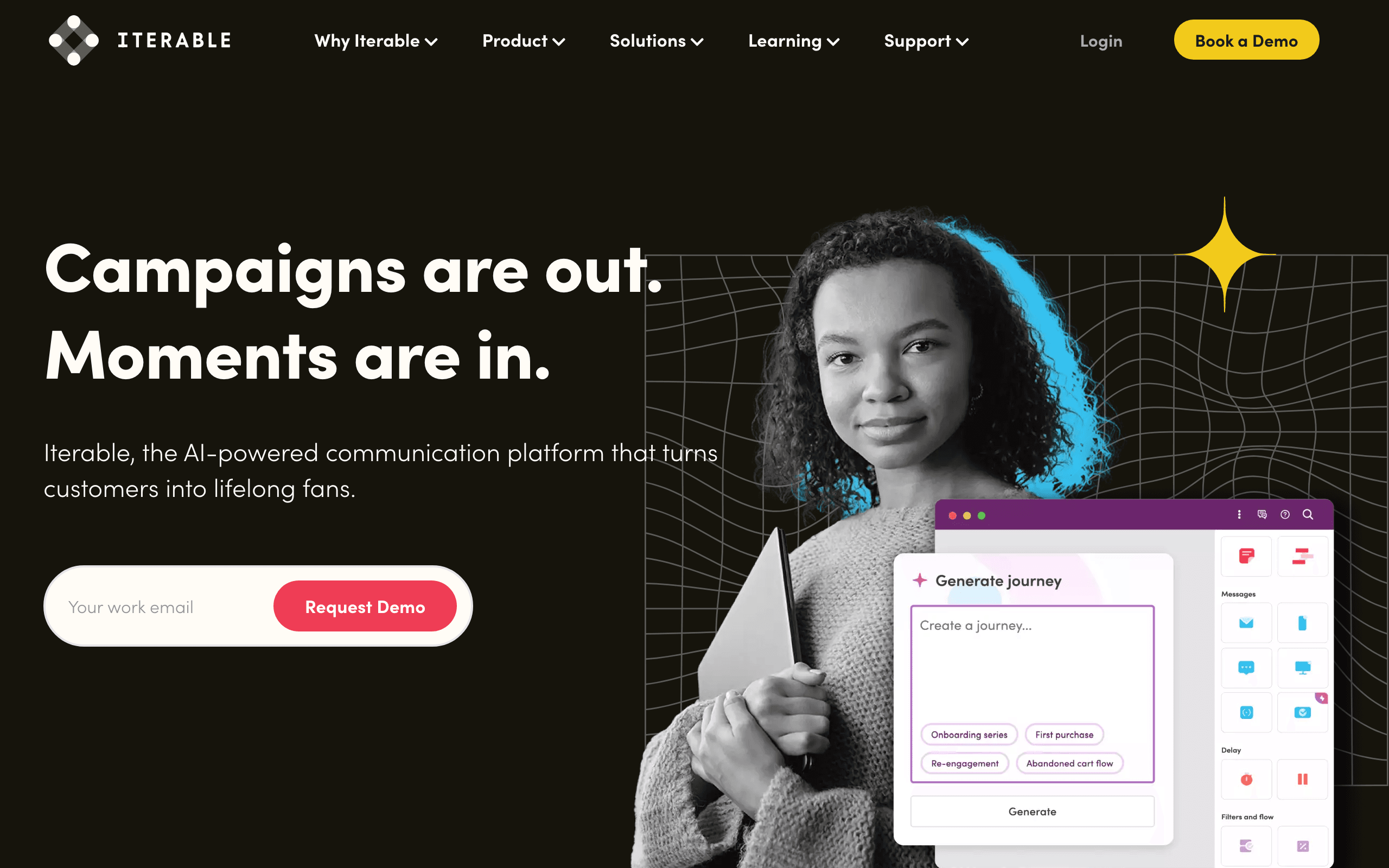
Best for: Enterprise SaaS with complex multi-channel lifecycle programs
Iterable is an enterprise messaging platform used by larger SaaS businesses for cross-channel lifecycle programs (email, SMS, push, in-app). There is no point-and-click Neon connector, but Iterable expects you to feed events from a CDP, data warehouse, or your own services. Neon events typically arrive via your data warehouse (Snowflake, BigQuery) or directly via API calls from your application code.
Once data is flowing, Iterable's strengths are real: sophisticated journey orchestration, robust experimentation, and the ability to run truly cross-channel lifecycle programs at scale. If you are a Series B+ SaaS on Neon with a real growth team, this is the tool that scales.
For early or mid-stage SaaS, Iterable is overkill. Licensing alone usually rules it out, and the time-to-value on a custom Neon integration is significant compared to plug-and-play options.
- Pricing: Custom enterprise pricing, typically $500+/month and up significantly with volume
- Integration: Events via warehouse, Segment, or direct API ingestion
- Pros: Enterprise-grade orchestration, true cross-channel, strong experimentation, scales to billions of messages
- Cons: Expensive, custom integration work required, overkill for small/mid SaaS, long implementation timelines
The Standard Integration Pattern
Since Neon is Postgres, the integration with any email tool follows this pattern:
- User takes an action in your app
- Your app writes to Neon (insert/update)
- In the same request handler (or via a background job), call the email tool's API
- The email tool processes the event and triggers any applicable automations
Example flow for a Next.js + Neon + email tool:
POST /api/signup -> Insert user into Neon -> Call email API (add subscriber + trigger welcome) -> Return response
For background-heavy operations, use a job queue (Inngest, Trigger.dev, BullMQ) to handle the email API call asynchronously, keeping your response times fast.
Error Handling and Reliability
Email API calls can fail. When they do, you need a strategy:
For critical emails (password resets, payment receipts): Use a job queue with automatic retries and dead letter processing. If the email API is down, the job retries with exponential backoff until it succeeds.
For non-critical emails (marketing events, analytics tracking): Fire-and-forget is acceptable. Log failures for debugging but do not block the user's request.
For idempotency: Include a unique event ID with each email API call. If the same event is sent twice (due to retries), the email tool can deduplicate. Most modern email platforms support this.
Performance Considerations
Neon's serverless architecture means your database connections scale with demand. Your email integration should match:
- Do not call email APIs synchronously in hot paths. A slow email API response should not slow down your user's experience.
- Batch events when possible. If multiple database writes happen in a single transaction, batch the corresponding email events into a single API call.
- Use connection pooling. Neon's connection proxy handles this for database connections, but your email SDK should also manage connections efficiently.
Choosing the Right Tool for Your Neon App
If you are building SaaS and want lifecycle automation: Sequenzy. Purpose-built for SaaS with event tracking, lifecycle sequences, and Stripe integration.
If you want the best developer experience: Resend. Same ecosystem (Next.js, Vercel, TypeScript) with React Email support.
If you are early-stage and want simplicity: Loops. Clean event API, good free tier, modern interface.
If transactional email reliability is your top priority: Postmark. Best deliverability and fastest delivery in the industry.
If you need deep automation and have the budget: Customer.io. Most powerful automation engine with flexible event handling.
If you need both transactional and marketing on a budget: Brevo. All-in-one solution at an affordable price point.
If you need complex multi-channel automation: Customer.io, Vero, or Iterable. Most powerful options for teams with complex messaging needs.
If you need B2B account-level data: Userlist supports company-level data alongside individual users.
If you have hybrid e-commerce + SaaS: Klaviyo blends both data shapes better than anything else on this list.
If your team is already on HubSpot or AWS: HubSpot or Amazon SES respectively, to avoid adding another vendor.
FAQ
Is there a direct Neon-to-email integration? Not at the database level. Neon is a Postgres database and doesn't send webhooks on data changes (unlike Supabase). Integration happens at the application level. This gives you full control but requires writing the integration code yourself.
Can I use Postgres triggers to send email? Technically yes (using pg_notify and a listener), but it's not recommended. Application-level integration is simpler, more maintainable, and keeps your database focused on data storage. Neon's serverless connection model also makes persistent LISTEN connections less practical.
What about Neon's branching for email testing? Neon's database branching is great for development. You can test email flows against a branch database without affecting production data. Just make sure your email tool is configured for a test environment so you don't send real emails from test branches. Most email tools offer sandbox or test modes for this purpose.
Do I need a separate email tool, or can I just use SMTP? You can send email via SMTP from any application, but you'll be building subscriber management, automation, deliverability, and analytics from scratch. An email tool handles all of this so you can focus on your product. The build vs. buy decision is worth considering carefully.
How does Neon's scale-to-zero affect email integration? Neon scales to zero when idle, but your email integration runs at the application level, not the database level. When your application handles a request, Neon wakes up for the database query, and your email API call happens independently. There is no conflict between Neon's scaling behavior and email integration.
What is the best stack for Neon + email? The most common and well-supported stack is Next.js (on Vercel) + Neon + an email tool with a good TypeScript SDK (Resend or Sequenzy). This gives you server actions and API routes for both database writes and email API calls, all in one deployment.
Can I use Neon's logical replication for email triggers? Neon supports logical replication, which streams database changes to external consumers. You could use this to trigger emails from database changes without application-level code. However, the setup is complex and better suited for data pipeline use cases. For most email integration needs, application-level triggers are simpler and more maintainable.
How do I track which emails have been sent for a given database record?
Add an email_events or notifications_log table to your Neon database. After successfully calling the email API, insert a record with the user ID, event type, and timestamp. This gives you an audit trail and lets you prevent duplicate sends by checking the log before triggering.
Should I use a job queue for email triggers from Neon? For production applications, yes. A job queue (Inngest, Trigger.dev, BullMQ) gives you automatic retries, better error handling, and keeps your response times fast. For low-volume development or simple use cases, inline API calls are acceptable but will impact response times.
How do I handle email API rate limits with Neon? Most email tools have rate limits on their APIs. If you're sending high volumes from Neon, implement rate limiting and batching in your application code. A job queue with backoff strategy is the most robust solution for handling rate limits gracefully.