The Creator vs Enterprise Divide
I tested both platforms for three months - Campaigner with a B2B software client (8,000 contacts, complex lead scoring) and ConvertKit with my own newsletter (3,500 subscribers, weekly writing about product development).
The experience gap was jarring. Campaigner felt like piloting a Boeing 747 - powerful but requiring training. ConvertKit felt like driving a Tesla - intuitive, focused, elegant.
For creators, ConvertKit wins on simplicity and monetization. For enterprise B2B, Campaigner wins on automation depth. For SaaS companies, neither is purpose-built for subscription business models.
Use-case matchups
| Need | Better fit | Why |
|---|---|---|
| Enterprise B2B nurture and multivariate testing | Campaigner | Campaigner has deeper branching, testing, segmentation, and templates. |
| Creator newsletters, landing pages, and paid products | ConvertKit | ConvertKit is built for creators monetizing an audience. |
| SaaS lifecycle and transactional email | Sequenzy | Sequenzy is better when Stripe and product events drive messaging. |
| Free path while growing a creator audience | ConvertKit | ConvertKit's free tier can matter before monetization. |
| Dedicated email optimization program | Campaigner | Campaigner fits teams that can use advanced testing weekly. |
Best Fit by Audience Model
Best email marketing tool for enterprise nurture and testing
Campaigner fits B2B or larger marketing teams that need branching, segmentation, templates, and weekly testing discipline. It is strongest when nurture optimization and campaign reporting matter more than creator monetization.
Best email platform for creators and paid products
ConvertKit is the better fit when creator newsletters, landing pages, audience monetization, paid products, and a free growth path matter. It works better when the audience relationship is personal and content-led.
Best email platform for SaaS lifecycle and transactionals
Sequenzy fits when Stripe and product events drive messaging more than creator monetization or enterprise testing. It is more relevant when users move through a software lifecycle rather than a newsletter funnel.
Pricing reality
Campaigner is a premium email optimization tool. ConvertKit is a creator platform with newsletter, landing page, commerce, and audience-growth features. Compare not just the monthly cost, but what each platform replaces: Campaigner may replace testing and advanced automation work; ConvertKit may replace landing page, paid newsletter, and digital product tooling.
Review signals
The structured review data on this page keeps sourced snippets from G2, Capterra, and Trustpilot. Campaigner reviews emphasize testing and B2B optimization, with price as the main caution. ConvertKit reviews emphasize paid newsletter revenue, Creator Network growth, and simplicity, with visual design limits as the main caution.
The Free Plan That Changes Everything
ConvertKit's free plan (up to 10,000 subscribers) is a game-changer for bootstrapped creators. You get:
- Unlimited email broadcasts
- Landing pages and signup forms
- Basic automation (tag-based sequences)
- Kit branding on emails
This is absurdly generous. Most email platforms offer 500-1,000 contacts on free tiers. ConvertKit lets you build to 10k before paying a penny. The catch: Kit branding in footer and no advanced features.
Campaigner has a 14-day trial, then $179/mo minimum. There's no "grow for free then upgrade when you monetize" path. For email marketing on a budget, ConvertKit's free tier is unmatched.
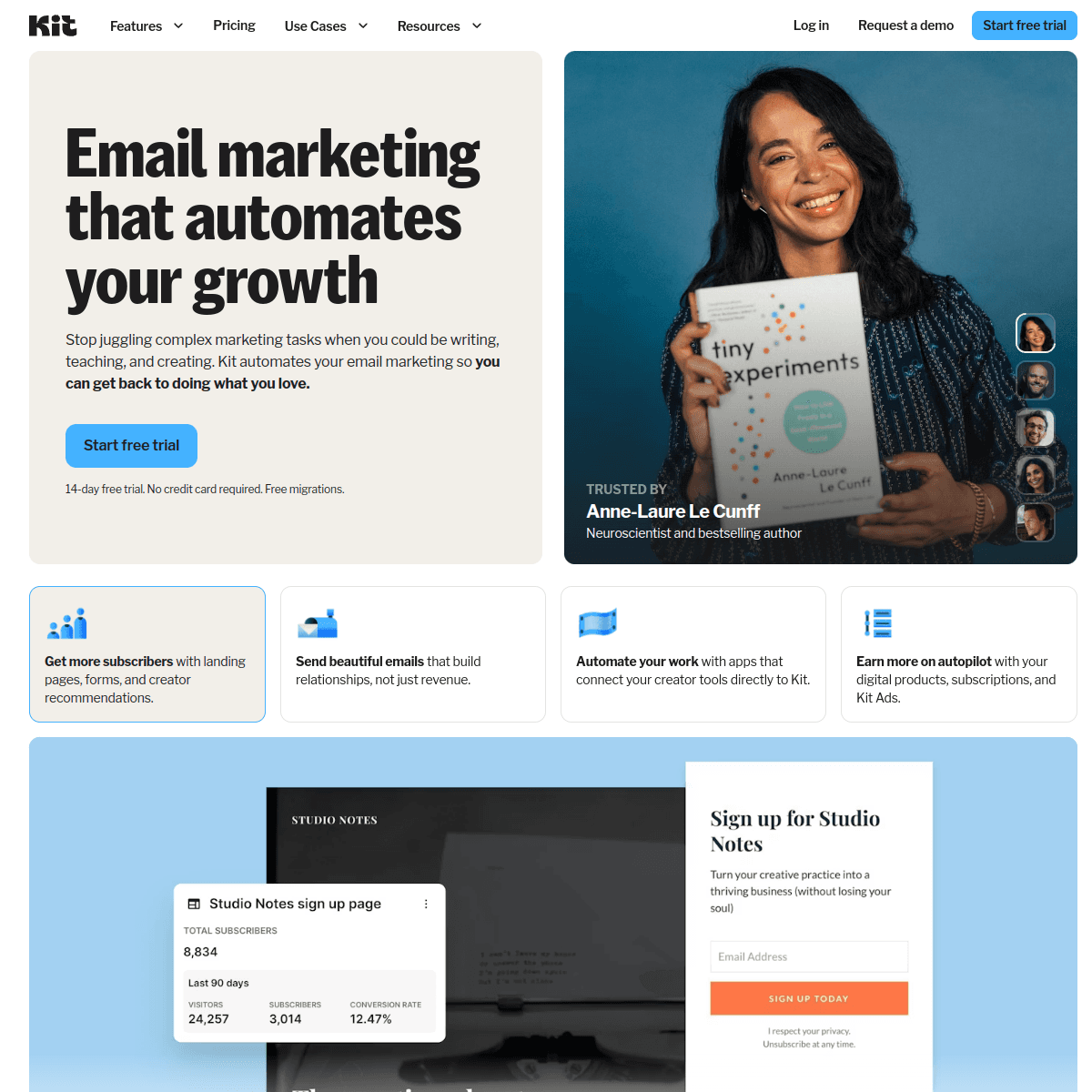
Landing Pages & Monetization: ConvertKit's Secret Weapon
ConvertKit includes unlimited landing pages and forms. I built a lead magnet landing page in 15 minutes - no coding, no separate landing page tool subscription.
More importantly, ConvertKit's Commerce features let you sell:
- Paid newsletter subscriptions (monthly/annual)
- Digital products (ebooks, templates, courses)
- Tip jars for content
This native monetization is huge for creators. You don't need Gumroad, Memberful, or Patreon. ConvertKit handles payments, subscriber management, and automated access emails.
Campaigner offers none of this. It's email marketing only. If you're monetizing an audience, you'll integrate external tools. For creator email marketing, ConvertKit's built-in Commerce justifies the platform choice.
Use-case notes
| Use case | Better fit | What to verify |
|---|---|---|
| Creator audience building | ConvertKit | Confirm free-plan limits, landing pages, forms, Creator Network, commerce fees, and branding restrictions. |
| Enterprise B2B nurture | Campaigner | Verify multivariate testing, branching workflows, reporting, template depth, and required support tier. |
| Paid newsletters and digital products | ConvertKit | ConvertKit is stronger when monetization happens inside the email platform. |
| Advanced optimization programs | Campaigner | Campaigner fits when a dedicated marketing team needs complex testing and segmentation. |
| SaaS subscription lifecycle email | Sequenzy | Compare if Stripe events, transactional email, and product lifecycle sequences matter more than creator monetization. |
Automation Depth: When Complexity Wins
Campaigner's automation builder is intimidatingly powerful. You can:
- Build multi-branch workflows with conditional logic
- Test 5+ variants of subject lines and content simultaneously
- Trigger actions based on website behavior, form submissions, API events
- Score leads based on engagement and custom criteria
ConvertKit's automation is tag-based. When a subscriber gets a tag, trigger a sequence. It's simple but limited. You can't build complex workflows like "if they open email A but not email B, wait 3 days then send email C unless they clicked link D."
For complex B2B lead nurturing, Campaigner wins. For creator use cases (welcome sequences, product launches, content series), ConvertKit's simplicity is actually better. You don't want to spend hours building automation - you want to write content.
Template Paradox: 900 vs 100
Campaigner has 900+ templates. ConvertKit has 100+. Yet I found ConvertKit's templates more useful.
Why? Campaigner's templates cover every industry imaginable - veterinarians, auto dealerships, dental offices. Most are outdated (2019-2020 design trends). ConvertKit's templates are modern, mobile-first, and focused on creator patterns (welcome emails, product launches, weekly newsletters).
For email design, I'd rather have 50 great templates than 900 mediocre ones. Sequenzy takes a different approach: 20 clean templates plus AI that writes the content for you. You're not scrolling through templates, you're describing your email in plain English.
Deliverability: The Hidden Competitive Moat
ConvertKit has one of the best deliverability reputations in email marketing. They're strict about list hygiene - no purchased lists, aggressive monitoring of engagement rates, mandatory double opt-in for new users.
This strictness pays off. My ConvertKit emails land in inbox at 96%+ consistently. Campaigner's deliverability is solid (uses SparkPost infrastructure) but not quite at ConvertKit's level - I saw 92-94% inbox placement.
For creators, this matters enormously. Your open rates directly impact revenue. A 4% deliverability difference on 10,000 subscribers means 400 fewer people seeing your monetization offers.
ConvertKit also offers free deliverability coaching on Creator Pro plans - a real human reviews your sending practices and suggests improvements. Campaigner charges extra for deliverability consulting.
Pricing Reality Check
At 10,000 subscribers:
- Campaigner Essential: $179/mo = $2,148/year
- ConvertKit Creator Pro: $119/mo = $1,428/year
- ConvertKit Free: $0/mo (with Kit branding)
- Sequenzy: $49/mo = $588/year
ConvertKit saves you $720/year vs Campaigner. If you can live with Kit branding, the free plan saves you $1,428/year.
For pricing transparency, Sequenzy costs 59% less than ConvertKit and 73% less than Campaigner. The catch: we're built for businesses with Stripe integration. Smaller landing page template library, no paid newsletter features, no digital product sales.
The SaaS Problem Neither Solves
If you're running a SaaS business, both platforms require extensive manual setup:
Campaigner:
- Connect Stripe via Zapier
- Build custom workflows for trial conversion, payment failures, churn
- Manually tag users by subscription status
- Create segments for MRR, plan type, billing interval
ConvertKit:
- Stripe integration only works for ConvertKit Commerce (paid newsletters)
- For SaaS subscriptions, you'll use Zapier or webhooks
- Tag-based system requires manual maintenance
- No native concept of MRR, LTV, or subscription status
I spent three weeks building a Stripe → ConvertKit integration with Zapier for a client. It worked but broke twice when Stripe changed webhook formats.
Sequenzy's Stripe integration is native. Connect your Stripe account and it automatically:
- Tags users by subscription status (trial, active, past_due, cancelled, churned)
- Tracks MRR and LTV per contact
- Triggers automations on payment events
- Segments customers by plan, billing interval, and trial status
For SaaS companies, this saves 20-30 hours of setup and eliminates ongoing integration maintenance. Read more about email marketing for SaaS.
The Verdict: Know Your Business Model
Choose Campaigner if:
- You're an enterprise B2B marketing team
- You need complex automation with multivariate testing
- You're integrating with Salesforce or Microsoft Dynamics
- You have budget for $179/mo and a dedicated email manager
- Your campaigns require sophisticated conditional logic
Choose ConvertKit if:
- You're a creator, blogger, coach, or newsletter writer
- You want to monetize your audience with paid subscriptions or digital products
- You need landing pages without a separate tool
- You want a generous free plan while building your audience
- Simplicity matters more than enterprise features
Choose Sequenzy if:
- You're running a SaaS business on Stripe
- You want AI to generate email sequences for you
- You need transactional + marketing emails in one platform
- You want to pay $49/mo instead of $119-179/mo
- You value Stripe integration over landing pages
What Sequenzy Doesn't Do
We're honest about our limitations. Sequenzy doesn't compete with ConvertKit for creators. We don't have:
- Landing page builders
- Paid newsletter features
- Digital product sales
- Native tip jars or course hosting
- A free plan for 10k subscribers (we offer free up to 1k)
What we do have: the best Stripe integration in email marketing. If you're selling software subscriptions, we're purpose-built for your business model.
For more on choosing the right platform, check out our guides on comparing email marketing tools and best email marketing platforms for different use cases.
The Creator Economy vs Enterprise Marketing Split
Campaigner and ConvertKit serve audiences so fundamentally different that this comparison is almost academic. Campaigner built its product for marketing teams at mid-to-large companies managing complex B2B campaigns with multivariate testing and sophisticated segmentation. ConvertKit built its product for individual creators - writers, podcasters, coaches, YouTubers - who want to grow and monetize an audience.
A creator evaluating Campaigner would find it impossibly complex and expensive for sending weekly newsletters. An enterprise marketing team evaluating ConvertKit would find it laughably simple for running multi-branch lead nurture campaigns. The overlap in potential customers is vanishingly small.
The rare exception is a creator who also runs a complex marketing operation, or an enterprise that also publishes creator-style content. In these hybrid cases, most choose the platform that serves their primary revenue model. If creator revenue exceeds enterprise marketing revenue, ConvertKit. If enterprise marketing drives the business, Campaigner.
The Free Plan Arithmetic
ConvertKit's free plan supporting up to 10,000 subscribers is the single most disruptive element of this comparison. A creator can build a substantial audience, send regular broadcasts, create landing pages, and run basic automation without paying anything. The Kit branding on emails is the only visible trade-off.
Campaigner offers a 14-day trial followed by $179/month. There is no path to build an audience for free. For a creator earning zero dollars from their newsletter in month one, committing to $179/month for email marketing is financially irrational when ConvertKit offers the same basic capability at no cost.
The free plan creates a powerful adoption flywheel. Creators start on ConvertKit because it is free, build their audience on the platform, and eventually upgrade to paid plans when they begin monetizing. By the time they could consider switching to Campaigner for advanced features, their subscriber data, automation workflows, and monetization infrastructure are deeply embedded in ConvertKit.
Neither Platform Solves the SaaS Problem
Both Campaigner and ConvertKit were built for fundamentally different markets than SaaS subscription businesses. Campaigner assumes you are running marketing campaigns to generate leads. ConvertKit assumes you are building an audience to monetize through content. Neither understands subscription lifecycle events.
ConvertKit's Stripe integration only works for its own Commerce features (paid newsletters and digital products). Connecting Stripe subscription data to ConvertKit for SaaS automation requires Zapier or custom webhooks. Campaigner requires the same workaround. In both cases, the integration is fragile and introduces latency that undermines time-sensitive emails like payment failure notifications.
Sequenzy addresses this specific gap with native Stripe integration that triggers email sequences based on actual subscription events - trial started, trial ending, payment failed, plan upgraded, subscription cancelled. For SaaS companies comparing Campaigner and ConvertKit, the more useful question is whether either general-purpose platform is the right tool category for a subscription software business.
Migration checklist
| Step | What to confirm |
|---|---|
| Audience export | Export subscribers, tags, segments, custom fields, unsubscribes, bounces, suppressions, consent, and acquisition source. |
| Creator assets | If leaving ConvertKit, replace landing pages, forms, paid newsletters, digital products, Creator Network referrals, and commerce emails. |
| Advanced campaign logic | If leaving Campaigner, preserve multivariate tests, branching workflows, dynamic content, templates, and performance reports. |
| Automations | Rebuild welcome, nurture, launch, paid-member, re-engagement, sales handoff, and suppression sequences. |
| Sender setup | Reverify SPF, DKIM, DMARC, tracking domains, sender identities, unsubscribe links, and preference centers. |
| Reporting | Export campaign, subscriber-growth, commerce, referral, deliverability, test, and automation reports before switching. |
Decision checklist
- Are you optimizing B2B campaigns or monetizing a creator audience?
- Will Campaigner's multivariate testing and advanced automation produce enough lift to justify the cost?
- Do ConvertKit's landing pages, Commerce features, and Creator Network replace other tools?
- Is plain-text/creator-style email acceptable for the brand?
- Would SaaS lifecycle and transactional email make Sequenzy the better fit?