
Best email marketing tools for musicians (2026)
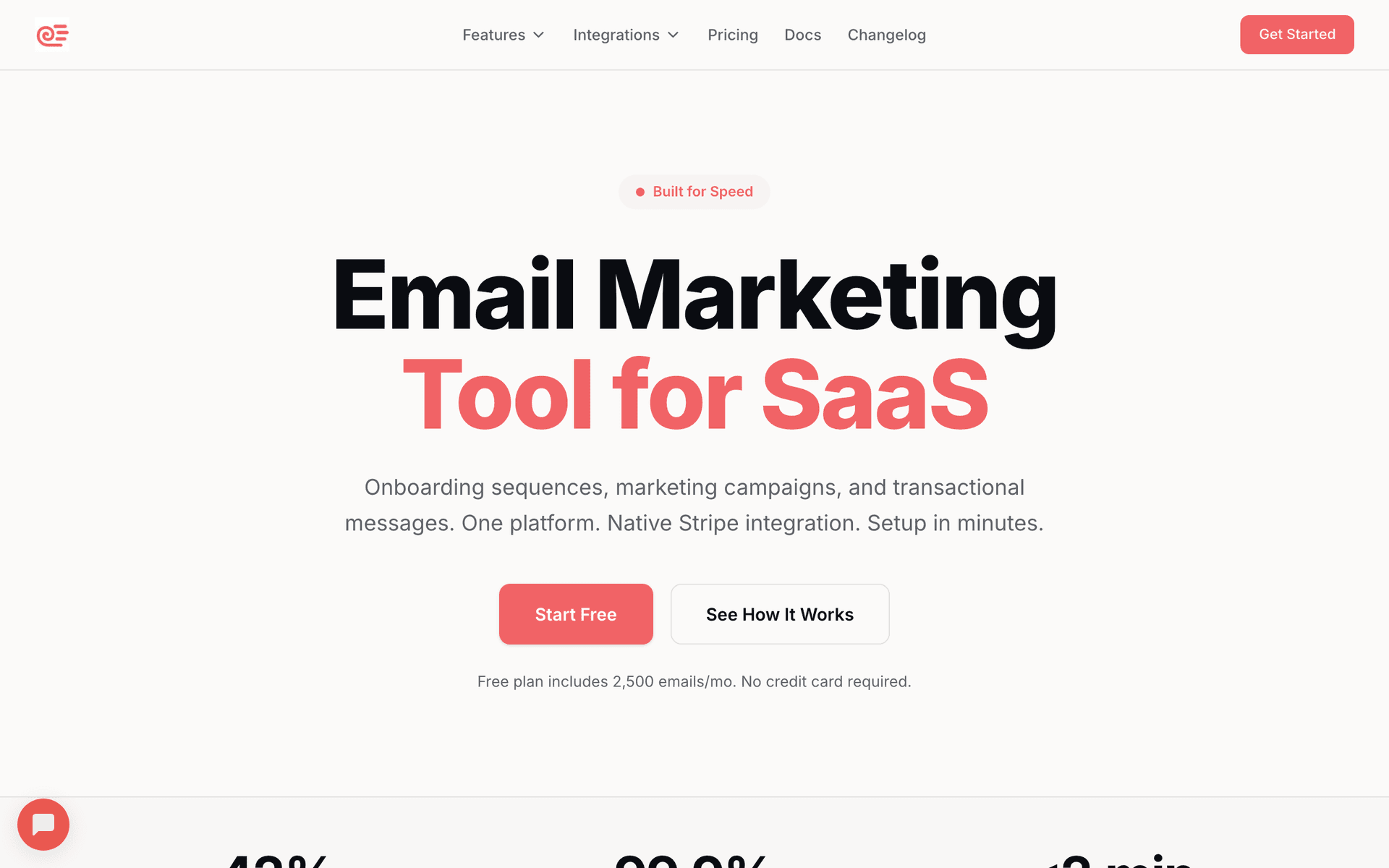
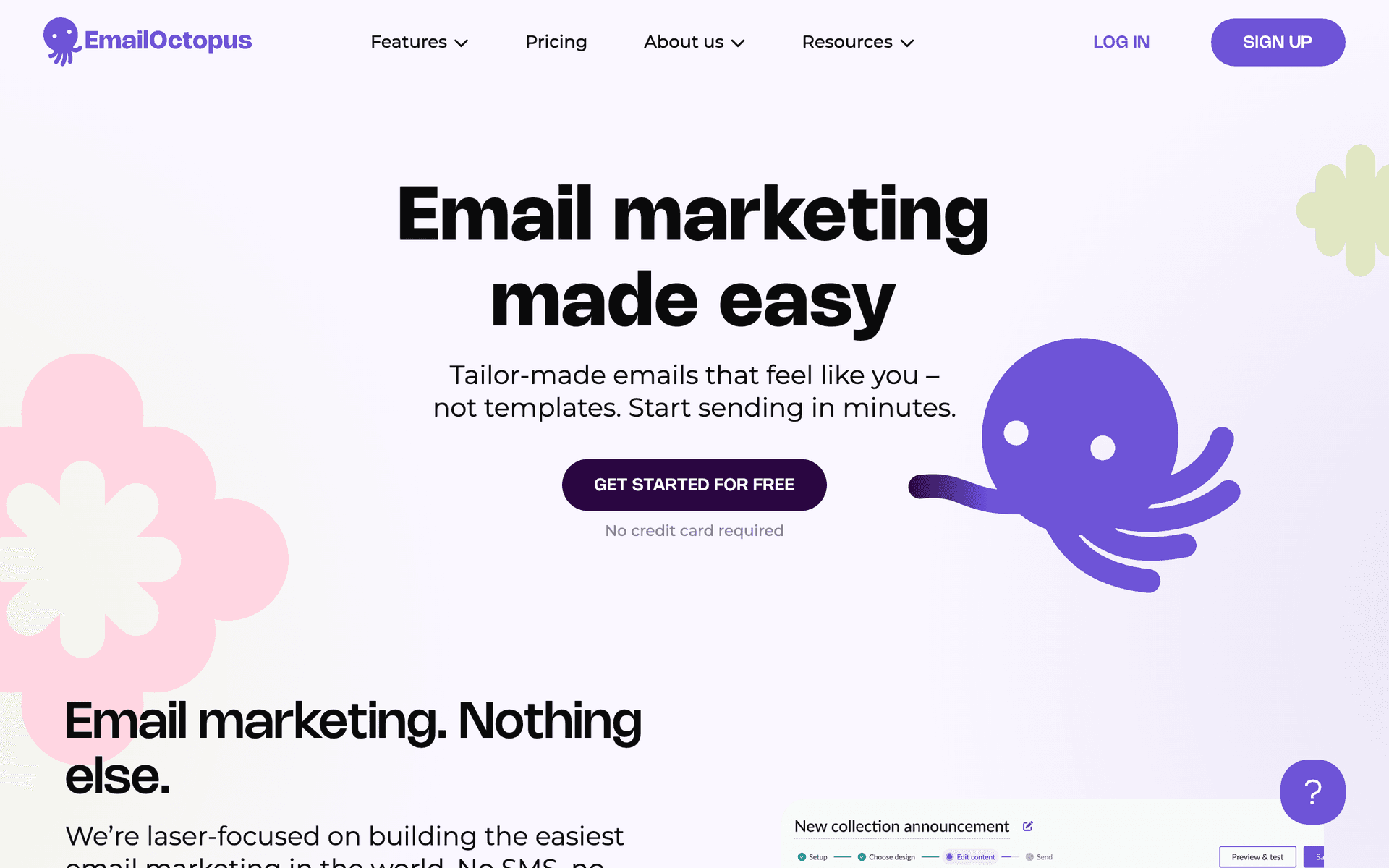
For a real fan list, pick a platform that charges for emails sent rather than fans stored. A working artist with 20,000 fans emailing twice a month sends 40,000 emails, which costs $49/mo for 60,000 emails on Sequenzy and several times that on any contact-priced platform. Sequenzy also covers the two workflows that make musicians money - Shopify merch triggers and a drop-day SMS add-on - in one account. If you want unlimited sends and prefer subscriber pricing, EmailOctopus is the value pick. If you want a website, a store and a list in one bill, Bandzoogle from $10/month. Laylo is a drop-day layer, not a replacement.
| If you are... | Pick | Because |
|---|---|---|
| A band with 5,000-50,000 fans emailing a few times a month | Sequenzy | Volume pricing plus Shopify merch triggers and an SMS add-on for drop day |
| Starting out with no budget | EmailOctopus | Free for 2,500 subscribers and 10,000 emails a month, the largest free tier here |
| Emailing a big list often | EmailOctopus Pro | Unlimited sends at every subscriber tier, so frequency never raises the bill |
| Without a website, store or list yet | Bandzoogle | Site, mailing list, merch store and ticketing from $10/month, no sales commission |
| Running a release or on-sale as a multi-channel blast | Laylo plus an email platform | Text, email and DM in one drop alert, but it is not a list you own |
How to choose email marketing software for musicians
Seven criteria decide this, and none of them are ease of use.
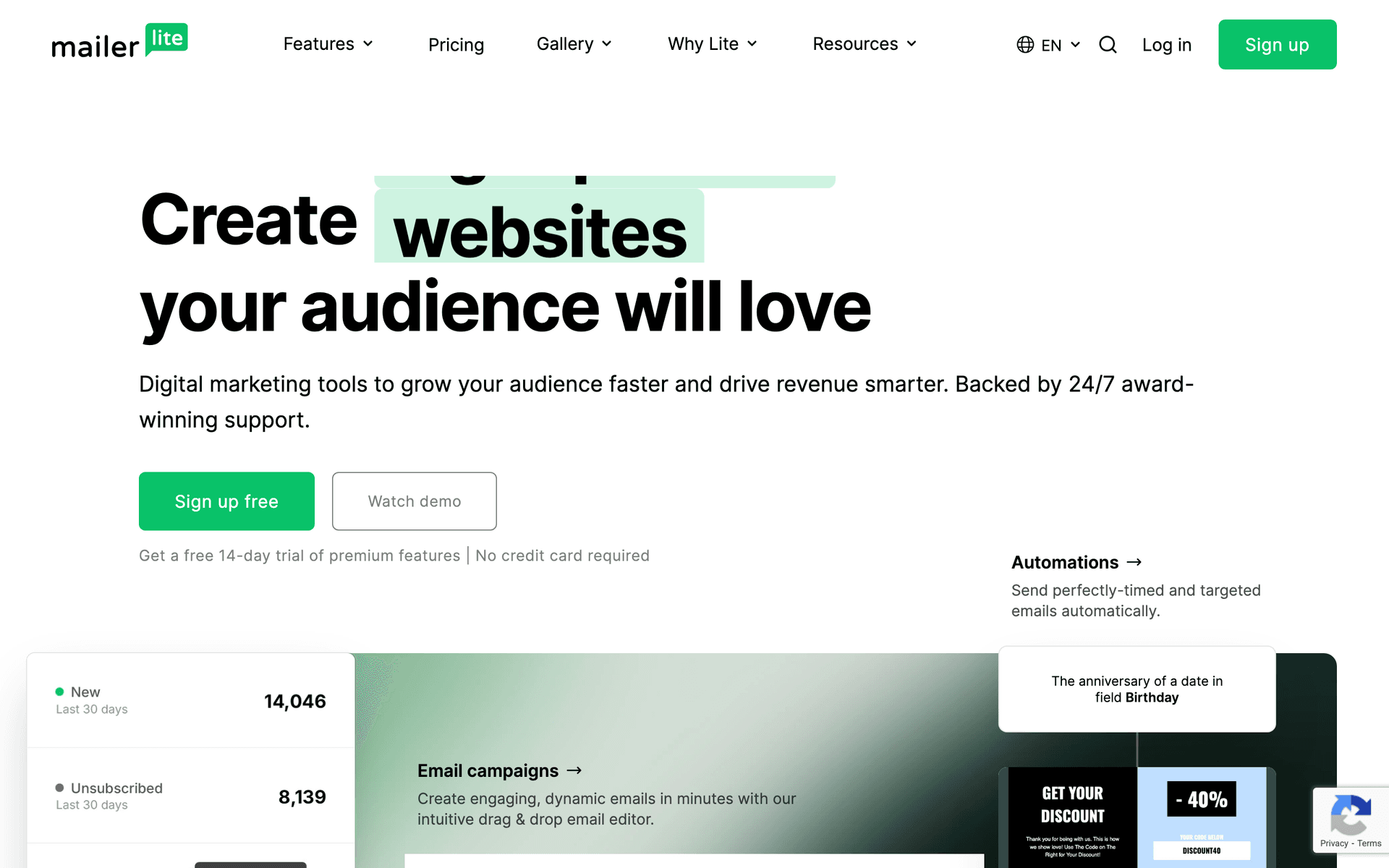
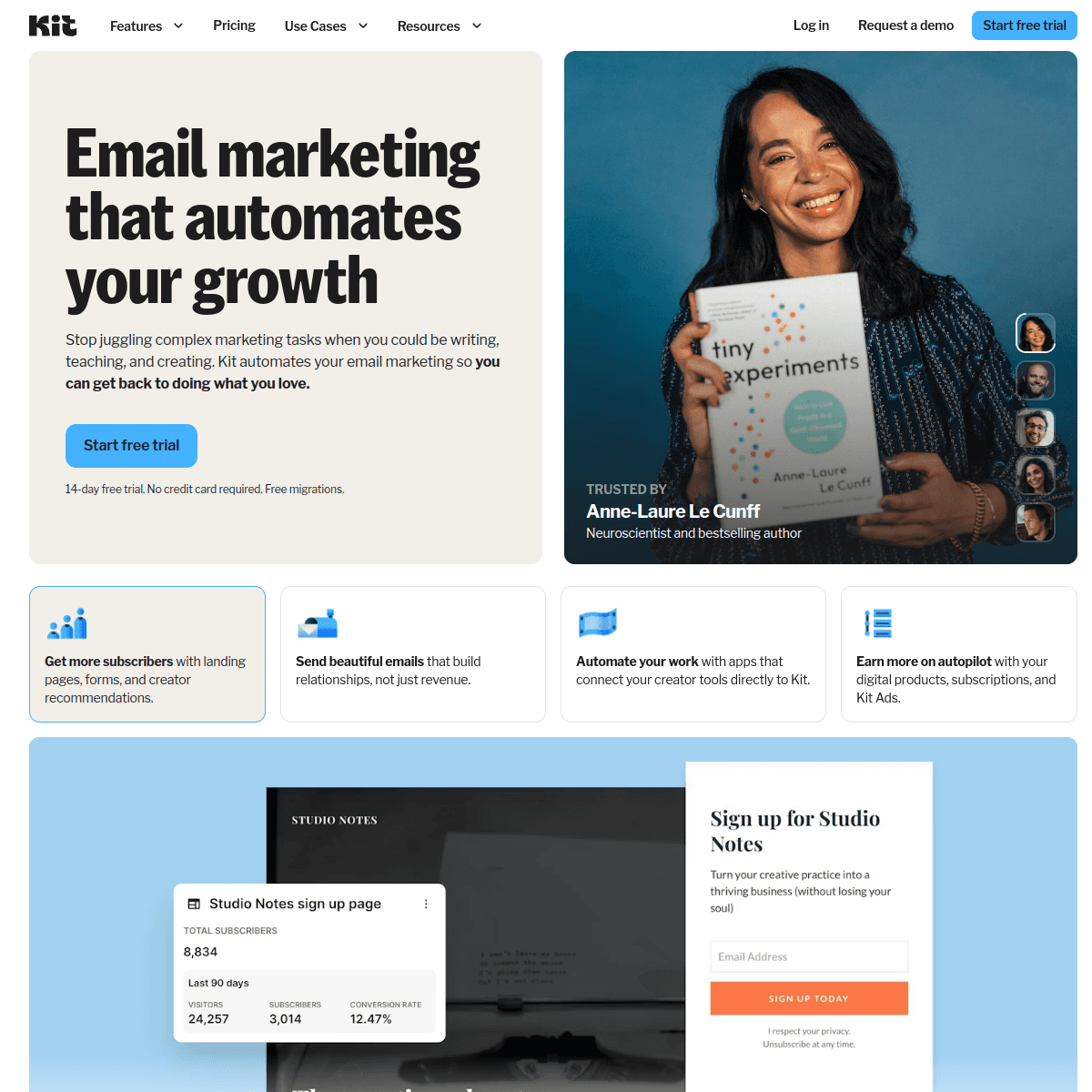
1. Does it charge for emails sent or fans stored? This is worth more than every other line combined. A 20,000-fan list emailed twice a month is 40,000 sends. On volume pricing that is one mid tier. On contact pricing you pay for 20,000 stored people every month, including the ones who signed up at a show in 2021 and have never opened anything. Volume-priced: Sequenzy, Brevo. Unlimited-send: EmailOctopus Pro, beehiiv, Bandzoogle. Contact-priced: Mailchimp, Kit, MailerLite, Flodesk, ActiveCampaign.
2. Can it segment by city without a spreadsheet? Good looks like a location attribute on the subscriber record and a segment builder that filters on it, so announcing five tour dates means five sends, not one apology. Sequenzy does this on custom attributes and tags, Kit on tags, ActiveCampaign on conditional logic, MailerLite and Mailchimp on segments. Audienceful and Laylo are too shallow for it.
3. Can it trigger from your merch store? Good looks like browse abandonment, price drop and back-in-stock firing automatically from real store activity, not a manual list of buyers. Sequenzy reads Shopify browse data natively. Mailchimp, MailerLite, Kit and ActiveCampaign have Shopify apps of varying depth. Bandzoogle has its own store, which is tighter but only inside Bandzoogle. Nobody has a Bandcamp connector.
4. Does it host a pre-save or capture page on your own domain? Good looks like a landing page builder included in the plan, on a domain you control, so the link in your bio is yours rather than a rented subdomain. Included on Sequenzy, MailerLite, Kit, EmailOctopus, Sender Standard, Brevo and Flodesk.
5. Is there an SMS path for drop day? Good looks like separate SMS consent, quiet hours, and STOP, START and HELP handled for you, because those are legal requirements you carry personally if the tool ignores them. Sequenzy runs SMS and MMS as a $16/mo add-on including 1,000 credits on a managed toll-free number. Brevo sells credits separately. Laylo is built around this. Sender adds SMS on Standard. Most of the rest have nothing.
6. Can you A/B test a subject line? Release day is one send a year where a five-point open-rate difference is worth real money. Included on Sequenzy, Kit, Mailchimp on higher tiers, ActiveCampaign, EmailOctopus and Sender Standard. On Brevo, A/B testing sits on the Business plan rather than Starter.
7. Can you get your list out? Good looks like a one-click CSV export of addresses, dates, sources and tags, plus an API. This matters more for musicians than for anyone else, because bands break up, managers change, and the list has to survive both. Every platform here exports, but check it before you commit rather than during a crisis.
The pricing model matters more than the feature list
Run the numbers before you look at anything else.
| Platform | What you are billed for | Consequence for an artist |
|---|---|---|
| Sequenzy | Emails sent, unlimited contacts | Fan count is free; sending is what costs |
| Brevo | Emails sent, unlimited contacts | Same shape, cheaper editor |
| EmailOctopus | Subscribers, unlimited sends | Frequency is free; list size is what costs |
| beehiiv | Subscribers, unlimited sends | Same shape, newsletter-oriented product |
| Bandzoogle | Flat subscription | Predictable, bundled with site and store |
| MailerLite, Kit, Mailchimp, Flodesk, ActiveCampaign | Contacts stored | You pay monthly for fans you did not email |
The gap is not marginal. On subscriber pricing you pay every month for people you contacted twice this year, and artists, more than almost anyone, have lists far larger than their sending frequency. If you find yourself hesitating before importing a stack of merch-table signups because it will push you into the next tier, that is a pricing problem, not a strategy problem, and it is costing you the asset.
The musician email playbook
Release campaigns: pre-save, reveal, release day, week two
Trigger: three weeks before the release date. Segment: the full list, minus anyone who unsubscribed or has not opened in 12 months. Metric to watch: release-day click rate, healthy at 8-20%.
- Three weeks out - the tease. A fifteen-second snippet, one lyric, or the artwork with the title held back. One link, to a pre-save page on your own domain that captures the email before handing off to Spotify or Apple. This is where a landing page earns its place: one URL that works in a bio, a story and a QR code. Subject lines that work: "Something new is coming", "We have been sitting on this since March".
- Three days out - the reveal. Title, artwork, what the song is about, who played on it. Pre-save links for every platform. Ask for one forward to one person, which is the only sharing mechanic that reliably works. Subject: "Ellis Wake is out Friday - hear it first".
- Release day - short and link-first. Streaming links above the fold, one paragraph underneath about what it means, nothing else competing for the click. Keep it under 120 words. A/B test this subject line and nothing else in the campaign: "It is here", "Out now: Ellis Wake", "Two years, four minutes".
- Day ten - the extra. A live take, a lyric video, the demo, the story of the session that nearly did not happen, or the merch bundle tied to the release. This is the send most artists skip, and it consistently out-earns release day for merch because the people who clicked on release day have now heard the song and want the object.
Do not send the release-day email to a list that has heard nothing from you in six months. Send a short reconnecting note two weeks before the tease, or the whole campaign lands on a cold list and generates spam complaints on the one day that matters.
Tour announcements and geo segmentation
Trigger: presale day, per city. Segment: fans whose city or postcode is within travelling distance of that date. Metric to watch: unsubscribe rate on tour sends, which should stay under 0.5% and will not if you blast.
Collect city or postcode at signup. One form field is the difference between a tour announcement that feels personal and one that emails a fan in Berlin about a show in Portland. Then run it in four passes:
| Send | Audience | Content |
|---|---|---|
| Presale announcement | One city at a time | Date, venue, support, presale code as an email-exclusive perk |
| Day before general sale | Same city, minus buyers | On-sale time, capacity, VIP or bundle options |
| Full round-up | Everyone | Every date in one email, plus a reply-with-your-city ask |
| Week of show | City segment | Doors, curfew, support, parking, food, what is special about this room |
The presale code is the part artists undersell. If being on the list does not get you tickets before the general public, the list has no benefit and people leave it. Give the list first access every single time, say so in the welcome sequence, and it becomes the reason people stay subscribed between records.
If you never collected location, ask twice before you need it: once in the welcome sequence, once in a standalone note a month before the announcement. You will get the engaged half of the list, which is the half that buys tickets.
Merch drops: email, SMS and Shopify
This is where independent music money actually is, and it is the most under-built part of most artists' email programmes.
Trigger: product goes live, plus automatic browse and stock triggers. Segment: full list for the drop, browse-abandoners for the follow-up, sold-out-size waiters for the restock. Metric to watch: conversion rate, 2-6% on the broadcast and several times that on the browse segment.
- Connect the store. If your merch is on Shopify, the Shopify integration gives you browse tracking, which turns fans who looked at the hoodie and did not buy into a segment you can email.
- Browse abandonment. A single email 24 hours later to people who viewed and did not check out beats a broadcast to your whole list, because intent is already established. Build this once and it runs on every drop forever.
- Price drops and back-in-stock. Both are automatic triggers. The restock email to people who tried to buy a sold-out size is the easiest revenue in the catalogue and takes about ten minutes to set up.
- Drop-day SMS. For genuinely limited runs, a text beats an email because the run sells out before tomorrow's inbox check. Two or three texts a year, with consent collected separately from email.
- Bandcamp buyers. No native connector exists anywhere. Export the CSV, tag them as buyers, and email them first on limited runs. They are your most valuable segment and they are not in your email tool unless you put them there.
- Ticket buyers. Same story: no email platform reads a ticketing platform natively. Export after each show, tag by city and by show, and you have built the geo segmentation for the next tour without asking anyone a question.
Fan ownership: why the list beats the algorithm
Every platform you build an audience on can change its reach overnight, and all of them have. An email list is the only audience you can take with you: you own the addresses, you can export them, and nobody sits between you and the people who like your music. Two hundred fans who chose to hear from you are worth more than twenty thousand followers a feed decides whether to show. That is the whole argument, and it has survived every platform shift so far.
The practical consequence is a rule about where you point links. Every piece of attention you receive - a playlist add, a viral clip, a support slot, a radio play - is temporary unless it produces an address. Point the link in your bio at a capture page, not at a streaming profile. Put the QR code on the merch table before you put a new design on it. The stream is worth fractions of a cent; the address is worth every future release.
The email formula that works for musicians
The pattern that consistently earns replies and clicks:
- Subject line: personal, conversational, under 50 characters. "Something happened in the studio" beats "Newsletter #14".
- Opening: one or two sentences of context. Where you are, what you have been doing.
- Body: one story. A behind-the-scenes moment, a reflection, something that actually happened. Not three stories.
- Link: one call to action. Stream this, buy this, come to this.
- Sign-off: your name, as a person.
No complex HTML template, no five competing buttons. The exception is a merch drop, where the product photo is the content and a designed layout earns its place.
What to send between releases
Monthly, minimum: a personal update. What you are working on, what is coming, something interesting that happened. Even with nothing to promote, stay in the inbox so that release day is not a cold start.
Around releases: the four-email campaign above.
Tour announcements: segmented by city, always.
Spontaneously: when something real happens. You finished tracking. A song came together. Someone covered you. These unplanned emails often get the highest engagement of the year because they are obviously not scheduled.
| Moment | Angle | Call to action |
|---|---|---|
| Three weeks before release | The story behind the song or record | Pre-save |
| Release day | Personal note, direct listening links | Stream now |
| Ten days after release | Thank-you plus one extra thing | Share, save, or buy the bundle |
| Tour announcement | City-specific invitation with presale code | Buy tickets |
| Two days after a show | Photos, gratitude, setlist | Stay connected, buy the shirt you saw |
| Merch drop | Product photos and honest stock numbers | Shop |
| Twice a year | Re-engagement or list clean | Stay or leave |
Segments worth building
Basic segmentation turns one broad fan list into a revenue asset. Five segments cover almost everything a musician needs.
| Segment | How you build it | What you send |
|---|---|---|
| By city | Location field at signup, plus ticket and show imports | Tour dates, presale codes, local support slots |
| Superfans | Opened the last five sends, or bought more than once | Early access, demos, limited runs before the public drop |
| Buyers | Merch, Bandcamp and ticket imports tagged at source | New drops, restocks, bundles |
| New subscribers | Joined in the last 30 days | Welcome sequence, best songs, the origin story |
| Dormant | No open in 180 days | Re-engagement, then removal |
Integrations that actually matter
Not all integrations are equal. Four matter for a musician, and two of them do not exist as native connectors anywhere.
- Merch store. Shopify is the one with real support across platforms. Sequenzy reads browse activity natively; Mailchimp, MailerLite, Kit and ActiveCampaign have apps of varying depth. Bandzoogle uses its own store.
- Bandcamp. No native connector on any platform. Export supporters as CSV, import with a buyer tag, refresh after each release.
- Ticketing. No native connector either. Export attendees after each run and tag by city and show. This is how you build geo segmentation without asking anyone anything.
- Your website. Embed the form in the header, the footer and a dedicated page, and point the link in your bio at a landing page rather than at a streaming profile. This is the integration that determines whether the list grows at all.
What a healthy fan list looks like at each stage
0-500 addresses. Build only. QR code at shows, form on every page, capture page in the bio, incentive on the signup. Do not worry about features. Any free tier here works.
500-2,000. Add the welcome sequence and start collecting city. This is where most independent artists live, and it is where the difference between a list and a database gets made.
2,000-10,000. Pricing starts to matter. Move to a volume-priced or unlimited-send platform if you have not. Add behavioural automation: browse abandonment, post-show follow-up, re-engagement.
10,000+. The list is now a meaningful revenue line. Segment properly, A/B test release subject lines, wire the merch store triggers, and add SMS for drop day. At this size the difference between contact pricing and volume pricing is hundreds of dollars a year.
The arithmetic
Take a list of 5,000 fans performing at the middle of the ranges above: a 40% open rate and an 8% click rate on a release send.
- 2,000 people open every email you send.
- 400 people click through to the release.
- If 10% of those clickers buy a $25 ticket or a $25 record, that is $1,000 from one send.
- A four-email release campaign that keeps roughly that shape produces a few thousand dollars of attributable revenue per release.
Now run the same arithmetic at 20,000 fans. The list is the only asset in a music career that compounds without anyone else's permission, and the cost of holding it should be close to nothing, which is exactly why the pricing model in the first table matters as much as it does.
What it costs at 2,000, 20,000 and 50,000 fans
Assumptions: two sends a month to the full list, monthly billing unless noted, prices from our pricing guides which track each vendor's published rates. Two sends a month means 4,000 emails at 2,000 fans, 40,000 at 20,000 fans and 100,000 at 50,000 fans.
| Platform | 2,000 fans | 20,000 fans | 50,000 fans |
|---|---|---|---|
| Sequenzy | $19/mo (15,000 emails) | $49/mo (60,000 emails) | $99/mo (120,000 emails) |
| Brevo | Starter from $9/mo at 5,000 emails | Between the 20,000 and 100,000 volume steps | 100,000 emails for $69 on Starter |
| EmailOctopus | About $18/mo, unlimited sends | Above the 10,000-subscriber rate of about $24/mo | Higher again; priced by subscriber slider |
| beehiiv | Free on Launch up to 2,500 subscribers | Scale from $43/month billed annually | Scale or Max, from $43 to $96/month annually |
| Bandzoogle | From $10/month all-in | From $10/month all-in | From $10/month all-in |
| Kit | $59/mo at 3,000 subscribers | Above the $119/mo 10,000-subscriber rate | Higher again; priced by subscriber band |
| MailerLite | Comfort from $12/mo at the entry band | Priced by subscriber band, well above entry | Priced by subscriber band |
| Flodesk | Lite $19/month | Lite $19/month, capped at 25,000 subscribers | Above the Lite cap; Pro or Everything tier |
| Mailchimp | From about $13/month on entry tiers | Priced by contact band, and the tier you need is rarely the cheapest | Priced by contact band |
| ActiveCampaign | Plus from $49/mo at 1,000 contacts | Above the $239/mo 10,000-contact rate | Higher again; quote-driven at this size |
Where a vendor does not publish a rate at a given list size, this table says so rather than inventing a number. The pattern is the point: volume-priced and unlimited-send platforms are flat or nearly flat across all three columns, and contact-priced platforms roughly triple between the first and the last.
Two things this table does not include. SMS is extra everywhere: Sequenzy's add-on is $16/mo including 1,000 credits, Brevo sells credits separately, and Laylo prices by fan count and message volume. And Bandzoogle's flat line only holds if you also use its website, so compare it against your current site hosting rather than against an email bill alone.
Getting started: first 30 days
Week 1 - own the addresses you already have. Choose a platform from the table above based on your list size and how often you send. Export everything you have: Bandcamp supporters, Patreon members, previous newsletter tool, the spreadsheet from the merch table, the shared band inbox. Import with a source tag on each batch. Set up your sending domain with SPF, DKIM and DMARC on day one, because it takes a few hours and fixing deliverability later takes months. Build one capture page on your own domain and point the link in your bio at it.
Week 2 - build the welcome sequence. Four emails over 14 days, written in one sitting: the welcome and best songs, the story behind the song that matters, where to find you plus one list-only extra, and the question that asks for a city and a reply. Turn it on. Every signup from now on gets it automatically, including the fifty people who scan the QR code at Saturday's show. Add the city field to your form while you are in there.
Week 3 - wire the store and the segments. Connect Shopify if your merch is there, and switch on browse abandonment, price drop and back-in-stock. Import your Bandcamp buyers and tag them. Build the five segments in the table above: by city, superfans, buyers, new, dormant. Send your first real broadcast - a monthly update, not a pitch - so the list hears from you before you need something.
Week 4 - test, measure, plan. Send a second broadcast and A/B test the subject line, so you learn the mechanic before release day rather than on release day. Look at three numbers: open rate, click rate, and unsubscribes per send. If open rate is under 25%, your list is cold and needs a re-engagement pass, not better subject lines. Then map the next release onto the four-email campaign above, with dates in the calendar, and set the QR code and merch-table routine as a standing job for every show.
By the end of the month you have a list you own, an automation that works while you sleep, a store that emails people for you, and the segments that make a tour announcement land. Everything after that is content.
Musician email benchmarks
| Metric | Healthy range | Notes |
|---|---|---|
| Open rate | 35-50% | Music lists run well above the cross-industry average |
| Release-day click rate | 8-20% | Streaming links convert hard when the email is short |
| City-segmented tour email click rate | 10-25% | The highest-clicking send a musician makes |
| Merch broadcast conversion | 2-6% | Several times higher on a browse-abandonment segment |
| Post-show follow-up open rate | 40-60% | They were in the room two days ago |
| Unsubscribe per send | Under 0.5% | Spikes on ungeotargeted tour blasts |
| Reply rate on a question email | 1-5% | Low-looking, but every reply is segmentation data |
| List growth per show | 5-15% of the room | With a real incentive at the merch table |
| Sending frequency | 1-2 per month plus events | Silence, not frequency, is the usual failure |
Where to go next
- Newsletter ideas for musicians - what to send between releases
- Email marketing for DJs - bookings, residencies and event promotion
- Email marketing for artists, podcasters and music teachers
- Shopify integration - merch drops, browse abandonment and restocks
- SMS - drop-day and show-day announcements with separate consent
- Landing pages - pre-save and email-capture pages on your own domain
- A/B testing - for the release-day subject line
- Smart segments - city, buyer and superfan segments from attributes
- Zapier integration - for Bandcamp, ticketing and anything without a native connector
- Product launch email templates - adaptable to a release campaign
- How to grow your email list and how to A/B test subject lines
- Email deliverability guide - domain authentication before your first send
- Compare Sequenzy and Mailchimp or MailerLite
- Pricing - what a 20,000-fan list actually costs
Start free - 2,500 emails a month, unlimited fans stored, and you can import your Bandcamp and Patreon CSVs on day one.