
Overview
MailUp and Constant Contact are established email platforms with different pricing models. For our take on each, see our MailUp comparison and Constant Contact comparison.
Constant Contact's Breadth
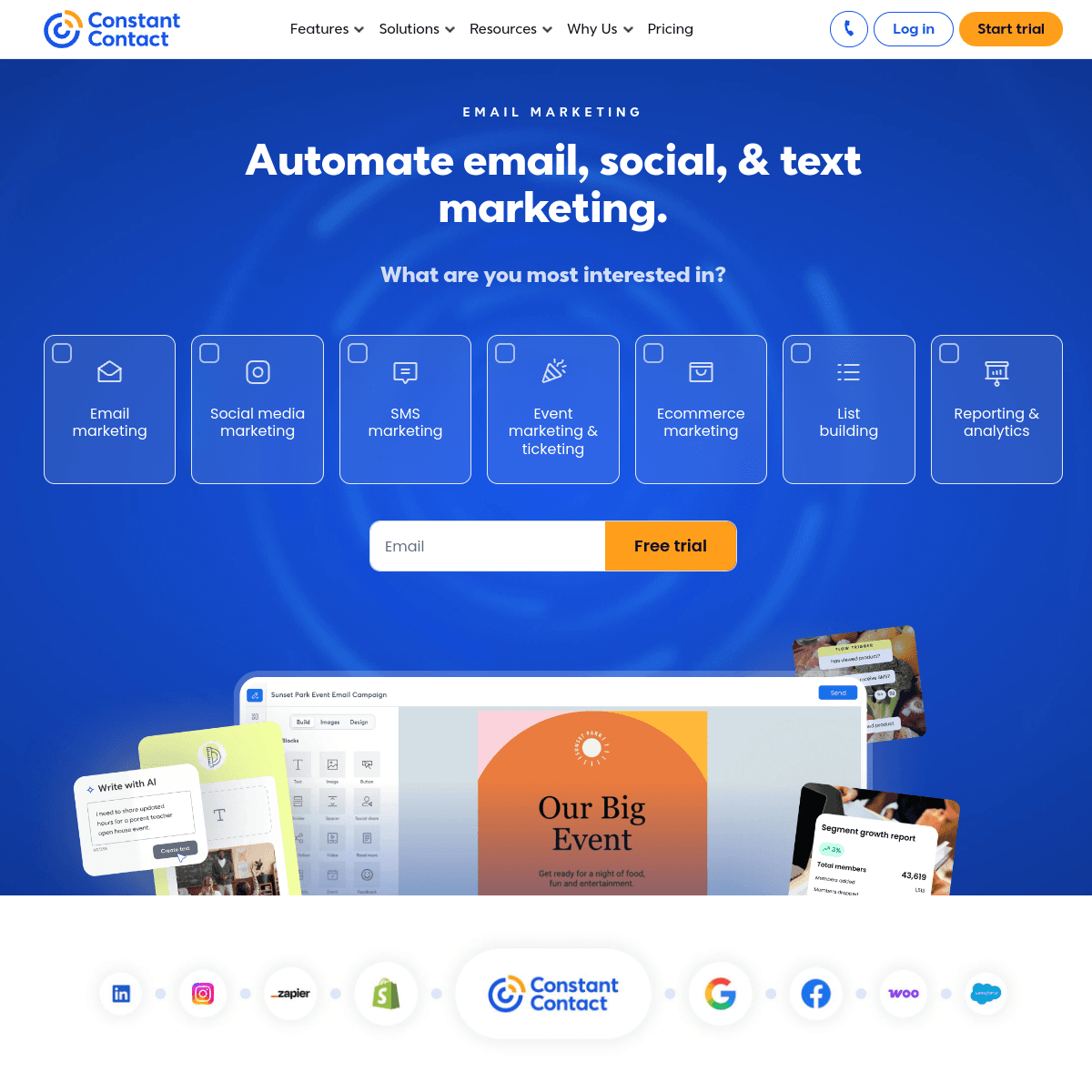
Constant Contact goes beyond email with event marketing, social media posting, surveys, and phone support. It's been around since 1995. MailUp has fewer extra features but focuses on email + SMS with unlimited contacts.
MailUp's Contact Value
At nearly half the price with unlimited contacts, MailUp is the better deal for businesses that primarily need email. The BEE editor and 76 email client previews are bonuses. If you don't need events or social tools, MailUp saves money.
The Sequenzy Alternative
For SaaS founders who don't need event marketing or social tools, Sequenzy combines transactional email and marketing campaigns with Stripe integration at $49/month.
Small Business vs Enterprise Needs
Constant Contact has been serving small businesses since 1995, and their platform reflects that experience. Event marketing, social posting, surveys, and phone support are all features that small business owners find valuable. MailUp, by contrast, is more focused on the email sending itself. If your business runs events and relies on social media, Constant Contact bundles those tools together.
However, Constant Contact's pricing reflects this breadth. At $80/month for 10K contacts, you are paying a premium for features you may not use. If your primary need is sending email campaigns to a large list, MailUp achieves that at roughly half the cost. Evaluate honestly which tools you actually use before deciding.
Support and Onboarding Experience
Constant Contact's phone support on all plans is genuinely rare in the email marketing space. Most platforms, including MailUp, limit support to email and chat. For teams that value being able to pick up the phone and talk to a human, this is a significant advantage. Constant Contact also offers in-person seminars and workshops in some regions.
MailUp's support is adequate but not exceptional. The BEE editor has its own documentation and community, which helps with email design questions. For technical email issues like deliverability, both platforms offer knowledge bases and ticket-based support.
Long-Term Cost Analysis
The price difference between these platforms becomes dramatic at scale. At 10K contacts, MailUp saves roughly $33/month. At 50K contacts, the gap widens to potentially hundreds of dollars monthly since Constant Contact's per-contact pricing keeps climbing while MailUp stays flat. Over a year, that difference can fund other marketing tools.
Before committing, run the numbers for your projected list growth over the next 12-24 months. If you expect rapid list growth, MailUp's unlimited contacts model provides predictable budgeting. If your list is stable and you value the extra marketing features, Constant Contact's premium may be justified.
Use-case matchups
| Need | Better fit | Why |
|---|---|---|
| Flat-rate email and SMS campaigns for growing lists | MailUp | MailUp is cited for unlimited contacts, BEE editor, SMS, 76-client previews, and lower cost at 10k. |
| Events, social posting, surveys, and phone support | Constant Contact | Constant Contact is cited for event management, social tools, phone support, surveys, long track record, and brand trust. |
| Large lists where per-contact pricing hurts | MailUp | MailUp is listed at about $47/month, while Constant Contact is listed at $80/month at 10k contacts. |
| SaaS marketing plus transactional email | Sequenzy | Sequenzy is listed at $49/month with transactional plus marketing and Stripe integration. |
Best Fit by List Growth and Support Need
Best email marketing tool for growing lists on flat-rate pricing
MailUp fits teams that want BEE design, SMS, client previews, and lower cost as contact count grows.
Best email platform for events, surveys, and phone support
Constant Contact is the better fit when event management, social tools, surveys, phone support, and long-standing small-business trust are the deciding factors.
Best email platform for SaaS lifecycle and transactionals
Sequenzy fits when transactional plus marketing email and Stripe integration matter more than event workflows or broad small-business support.
Pricing reality
MailUp is listed at about $47/month for Starter with unlimited contacts and emails. Constant Contact is listed at $80/month for Standard at 10k subscribers. Sequenzy is listed at $49/month for 60k emails (unlimited subscribers), with transactional plus marketing email and Stripe integration.
MailUp wins on predictable cost and design-oriented email sending. Constant Contact costs more but adds events, social, surveys, phone support, and a longer support-oriented small-business package.
Review signals
MailUp reviews cited here highlight cost savings, the BEE editor, and unlimited contacts for large lists. The cautions are basic automation and fewer adjacent marketing tools.
Constant Contact reviews cited here highlight event management, phone support, surveys, social posting, and reliability. The tradeoff is aggressive pricing as contact counts grow.
Migration checklist
- Export contacts, lists, templates, campaigns, automations, events, social settings, surveys, SMS settings, forms, and suppression data.
- If moving to Constant Contact, rebuild event workflows, surveys, social posting, and support-dependent campaign processes.
- If moving to MailUp, identify how events, social posting, surveys, and phone-support needs will be replaced.
- Reconfigure SPF, DKIM, DMARC, sender identities, tracking domains, SMS settings, forms, and unsubscribe handling.
- Test campaigns, events, surveys, signup forms, automations, and suppression behavior before switching traffic.
Decision checklist
- Choose MailUp if email/SMS volume and predictable pricing matter most.
- Choose Constant Contact if events, phone support, surveys, and social tools are central.
- Avoid MailUp if you need integrated event marketing.
- Avoid Constant Contact if list growth makes per-contact pricing too expensive.
- Choose Sequenzy if SaaS lifecycle and transactional email are the main requirements.








