Overview
Encharge and Drip both offer marketing automation, but they serve different business models. Encharge is built for B2B SaaS with Stripe integration, lead scoring, and behavior-based onboarding. Drip comes from e-commerce with revenue tracking, abandoned cart flows, and native Shopify integration.
Choosing between them depends entirely on what you sell - software subscriptions or physical products.
The SaaS vs E-commerce Divide
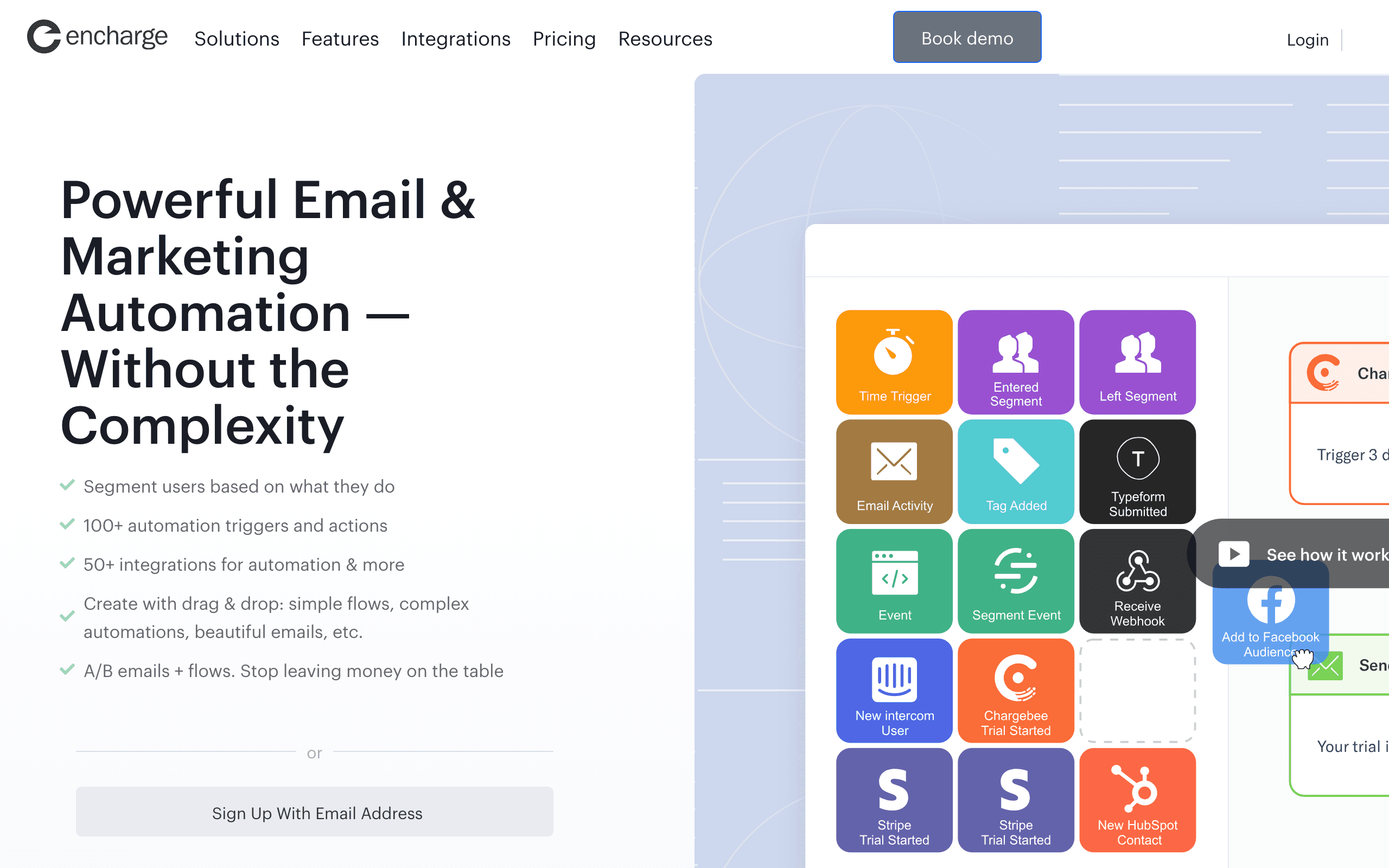
Encharge understands SaaS. Native Stripe and Chargebee integrations let you trigger automations based on subscription events - trial starts, upgrades, cancellations, failed payments. Lead scoring helps identify users ready for sales conversations. These features matter when you sell software.
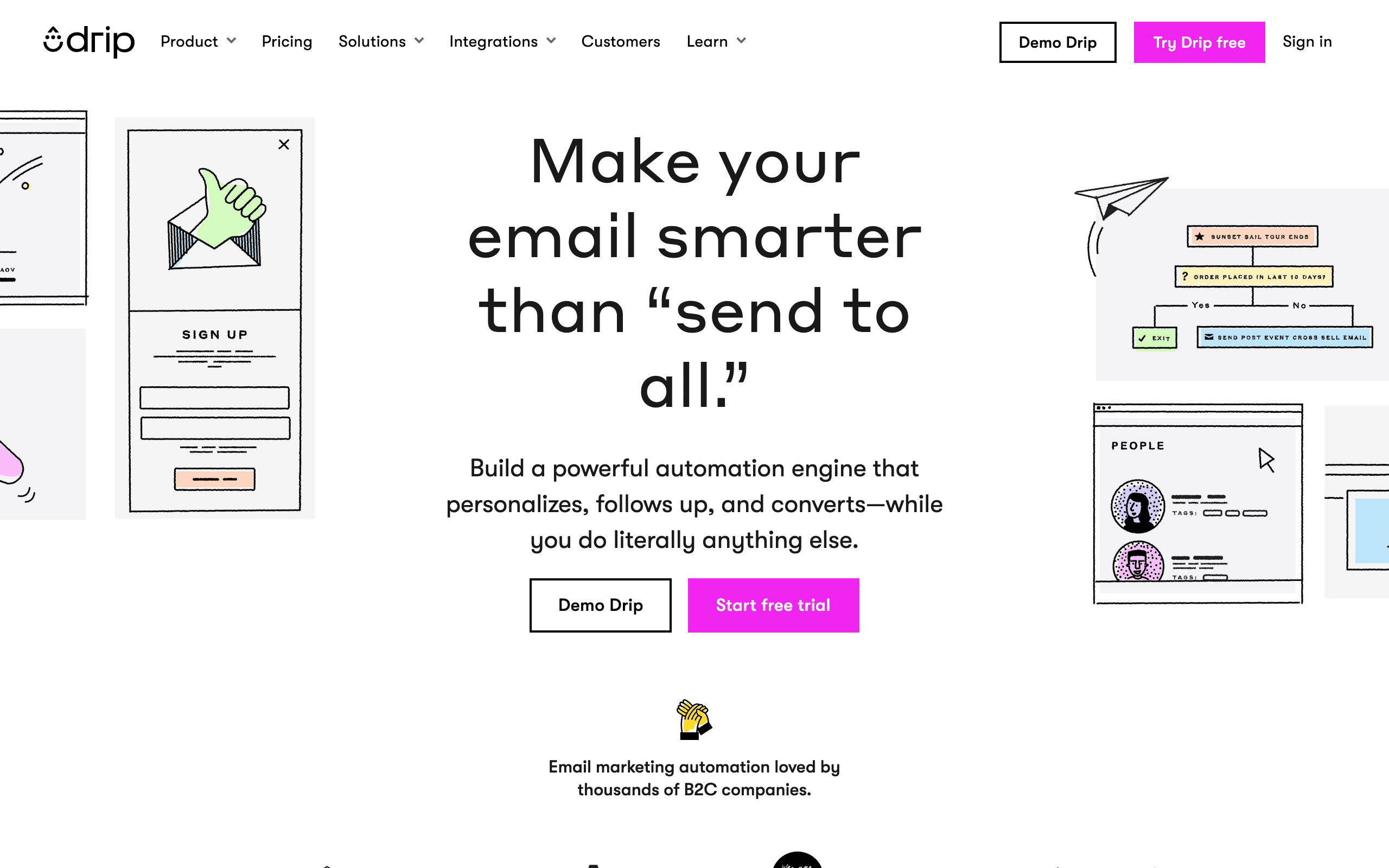
Drip understands e-commerce. Native Shopify integration, cart abandonment triggers, browse abandonment tracking, and revenue-per-campaign attribution are core features. These matter when you sell products. Compare options in our email marketing guide.
Payment Tool Integrations
This is where Encharge clearly wins for SaaS. Native Stripe integration means subscription events flow into your automation workflows automatically. Trial expiry reminders, upgrade nudges, and churn prevention campaigns work without custom development.
Drip requires Zapier for Stripe integration. It works, but it is not as deep or reliable. Drip's native integrations focus on e-commerce platforms, not payment processors. For subscription businesses, this matters.
E-commerce Capabilities
This is where Drip clearly wins for online stores. Native Shopify, WooCommerce, and BigCommerce integrations provide cart abandonment, browse abandonment, and revenue tracking out of the box. Revenue attribution shows which campaigns drive sales.
Encharge has no e-commerce features. No cart abandonment, no product recommendations, no Shopify integration. It is not trying to serve e-commerce - it is focused on SaaS.
Automation Features
Both platforms have solid visual workflow builders. The difference is in what events trigger automations.
Encharge triggers on SaaS events: feature usage, login frequency, trial days remaining, subscription changes. Drip triggers on e-commerce events: cart additions, purchases, browse behavior, order value. Learn more about smart segmentation.
Both support time-based triggers, form submissions, and tag-based segmentation. The fundamentals are similar.
Pricing Comparison
Surprisingly, pricing is nearly identical at scale. At 10,000 contacts:
- Encharge: $179/month (Growth plan)
- Drip: $184/month (all features included)
Both include all features at their standard tiers. Neither nickel-and-dimes you with add-ons. The price is similar - the difference is in what you get for that price. Compare with Sequenzy's pricing at $49/month.
When Each Platform Wins
Choose Encharge when: You run a B2B SaaS company with Stripe billing and need behavior-based onboarding, lead scoring, and payment event automation.
Choose Drip when: You run an e-commerce store on Shopify or WooCommerce and need cart abandonment, revenue tracking, and purchase-based segmentation.
Use-case matchups
| Use case | Better fit | Why |
|---|---|---|
| B2B SaaS onboarding | Encharge | Encharge is built around product behavior, trial journeys, Stripe/Chargebee events, and lead scoring. |
| Shopify or WooCommerce retention | Drip | Drip is stronger for cart recovery, browse abandonment, purchase history, and revenue attribution. |
| Subscription billing lifecycle | Sequenzy | Sequenzy is better when Stripe-triggered lifecycle email and transactional messages should live in one platform. |
| Sales-qualified lead nurture | Encharge | Encharge has better B2B scoring and qualification logic than Drip's ecommerce-oriented model. |
| Ecommerce revenue campaigns | Drip | Drip's reports and triggers are oriented around products, carts, orders, and revenue. |
| Lower-cost SaaS email stack | Sequenzy | Sequenzy is a better fit when Encharge's SaaS focus is useful but the team also needs transactional email at lower cost. |
Best Fit by Business Model
Best email automation tool for B2B SaaS onboarding
Encharge is the better fit when the email strategy depends on product behavior, trial status, lead scoring, and SaaS billing context. Choose it for onboarding sequences, activation nudges, sales-qualified lead nurture, account-based handoff, and Stripe or Chargebee events that should influence marketing automation. It is strongest when the buyer journey is software adoption rather than product-cart recovery.
Best ecommerce email platform for Shopify and WooCommerce stores
Drip is stronger when the business sells products through a store and needs automation tied to carts, orders, products, discounts, purchase history, and repeat buying. It is a better fit for DTC brands and ecommerce teams that want abandoned cart recovery, browse abandonment, post-purchase flows, and revenue reporting. Drip's value appears when store data drives campaigns every week.
Best SaaS email platform for Stripe lifecycle plus transactionals
Sequenzy is the better fit when the team wants SaaS lifecycle automation and transactional email together at a lower operational cost. It is especially relevant for founders who need onboarding, receipts, renewal reminders, failed-payment emails, and customer campaigns without paying for an ecommerce platform or a broader SaaS marketing suite. The deciding factor is unified Stripe-triggered email.
The Sequenzy Alternative
Both Encharge and Drip cost around $180/month at 10k contacts. Sequenzy costs $49/month with deeper Stripe integration than Encharge and unified transactional + marketing email. For SaaS founders on Stripe who want simplicity, Sequenzy offers better value.
Business Model Alignment
The most important factor in this comparison is what your business sells. If you sell software subscriptions billed through Stripe or Chargebee, Encharge's native payment integrations and SaaS-specific workflows give you relevant automation out of the box. If you sell physical products through Shopify or WooCommerce, Drip's e-commerce features - cart abandonment, browse tracking, revenue attribution - are essential.
Trying to use Drip for SaaS or Encharge for e-commerce means fighting against the platform's design. Both tools are opinionated about their target market, and that opinion is reflected in every feature, integration, and workflow template.
Trigger Event Differences
The events that drive automation differ fundamentally between these platforms. Encharge triggers on SaaS-specific events: feature usage, login frequency, trial days remaining, subscription plan changes, and payment failures. Drip triggers on e-commerce events: cart additions, product views, purchase history, order value, and browse behavior.
Both platforms support basic triggers like email opens, link clicks, and form submissions. But the specialized triggers are what make each platform valuable for its target market. Choosing the platform whose triggers align with your business events is the key decision.
Cost Parity and Value Assessment
At approximately $180/month for 10k contacts, both platforms are in the same price range. The question is not which is cheaper but which delivers more relevant value for your specific business model. Paying $179/month for SaaS automation you actually use is better value than paying $184/month for e-commerce features you will never touch, and vice versa.
For SaaS founders who find both platforms expensive, Sequenzy offers native Stripe integration and unified marketing plus transactional email at $49/month - roughly 73% less than either option.
Pricing reality
The listed 10,000-contact prices are close: Encharge at $179/month and Drip at $184/month. That removes price as the main decision point and makes business model fit more important.
Encharge should be evaluated by SaaS workflow value: Stripe or Chargebee events, trial-to-paid automation, lead scoring, and user behavior triggers. Drip should be evaluated by ecommerce revenue value: cart recovery, purchase behavior, Shopify or WooCommerce data, and campaign revenue attribution.
Sequenzy's $49/month price is relevant only when the team wants a lower-cost SaaS email stack with Stripe-triggered lifecycle and transactional messages rather than Drip's ecommerce feature set.
Review signals
The Encharge reviews here support the SaaS positioning: one reviewer praises Stripe-triggered onboarding and lead scoring, while another says the product works for email-only workflows but feels expensive without more channels or integrations.
The Drip reviews are ecommerce-specific. Users praise Shopify revenue tracking and abandoned cart recovery, while also noting that Drip is not a good fit for SaaS product emails. That makes the review signal unusually clear: choose by business model, not by generic automation claims.
Migration checklist
- Decide whether the business model is SaaS subscription lifecycle automation or ecommerce retention before rebuilding workflows.
- Export contacts, companies, tags, segments, custom fields, lead scores, product events, Stripe/Chargebee data, ecommerce events, templates, automations, and reports.
- If moving to Encharge, map Drip customers, purchase history, tags, and campaigns into SaaS fields, product events, scores, and billing-triggered flows.
- If moving to Drip, map Encharge users, lead scores, SaaS events, templates, and billing data into customer profiles, ecommerce events, and store-driven automations where possible.
- Rebuild priority flows first: onboarding, trial expiry, activation, upgrade, payment failure, abandoned cart, post-purchase, win-back, and re-engagement.
- Reconnect Stripe, Chargebee, Shopify, WooCommerce, forms, analytics, CRM, support tools, webhooks, and suppression syncing.
- Authenticate sending domains, test unsubscribe behavior, and run one billing-triggered flow plus one purchase-triggered flow before full migration.
- Preserve historical MRR, revenue, score, cart, campaign, and deliverability reports so the team can compare SaaS relevance against ecommerce depth.
Decision checklist
- Does the business sell software subscriptions or ecommerce products?
- Are Stripe or Chargebee events central to the lifecycle email strategy?
- Are cart abandonment, purchase history, and revenue attribution central to the email strategy?
- Would Encharge's email-only model be enough, or are other channels needed?
- Is Sequenzy's lower-cost Stripe lifecycle model a better fit than either specialist platform?