

Overview
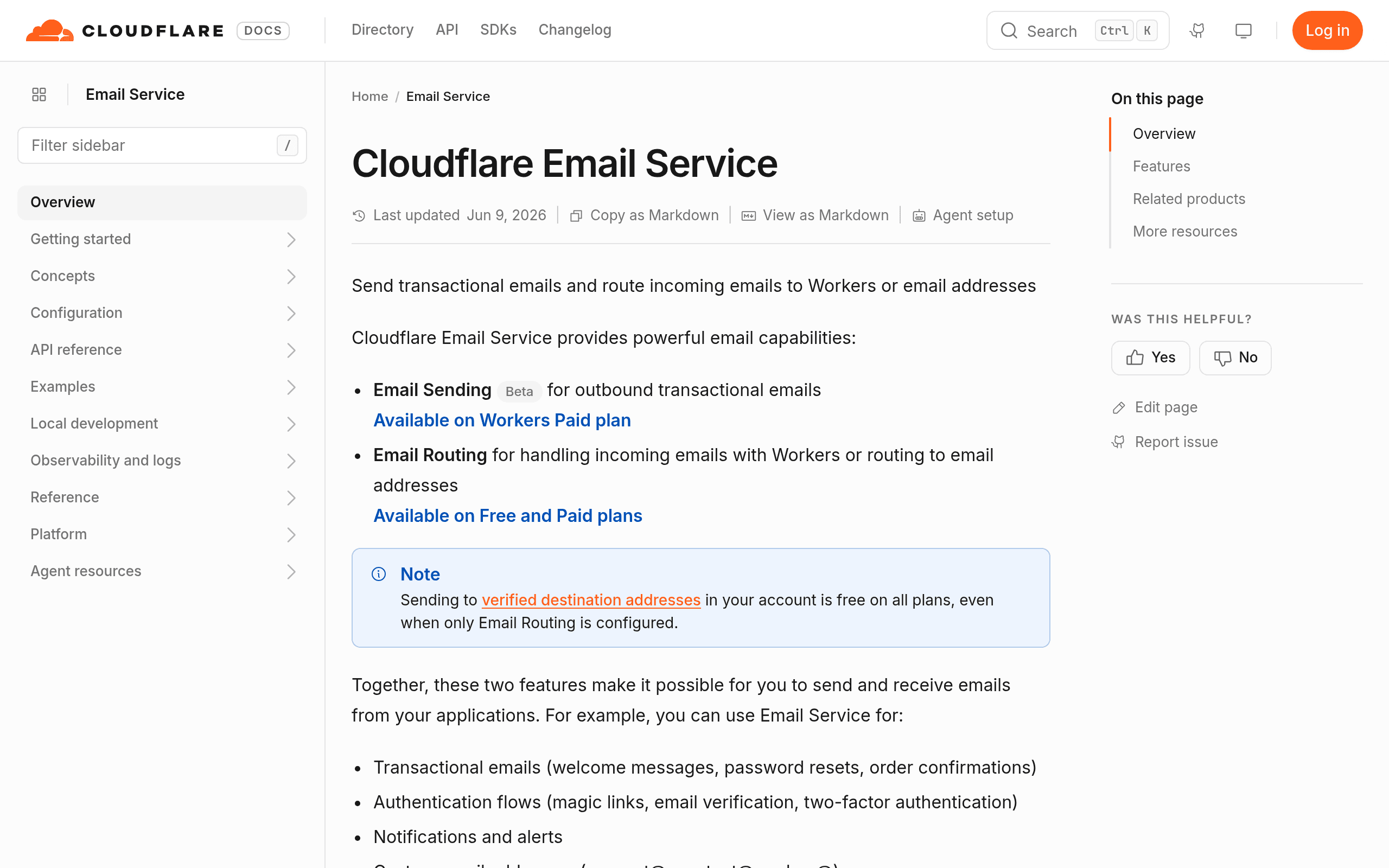
Cloudflare Email Service and Resend are both developer-first transactional email products with similar philosophies but very different ecosystems. Cloudflare Email is the new entrant - public beta since April 2026 - tightly integrated with the Workers stack and AI Agents SDK. Resend has been the modern-DX standard since 2023, with first-class React Email support, broad SDK coverage, and GA stability.
DX Showdown
Inside Workers, Cloudflare Email is genuinely the cleanest DX option: enable Email Service on your account, declare a binding in wrangler.toml, and send mail with no API keys, no HTTP, no fetch boilerplate. Edge co-location means your sending call doesn't leave Cloudflare's network.
Outside Workers, the gap closes. Both expose REST APIs and SDKs. Cloudflare ships TypeScript, Python, and Go SDKs; Resend ships TS/JS, Python, Ruby, Go, PHP, Java, Rust, and .NET. Resend's docs and onboarding are noticeably more polished, and the React Email integration is tightly coupled - the @react-email packages and Resend's SDK are designed together.
React Email
Resend created React Email and treats it as first-class. Their docs walk through component-based templates with examples and the SDK accepts a React component directly. Cloudflare Email works with React Email - you render the component to HTML and pass the string to the API - but the integration is manual.
For teams that want their email templates as React components living next to their app code, Resend remains the better default.
Pricing reality
Cloudflare is cheaper at most volumes. At 100k emails/mo, Cloudflare is roughly $39 ($5 Workers Paid + ~$34 sending) vs Resend's $90 Scale plan. At 1 million emails, Cloudflare is ~$355 vs Resend's $650+. The cost gap is meaningful at scale.
The exception is the very low end. Resend's 3,000/mo free tier has no base-plan requirement - so a side project that sends 500 emails/mo is genuinely free. Cloudflare's 3,000/mo included tier requires the $5/mo Workers Paid plan.
Review signals
The existing reviews split by maturity and DX. Cloudflare Email reviews praise Workers binding ergonomics, no environment variables, and the combined Email Service plus Routing stack, while still keeping it away from user-facing critical paths because of beta status. Resend reviews praise fast production setup, React Email, DX, and the free tier, while flagging cost growth at scale.
Use reviews to decide which risk matters more: Cloudflare's beta and narrower ecosystem, or Resend's higher cost at volume.
Use-case matchups
| Use case | Better fit | What to verify |
|---|---|---|
| Workers-native transactional layer | Cloudflare Email | Confirm beta status, binding ergonomics, DNS automation, recipient caps, and Workers ownership. |
| Modern provider-independent email API | Resend | Verify SDK coverage, React Email workflow, webhooks, logs, domains, and GA stability. |
| React component email templates | Resend | Resend's React Email path is first-class; Cloudflare requires manual rendering. |
| Lowest per-email cost inside Cloudflare stack | Cloudflare Email | Model Workers Paid, per-email charges, and any limits. |
| SaaS marketing plus transactional email | Sequenzy | Compare if lifecycle campaigns and billing-triggered email are required. |
Maturity Trade-off
Resend has been GA since 2023, has thousands of production customers, and a well-developed ecosystem (SDKs, integrations, third-party libraries). Cloudflare Email is in public beta as of April 2026 with explicit notes that APIs may change. For mission-critical email (auth, billing, password resets) the maturity difference matters.
That said, Cloudflare is Cloudflare - the underlying network and operational maturity are world-class. The "beta" label here is mostly about API stability, not infrastructure reliability.
Inbound
Both have inbound stories. Cloudflare Email Routing is free and integrates cleanly with Email Workers for programmatic processing. Resend Inbound parses incoming email and forwards via webhooks. Both are reasonable - Cloudflare's free tier is the cleanest "just forward this address to my Gmail" UX, and Resend's webhook model integrates naturally with existing app code.
When Cloudflare Email Wins
You're already on Workers, you want the binding ergonomics, your domain is on Cloudflare DNS (auto SPF/DKIM/DMARC), or you're building an AI agent on Cloudflare's stack. Volume small enough that the included tier covers most or all sending makes it even more attractive.
When Resend Wins
You want GA stability, React Email as first-class, broader SDK coverage, or you're building from anywhere other than Workers. The DX is more polished, the ecosystem is wider, and the maturity story is several years ahead.
The Marketing Gap
Neither product solves marketing. If your SaaS needs lifecycle email, drip sequences, or campaign analytics, you'll either build on top or run a marketing platform alongside. Sequenzy is purpose-built for that case - unified marketing and transactional with native Stripe integration, AI sequence generation, and a visual editor.
Making the Choice
Choose Cloudflare Email if you're on Workers and care about edge ergonomics. Choose Resend for the best provider-independent transactional DX with GA maturity. Choose Sequenzy if you also need marketing automation in one platform.
Migration checklist
| Step | What to confirm |
|---|---|
| Domain and DNS | Reverify domains, SPF, DKIM, DMARC, return-path, tracking domains, and Cloudflare DNS assumptions. |
| API calls | Replace Workers bindings, Resend SDK calls, REST payloads, retries, idempotency, and error handling. |
| Templates | Move React Email components, rendered HTML, text fallbacks, variables, and preview/test workflow. |
| Events | Rebuild delivery, bounce, complaint, open, click, webhook, log, and alert pipelines. |
| Suppressions | Preserve bounced, complained, unsubscribed, blocked, and manually suppressed recipients. |
| Rollout | Parallel-send low-risk templates before moving password resets, 2FA, receipts, and billing emails. |
Best Fit by Developer Email Workflow
Best transactional email option for Cloudflare Workers apps
Choose Cloudflare Email when the app already lives on Workers and the team values edge-native bindings over provider-independent abstractions. The fit is strongest when email is tightly coupled to Workers infrastructure.
Best transactional email API for React Email teams
Choose Resend when the team wants a polished provider API, React Email workflow, and mature transactional sending outside a single edge platform. It is the better fit when developer experience and portability matter.
Best email marketing tool for SaaS apps that also need campaigns
Choose Sequenzy when transactional email is only part of the requirement and the product also needs newsletters, lifecycle sequences, and subscription-triggered automation. Cloudflare Email and Resend handle sending; Sequenzy handles the broader SaaS email program.
Decision checklist
| Question | Why it matters |
|---|---|
| Is your app primarily on Workers? | Cloudflare's binding is the clearest advantage inside Workers. |
| Do you need GA maturity today? | Resend is more mature for mission-critical transactional email. |
| Are React Email templates central to the workflow? | Resend's first-class React Email support is stronger. |
| How painful is cost at scale? | Cloudflare is cheaper at most higher-volume scenarios. |
| Is Sequenzy enough? | If lifecycle campaigns and billing-triggered email are required, a transactional-only API may not be enough. |









