
Overview
SendPulse and Sender both target budget-conscious businesses. For our take on each, see our SendPulse comparison and Sender comparison.
Sender's Budget Advantage
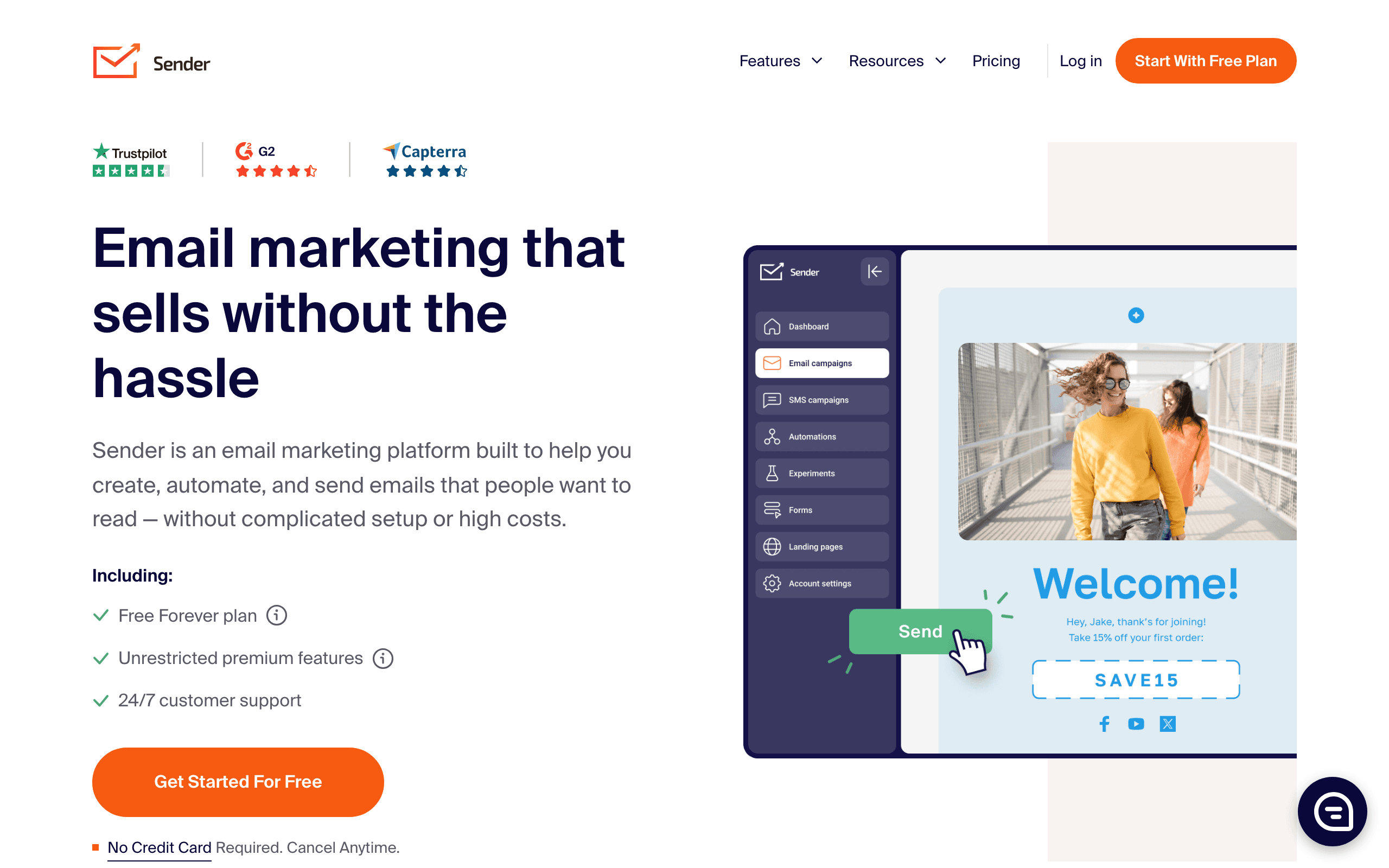
Sender is half the price of SendPulse and includes SMS. Its free tier lets 2,500 subscribers send 15,000 emails/month. For email and SMS on a budget, Sender is one of the best values in the market. No chatbots, no CRM, no frills, just affordable email and SMS.
SendPulse's Extra Channels
If you need chatbots for WhatsApp, Telegram, or other platforms, SendPulse is the only choice here. It also includes CRM and landing pages. But you're paying double for those extras. Only worth it if you'll actually use the additional channels.
The Sequenzy Alternative
The Budget Email Platform Category
Sender represents a growing category of email platforms that compete on value rather than feature breadth. At $47/month for 10,000 subscribers, it costs less than half of SendPulse while delivering solid email marketing with good automation.
For businesses where email is the primary marketing channel and budget optimization matters, Sender's pricing is compelling. The $49/month savings compared to SendPulse adds up to nearly $600/year. That money can fund ad spend, content creation, or other growth initiatives.
The trade-off is clear: fewer channels, fewer features, less brand recognition. But if your marketing is email-centric, these trade-offs cost you nothing in practical terms.
Free Tier Generosity
Sender's free tier with 2,500 subscribers and 15,000 emails per month is one of the most generous in the industry. SendPulse's free tier caps at 500 subscribers with 15,000 emails. For getting started, Sender allows 5x more subscribers before requiring payment.
This generous free tier makes Sender particularly attractive for startups and small businesses that want to build their email list before committing to paid software. You can reach 2,500 subscribers and validate your email marketing strategy before spending anything.
Both platforms allow enough volume on free tiers to test email marketing viability. Sender's higher subscriber limit provides more room to grow before upgrading.
When Multi-Channel Justifies the Premium
SendPulse costs roughly twice what Sender charges. The premium buys chatbots, web push notifications, CRM, and SMS alongside email. For businesses that actively use these channels, the consolidation value is real -- managing one platform instead of four saves time and reduces complexity.
But most small businesses do not actively use five communication channels. If you are honest about your channel usage and find that 90% of your customer communication happens via email, Sender at half the price provides the same practical value.
The multi-channel premium is only justified if you will actually deploy chatbots, use web push, and send SMS campaigns. Features that sit unused are wasted spend regardless of how impressive they look on a comparison chart.
Use-case matchups
| Situation | Best first look | Why |
|---|---|---|
| Team wants budget multi-channel marketing | SendPulse | SendPulse is the baseline here for teams that want email plus adjacent channels without buying a heavier suite. |
| Team wants low-cost email and SMS | Sender | Sender is the budget alternative when SendPulse feels too broad or expensive for simple campaigns. |
| SaaS or subscription team wants lifecycle email | Sequenzy | Sequenzy is stronger when Stripe events, transactional email, and campaigns need one subscriber model. |
| Team wants the broadest channel mix for the price | SendPulse | SendPulse is useful when email, SMS, chatbots, and web push are part of the same evaluation. |
| Team wants the specialist capability | Sender | Sender deserves the first demo when the main requirement is affordable email and SMS for small teams. |
| Team wants fewer channels and cleaner email workflows | Sequenzy | Sequenzy is intentionally narrower: email automation, transactional email, and lifecycle journeys without SMS or chatbot scope. |
Best Fit by Low-Cost Channel Mix
Best budget multi-channel marketing tool for broad channel experiments
SendPulse fits teams that want email, SMS, chatbots, and web push in one platform and are willing to manage broader channel scope.
Best affordable email and SMS platform for small teams
Sender is the better fit when the main requirement is low-cost email and SMS without SendPulse's wider chatbot and web-push footprint.
Best email platform for lifecycle and transactional workflows
Sequenzy fits when the team wants fewer channels and cleaner email automation around Stripe, lifecycle campaigns, and transactionals.
Pricing reality
The pricing signals on this page list SendPulse at $96/month, Sender at $47/month, and Sequenzy at $49/month. Use those as starting points, not final buying numbers.
SendPulse cost depends on contacts, channel usage, email volume, SMS or chatbot requirements, and plan limits. Sender's real cost depends on whether the team needs affordable email and SMS for small teams.
Review signals
For SendPulse, validate current review themes around multi-channel breadth, support, deliverability, editor quality, SMS or chatbot usability, and pricing transparency. For Sender, focus review research on the specific reason to choose it: affordable email and SMS for small teams.
Migration checklist
| Workstream | Moving toward SendPulse | Moving toward Sender | Simplifying to Sequenzy |
|---|---|---|---|
| Contacts and consent | Import contacts, attributes, lists, tags, email consent, SMS consent, suppressions, and unsubscribes. | Map subscribers, groups, SMS consent, templates, automations, forms, and suppression data. | Import subscribers, attributes, tags, suppressions, and lifecycle events. |
| Channel scope | Decide which channels actually move: email, SMS, web push, chatbots, landing pages, or SMTP. | Keep only the channels that match Sender's strongest use case. | Keep the migration focused on marketing email, transactional email, and lifecycle automation. |
| Automations | Rebuild welcome, nurture, cart, post-purchase, reactivation, and multi-channel flows. | Rebuild the workflows that prove Sender's advantage in affordable email and SMS for small teams. | Rebuild email sequences and transactional paths around product, store, or Stripe events. |
| Templates and forms | Move email templates, forms, landing pages, sender identities, and brand settings. | Move templates, forms, brand assets, and any workflow-specific content. | Move email templates and lifecycle message content. |
| Reporting | Validate campaign reports, channel reports, conversions, exports, and attribution. | Validate reporting for affordable email and SMS for small teams before committing. | Validate campaign, automation, transactional, and subscription lifecycle reporting. |
Decision checklist
- Will you use SendPulse's chatbots, web push, CRM, and landing pages, or pay roughly double for features that sit idle?
- Does Sender's strength in affordable email and SMS for small teams matter more than SendPulse's channel breadth?
- How do SMS consent, suppressions, and unsubscribes map into SendPulse or Sender, and which of your lists need rework before import?
- Do the $96 and $47 figures, quoted at 10,000 subscribers, still hold once SendPulse's SMS and chatbot charges are added?
- Would a narrower option like Sequenzy ($49/month for 60,000 emails with unlimited contacts) be easier to run than either multi-channel platform?
- Sender should be validated for support, limits, and automation depth at real volume.









