Overview
Emma and AWeber serve different audiences. AWeber is classic email marketing for small businesses. Emma is brand governance for organizations. For our take on each, see our Emma comparison and AWeber comparison.
AWeber's Small Business Value
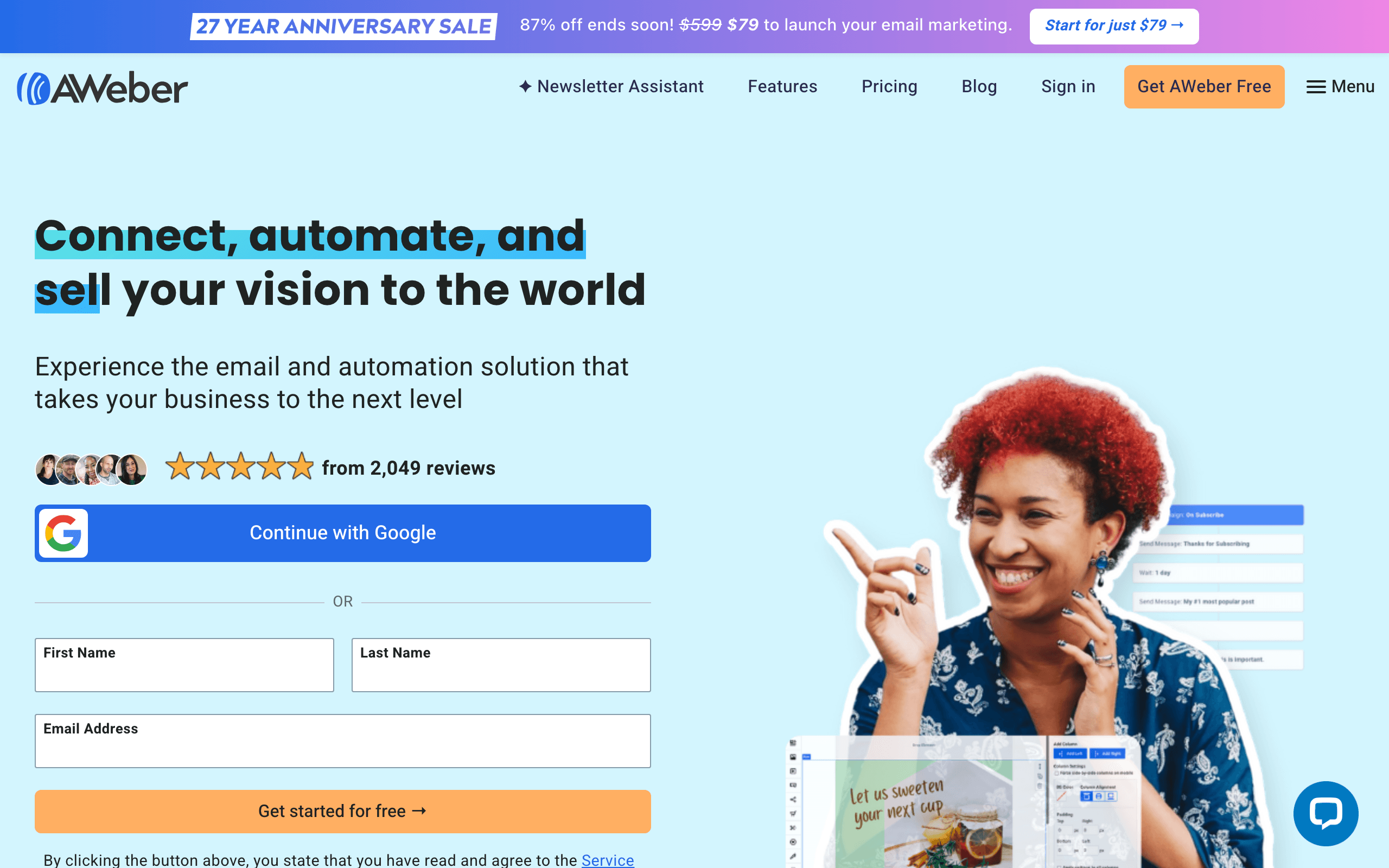
AWeber has been serving small businesses since 1998. Free tier, 600+ templates, phone support, simple automation. It's reliable and affordable. Emma offers less for more, unless you need brand governance.
Emma's Organizational Niche
For franchises and multi-location businesses, Emma's locked templates and approval workflows maintain brand consistency. AWeber doesn't offer these governance features.
Pricing reality
AWeber at $66.15/month with a free tier vs Emma at $99+/month with no free option. Unless brand governance is critical, AWeber is better value for small businesses.
Review signals
Emma's reviews on this page support its narrow governance niche. One reviewer says locked templates keep 30 restaurant locations on brand, while another says the automation is too basic for the price.
AWeber's reviews support the small-business value case: long-term reliability, phone support, and a large template library. The caution is that the interface and automation can feel dated compared with newer platforms.
The Sequenzy Alternative
For SaaS founders, Sequenzy combines transactional email and marketing campaigns with native Stripe integration at $49/month.
Template Selection and Design Quality
AWeber's library of 600+ templates gives users a significant head start when creating emails. Whether you run a restaurant, a fitness studio, or a consulting firm, you can likely find a template that matches your industry. Emma has branded templates but a much smaller selection, and the focus is on controlling brand elements rather than providing creative variety.
For small businesses without a dedicated designer, AWeber's template variety saves considerable time and effort. Emma's templates are functional but designed for organizational brand control rather than creative inspiration.
Support and Onboarding Experience
AWeber's phone support is a meaningful differentiator, especially for non-technical users who need help setting up their first campaigns. Being able to call and speak with a real person about email authentication, list management, or template customization builds confidence. Emma offers limited support and typically requires a sales conversation before you can even access the platform.
For small business owners who are new to email marketing, AWeber's support infrastructure makes the learning process much smoother. Emma's support is geared toward enterprise accounts with dedicated account managers, which is overkill for most small businesses.
Pricing Accessibility
The pricing gap between these platforms reflects their different target markets. AWeber's free tier lets anyone get started with email marketing at zero cost, and paid plans start at $14.99/month. Emma starts at $99/month with no self-serve option - you need to contact sales.
For entrepreneurs and small businesses evaluating email marketing platforms, AWeber allows you to test the waters without financial risk. Emma's pricing model assumes you already know you need brand governance and are willing to pay a premium for it. Unless that specific need exists, AWeber provides vastly better value for the money.
Use-case matchups
| Use case | Better fit | Why |
|---|---|---|
| Multi-location brand governance | Emma | Emma is better when locked templates, approval workflows, and sub-accounts are required to protect brand consistency. |
| Small business email marketing | AWeber | AWeber is stronger when the team wants templates, landing pages, phone support, and a free starting point. |
| Franchise or distributed team email | Emma | Emma fits organizations where local teams need controlled customization inside approved templates. |
| Beginner-friendly newsletters | AWeber | AWeber is easier to start with because of the free tier, support, and broad template library. |
| SaaS lifecycle automation | Sequenzy | Sequenzy is better when Stripe events, transactional email, and lifecycle campaigns need one SaaS-focused workspace. |
| Template variety for non-designers | AWeber | AWeber's large template library helps teams ship campaigns without dedicated design resources. |
Best Fit by Governance and Beginner-Friendly Email
Best email platform for distributed brand governance
Choose Emma when the marketing risk is inconsistent local execution. Locked templates, sub-accounts, approvals, permissions, and brand-controlled campaign workflows are the right fit for franchises, campuses, associations, and distributed teams.
Best small-business email platform for templates and support
Choose AWeber when the team needs accessible email marketing with templates, landing pages, autoresponders, phone support, and a free starting point. It is the better fit when the team wants to ship conventional campaigns without paying for governance infrastructure.
Best SaaS email platform for transactional and lifecycle automation
Choose Sequenzy when email is driven by product or billing events rather than brand approvals or beginner templates. Stripe lifecycle messages, transactional sends, onboarding, renewals, and customer campaigns need a SaaS-focused workflow.
Migration checklist
- Decide whether the destination should optimize for brand governance, accessible small-business email, or SaaS lifecycle automation.
- Export subscribers, custom fields, tags, segments, campaigns, templates, brand assets, approval workflows, sub-accounts, forms, landing pages, suppressions, and reports.
- If moving to Emma, rebuild locked templates, approval workflows, sub-accounts, brand permissions, and location/team access before importing all users.
- If moving to AWeber, identify which Emma governance controls, approval workflows, locked template regions, and sub-account structures need replacement elsewhere.
- Rebuild priority flows first: welcome, newsletter, local/location campaign, lead magnet delivery, re-engagement, and win-back.
- Reconnect forms, landing pages, web push if used, approval processes, team permissions, analytics, webhooks, unsubscribe logic, and suppression syncing.
- Authenticate SPF, DKIM, and DMARC, then test one campaign, one automation, one form, and one governance or template workflow before full migration.
- Preserve historical campaign, template, approval, support, deliverability, and cost reports so the team can compare governance value against small-business accessibility.
Decision checklist
- Does the organization need locked templates, approvals, and sub-accounts across locations?
- Would AWeber's free tier, phone support, and template library cover the real workflow?
- Is Emma's higher price justified by preventing off-brand local campaigns?
- Is AWeber's older interface acceptable for the team?
- Would SaaS lifecycle and transactional email make Sequenzy more relevant?