

Overview
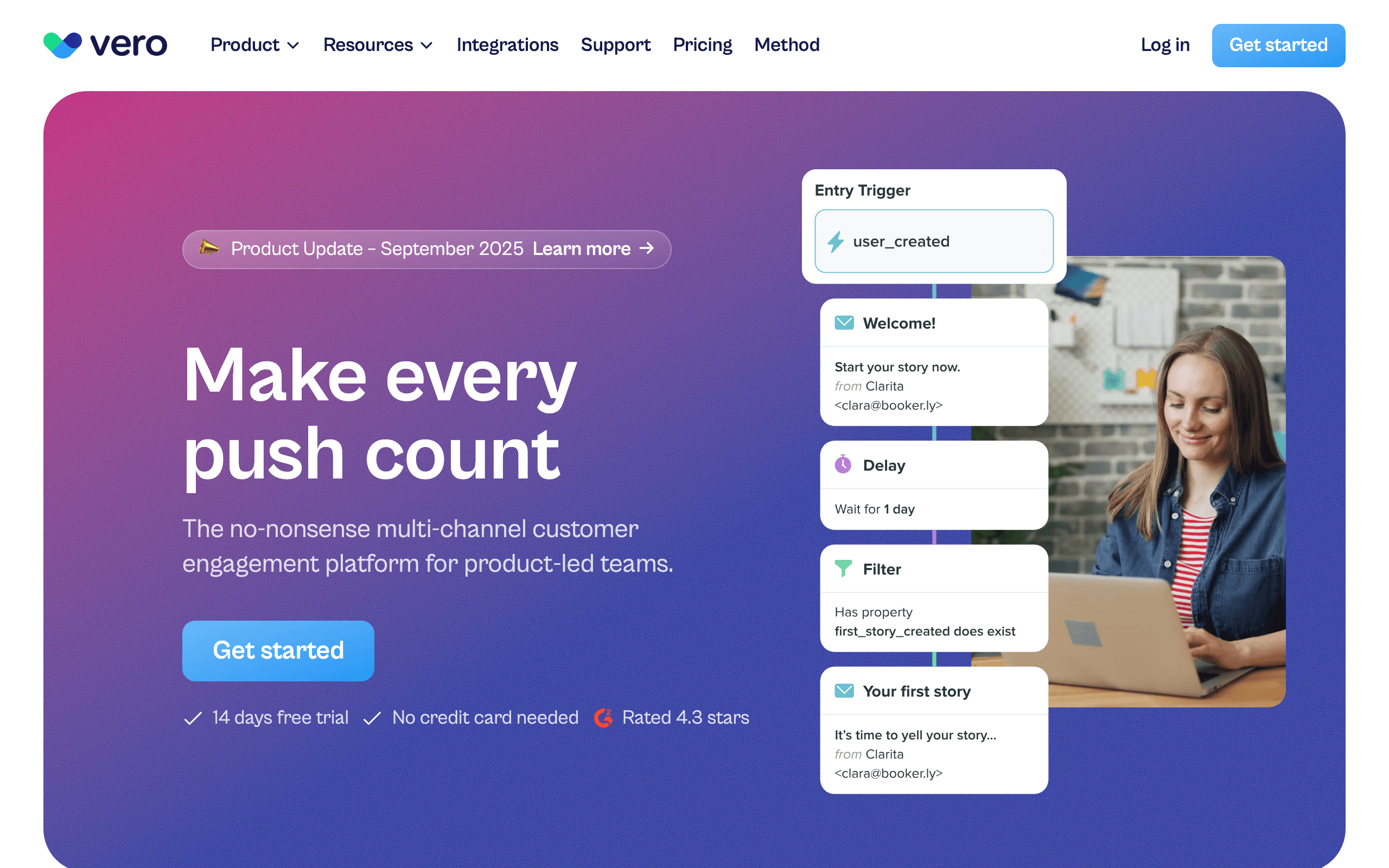
Vero is event-based email for products. ActiveCampaign is comprehensive marketing automation. Different tools for different needs. See our Vero comparison and ActiveCampaign comparison for details.
Pricing Comparison
Vero: ~$100+/month (custom)
ActiveCampaign: $149/month at 10k
Sequenzy: $49/month for 10k contacts
Compare on our pricing page.
Where Vero Wins
Pure event-based email with product focus.
Where ActiveCampaign Wins
Full marketing platform with CRM, landing pages, and 500+ automations.
Why Sequenzy Beats Both
Event triggers + marketing features + Stripe integration with a free tier and paid plans from $19/month.
Event-Driven vs Marketing-Driven Email
The core philosophical difference between Vero and ActiveCampaign is what triggers an email. Vero is built around product events. A user signs up, activates a feature, invites a teammate, or abandons a workflow. These in-product actions drive the email strategy.
ActiveCampaign triggers emails based on marketing interactions. Form submissions, page visits, email opens, link clicks, and CRM stage changes drive campaigns. Product events can be sent via API, but they are not the native language of the platform.
For product-led growth companies where user behavior in the app is the primary signal, Vero's event-first approach feels more natural. For marketing-led organizations where campaigns, lead nurturing, and sales alignment matter more, ActiveCampaign's breadth is the advantage.
The CRM Question for Product-Led Companies
ActiveCampaign includes a full CRM with pipelines, deals, and sales automation. For companies with dedicated sales teams, this unification of marketing and sales is valuable. Lead scoring identifies prospects ready for outreach. Deal tracking follows opportunities through the pipeline.
Vero has no CRM. It is purely a messaging tool triggered by user behavior. For product-led growth companies without traditional sales processes, this is not a limitation. PLG companies often do not need CRM features because the product drives conversion rather than salespeople.
The question is whether your growth model requires sales-marketing alignment or whether your product drives its own conversions. ActiveCampaign assumes the former. Vero assumes the latter.
Pricing Models and Total Cost
ActiveCampaign charges $149/month at 10,000 contacts with transparent tier pricing. Vero uses custom pricing at scale, which makes comparison difficult. At smaller volumes, Vero starts around $49/month. At 10,000+ contacts, expect $100+ per month depending on email volume.
The real cost consideration is what you need alongside each tool. Vero users often need a separate marketing platform for newsletters and campaigns. ActiveCampaign users may need a separate product analytics tool for event tracking. Factor in supplementary tools when comparing total cost.
For SaaS companies that want event-based triggers combined with marketing campaigns and Stripe billing automation in a single platform, Sequenzy offers all three at $49/month. No supplementary tools required for core SaaS email needs.
User Behavior Tracking
Vero was built around product events, with a clean API for sending custom actions straight from your app so automation can trigger on real user behavior. ActiveCampaign's site tracking watches browsing activity and feeds it into its broader marketing automation, but that setup takes more configuration if event-driven triggers are your main goal. For product-led teams where every email should map to something a user did, Vero's event focus is the more direct fit.
Trial and Onboarding Optimization
Turning a trial into a paying account often depends on emails that respond to what a user actually did, not just how many days have passed. Vero's behavioral triggers and transactional email support suit that milestone-based approach directly. ActiveCampaign leans on its 500-plus automation templates and predictive lead scoring instead, which works well if onboarding also needs a CRM record and sales visibility. Pick based on whether onboarding is purely product-driven or needs sales involved.
Company-Level vs User-Level Communication
B2B SaaS accounts usually have several users, and targeting at the company level rather than the individual matters for renewal and expansion emails. ActiveCampaign's built-in CRM and pipeline tracking give you a place to hold account-level context alongside deal stage, which Vero does not offer since it has no CRM or pipeline management. Vero instead relies on its event API, so grouping by organization means building that logic into what you send from your product.
Use-case matchups
| Situation | Best first look | Why |
|---|---|---|
| SaaS team wants event-driven lifecycle messaging and customer messaging workflows | Vero | Vero is the baseline here when that product-led lifecycle job is central. |
| Team wants advanced marketing automation and CRM-style journeys | ActiveCampaign | ActiveCampaign deserves the first demo when that specialist capability matters more. |
| SaaS or subscription team wants email plus transactional paths | Sequenzy | Sequenzy is stronger when Stripe events, transactional messages, campaigns, and subscriber automation should live together. |
| Product team has clean event instrumentation | Vero or ActiveCampaign | Event-driven tools only pay off when product events, traits, and lifecycle definitions are reliable. |
| Team wants fewer tools and a lower-cost email workflow | Sequenzy | Sequenzy is more relevant when email lifecycle automation is enough and support chat or complex engagement channels are out of scope. |
Pricing reality
The pricing signals on this page list Vero at ~$100+/month, ActiveCampaign at $149/month, and Sequenzy at $49/month. The right comparison depends on the workflow being purchased, not just the monthly number.
Vero's value depends on whether the team uses event-driven lifecycle messaging and customer messaging workflows. ActiveCampaign's real cost depends on whether the team needs advanced marketing automation and CRM-style journeys.
Review signals
For Vero, validate review themes around event-driven lifecycle messaging and customer messaging workflows. For ActiveCampaign, focus review research on whether users praise advanced marketing automation and CRM-style journeys.
Best Fit by Event Data Model
Best email platform for event-based product messaging
Vero fits product-led teams that want email journeys driven by user events, attributes, and behavior inside the app. It is strongest when lifecycle messaging depends on what users actually do rather than traditional lists and CRM stages.
Best marketing automation CRM for sales-led teams
ActiveCampaign is the better fit when email automation needs to sit beside lead scoring, CRM pipelines, forms, and sales follow-up. It works better when the customer journey is managed through contacts and deals, not only product events.
Best SaaS lifecycle platform for product plus billing events
Sequenzy fits SaaS teams that need event-triggered email with billing and subscription context included. It is more relevant when product behavior, Stripe events, transactionals, and lifecycle campaigns need to share one workflow.
Migration checklist
| Workstream | Moving toward Vero | Moving toward ActiveCampaign | Simplifying to Sequenzy |
|---|---|---|---|
| Data model | Map users, companies, events, traits, segments, suppressions, and lifecycle stages. | Map the users, events, traits, records, and channels needed for advanced marketing automation and CRM-style journeys. | Import subscribers, attributes, tags, suppressions, Stripe events, and transactional paths. |
| Instrumentation | Validate identity resolution, event names, timestamps, and company/account relationships. | Validate instrumentation and channel setup before rebuilding journeys. | Connect only the events needed for campaigns, lifecycle automations, and transactional messages. |
| Automations | Rebuild onboarding, activation, retention, expansion, and winback journeys. | Rebuild the workflows that prove ActiveCampaign's advantage. | Rebuild lifecycle and transactional email flows. |
| Templates and channels | Move email templates, in-app content where relevant, sender identities, and brand rules. | Move templates, chat or in-app surfaces where relevant, and brand assets. | Move email templates and transactional message content. |
| Reporting | Validate activation, conversion, churn, engagement, deliverability, and journey reporting. | Validate reporting for advanced marketing automation and CRM-style journeys. | Validate campaign, automation, transactional, and subscription lifecycle reporting. |
Decision checklist
- Is the team buying SaaS lifecycle messaging, support/chat, CRM automation, or simpler email workflows?
- Which platform best matches the current event and customer data model?
- Does ActiveCampaign's strength in advanced marketing automation and CRM-style journeys matter more than Vero's focus?
- Are the listed prices still realistic after contacts, seats, channels, and event volume are included?
- Would Sequenzy cover the lifecycle and transactional email job with less setup?









