Overview
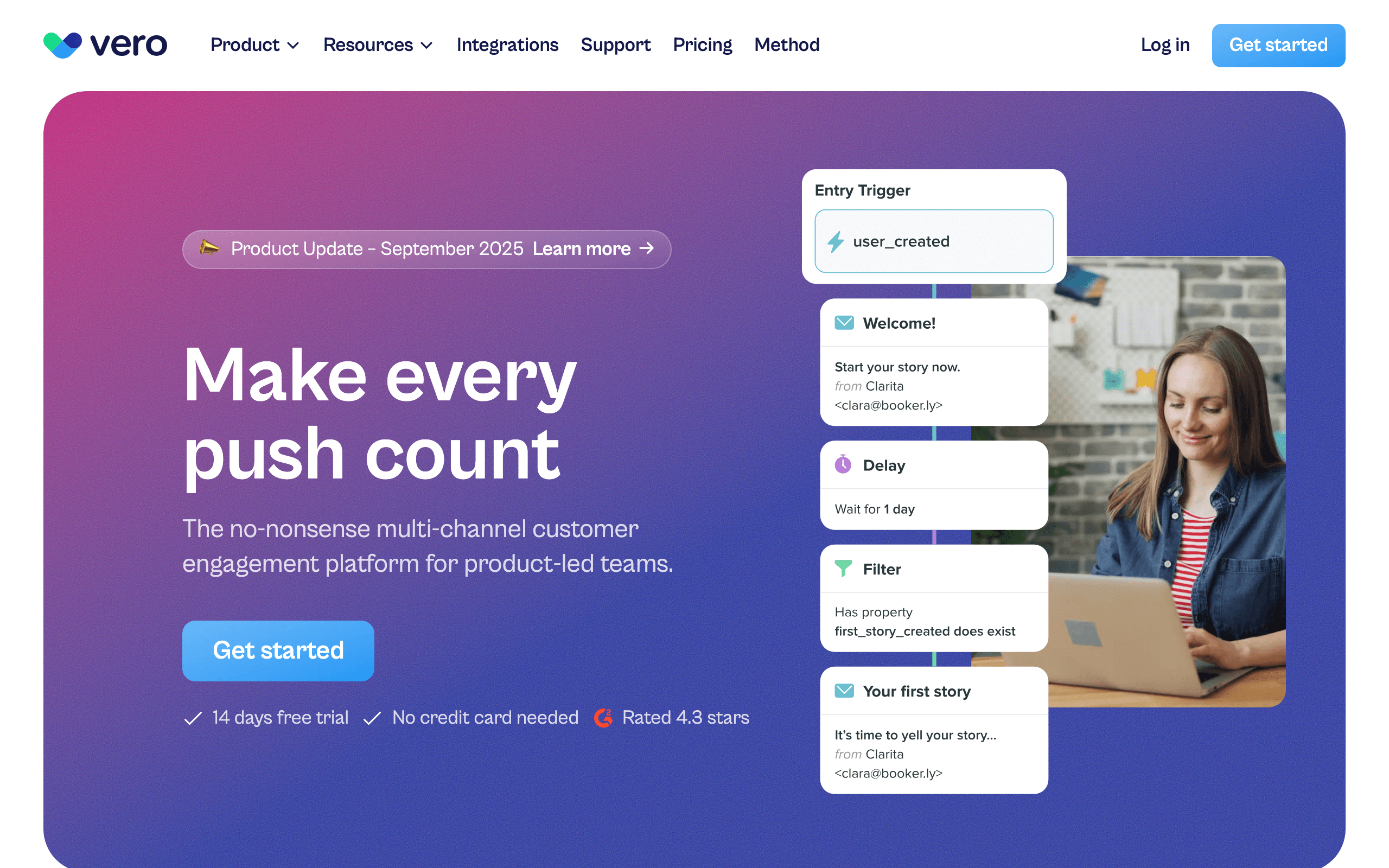
Vero and Customer.io both focus on behavior-based email for product-led companies, but Customer.io has evolved into a broader platform. See our Vero comparison and Customer.io comparison for details.
Pricing Comparison
Vero: ~$100+/month (custom pricing at scale)
Customer.io: ~$150/month at scale
Sequenzy: Free tier available, then $19/month for 15k emails (unlimited contacts)
Compare on our pricing page.
Where Customer.io Wins
More channels, more mature platform, advanced workflows.
Where Vero Wins
Simpler interface, event-focused, easier to learn.
Why Sequenzy Beats Both
Native Stripe integration, unified transactional + marketing email, and $19/month pricing.
Two Products Born from the Same Insight
Both Vero and Customer.io were built on the same insight: email should be triggered by what users do, not by static lists and scheduled blasts. Both let you send events from your product and use those events to trigger personalized messages. The difference is how far each platform has evolved beyond that core idea.
Customer.io has expanded into a full multi-channel messaging platform. Email is one channel alongside push notifications, SMS, and in-app messages. The automation builder handles complex cross-channel workflows. Advanced segmentation lets you target users based on any combination of attributes and events.
Vero has stayed closer to its roots. Email and push notifications remain the primary channels. The interface is simpler. The setup is faster. For teams that need behavioral email without multi-channel complexity, this focus is an advantage rather than a limitation.
Segmentation Depth and Data Models
Customer.io's segmentation is a genuine strength. You can combine any user attribute, event property, page view, or custom data point into segment definitions. Real-time segment evaluation means users enter and exit segments as their behavior changes. This powers highly targeted messaging.
Vero's segmentation works well for straightforward behavioral criteria. User properties and event data can define segments. But the depth of conditional logic and the number of data points you can combine are more limited than Customer.io.
For teams sending five to ten different behavioral campaigns, Vero's segmentation is sufficient. For teams running dozens of campaigns with micro-targeted audiences based on complex behavioral patterns, Customer.io's segmentation justifies the higher price and complexity.
Implementation Investment Comparison
Vero can be sending event-driven emails within a day or two. Install the JavaScript snippet, send a few key events from your backend, and build your first workflow. The API is clean and the documentation is straightforward.
Customer.io's full implementation is a larger project. Beyond basic event tracking, you want to send comprehensive user properties, track page views, and potentially integrate multiple channels. Planning the data architecture, implementing the SDK, and building workflows takes days to weeks depending on your product's complexity.
The payoff scales with the investment. A well-implemented Customer.io instance with rich event data and multi-channel workflows delivers sophisticated user communication. A quick Vero setup delivers solid behavioral email without the implementation overhead.
When to Choose a Third Option
Both Vero and Customer.io focus on event-driven messaging but lack native billing integration for SaaS companies. If your most important behavioral triggers are subscription events like trial starts, plan upgrades, payment failures, and cancellations, neither platform tracks these natively from your billing system.
Sequenzy's Stripe integration automatically syncs subscription data and triggers automation sequences based on billing events. Combined with transactional email support, it covers the core email needs of subscription SaaS without custom event tracking code for billing events.
User Behavior Tracking
Vero and Customer.io both trigger email off user behavior, but Customer.io has grown into the broader platform, adding SMS, in-app messaging, and more advanced segmentation on top of its event tracking. Vero stays more focused, covering event tracking, push notifications, and email without the additional channels or the added complexity that comes with them. If you need only email and push tied to user actions, Vero's narrower scope may be easier to run day to day.
Trial and Onboarding Optimization
Both platforms can trigger onboarding sequences off specific product events, but Customer.io's more advanced conditional branching supports more elaborate onboarding paths once your event tracking is fully built out. Vero's simpler interface and gentler learning curve can get a basic milestone-triggered onboarding sequence running faster, at a lower starting price of roughly $100 a month versus Customer.io's approximately $150 for 10,000 contacts.
Company-Level vs User-Level Communication
Customer.io's advanced segmentation works off any tracked attribute or event, giving it more room to build account-level targeting for B2B SaaS. Vero has no in-app messaging and simpler segmentation overall, which covers straightforward event-based targeting well but has less depth for grouping users by organization. Teams with complex account structures likely need Customer.io's added segmentation power despite the higher price.
Use-case matchups
| Situation | Best first look | Why |
|---|---|---|
| SaaS team wants event-driven lifecycle messaging and customer messaging workflows | Vero | Vero is the baseline here when that product-led lifecycle job is central. |
| Team wants event-driven product messaging and behavioral journeys | Customer.io | Customer.io deserves the first demo when that specialist capability matters more. |
| SaaS or subscription team wants email plus transactional paths | Sequenzy | Sequenzy is stronger when Stripe events, transactional messages, campaigns, and subscriber automation should live together. |
| Product team has clean event instrumentation | Vero or Customer.io | Event-driven tools only pay off when product events, traits, and lifecycle definitions are reliable. |
| Team wants fewer tools and a lower-cost email workflow | Sequenzy | Sequenzy is more relevant when email lifecycle automation is enough and support chat or complex engagement channels are out of scope. |
Pricing reality
The pricing signals on this page list Vero at ~$100+/month, Customer.io at ~$150/month, and Sequenzy at $49/month. The right comparison depends on the workflow being purchased, not just the monthly number.
Vero's value depends on whether the team uses event-driven lifecycle messaging and customer messaging workflows. Customer.io's real cost depends on whether the team needs event-driven product messaging and behavioral journeys.
Review signals
For Vero, validate review themes around event-driven lifecycle messaging and customer messaging workflows. For Customer.io, focus review research on whether users praise event-driven product messaging and behavioral journeys.
Best Fit by SaaS Messaging Model
Best SaaS customer messaging platform for event-driven lifecycle teams
Vero fits SaaS teams that want event-driven lifecycle messaging and customer communication workflows without switching into a broader CRM or support suite. It should be tested first when the team values the product's lifecycle focus and can model users, companies, events, and traits cleanly.
Best behavioral messaging platform for product-led growth teams
Customer.io fits teams that want product-event journeys, behavioral segmentation, and flexible messaging workflows with a larger ecosystem. Choose it when the product-led growth program depends on event depth, workflow branching, and multi-channel expansion.
Best email platform for subscription and transactional lifecycle
Sequenzy fits when the team wants lifecycle email, campaigns, transactional messages, and Stripe-triggered automation in one focused email stack. It is the simpler option when support chat, CRM scope, and broad product-messaging suites are not required.
Migration checklist
| Workstream | Moving toward Vero | Moving toward Customer.io | Simplifying to Sequenzy |
|---|---|---|---|
| Data model | Map users, companies, events, traits, segments, suppressions, and lifecycle stages. | Map the users, events, traits, records, and channels needed for event-driven product messaging and behavioral journeys. | Import subscribers, attributes, tags, suppressions, Stripe events, and transactional paths. |
| Instrumentation | Validate identity resolution, event names, timestamps, and company/account relationships. | Validate instrumentation and channel setup before rebuilding journeys. | Connect only the events needed for campaigns, lifecycle automations, and transactional messages. |
| Automations | Rebuild onboarding, activation, retention, expansion, and winback journeys. | Rebuild the workflows that prove Customer.io's advantage. | Rebuild lifecycle and transactional email flows. |
| Templates and channels | Move email templates, in-app content where relevant, sender identities, and brand rules. | Move templates, chat or in-app surfaces where relevant, and brand assets. | Move email templates and transactional message content. |
| Reporting | Validate activation, conversion, churn, engagement, deliverability, and journey reporting. | Validate reporting for event-driven product messaging and behavioral journeys. | Validate campaign, automation, transactional, and subscription lifecycle reporting. |
Decision checklist
- Is the team buying SaaS lifecycle messaging, support/chat, CRM automation, or simpler email workflows?
- Which platform best matches the current event and customer data model?
- Does Customer.io's strength in event-driven product messaging and behavioral journeys matter more than Vero's focus?
- Are the listed prices still realistic after contacts, seats, channels, and event volume are included?
- Would Sequenzy cover the lifecycle and transactional email job with less setup?