Updated 2026-02-23
Emma
HubSpot

Emma vs HubSpot

Brand-controlled team email vs all-in-one growth platform

12
Features Compared
4
Key Differences
5
User Reviews
5
FAQs Answered
TL;DR

Emma is mid-market email with brand governance at $99+/month. HubSpot is a full growth platform with free CRM, marketing, sales, and service tools. HubSpot wins on features, CRM, ecosystem, and free tier. Emma wins only on multi-location brand governance.

Platform Overview

See how each platform looks

HubSpot

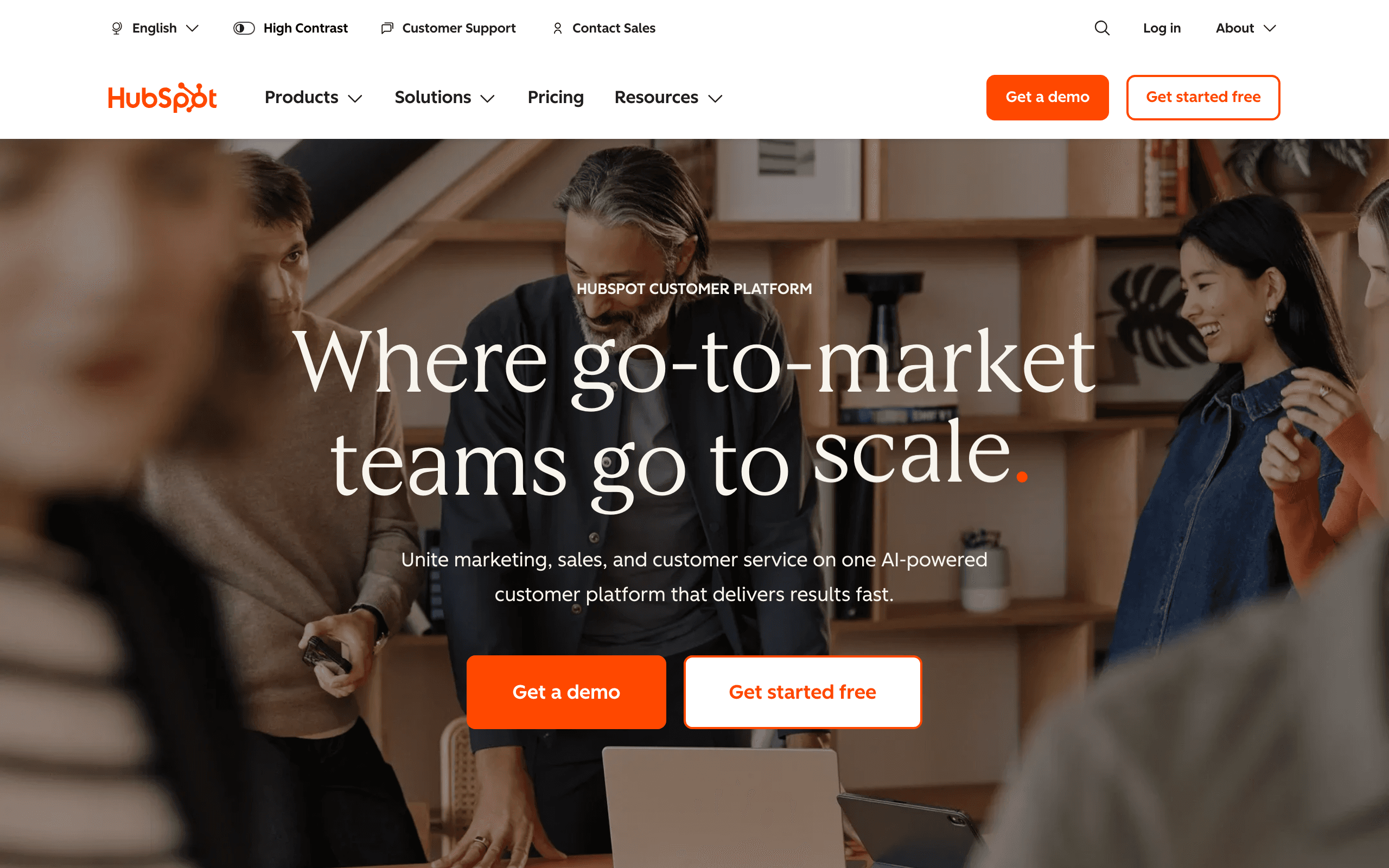
HubSpot dashboard screenshot

Enterprise all-in-one CRM, marketing, sales, and service platform.

Key Differences

The main things that set these tools apart

Platform Scope
HubSpot wins

HubSpot is a complete growth platform: CRM, marketing, sales, service, CMS. Emma does email with brand governance. The scope difference is massive.

Free CRM
HubSpot wins

HubSpot's free CRM is industry-leading. Unlimited contacts, deal tracking, task management. Emma doesn't include any CRM. For businesses needing CRM + email, HubSpot is the obvious choice.

Brand Governance
Emma wins

Emma's locked templates and sub-accounts are better for multi-location brand control than HubSpot's standard tools. HubSpot Enterprise has business units, but at $3,600/month.

Entry Price
HubSpot wins

HubSpot starts free. Emma starts at $99/month. HubSpot Marketing Hub Starter is $20/month. The entry pricing strongly favors HubSpot.

Pricing Comparison

At 10,000 contacts

Emma
$99+/month

Base plan. Brand governance, basic automation.

Visit Emma
HubSpot
$890/month

Marketing Hub Professional. Full automation, ABM, reporting. Annual.

Visit HubSpot
Best for SaaS
Sequenzy
$49/month

10k subscribers, unlimited emails, transactional + marketing, Stripe integration.

Start Free Trial

Feature Comparison

12 features compared side-by-side

Feature
Emma
HubSpot
Sequenzy
Marketing
Email Marketing
Full
Full
Full
Automation
Basic workflows
Visual workflows
AI sequences
CRM
Free CRM
Stripe-based
Landing Pages
Basic
Full builder
Brand & Governance
Brand Control
Centralized governance
Brand kit
Sub-Accounts
Per location
Business units (Enterprise)
Approval Workflows
Built-in
Approval (Enterprise)
Content Management
CMS Hub
Platform
Free Tier
Free CRM + tools
Yes (100 subs)
Sales Tools
Full sales hub
Service Tools
Full service hub
Integrations
Limited
1,500+ integrations
Stripe, Zapier, API

Pros & Cons

Honest strengths and weaknesses of each platform

Emma

Pros
  • More affordable brand governance than HubSpot Enterprise
  • Sub-account management for multiple locations
  • Built-in approval workflows for email review
  • Simpler setup for franchise brand control
  • Locked templates prevent off-brand messaging
  • Lower complexity than HubSpot's enterprise tier
Cons
  • Very limited compared to HubSpot's feature set
  • No CRM capabilities
  • No sales or service tools
  • No content management system
  • Limited integrations ecosystem
  • No free tier available
  • Basic automation capabilities

HubSpot

Pros
  • Free CRM with unlimited contacts
  • Complete growth platform with marketing, sales, and service
  • 1,500+ native integrations
  • Extensive content management system
  • Advanced automation with workflows
  • Comprehensive analytics and reporting
  • Large ecosystem of agencies and consultants
  • Free tier includes email marketing
Cons
  • Marketing Hub Professional is $890/month for 10k contacts
  • Business units require Enterprise at $3,600/month
  • Complex platform with steep learning curve
  • Can be overkill for simple email marketing
  • Pricing scales rapidly with contact count
  • Many features require higher-tier plans
  • Annual contracts required for professional plans

What Users Say

Real reviews from Emma and HubSpot users

Emma Reviews

G2

For our franchise, Emma's brand governance at $99/month is far more practical than trying to achieve the same thing with HubSpot Enterprise at $3,600/month. It does what we need.

Catherine B.2025-10-17
Capterra

Emma is fine for brand control but it feels like a one-trick pony compared to HubSpot. We use it alongside HubSpot CRM which creates an awkward two-platform workflow.

Philip R.2025-11-29

HubSpot Reviews

G2

HubSpot transformed our entire go-to-market operation. CRM, email, landing pages, blog, analytics - all connected. The free CRM alone is worth more than most paid platforms.

Jennifer A.2025-09-20
Trustpilot

Powerful platform but expensive at scale. We started on the free tier and grew into Professional. The investment pays off if you use the full platform, but it's a lot to manage.

David W.2025-12-11
Capterra

HubSpot does everything but nothing comes cheap. Marketing Professional for our 15k contact list costs $1,100/month. Great platform but the pricing escalation is aggressive.

Michelle S.2025-08-24

Best For

When to choose each tool

Choose Emma if you...
  • Franchises needing brand-controlled email
  • Multi-location businesses with governance needs
Choose HubSpot if you...
  • Growing businesses wanting CRM + marketing
  • Teams wanting free CRM to start
  • Companies wanting sales + marketing alignment
  • Businesses wanting a complete growth platform

When to Consider Sequenzy Instead

SaaS-Specific

Neither Emma's brand governance nor HubSpot's growth platform is purpose-built for SaaS. Sequenzy syncs with Stripe for subscription-aware automation at $49/month.

Simpler Than HubSpot

HubSpot is powerful but complex. If you just need SaaS email with Stripe integration, Sequenzy is focused and simple.

Overview

Emma and HubSpot are in different categories. HubSpot is a complete growth platform with CRM, marketing, sales, and service. Emma is email marketing with brand governance. For our take on each, see our Emma comparison.

HubSpot's Platform Advantage

HubSpot offers a free CRM, marketing automation, sales tools, service desk, and CMS. Emma offers basic email with brand governance. The feature gap is enormous. For any business that needs more than just email, HubSpot provides an entire growth platform.

Emma's Governance Niche

Emma's advantage is specific: brand control for distributed teams. For franchises with 20+ locations, Emma's locked templates, approval workflows, and sub-accounts solve a real problem. HubSpot's equivalent features require Enterprise at $3,600/month.

The Honest Assessment

Unless multi-location brand governance is your primary requirement, HubSpot (or a similar platform like ActiveCampaign) provides dramatically more value than Emma at comparable or lower prices.

Pricing reality

At 10,000 contacts, this page lists Emma at $99+/month and HubSpot Marketing Hub Professional at $890/month. That makes the buying question less about "which is cheaper" and more about whether HubSpot's CRM, automation, sales, service, CMS, and reporting replace enough separate tools to justify the higher plan.

Emma's price only makes sense when brand governance is the reason for buying: locked templates, sub-accounts, and approvals for distributed teams. If a team only needs general email plus CRM, HubSpot's free and starter entry points are easier to test before committing to a larger plan.

Sequenzy's $49/month comparison point is relevant only for SaaS teams that want Stripe-aware lifecycle and transactional email rather than Emma's governance model or HubSpot's broad growth suite.

Review signals

The Emma reviews on this page point to a narrow but real fit: franchises value governance when HubSpot Enterprise-style controls are too expensive, but one reviewer also describes Emma as awkward when paired with a separate HubSpot CRM workflow.

The HubSpot reviews are stronger on platform breadth. Users praise the connected CRM, email, landing pages, blog, and analytics, while the critical reviews focus on cost escalation and operational complexity. That supports the core tradeoff: HubSpot is a better system when the team will use the full platform, not just email.

The Sequenzy Alternative

For SaaS founders, Sequenzy combines transactional email and marketing campaigns with native Stripe integration at $49/month - focused and simple.

The Scale Mismatch

Comparing Emma and HubSpot is somewhat unfair because they operate at different scales of ambition. HubSpot wants to be your entire business operating system - CRM, marketing, sales pipeline, customer service, content management, and analytics. Emma wants to solve one specific problem: brand-consistent email across distributed teams.

This scope difference means most businesses evaluating both will find them complementary rather than competitive. Some organizations actually use Emma for brand governance alongside HubSpot CRM for sales and marketing - an expensive but sometimes necessary combination.

Free CRM as a Starting Point

HubSpot's free CRM is genuinely industry-leading. Unlimited contacts, deal tracking, task management, and basic email marketing - all without paying anything. Emma offers no free tier, no self-serve trial, and requires a sales conversation to get started. For organizations exploring email marketing options, HubSpot's accessibility is unmatched.

The free CRM creates a powerful growth path: start free, add Marketing Hub Starter at $20/month, then Professional when you need advanced automation. Emma's growth path is flatter - you enter at $99/month for brand governance and the feature set does not expand dramatically at higher tiers.

When Emma Actually Wins

Emma wins in a specific scenario: mid-market franchises that need brand governance but cannot justify HubSpot Enterprise's $3,600/month price tag for business units. At $99/month, Emma provides sub-accounts, locked templates, and approval workflows that accomplish similar goals for brand-conscious organizations.

This is a narrow but real use case. A franchise with 15-30 locations that needs centralized brand control without enterprise-level budgets finds genuine value in Emma's approach. HubSpot's equivalent functionality requires a dramatic jump in investment that many mid-market organizations cannot support.

Use-case matchups

Use case Better fit Why
Multi-location brand governance Emma Emma is better when locked templates, approval workflows, and sub-accounts are required below HubSpot Enterprise pricing.
CRM-led growth platform HubSpot HubSpot is stronger when CRM, sales, service, CMS, landing pages, automation, and reporting should live together.
Franchise email control Emma Emma fits organizations that need local teams to send within centrally controlled brand rules.
Full marketing and sales alignment HubSpot HubSpot connects email activity to deals, contacts, companies, sales tasks, and lifecycle reporting.
SaaS lifecycle automation Sequenzy Sequenzy is better when Stripe events, transactional email, and lifecycle campaigns need one focused SaaS workspace.
Teams starting with free CRM HubSpot HubSpot is more accessible when the team wants to start free and expand gradually.

Best Fit by Governance and Growth Suite Needs

Best email platform for brand-controlled organizations

Emma fits universities, franchises, associations, and multi-location teams that need shared templates, approval workflows, and brand governance. It is strongest when many distributed users send email under one brand system.

Best CRM growth platform for sales and marketing alignment

HubSpot is the better fit when the team needs CRM, landing pages, forms, content, pipelines, automation, reporting, and service tools in one platform. It works best when acquisition, sales handoff, and team alignment matter more than email governance.

Best lifecycle email platform for product-led teams

Sequenzy fits teams whose customer emails should respond to product activity, subscriptions, invoices, and retention signals. It is more relevant when customer lifecycle state matters more than brand governance or broad CRM-suite scope.

Migration checklist

  • Decide whether the destination should optimize for brand governance, CRM-centered growth, or SaaS lifecycle email.
  • Export contacts, companies, custom fields, tags, segments, campaigns, templates, brand assets, approval workflows, sub-accounts, CRM data, forms, landing pages, suppressions, and reports.
  • If moving to HubSpot, map Emma subscribers, sub-accounts, brand assets, campaigns, and approvals into contacts, properties, lists, workflows, business units if available, and CRM stages.
  • If moving to Emma, identify which HubSpot CRM records, sales pipelines, forms, landing pages, CMS content, service data, and advanced automation need replacement elsewhere.
  • Rebuild priority flows first: welcome, newsletter, franchise/local campaigns, lead nurture, sales handoff, re-engagement, and win-back.
  • Reconnect forms, landing pages, CRM syncs, team permissions, approval workflows, analytics, webhooks, unsubscribe logic, and suppression syncing.
  • Authenticate SPF, DKIM, and DMARC, then test one campaign, one CRM workflow, one brand approval path, and one unsubscribe path before full migration.
  • Preserve historical campaign, CRM, approval, attribution, deliverability, and cost reports so the team can compare governance value against platform breadth.

Decision checklist

  • Is the main need brand governance across locations, or a connected CRM-led growth platform?
  • Would HubSpot replace enough sales, service, CMS, and reporting tools to justify the Professional plan?
  • Does Emma solve a real approval or local-sender problem that HubSpot Starter or Professional cannot solve cleanly?
  • Will the team maintain two systems if Emma is used alongside HubSpot CRM?
  • Is SaaS lifecycle email better served by Stripe-aware transactional and marketing email instead of either platform?

Frequently Asked Questions

5 questions answered about Emma vs HubSpot

Testimonials

Sequenzy Testimonials

Elvis Sun

Elvis Sun

Founder, PressPulse & Medialyst

Codex basically one-shotted the migration for syncing our audience from SendGrid to Sequenzy. Sequenzy is fully observable, so agents can just set everything up. The net impact is saving $45/mo, plus 2 hours of my time every time I need to repurpose a newsletter. That's 8 hours a month. My consulting rate is $550/hr, so every hour automated is super valuable.

Jim

Jim

Founder

I run a SaaS, and found Nic on X where I kept seeing posts about his email marketing tool, Sequenzy. I decided to try it for email marketing. Literally on the first day, I used it to send a marketing campaign and I got 5 sales. What I like most is the ai assistant because it actually writes emails that feel real instead of the usual ai slop chatgpt returns, so they do not end up in spam. It also has a 2.5k free email limit which is way better than most tools that only give you around 1k. The best part though is that it handles everything for me, tags, subscribers, sequences and all of it. Without it i would probably be managing a database and a bunch of cron jobs just to make email automation work. Sequenzy just makes my life a lot easier. it can also be set up with 2-3 clicks! Give it a try!!

Mar 10, 2026

King Killers

King Killers

Shopify App Store review

Loving the Sequenzy app so far due to the affordability and large subscriber limits. Planning on this becoming my main email app. Campaign + flows setup with the help of their AI took less than 30 minutes.

Verified User

Verified User

Computer Software

SaaS-focused feedback, fast processing, and plenty of integrations. It is very SaaS-focused, supports a wide range of integrations, and processes feedback right away.

Jun 17, 2026

G2
Louis

Louis

Founder

Easy migration from another tool. Premium customer service and easy to set everything up

Apr 9, 2026

Dhiva Logu

Dhiva Logu

Founder

I love everything about Sequenzy and also the kind of support I get from Nic. It's already the best choice for campaigns & Sequences. Specially the integrations with payment providers, auth providers & analytics etc.. is really spot on. Best in terms of features & pricing in the email segment 100% recommend it for SaaS emails :)

Mar 10, 2026

Petros

Petros

Shopify App Store review

The setup was fast and simple. It synced customer, product, and order data quickly. Generating automated flows was simple, and it improved my monthly bottom line by about 7%.

Not sure which to pick?

If you're a SaaS founder who needs Stripe integration and unified email, try Sequenzy free. No credit card required.

Related Comparisons

Sequenzy pricing reference

Sequenzy - Complete Pricing Guide

Pricing Model

Sequenzy uses email-volume-based pricing. You only pay for emails you send. Unlimited contacts on all plans — storing subscribers is always free.

All Pricing Tiers

  • 2.5k emails/month: Free (Free annually)
  • 15k emails/month: $19/month ($205/year annually)
  • 30k emails/month: $29/month ($313/year annually)
  • 60k emails/month: $49/month ($529/year annually)
  • 120k emails/month: $99/month ($1069/year annually)
  • 300k emails/month: $199/month ($2149/year annually)
  • 600k emails/month: $399/month ($4309/year annually)
  • 900k emails/month: $599/month ($6469/year annually)
  • 1.2M emails/month: $799/month ($8629/year annually)
  • 2M emails/month: $1299/month ($14029/year annually)
  • 3M emails/month: $1999/month ($21589/year annually)
  • 4M emails/month: $2499/month ($26989/year annually)
  • 5M emails/month: $2999/month ($32389/year annually)
  • Unlimited emails/month: Custom pricing (Custom annually)

Yearly billing: All plans offer a 10% discount when billed annually.

Free Plan Features (2,500 emails/month)

  • Visual automation builder
  • Transactional email API
  • Reply tracking & team inbox
  • Landing pages
  • Unlimited team members
  • Goal tracking & revenue attribution
  • Unlimited lists and segments
  • Payment integrations
  • API, MCP, and CLI access
  • Unlimited sending domains
  • SPF, DKIM, and DMARC
  • Deliverability monitoring
  • Send time optimization
  • A/B testing

Paid Plan Features (15k - 5M emails/month)

  • Visual automation builder
  • Transactional email API
  • Reply tracking & team inbox
  • Landing pages (Create hosted signup pages and attach a custom domain.)
  • Unlimited team members
  • Goal tracking & revenue attribution
  • Unlimited lists and segments
  • Payment integrations (Stripe, Paddle, Lemon Squeezy)
  • API, MCP, and CLI access
  • Unlimited sending domains
  • SPF, DKIM, and DMARC
  • Deliverability monitoring
  • Send time optimization
  • A/B testing

Enterprise Plan Features (Unlimited emails)

  • Visual automation builder
  • Transactional email API
  • Reply tracking & team inbox
  • Landing pages
  • Unlimited team members
  • Goal tracking & revenue attribution
  • Unlimited lists and segments
  • Payment integrations
  • API, MCP, and CLI access
  • Unlimited sending domains
  • SPF, DKIM, and DMARC
  • Deliverability monitoring
  • Send time optimization
  • A/B testing

Important Pricing Notes

  • You only pay for emails you send — unlimited contacts on all plans
  • No hidden fees - all features included in the price
  • No credit card required for free tier

Contact

  • Pricing Page: https://sequenzy.com/pricing
  • Sales: hello@sequenzy.com



