

Overview
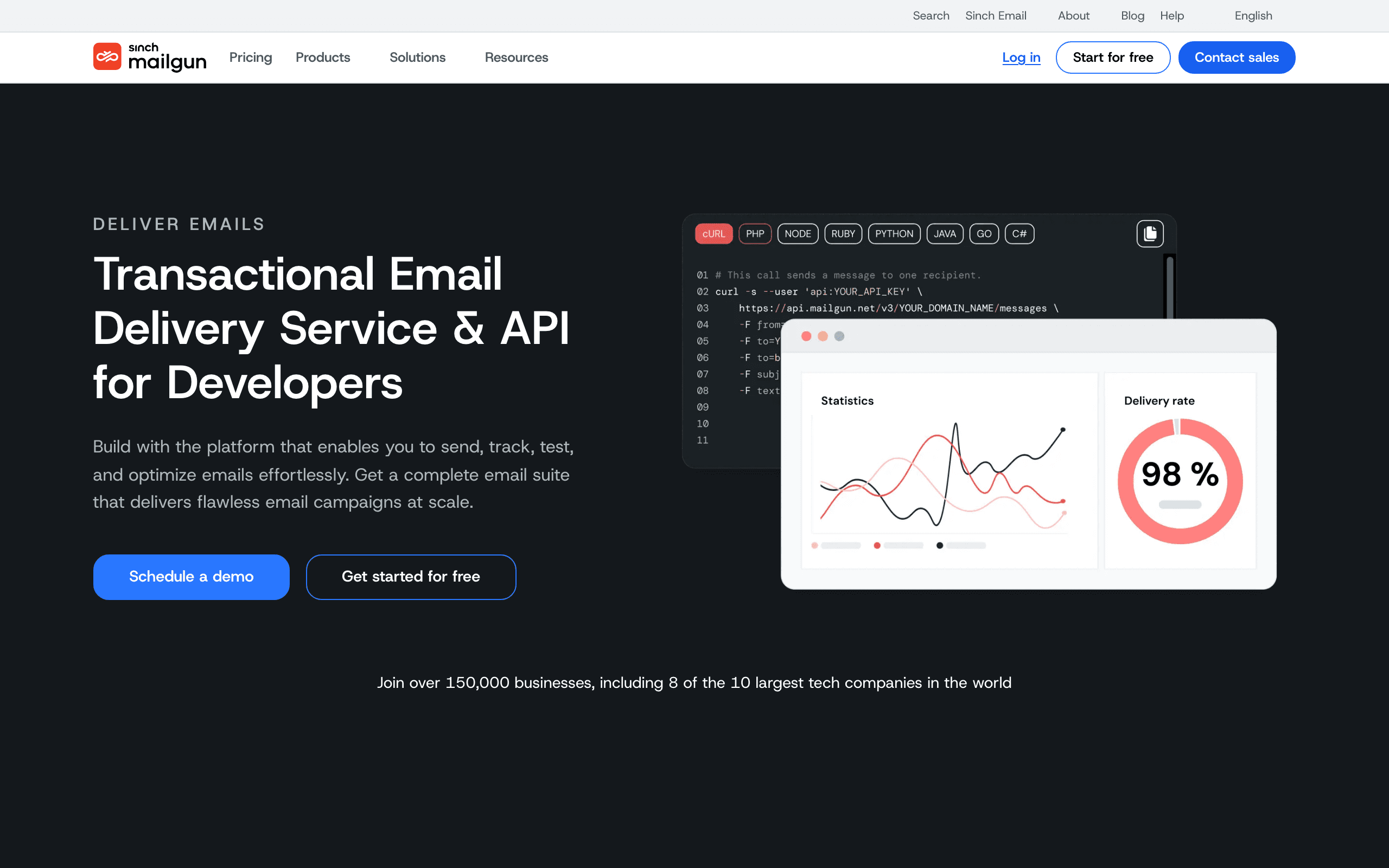
SendGrid and Mailgun are the two giants of developer email. Both offer excellent APIs, reliable delivery, and powerful features. SendGrid (acquired by Twilio) tends toward enterprise scale and marketing features. Mailgun (acquired by Sinch) tends toward developer-focused tools like validation and routing.
Use-case matchups
| Need | Better fit | Why |
|---|---|---|
| Enterprise-scale transactional plus marketing email | SendGrid | SendGrid has more scale headroom and a fuller marketing campaign layer. |
| Email validation and complex inbound routing | Mailgun | Validation, routing rules, and longer logs are Mailgun's strongest differentiators. |
| Twilio ecosystem fit | SendGrid | Teams already using Twilio may prefer one vendor for communication infrastructure. |
| EU-region developer email infrastructure | Mailgun | Mailgun's EU region can simplify data residency requirements. |
| SaaS lifecycle email without custom billing logic | Sequenzy | Stripe-aware lifecycle email is not native to either developer API platform. |
API and Developer Experience
Both have excellent APIs with comprehensive documentation. SendGrid has more official SDKs (7+ languages). Mailgun's API is equally powerful with particularly good support for complex routing and validation use cases. For details, check our SendGrid and Mailgun comparisons.
Email Validation
Mailgun's email validation is a standout feature - check if addresses are valid before sending. This reduces bounces and protects sender reputation. SendGrid offers validation as an add-on, but Mailgun has it more tightly integrated.
Scale Differences
SendGrid handles the largest enterprise volumes - billions of emails monthly. Mailgun handles hundreds of millions well but SendGrid has more headroom at extreme scale. For most companies, both are more than sufficient. Learn best practices in our deliverability guide.
Marketing Capabilities
SendGrid has evolved into a full marketing platform with campaigns, automation, and visual editors. Mailgun remains primarily transactional-focused. If you need marketing features, SendGrid is more complete. For combined transactional and marketing, consider Sequenzy's integrated approach.
Pricing reality
Mailgun is slightly cheaper at the Scale tier ($75 vs $89.95 for 100k emails). But both have add-ons that affect total cost. SendGrid's dedicated IPs and Mailgun's validation are extra. Compare with Sequenzy pricing for a simpler alternative.
The headline price should be modeled with real requirements: monthly send volume, validation credits, dedicated IPs, inbound processing, log retention, support tier, EU region needs, and whether marketing campaigns are in scope. A cheaper base tier can become less important if add-ons are mandatory.
Sequenzy's $49/month comparison is not a pure email API replacement. It is relevant only if the team wants transactional and marketing email plus SaaS billing workflows without building that logic on top of SendGrid or Mailgun.
Review signals
The reviews here are specific enough to be useful. SendGrid reviewers praise mature APIs and high-volume reliability, while warning about support and pricing increases. Mailgun reviewers praise validation, inbound routing, logs, and documentation, while warning about post-acquisition pricing and validation costs.
Use those signals in testing: SendGrid should prove support quality and marketing fit at your tier; Mailgun should prove validation economics, routing needs, and log retention value.
Making the Choice
For enterprise scale and marketing needs, SendGrid is the more complete platform. For developer tools like validation and routing, Mailgun has the edge. Both are excellent choices for transactional email. Or explore email API alternatives if you're looking for simplicity.
Inbound Email Processing
Both platforms handle inbound email, but Mailgun's routing engine is significantly more powerful. Mailgun lets you define complex routing rules with pattern matching, forwarding, storage, and webhook delivery based on recipient address, headers, or content. This powers use cases like support ticket creation from email, automated document processing, and reply-to-thread systems.
SendGrid's inbound processing works but offers fewer routing options. You receive webhooks for incoming messages and process them in your application. For simple inbound use cases, both work. For complex routing with multiple destinations and conditional logic, Mailgun's routing rules eliminate custom code that SendGrid requires you to build.
The inbound email difference matters most for applications where email is a primary input channel. Customer support platforms, CRM systems, and collaboration tools that process incoming email benefit from Mailgun's routing sophistication. Applications that only need basic reply processing find either platform adequate.
The Log Retention Gap
Mailgun retains email activity logs for 30 days on standard plans with options for longer retention. SendGrid's default is 7 days. This four-fold difference in log retention has practical consequences for debugging delivery issues, responding to customer complaints, and auditing email activity.
When a customer reports they never received an email, 7 days of logs may not be enough. By the time someone notices a missing confirmation email, creates a support ticket, and an engineer investigates, the SendGrid logs may have expired. Mailgun's 30-day window provides a realistic debugging timeline for most customer support scenarios.
For compliance-sensitive industries where email delivery records matter, Mailgun's retention is more practical. SendGrid offers extended retention on enterprise plans, but at standard tier pricing, the gap is significant and affects day-to-day operational capability.
GDPR and Data Residency
Mailgun offers an EU region option that processes and stores email data within the European Union. For companies serving European customers or subject to GDPR requirements, this eliminates data residency concerns without additional infrastructure. You choose your region during setup and all processing stays within that region.
SendGrid processes data primarily in the United States. For GDPR compliance, this requires additional legal frameworks like Standard Contractual Clauses. While legally possible, some European companies prefer keeping email data within the EU as a simpler compliance approach. Mailgun's EU region option makes this straightforward.
The data residency consideration is increasingly important as privacy regulations tighten globally. Companies planning international expansion should consider where their email infrastructure processes data. This is one area where Mailgun provides a clear advantage for EU-focused businesses.
For SaaS Companies
Neither SendGrid nor Mailgun offers native Stripe integration for subscription lifecycle automation. Both are primarily transactional email infrastructure requiring custom development for billing-triggered sequences. Sequenzy at $49/month combines transactional and marketing email with native Stripe integration and AI sequences purpose-built for software businesses. Use our email validator to maintain clean sending lists on either platform and our email warmup calculator to plan IP reputation building.
Migration checklist
| Step | What to confirm |
|---|---|
| Domains and authentication | Recreate SPF, DKIM, DMARC, return-path, link branding, dedicated IPs, and warmup rules. |
| API and SDK usage | Map endpoints, SDK methods, templates, metadata, categories/tags, webhooks, retries, and error handling. |
| Inbound and validation | Replace inbound routes, parsing rules, validation calls, suppression handling, and bounce processing. |
| Logs and compliance | Confirm log retention, EU/US region behavior, audit needs, and support access before cutover. |
| Marketing scope | If moving to SendGrid for campaigns, rebuild lists, segments, templates, automations, and unsubscribe preferences. |
Best Fit by Developer Email Requirement
Best transactional email platform for high-volume sending
Choose SendGrid when scale, broad SDK coverage, Twilio ecosystem fit, and optional marketing campaigns matter. It is the safer pick when the organization wants one established provider for multiple email workloads.
Best transactional email platform for inbound routing and validation
Choose Mailgun when inbound parsing, validation, EU region options, and longer operational logs are core requirements. Mailgun is often the better fit for teams that treat email as infrastructure, not just outbound delivery.
Best email marketing tool for SaaS teams that also need lifecycle campaigns
Choose Sequenzy when the product needs transactional email plus onboarding, newsletters, subscription events, and lifecycle automation. SendGrid and Mailgun handle delivery; Sequenzy handles the SaaS email program around it.
Decision checklist
- Choose SendGrid if scale, Twilio fit, SDK breadth, and marketing campaigns matter.
- Choose Mailgun if validation, inbound routing, EU region, and longer log retention matter.
- Avoid SendGrid if 7-day logs or support quality at your tier are operational risks.
- Avoid Mailgun if validation add-ons and post-acquisition pricing make the total cost unclear.
- Consider Sequenzy if you need SaaS lifecycle email rather than raw developer email infrastructure.









