

The short version
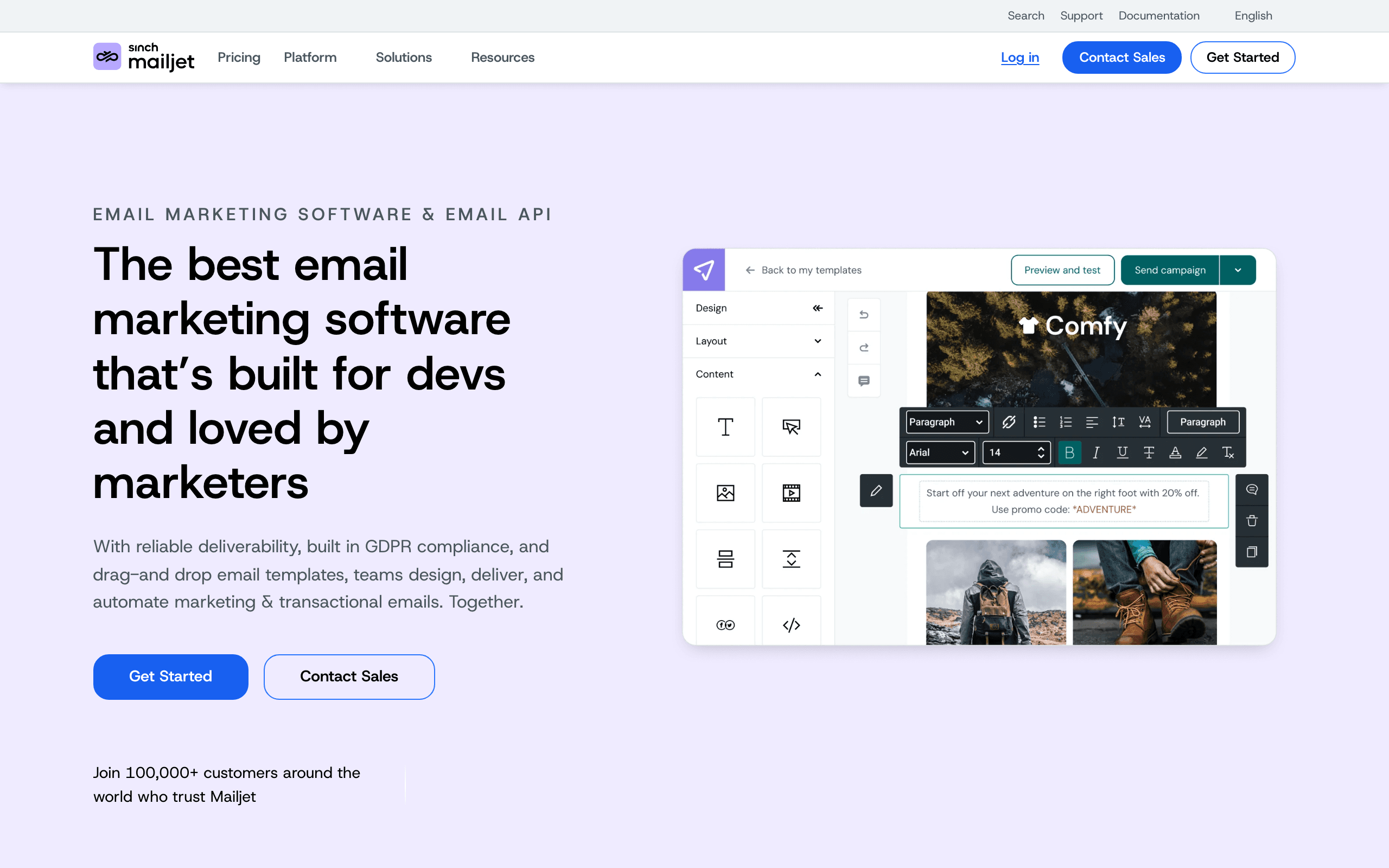
Mailjet is a sending platform with marketing tools on top. ActiveCampaign is a marketing automation and CRM platform that happens to send email. That sounds like a fine distinction, but it decides who should buy which. If your developers need an API and SMTP credentials this week, Mailjet is the natural choice. If your marketer needs a lead to move from a nurture into a sales pipeline when they hit a score, ActiveCampaign is.
More detail on each: the Mailjet comparison and the ActiveCampaign comparison.
Who picks Mailjet
Mailjet, owned by Sinch alongside Mailgun, tends to land with:
- Product teams who want password resets, receipts, and notifications sent through the same provider as the monthly newsletter.
- EU companies that prefer a French-headquartered provider with a GDPR-first posture.
- Agencies that manage several clients or brands and use sub-accounts to keep sending reputation and reporting separate.
- Design-heavy teams who like building in MJML or co-editing an email in real time before sending.
Who picks ActiveCampaign
ActiveCampaign tends to land with teams where email is part of a sales or nurture system:
- B2B companies that score leads on site visits, email clicks, and form fills and hand hot leads to a rep.
- Coaches, course sellers, and agencies running multi-week programs with branches for buyers and non-buyers.
- Small sales teams that want deals and tasks on the same record as marketing activity instead of paying for a separate CRM.
How the automation actually compares
Mailjet's automation lives on the Premium plan. You can trigger workflows on signup, a date property, or an event you send via the API, then run a sequence of emails with delays. It is enough for a welcome series, an onboarding drip, or a birthday message.
ActiveCampaign's builder is a different class. A single automation can wait until a contact visits a pricing page, branch on a custom field, add to a lead score, create a deal, notify the owner, and exit the moment a goal is met. Pro adds split testing inside automations and predictive sending. The cost is more to learn and more to maintain, and Starter caps each automation at 5 actions, so the depth you are paying for usually starts on Plus.
Transactional email is the real fork
This is the question that settles the choice for many teams. Mailjet sends transactional email through its API and SMTP relay in the same account as campaigns, with one set of domain records and one suppression list.
ActiveCampaign does not send app email in its marketing product. It owns Postmark, which is a strong transactional service, but it is a separate product with a separate bill, dashboard, and suppression list. If you pick ActiveCampaign for marketing, plan on running two systems.
Sinch and Postmark: who stands behind the sending
Both tools sit inside larger sending businesses. Sinch bought Mailjet together with Mailgun in 2021, so Mailjet shares a parent with one of the larger developer email APIs, and Sinch also runs SMS and voice at scale. ActiveCampaign bought Postmark in 2022 and kept it as its own brand, with a reputation for fast, transactional-only delivery.
That shapes the day-to-day experience. With Mailjet, one account covers newsletters and app email, and one support team answers for both. With ActiveCampaign, marketing and transactional live in separate products that happen to share an owner. Some teams prefer that separation, since a marketing complaint spike cannot touch password-reset delivery. Others prefer a single dashboard. Neither is wrong, but decide on purpose.
Data residency and GDPR
Mailjet is headquartered in Paris and positions itself around EU data hosting and GDPR compliance, which is a common reason EU companies shortlist it. ActiveCampaign is a US company that provides GDPR tools such as consent fields, data processing agreements, and deletion requests, but it is not an EU-hosted service.
If your legal team requires EU data residency for customer records, that requirement alone may decide this comparison. If standard GDPR tooling and a DPA are enough, compare on features instead.
Pricing models side by side
| Mailjet | ActiveCampaign | |
|---|---|---|
| What you pay for | Monthly email volume | Contacts stored |
| Free option | 6,000 emails/month, 200 per day | 14-day trial |
| Entry price | Starter $9/month for 8,000 emails; Essential $17 for 15,000 (June 2026) | Starter from $15/month at 1,000 contacts (annual) |
| Automation plan | Premium, $27/month for 15,000 emails (June 2026) | Plus from $49/month at 1,000 contacts (annual) |
| Around 10,000 contacts | Depends on sends; about $55 for 50,000 emails on Premium | Starter around $149, Plus around $189 to $239 |
Mailjet announced a self-serve price update effective September 9, 2026. The structure (volume tiers, feature gates by plan) is the same, but check the live page before you budget.
Worked example: a 25,000-contact list
An events company keeps 25,000 past attendees and sends two newsletters a month, about 50,000 emails, plus a few thousand ticket confirmations from its app.
- Mailjet prices the email volume, so this looks like the roughly $55 Premium tier for 50,000 emails (pre-September 2026 pricing), with confirmations sent from the same account.
- ActiveCampaign prices all 25,000 contacts, so the bill is well above the 10,000-contact figures in the table, and confirmations need Postmark on top.
Flip the pattern, with 3,000 very engaged contacts emailed several times a week through branching nurtures, and ActiveCampaign's contact pricing becomes reasonable while its automation earns its keep.
Use-case matchups
| Situation | Better fit | Why |
|---|---|---|
| App sends receipts and resets, plus a monthly update | Mailjet | API, SMTP, and campaigns share one account and suppression list. |
| EU company with data residency requirements | Mailjet | Paris-based with EU data hosting. |
| Agency running email for several clients | Mailjet | Sub-accounts separate brands, reporting, and reputation. |
| B2B lead nurture with sales follow-up | ActiveCampaign | Site tracking, lead scoring, and deals in one tool. |
| Multi-week course or coaching funnel | ActiveCampaign | Branches, goals, and waits handle buyers and non-buyers. |
| SaaS onboarding and dunning email | Sequenzy | Billing events trigger journeys; transactional and marketing in one account. |
What moves, and what does not
Mailjet to ActiveCampaign
- Export contact lists with contact properties and import them, mapping properties to ActiveCampaign custom fields. Lists can become lists or tags.
- Export unsubscribed, bounced, and blocked addresses and import them as unsubscribed.
- Rebuild Premium workflows as ActiveCampaign automations. There is no import path.
- MJML or HTML templates can be pasted into ActiveCampaign's HTML editor, but they will not be editable in the drag-and-drop builder.
- Decide what happens to app email. Keep it on Mailjet, move it to Postmark, or move it elsewhere, but do not cut API keys until every transactional template is tested.
ActiveCampaign to Mailjet
- Contacts, tags, and custom fields move as contacts and properties.
- Deals, pipelines, lead scores, and site-tracking history have no Mailjet equivalent. Move them to a CRM first.
- Branching automations need to be simplified into linear workflows.
For either direction, add the new provider's SPF and DKIM records alongside the old ones and warm up the new sending gradually.
Transactional cutover checklist
Moving app email is where migrations between these two go wrong. Use this list for whichever direction applies.
| Step | What to check |
|---|---|
| Inventory | List every message your app sends: signup, reset, receipt, invite, alert. |
| Templates | Recreate each template in the new provider and test variables with real payloads. |
| Credentials | Swap API keys or SMTP credentials behind a config flag so you can roll back. |
| Webhooks | Rebuild bounce, complaint, and delivery webhooks and point them at the same handlers. |
| Suppressions | Carry hard bounces and complaints across so the new provider does not retry bad addresses. |
| Monitoring | Watch delivery and bounce rates for the first week and compare with the old provider's baseline. |
Where Sequenzy fits
Sequenzy sits between the two for SaaS products. Like Mailjet, it sends transactional email and campaigns from one account and bills by emails sent. Like ActiveCampaign, it has a branching automation builder. The difference is the triggers: Sequenzy connects natively to Stripe, Paddle, and Polar, so journeys start on trial end, failed payment, or upgrade.
Sequenzy has no sales CRM and no sub-accounts. If your team runs deals in a pipeline, ActiveCampaign remains the better fit; if you manage many client brands, Mailjet's sub-accounts are a real advantage.
Choosing
- Pick Mailjet for affordable, combined app and marketing email, EU hosting, and agency sub-accounts.
- Pick ActiveCampaign for behavior-driven nurture, lead scoring, and a sales pipeline.
- Pick Sequenzy if you want one account for app and marketing email with automations driven by subscription events.









