Overview
Mailgun and SMTP2GO both handle transactional email delivery but with different focuses. Mailgun is a comprehensive developer platform with API-first design. SMTP2GO specializes in reliable SMTP relay with simpler setup. See our Mailgun comparison for more alternatives.
API-First vs SMTP Specialist
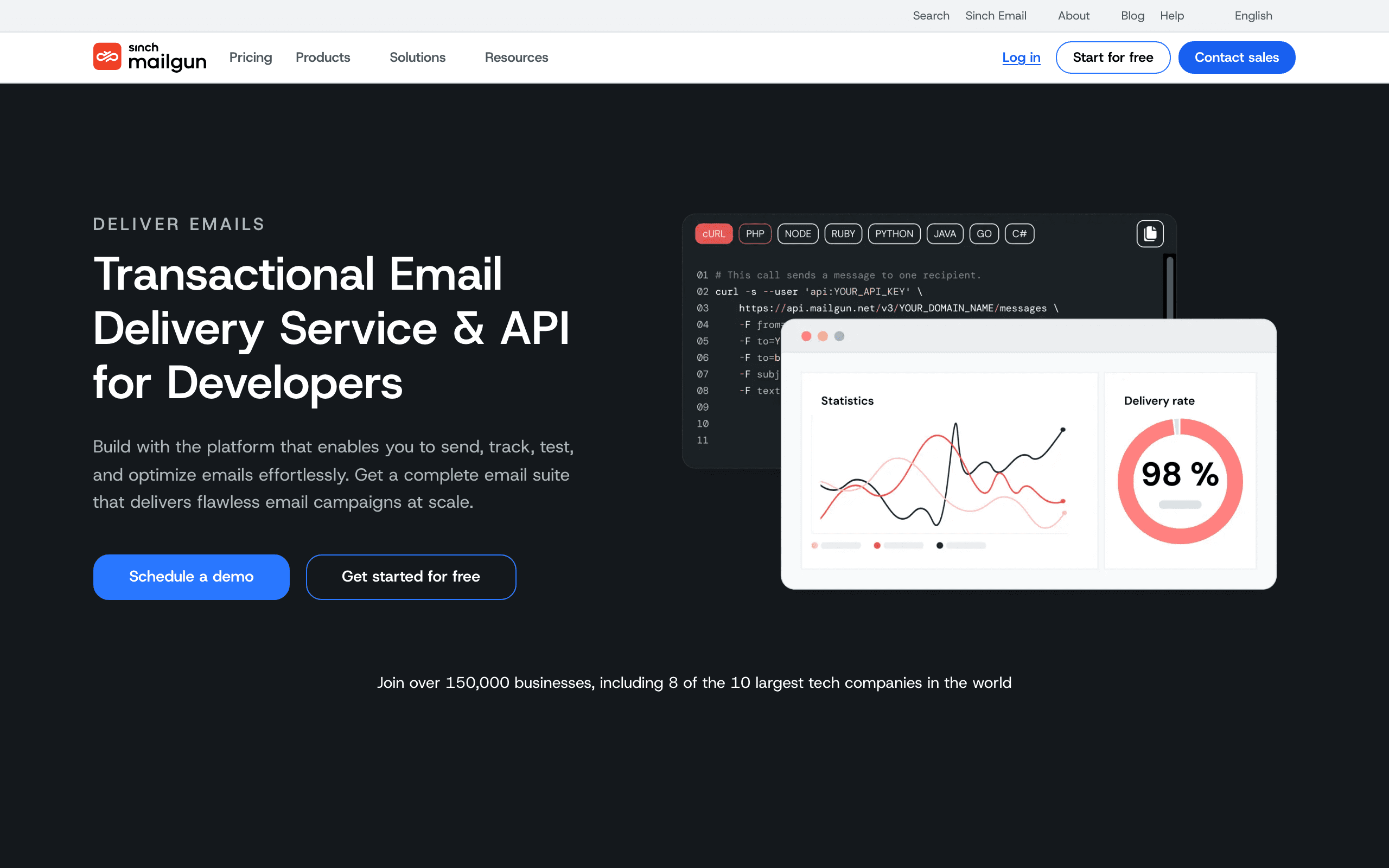
Mailgun is built API-first. While they offer SMTP, their REST API is the primary interface with SDKs in 8+ languages, detailed webhooks, and comprehensive documentation.
SMTP2GO specializes in SMTP relay. Their API exists but SMTP is their strength. If your systems already use SMTP, SMTP2GO offers a smooth path.
Developer Tools
Mailgun provides more developer features: built-in email validation, detailed analytics, sophisticated webhooks, and broad SDK support. It is a complete developer toolkit for email.
SMTP2GO is simpler with fewer developer features. The dashboard is clean, the SMTP works reliably, and support is good. But you will not find the same depth of tools.
Setup Experience
SMTP2GO is often faster to set up, especially for SMTP relay. Configure your SMTP settings, verify your domain, and start sending. Many teams are up and running in minutes.
Mailgun has more to configure but offers more power. The tradeoff is complexity for capability.
Pricing Comparison
At 100,000 emails monthly, both cost about $75. Pricing is similar at most volumes. The choice is about features and approach, not cost.
For unified email marketing and transactional at simpler pricing, consider Sequenzy.
Making the Decision
Choose Mailgun for comprehensive developer tools, API-first integration, and advanced features like email validation. Choose SMTP2GO for simple, reliable SMTP relay with straightforward setup. For SaaS with Stripe integration, Sequenzy offers a unified approach.
The Sequenzy Alternative
For SaaS companies, Sequenzy combines transactional and marketing email with native Stripe integration, smart segmentation, and per-subscriber pricing instead of per-email costs.
API-First vs SMTP-First Philosophies
Mailgun and SMTP2GO represent different integration philosophies. Mailgun's REST API is the primary interface, designed for modern applications that make HTTP calls. SMTP2GO's SMTP relay is the primary interface, designed for applications that already speak SMTP. Both support the other protocol, but their strengths differ.
For new applications, Mailgun's API provides more control and better error handling. For existing applications that already use SMTP, SMTP2GO offers the path of least resistance. Choose based on your current architecture, not which technology is theoretically better.
Setup Time and Ongoing Maintenance
SMTP2GO's setup advantage is real and measurable. Many teams report being operational within minutes by simply updating SMTP credentials. Mailgun's API integration typically takes hours to days depending on the application's complexity and the features you want to leverage.
However, SMTP2GO's simplicity means less visibility into what happens after you send. Mailgun's richer analytics and webhooks provide ongoing operational intelligence that SMTP2GO cannot match. The initial time investment in Mailgun's setup often pays dividends in operational insight over time.
Choosing for Your Organization's Technical Depth
Consider your team's technical capabilities honestly. If you have developers comfortable with REST APIs, webhooks, and SDK integration, Mailgun's depth rewards that investment. If your team manages email through configuration files and SMTP settings, SMTP2GO's approach is more practical.
Neither approach is wrong. The email service that matches your team's workflow and capabilities will be more maintainable long-term than the one with the most features on paper.
Delivery Speed and Reliability
Mailgun and SMTP2GO both prioritize fast, reliable delivery for transactional messages like receipts and verification codes, but they get there differently. Mailgun runs a comprehensive API-first platform with inbound routing and detailed webhooks. SMTP2GO specializes in SMTP relay itself, favoring a simpler setup over Mailgun's broader feature set.
API Design and Developer Experience
Mailgun offers SDKs in 8+ languages, detailed webhook events, and built-in email validation, all backed by extensive documentation. SMTP2GO's developer tooling is comparatively limited, with fewer SDKs and no validation service, but its more focused scope means less to configure when SMTP relay is all you need.
Scaling and Cost at Volume
At 100,000 emails a month, Mailgun and SMTP2GO land at roughly the same $75-a-month price point, so the decision comes down to features rather than cost. Mailgun's extra validation, inbound processing, and 99.99% uptime SLA versus SMTP2GO's 99.9% SLA are worth weighing against how much of that breadth your team will actually use.
Use-case matchups
| Use case | Better fit | Why |
|---|---|---|
| API-first application email | Mailgun | Mailgun has broader SDK support, detailed webhooks, validation, and developer tooling. |
| Legacy systems that already send through SMTP | SMTP2GO | SMTP2GO is built around straightforward SMTP relay setup. |
| Teams needing email validation in the same platform | Mailgun | Validation is part of Mailgun's cited feature set. |
| Fast migration with minimal code changes | SMTP2GO | Updating SMTP credentials is often enough for many existing systems. |
| SaaS transactional plus marketing email | Sequenzy | Mailgun and SMTP2GO are primarily delivery infrastructure, not SaaS lifecycle marketing tools. |
Best Fit by API-First Application Email and SMTP Migration Simplicity
Best transactional email API for application email and validation
Mailgun is the better fit when developers need API-first sending, SDKs, webhooks, validation, suppression handling, and deeper delivery event data.
Best SMTP relay for legacy systems and fast migration
SMTP2GO is the better fit when existing systems already send through SMTP and the team wants a low-friction migration by updating credentials and keeping workflows stable.
Best email tool for SaaS transactional plus marketing automation
Sequenzy is the better fit when transactional delivery also needs campaigns, Stripe billing triggers, lifecycle sequences, and customer messaging in one product.
Pricing reality
At 100,000 emails per month, this page lists both Mailgun and SMTP2GO at $75/month. Since the cited price is the same, the choice should come from integration style and operational needs.
Mailgun gives more developer control and visibility. SMTP2GO gives a simpler SMTP-first path. If you are paying the same amount, choose the tool your team will operate better under pressure.
Review signals
The Mailgun reviews on this page call out powerful API capabilities, inbound routing, and validation, while flagging pricing and free-tier limits. That matches Mailgun's position: strong developer infrastructure with more complexity and cost considerations.
The SMTP2GO reviews emphasize easy setup, reporting, and deliverability, with limited marketing and basic templates as the tradeoffs. That suggests SMTP2GO is strongest when the main requirement is dependable sending without a heavy developer platform.
Migration checklist
- List every sender using the current provider, including app servers, CRON jobs, worker queues, and third-party systems.
- Decide whether each sender should use SMTP or API after migration.
- Rebuild templates, inbound routes, suppressions, and webhook consumers.
- Reconfigure SPF, DKIM, DMARC, tracking domains, bounce handling, and return-path records.
- If moving from SMTP2GO to Mailgun, test API errors, retries, and webhook event handling.
- If moving from Mailgun to SMTP2GO, confirm you do not depend on Mailgun-only validation or inbound routing features.
- Move traffic gradually by email type and monitor bounces, complaints, latency, and authentication failures.
Decision checklist
- Choose Mailgun if your product team wants an API-first email platform with rich developer controls.
- Choose SMTP2GO if SMTP relay simplicity and quick setup are more important than advanced APIs.
- Avoid Mailgun if your team wants minimal configuration and does not need validation or rich webhooks.
- Avoid SMTP2GO if your application depends on deeper developer tooling or inbound email routing.
- Consider Sequenzy if the goal is not just delivery infrastructure but a unified SaaS email platform.