
Overview
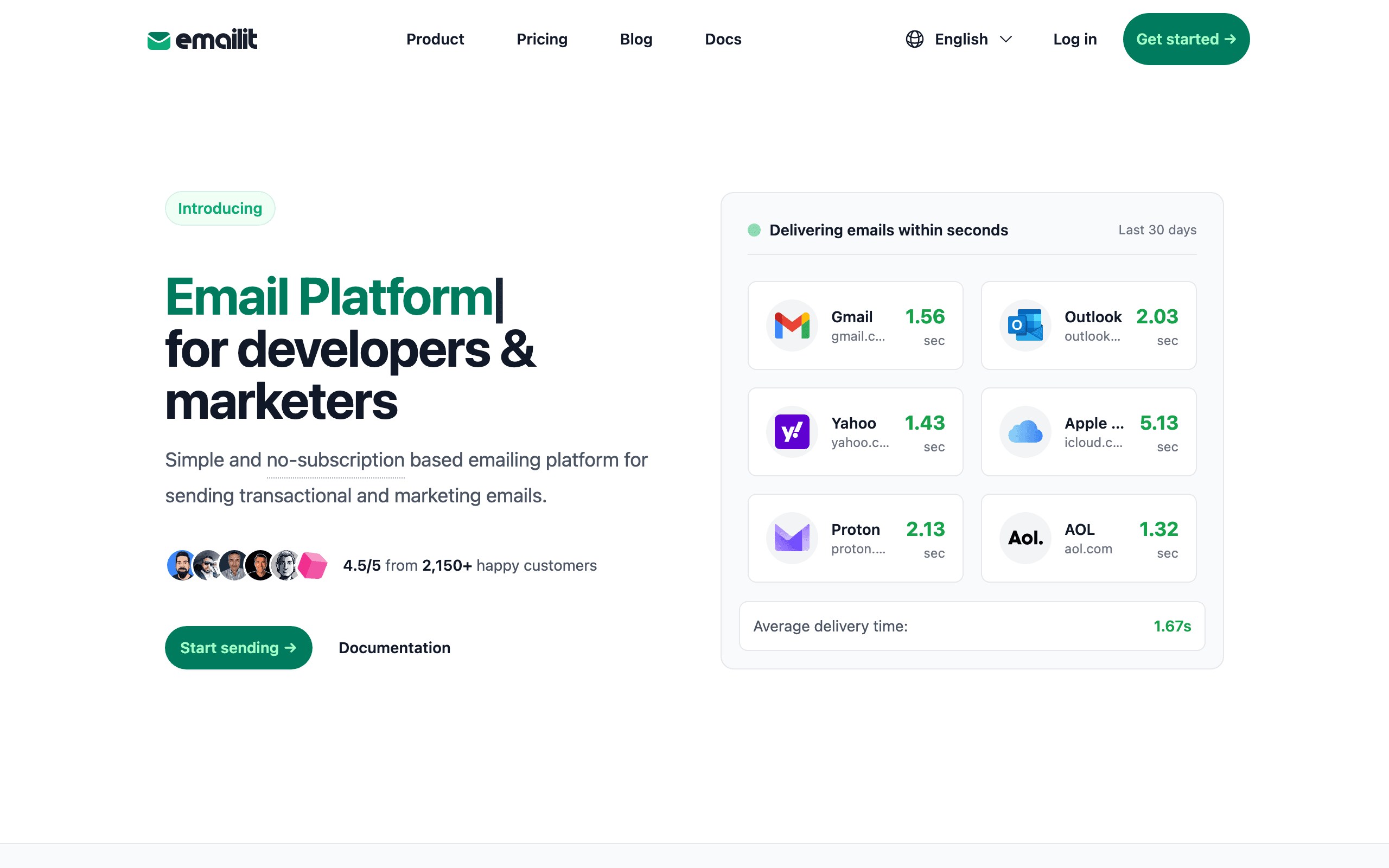
EmailIt and SparkPost serve different needs in the email space. EmailIt is a budget pay-per-email delivery service. SparkPost is a enterprise email API with predictive analytics.
The choice depends on what you need: cheapest per-email pricing (EmailIt) or enterprise-grade (SparkPost). For SaaS businesses specifically, Sequenzy offers purpose-built features that neither tool provides.
Pricing reality
- EmailIt: ~$1-2 per 10k emails, billed per email with no subscription, and you connect over SMTP or API.
- SparkPost: $20/month - Enterprise email API. Now part of Bird/MessageBird.
- Sequenzy: $49/month for 60,000 emails, with yearly billing 10% off. See pricing.
Review signals
The EmailIt reviews on this page support the low-volume mismatch. One reviewer says comparing EmailIt to SparkPost is absurd for a side project sending 500 monthly notifications because SparkPost is built for enterprise budgets.
The negative EmailIt review shows the growth ceiling: at 100k monthly emails, the team needed SparkPost's deliverability intelligence and optimization tooling.
SparkPost's reviews validate the enterprise analytics story through Signals and high-volume infrastructure. The caution is the Bird transition, with reviewers flagging moved docs, changed account teams, and rebrand friction.
Where EmailIt Wins
Cheapest per-email pricing
EmailIt's per-email pricing is the cheapest in this comparison, so a team sending a steady stream of notifications pays only for what it sends.
No monthly subscription
Because EmailIt has no monthly subscription, a quiet month costs nothing beyond the emails you actually send. That suits side projects with uneven traffic.
Simple SMTP/API
EmailIt's SMTP and API interface is simple, with no enterprise configuration to work through, which keeps setup short for a small team.
Fast delivery
EmailIt lists fast delivery among its strengths, which suits time-sensitive mail such as verification codes and password resets.
Where SparkPost Wins
Enterprise-grade
SparkPost offers enterprise-grade, which matters for teams that prioritize this.
Predictive analytics
SparkPost offers predictive analytics, which matters for teams that prioritize this.
High-volume sending
SparkPost offers high-volume sending, which matters for teams that prioritize this.
Good deliverability
SparkPost offers good deliverability, which matters for teams that prioritize this.
Delivery Speed and Reliability
For transactional email, delivery speed is non-negotiable. Receipts, password resets, and verification codes need to arrive in seconds. Both Emailit and SparkPost (MessageBird) prioritize fast delivery, but their approaches differ in infrastructure and routing.
API Design and Developer Experience
Emailit and SparkPost (MessageBird) both target developers, but with different philosophies. The quality of API documentation, SDK support, and error handling directly impacts how quickly your team can integrate and how much ongoing maintenance is needed.
Scaling and Cost at Volume
Email costs become significant at scale. What starts as a few hundred emails per day can grow to millions. Understanding how Emailit and SparkPost (MessageBird) price at different volume tiers helps you plan for growth without budget surprises.
The Bird Acquisition Uncertainty
SparkPost's acquisition by MessageBird (now Bird) has created genuine uncertainty for customers. Documentation links break as content migrates to the Bird domain. Account management teams have shuffled. The product roadmap now serves Bird's multi-channel ambitions rather than email-specific innovation. EmailIt, as an independent company, has none of this organizational turbulence.
For teams evaluating a long-term email infrastructure choice, platform stability matters. SparkPost's underlying technology remains excellent, but the organizational chaos around rebranding creates friction. Support tickets may route through unfamiliar channels. Pricing conversations may involve enterprise sales processes that did not exist before the acquisition.
EmailIt's independence is a genuine advantage for teams that value simplicity and predictability. No acquisition risk, no rebranding confusion, no enterprise sales conversations. The trade-off is that EmailIt also lacks the resources, infrastructure, and innovation that come with being part of a larger platform.
The Predictive Analytics Divide
SparkPost's Signals product offers predictive inbox placement scoring that estimates whether your email will land in the inbox or spam folder before you send it. This intelligence is genuinely unique in the email industry and can dramatically improve deliverability for high-volume senders. EmailIt has nothing comparable.
Predictive analytics matter most at enterprise scale. When you send millions of emails daily, even small improvements in inbox placement translate to thousands of additional delivered messages. SparkPost's machine learning models analyze engagement patterns, content signals, and recipient behavior to optimize delivery timing and content.
For smaller senders doing under 100,000 emails monthly, these predictive capabilities are less impactful. Basic email deliverability practices -- proper authentication, clean lists, good content -- matter more than predictive models at modest volumes. EmailIt handles these fundamentals adequately for small-scale sending.
When Neither Platform Serves SaaS
Both EmailIt and SparkPost focus on email delivery infrastructure. Neither understands your SaaS business model. They cannot trigger emails when a Stripe subscription upgrades. They cannot segment users by MRR or plan tier. They cannot build onboarding sequences that adapt based on product usage.
SparkPost's enterprise infrastructure excels at delivering billions of emails reliably. EmailIt's pay-per-email model excels at keeping costs minimal. But SaaS companies need more than reliable delivery at the right price -- they need email that responds to business events automatically.
Connecting email to Stripe billing, building automated campaigns that respond to user behavior, and managing the full subscriber lifecycle from trial signup through expansion revenue requires a platform designed specifically for subscription businesses. Neither a budget relay nor an enterprise delivery API fills this role.
Use-case matchups
| Use case | Better fit | Why |
|---|---|---|
| Low-volume transactional sending | EmailIt | EmailIt is better when the team needs simple API/SMTP delivery and wants to avoid a recurring subscription. |
| Enterprise deliverability analytics | SparkPost | SparkPost is stronger when predictive analytics, deliverability monitoring, and high-volume infrastructure matter. |
| Side projects and small apps | EmailIt | EmailIt's no-subscription pricing is easier to justify when email volume is inconsistent or low. |
| Millions of messages per day | SparkPost | SparkPost is built for enterprise-scale sending, analytics, IP management, and reputation monitoring. |
| SaaS lifecycle automation | Sequenzy | Sequenzy is better when Stripe events, transactional email, and lifecycle campaigns need one SaaS-focused workspace. |
| Teams avoiding acquisition complexity | EmailIt | EmailIt is simpler when Bird/SparkPost branding, docs, and enterprise sales processes add too much overhead. |
Best Fit by Sending Scale
Best low-cost transactional sender for small apps
EmailIt is the better fit when the workload is low-volume transactional sending and the team wants to avoid contracts, sales processes, or enterprise delivery tooling. It suits side projects, SaaS MVPs, admin apps, and small products where templates live in code and volume is inconsistent. The value is simplicity and cost control, not predictive deliverability analytics.
Best enterprise email infrastructure for high-volume senders
SparkPost is stronger when the organization sends at serious scale and needs deliverability analytics, reputation monitoring, IP management, and infrastructure built for millions of messages. Choose it when Signals, high-volume routing, and enterprise operations can materially protect revenue or sender reputation. It is too heavy if the team only needs basic notifications.
Best SaaS email platform for lifecycle and billing events
Sequenzy is the better fit when the email problem is customer lifecycle, not raw throughput. SaaS teams need Stripe-triggered subscription messages, onboarding sequences, receipts, failed-payment recovery, renewal reminders, and campaigns based on user behavior. That workflow needs business context neither EmailIt nor SparkPost provides by default.
Migration checklist
| Workstream | What to verify |
|---|---|
| Sending infrastructure | Move domains, credentials, templates, webhooks, suppressions, bounce handling, and event streams. |
| Scale and analytics | If moving to SparkPost, validate Signals, IP setup, reputation monitoring, dashboards, and support ownership. |
| Simplicity | If moving to EmailIt, confirm logs, alerts, retry behavior, complaint handling, and procurement requirements are acceptable. |
| SaaS lifecycle | If moving to Sequenzy, map Stripe events, product events, transactional templates, and campaign segments together. |
| Rollout | Run low-volume production tests, compare bounce/deferral rates, and ramp traffic gradually after DNS verification. |
Decision checklist
Is the workload low-volume transactional sending or enterprise-scale deliverability optimization?
Would SparkPost Signals and predictive inbox placement change revenue or deliverability outcomes?
Is the Bird transition acceptable for documentation, account ownership, and support workflows?
Would EmailIt's simplicity reduce procurement and implementation time enough to matter?
Would SaaS lifecycle automation and billing-aware email make Sequenzy a better fit?
Decide whether the destination should optimize for low-volume simplicity, enterprise deliverability intelligence, or SaaS lifecycle automation.
Export verified domains, sender identities, SMTP/API keys, templates, webhooks, suppression data, bounce rules, analytics, IP data, and delivery reports.
If moving to SparkPost, plan dedicated IPs, suppression lists, Signals analytics, webhooks, and any Bird platform account changes before shifting traffic.
If moving to EmailIt, identify which SparkPost analytics, deliverability monitoring, A/B testing, IP warming, and enterprise reporting need replacement.
Recreate the transactional templates users notice most before anything else, starting with verification, password reset, invite, receipt, invoice, billing, alert, and notification emails.
Reconnect API/SMTP calls, webhooks, bounce handling, complaint handling, dashboards, alerts, analytics, and suppression syncing.
Authenticate SPF, DKIM, and DMARC, then test a small production cohort before moving all email traffic.
Preserve historical delivery, analytics, predictive scoring, bounce, complaint, cost, and support reports so the team can compare simplicity against enterprise deliverability tooling.









